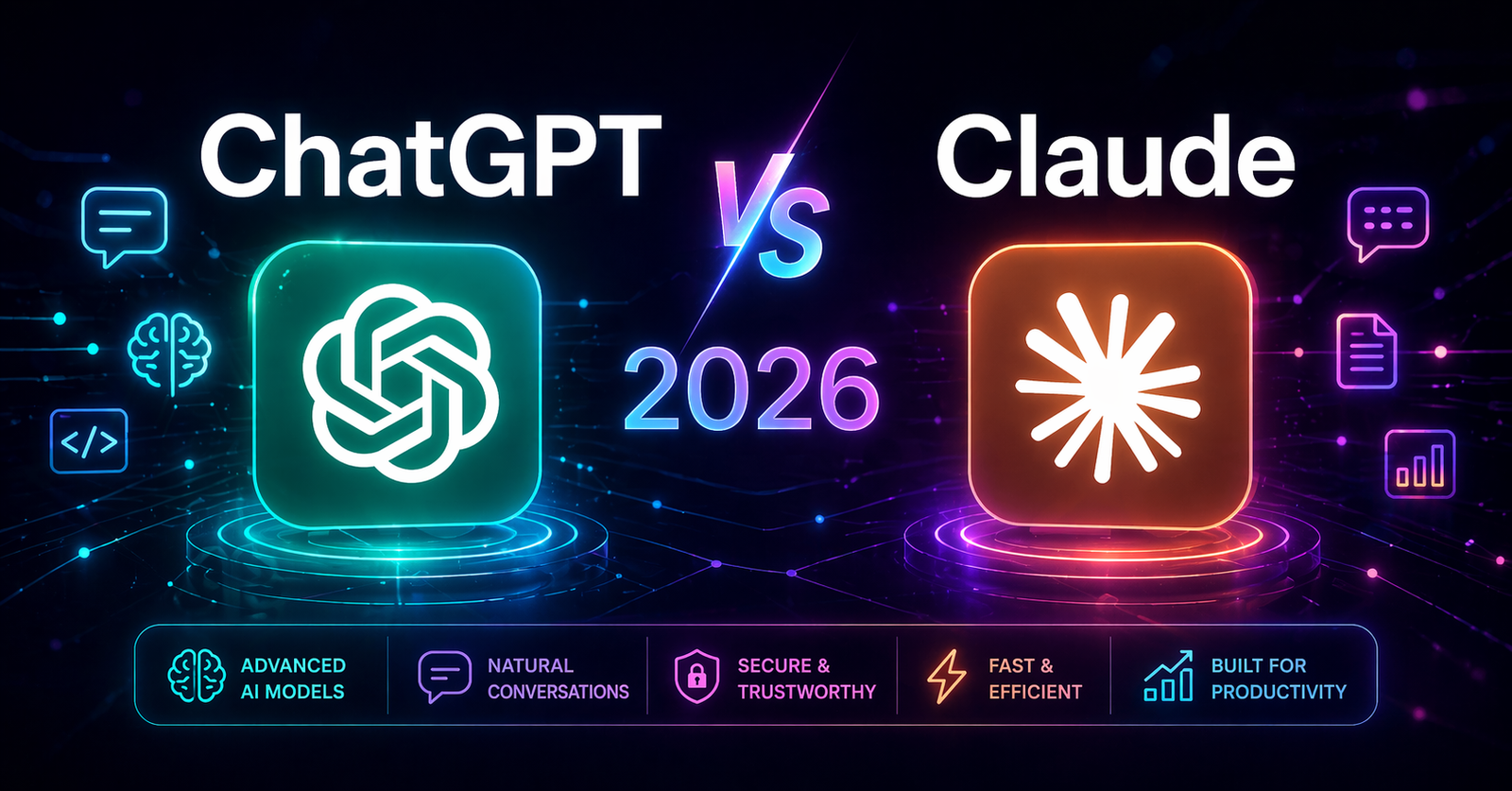
ChatGPT vs Claude 2026: Which AI Assistant Wins?
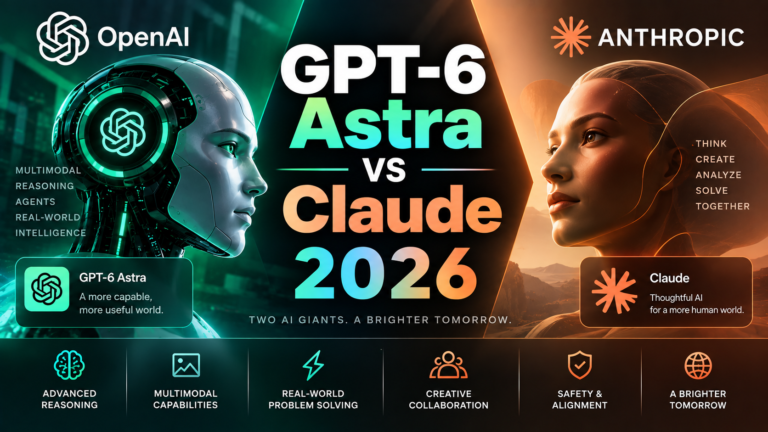
Two tools dominate the AI assistant conversation in 2026. ChatGPT, built by OpenAI, launched in late 2022 and became the fastest-growing consumer application in history. Claude, built by Anthropic, arrived a few months later and has grown steadily into one of the most respected AI tools among developers, writers, and knowledge workers.
Both are large language model-based assistants that generate text, analyze documents, write and debug code, answer questions, and engage in extended reasoning tasks. Both cost $20 per month at their standard paid tier. Both serve hundreds of millions of users. And in 2026, both are genuinely excellent at most tasks the average professional will throw at them.
The meaningful question is no longer which is smarter in some abstract sense. It is which one is better for your specific work. The answer to that question is clear, and this comparison gives you the data to make the right call.
Our Take: ChatGPT is more versatile. Claude is better at long documents and nuanced writing. Most people should pick one and get good at it rather than constantly switching between them.
Side-by-Side Comparison Table
| Feature | ChatGPT (Plus) | Claude (Pro) |
|---|---|---|
| Starting price | $20/month (Plus) | $20/month (Pro) |
| Free tier | Yes (GPT-5.x with limits) | Yes (Sonnet 4.6 with limits) |
| Flagship model | GPT-5.4 | Claude Opus 4.6 / Sonnet 4.6 |
| Context window | 128K tokens (standard) | 200K tokens (standard) |
| Image generation | Yes (DALL-E built in) | No |
| Voice mode | Yes (Advanced Voice Mode) | Limited |
| Web browsing | Yes | Yes (less comprehensive) |
| Coding benchmark (SWE-bench) | 74.9% (GPT-5.4) | 80.8% (Opus 4.6) |
| Agentic coding tool | API credits required | Claude Code (included in Pro) |
| Writing quality | Very good | Best-in-class |
| Long-document processing | Good (128K) | Excellent (200K standard) |
| Image understanding | Yes | Yes |
| Video/audio understanding | Yes | No |
| Plugin/GPT ecosystem | Extensive (Custom GPTs) | Limited |
| Team plan | $25/user/month (annual) | $25/user/month (annual) |
| Training on your data | No (paid plans) | No (paid plans) |
“Pricing is subject to change. Always verify current pricing on the tool’s official website before purchasing.”
ChatGPT: Detailed Breakdown
What It Does
ChatGPT is OpenAI’s AI assistant, now running on GPT-5.4 and available via web, iOS, Android, and desktop. It is the most widely used AI tool in the world, serving over 500 million weekly users. Its defining characteristic is breadth: ChatGPT does more distinct things from a single subscription than any competitor, combining text generation, image creation, voice conversation, code execution, web browsing, and video understanding in one interface.
Key Features
DALL-E image generation. ChatGPT Plus includes built-in AI image generation from text prompts. No separate subscription, no image generation tool needed. This is the single feature most absent from Claude and the one that matters most for users who work with visual content regularly.
Advanced Voice Mode. Conversational voice interaction with natural pacing, emotional inflection, and real-time interruption handling. The most capable AI voice interface available to consumers in 2026, useful for language practice, hands-free assistance, brainstorming while commuting, and accessibility applications.
Custom GPTs and plugin ecosystem. Users can build or access thousands of pre-configured GPTs optimized for specific tasks: legal research, recipe generation, customer service scripts, SQL queries, and more. The breadth of the ecosystem gives ChatGPT a versatility edge that extends well beyond its base capabilities.
Web browsing and real-time data. ChatGPT’s web browsing is comprehensive, pulling current pricing, news, stock data, and recent research into conversations with reliable source citation.
Memory across conversations. ChatGPT Plus includes persistent memory that learns your preferences, work context, and communication style over time. It remembers your name, your projects, your stylistic preferences, and applies that context across sessions.
Canvas for document editing. ChatGPT’s Canvas interface turns long-form writing and code into collaborative documents where AI edits are made inline with visible change tracking.
Pros
- Only major AI assistant with built-in image generation at the $20/month tier
- Advanced Voice Mode is the most natural AI voice interface available
- Broadest ecosystem with Custom GPTs and third-party integrations
- Best multimodal coverage: text, images, voice, video, and audio understanding
- Memory feature builds context over time across sessions
- Higher daily usage limits than Claude Pro for most users
- Most widely adopted; the most training resources, community prompts, and third-party guides
Cons
- Writing quality is very good but produces a recognizable style that experienced users describe as slightly formulaic
- Context window of 128K tokens at the standard tier is smaller than Claude’s 200K
- Claude Code is included in Claude Pro; equivalent agentic coding in ChatGPT requires API credits beyond the base subscription
- Hallucination rates remain slightly higher than Claude’s, particularly for API calls and technical specifications
- Occasionally more willing to produce confident-sounding incorrect output than Claude
Pricing
- Free: GPT-5.x with daily usage limits, no credit card required
- Plus: $20/month, full GPT-5.4 access, image generation, voice mode, browsing, memory, Canvas
- Pro: $200/month, highest usage limits, unlimited access to OpenAI’s most capable models
- Team: $25/user/month (annual) or $30/user/month (monthly), minimum 2 users
- Enterprise: Custom pricing, unlimited access, SSO, admin controls, data privacy
Claude: Detailed Breakdown
What It Does
Claude is Anthropic’s AI assistant, built by a company founded by former OpenAI researchers who believed the AI industry needed a more safety-focused approach. Claude runs on the Opus 4.6 and Sonnet 4.6 model family and is available via claude.ai on web, iOS, Android, and desktop, plus through an API powering enterprise applications across AWS, Google Cloud, and Microsoft Azure.
Claude has earned a devoted professional user base, not by matching ChatGPT feature for feature, but by doing a smaller number of things better than any competitor. Writing quality, instruction-following, long-document analysis, and agentic coding are the four categories where Claude consistently leads independent evaluations.
Key Features
Industry-leading writing quality. Claude produces prose with more natural cadence, more faithful adherence to stylistic instructions, and better paragraph structure than competing models. In a 134-person blind test conducted in early 2026, Claude won four of eight writing evaluation rounds. ChatGPT won one. This is Claude’s most frequently cited and most consistently verified advantage.
200K token context window at the standard tier. Claude Pro provides 200K tokens of context by default, versus ChatGPT’s 128K. For users working with long documents, entire codebases, or multi-document research synthesis, this additional capacity is practically significant. Claude also reliably uses context across the full window rather than degrading on content positioned late in a long document.
Claude Code included in Pro. Claude Code is an agentic coding tool that reads your entire codebase, edits files, runs commands, and uses your local git, executing entirely on your machine without uploading code to an external cloud container. Claude Opus 4.6 scores 80.8% on SWE-bench Verified, placing it at the top of independent coding benchmarks. Claude Code is included in the Pro plan at no additional cost; achieving equivalent agentic coding through ChatGPT requires API credits beyond the Plus subscription.
Precise instruction-following. Claude adheres to complex, detailed system prompts and long instructions more consistently across extended conversations than major competitors. For users who work with structured templates, specific formatting requirements, or multi-constraint writing tasks, this reliability is meaningfully valuable.
Projects for persistent context. Projects maintain persistent memory, document libraries, and conversation history across sessions, allowing Claude to build working context about ongoing projects rather than starting each conversation from scratch.
Constitutional AI safety approach. Anthropic’s Constitutional AI training produces a model that acknowledges uncertainty more consistently and produces confident-sounding incorrect output less frequently than ChatGPT. Claude is slightly more conservative on edge-case requests, which some users find frustrating and others find reassuring.
Pros
- Best writing quality in the market across independent blind evaluations
- 200K token context window at the standard tier outperforms ChatGPT’s 128K
- Claude Code (included in Pro) is the leading agentic coding tool in 2026
- Lower hallucination rates than ChatGPT, particularly on technical content and API specifications
- More precise instruction-following across long conversations
- No-training-by-default on paid plans; strong privacy posture for sensitive professional work
- Anthropic’s PBC legal structure and Constitutional AI approach are differentiators for regulated industries
Cons
- No native image generation: requires a separate tool for any visual content creation
- Voice mode is limited compared to ChatGPT’s Advanced Voice Mode
- Daily usage limits on free and Pro tiers are tighter than ChatGPT for most users
- No native video or audio comprehension
- The interface is more minimal than ChatGPT’s Canvas environment
- Smaller plugin and integration ecosystem
- Web browsing is functional but less comprehensive than ChatGPT’s implementation
Pricing
- Free: Claude Sonnet 4.6 with daily limits, no credit card required
- Pro: $20/month, Opus 4.6 and Sonnet 4.6 access, Claude Code included, 200K context, Projects
- Max: $100/month (5x Pro capacity) or $200/month (20x Pro capacity)
- Team: $25/user/month (annual), minimum 5 users, no training on team data
- Enterprise: Custom pricing, SSO, compliance documentation, consumption commitments
Head-to-Head: Key Category Comparisons
Writing Quality Claude wins. This is the most consistently verified advantage in the comparison. Blind tests, developer surveys, and independent reviewer consensus converge on Claude producing more natural, tonally precise, and stylistically faithful prose. ChatGPT is capable and consistent but tends toward a polished, slightly formulaic output that experienced writers recognize. For marketing copy, long-form editorial content, client communications, and anything where the AI’s default voice would be perceptible in the final product, Claude is the stronger tool.
Coding Claude wins on benchmarks and developer preference. Claude Opus 4.6 scores 80.8% on SWE-bench Verified versus GPT-5.4’s 74.9%. In developer surveys, 70% of developers prefer Claude for coding tasks. Claude Code’s codebase-aware agentic workflow, included in the Pro subscription, powers the two most widely used AI coding editors (Cursor and Windsurf). ChatGPT is a capable coding assistant but requires additional API spend for comparable agentic functionality.
Multimodal Features ChatGPT wins decisively. Image generation, Advanced Voice Mode, video understanding, and audio analysis are either absent from Claude or significantly weaker. For any workflow involving visual content creation, voice interaction, or multimedia processing, ChatGPT is the correct tool.
Long-Document Processing Claude wins at the standard paid tier. The 200K token default context window outperforms ChatGPT’s 128K, and Claude’s reliable use of context across the full window is consistently reported as superior to ChatGPT’s handling of very long documents. For legal review, research synthesis, codebase analysis, and any task involving book-length or multi-document inputs, Claude’s advantage is practically meaningful.
Web Browsing and Real-Time Data ChatGPT wins. ChatGPT’s web browsing is more comprehensive, faster, and better integrated than Claude’s implementation. For tasks requiring current pricing, recent news, live market data, or real-time research, ChatGPT is the stronger choice.
Ecosystem and Integrations ChatGPT wins. The Custom GPT library, extensive plugin ecosystem, Microsoft Copilot integration, and broader third-party tooling give ChatGPT more flexibility for specialized workflows. Claude’s integration ecosystem is more limited, though it is expanding through the API and enterprise partnerships.
Pricing Value at $20/Month Tie, with different value depending on use case. ChatGPT Plus packs more features at $20, including image generation, voice mode, and Custom GPTs. Claude Pro includes Claude Code and a larger context window at the same price. For developers, Claude Pro is the higher-value subscription. For non-technical users who want the widest feature set, ChatGPT Plus delivers more at the same price.
Who Should Choose Each Tool
Choose ChatGPT if:
- You create visual content and need AI image generation without a separate subscription
- You use voice interaction regularly and want the most natural AI voice experience available
- You work across diverse tasks and want a single tool that handles text, images, voice, code, and browsing
- You are already embedded in the Microsoft ecosystem through Copilot or Azure
- You want the largest available library of pre-configured Custom GPTs for specialized tasks
- You need higher daily usage capacity on the standard tier
Choose Claude if:
- Writing quality is a priority and you need AI that produces natural, tonally consistent prose
- You are a developer who wants agentic coding included in the base subscription price
- Your work involves long documents, legal review, research synthesis, or codebase analysis that exceeds 128K tokens
- You need an AI that follows complex, multi-constraint instructions reliably across long conversations
- You work with sensitive professional content and want the strongest privacy posture among major AI assistants
- You are in a regulated industry where Constitutional AI’s safety approach and Anthropic’s PBC status simplify compliance conversations
Frequently Asked Questions
Can I use both ChatGPT and Claude at the same time?
Yes, and many serious AI users do. The two tools are genuinely complementary rather than simply redundant. A common workflow is Claude for writing, coding, and long-document analysis, and ChatGPT for image generation, voice interaction, quick web searches, and tasks where multimodal breadth matters. At $40 per month for both Pro subscriptions, the combined cost is justified for heavy users who encounter the limitations of a single tool regularly. Many professional users who started on one platform maintain both subscriptions because the specific advantages of each are real enough to matter on different days of the week.
Are there usage limits on the $20/month plans?
Yes, both plans include usage limits that are more restrictive than many users expect. Claude Pro provides approximately five times the capacity of the free tier, and daily limits are not published as fixed message counts since they vary based on message length, attachments, and model selection. Opus 4.6 consumes capacity faster than Sonnet 4.6 per conversation. ChatGPT Plus operates similarly, with GPT-5.4 consuming limits faster than lighter models. Heavy daily users on either platform frequently report hitting limits and either upgrading to the higher-capacity tiers (Claude Max at $100 to $200 per month, ChatGPT Pro at $200 per month) or spacing usage across the day as limits reset.
Which tool is better for business use in teams?
For teams, the choice depends on primary workflow. Writing-focused teams (marketing, editorial, communications) tend to prefer Claude for output quality. Development teams prefer Claude for coding capability and the included Claude Code access. Sales and customer-facing teams frequently prefer ChatGPT for its broader feature set and CRM integrations available through Custom GPTs. Both Team plans are priced at $25 per user per month on annual billing. Claude’s Team plan requires a minimum of 5 users versus ChatGPT’s minimum of 2, which matters for small teams. Enterprise deployments for either platform require direct sales engagement and include SSO, admin controls, and contractual data privacy guarantees that are not available on the standard Team plans.
Final Verdict
ChatGPT and Claude are the two best AI assistants available in 2026. They are within a few percentage points of each other on most general benchmarks, cost the same at the standard tier, and both deliver genuine professional value. Neither is universally the right choice.
ChatGPT wins on breadth. Image generation, Advanced Voice Mode, Custom GPTs, and the broadest multimodal coverage make it the stronger all-in-one tool for users who want a single AI that handles everything. If you are starting with AI for the first time and want to explore the full range of what these tools can do, ChatGPT Plus is the right place to start.
Claude wins on depth. Writing quality, coding capability, long-document processing, and instruction-following precision consistently outperform ChatGPT in the categories where professional knowledge workers spend most of their time. If you write, build software, or analyze large documents as your primary work, Claude Pro delivers more value at the same $20 per month.
The most practical advice for anyone who has not yet chosen: use the free tiers of both for two weeks on your actual work. Most people discover a clear preference within days. The preference almost always aligns with the use-case breakdown above.
ChatGPT Rating: 4.5 / 5 — Best AI all-in-one for breadth, multimodal features, and ecosystem versatility.
Claude Rating: 4.6 / 5 — Best AI assistant for writing quality, coding depth, and long-document precision.
“Pricing is subject to change. Always verify current pricing on the tool’s official website before purchasing.”