Synthesia Review 2026: The Best AI Video Tool for Corporate Teams?
Traditional video production has always been expensive, slow, and difficult to scale. A single corporate training video can cost thousands of dollars and take weeks to produce, and when the content needs updating, the entire production process starts over. Synthesia was built to eliminate that bottleneck.
Since launching in 2017, Synthesia has grown into the world’s most widely used AI video platform for business, serving over 50,000 teams including Zoom, Heineken, SAP, Bosch, and Mondelez. It transforms written scripts into professional videos featuring lifelike AI avatars speaking over 160 languages, with no cameras, actors, microphones, or editing software required. When a policy changes or a product updates, the video can be changed in minutes rather than re-shot from scratch.
This review examines whether Synthesia delivers on that promise, where it falls short, and whether it is the right tool for your specific use case.
Our Take: Synthesia remains the best AI video platform for corporate training, onboarding, and internal communications. It may not be the most creative AI video generator, but few tools match its ease of use and enterprise focus.
What Synthesia Is and Who It Is For
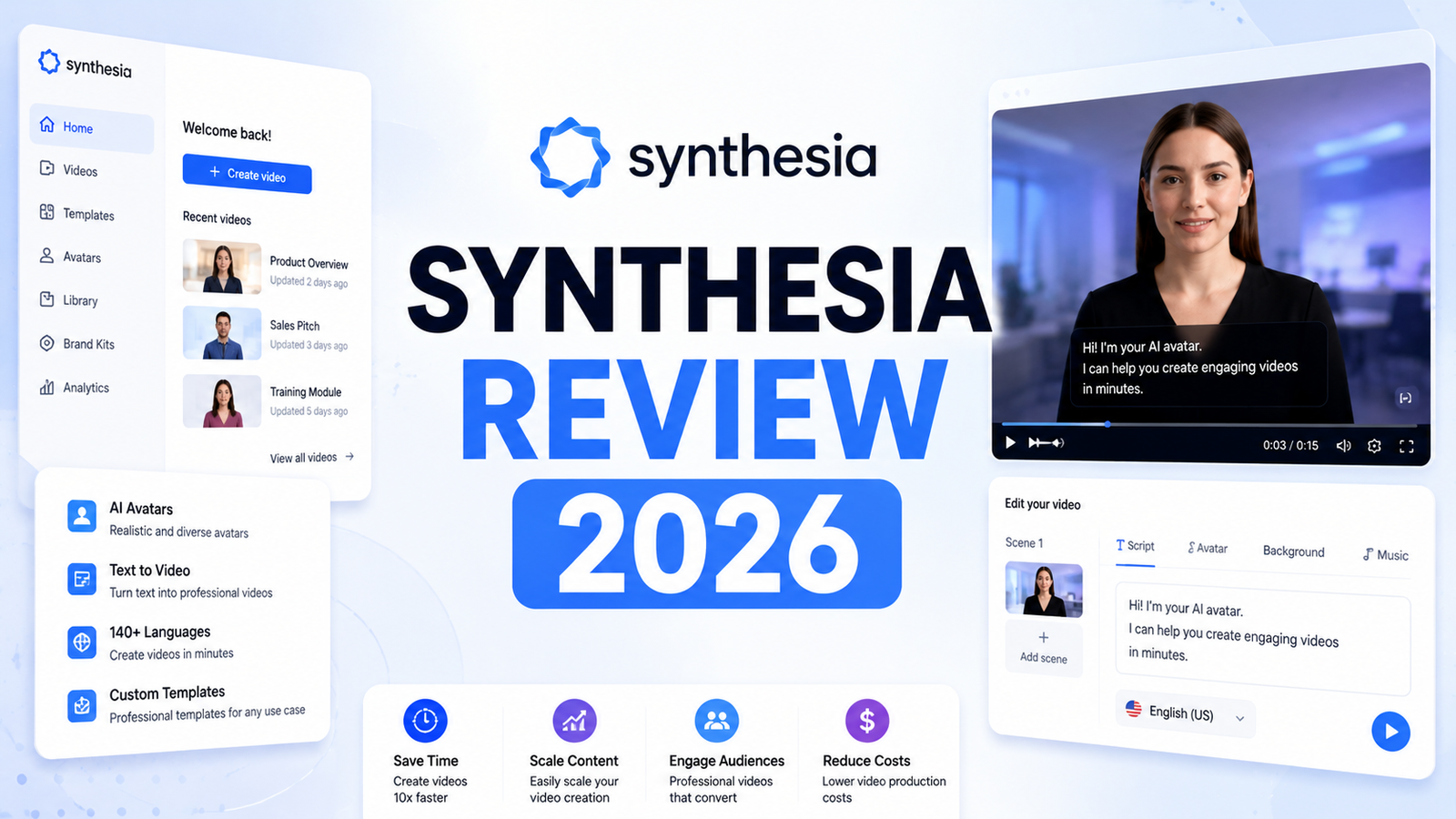
Synthesia is a browser-based AI video generation platform that converts text into structured, presenter-led videos using AI-generated human avatars. The workflow is intentionally straightforward: write or paste your script, choose an avatar, select a voice and language, customize the layout using templates, and generate the video. No video production experience is required, and the output is typically available within minutes.
The platform is designed for a specific type of content: structured, informational videos where the message matters more than cinematic production value. This covers an enormous amount of the video content that organizations actually need to produce.
The users who get the most value from Synthesia are:
HR and L&D teams producing onboarding videos, policy updates, compliance training, and employee communications that need to be consistent, multilingual, and easy to update when information changes. This is Synthesia’s core use case and where it is most clearly best-in-class.
Corporate trainers and instructional designers building scalable training libraries across departments or geographies. Synthesia integrates with major Learning Management Systems, and its translation feature allows one English training module to become versions in dozens of languages within minutes.
Marketing teams at mid-size and enterprise companies who need regular product explainer videos, internal briefings, and regional campaign content that previously required full production budgets and timelines.
Global companies that need to communicate consistently across multiple languages. Converting 100 hours of work into 10 minutes through one-click translation is a genuinely transformative workflow for multinational organizations.
Synthesia is not the right tool for emotionally driven storytelling, consumer-facing social media content where avatar realism needs to create personal connection, cinematic or visually ambitious creative work, or any project where authentic human warmth is central to the message. For those use cases, live video production or tools like HeyGen with its more expressive avatar technology are better fits.
Key Features
240-plus AI avatars with customization. Synthesia maintains one of the largest avatar libraries in the market, with over 240 stock avatars representing diverse ages, ethnicities, professions, and presentation styles. Avatars can be customized in the Avatar Studio, with options to change clothing, add brand logos and colors, and adjust visual styling. The platform’s expressive avatar technology has improved significantly in recent versions, with more natural head movements, gestures, and facial expressions that reduce the uncanny valley effect common in earlier AI video tools.
160-plus languages with one-click translation. Synthesia’s multilingual capability is its most operationally powerful feature for global organizations. The AI dubbing system translates an entire video into another language and re-syncs the avatar’s lip movements to match the new audio, producing a localized version without reshooting. Supporting over 160 languages with local accents and voice varieties, this feature can reduce localization timelines from weeks to minutes for teams managing content across international markets.
Voice cloning and Personal Avatars. Synthesia enables users to clone their own voice for pairing with any avatar, creating consistent branded audio across all video content. Personal Avatars allow organizations to create a custom digital twin of a real presenter, which can be deployed across unlimited future videos once created. This is particularly valuable for executive communications and brand spokesperson content where the presenter’s face and voice need to be consistent.
AI-powered script generation and document-to-video conversion. Synthesia’s built-in AI Assistant generates video scripts from text descriptions, uploaded documents, PDF files, website links, or presentation files. PowerPoint files can be converted directly into structured video sequences, retaining the original design layout and converting speaker notes into narration scripts. This conversion feature compresses the workflow from an existing document to a finished video significantly for content teams working from existing materials.
Scene-based editor with templates and brand kit. The editing interface is deliberately structured to resemble PowerPoint, making it accessible to non-designers. The scene-based layout organizes content into sequential sections, and over 250 templates provide starting points for common corporate video formats including training modules, product demos, and internal communications. Teams plans include brand kit features that enforce consistent fonts, colors, and logos across all team-produced content.
Team collaboration and video management. On Creator and Enterprise plans, multiple team members can comment, review, and edit videos in shared workspaces. The platform maintains a video library with searchable assets, and once created, videos can be updated without regenerating from scratch. Embedded sharing, LMS integration, and branded video page hosting extend the platform beyond creation into a distribution and management layer for video content.
Pros and Cons
Pros:
- Most complete enterprise training video platform available, with workflow features specifically designed for L&D and HR use cases
- One-click translation into 160-plus languages with lip-sync matching is genuinely transformative for global content teams
- PowerPoint-to-video and document-to-video conversion compresses production timelines dramatically for teams working from existing materials
- SOC 2 Type II, GDPR, ISO 27001, and ISO 42001 compliance makes it viable for organizations with enterprise security requirements
- 240-plus stock avatar library is the largest in the market at comparable price points
- Video updates without reshooting means content stays current as products, policies, and processes change
- Intuitive interface accessible to non-designers; most teams report reaching competence within their first session
- Rated the world’s number one AI video platform on G2 based on verified user reviews
Cons:
- Video minute allocations on paid plans are restrictive for high-volume producers: 120 minutes per year on Starter and 360 per year on Creator is a genuine constraint
- Custom Personal Avatar creation costs $1,000 per year as an add-on on annual plans, limiting this feature to teams with real budgets
- Avatar emotional range remains below HeyGen for content requiring genuine human warmth or expressive emotional delivery
- Occasional uncanny valley effect in close-up framing, and minor lip-sync imperfections appear in some language-specific outputs
- Monthly billing significantly more expensive than annual billing (nearly double on some tiers), making short-term commitments costly
- HIPAA compliance documentation has not been published; healthcare organizations handling patient-related content should evaluate this gap carefully
- No desktop application; fully browser-dependent requires reliable internet connectivity
Pricing Breakdown
Synthesia moved to a unified credit system in 2026, where one credit equals one minute of generated video content. Credits draw from a shared pool used across video generation, AI dubbing, and other features.
Free (Basic): $0. 10 minutes of video per month, 9 stock avatars, 160-plus languages, watermarked exports. Useful for evaluating the platform’s quality and workflow before committing to a paid plan.
Starter: $18/month (annual billing) or $29/month (monthly billing). 120 video minutes per year (10 minutes per month). Access to 125-plus AI avatars, AI dubbing, downloads, one Personal Avatar creation, and no watermark. Annual billing saves $132 over monthly billing. The 120-minute annual cap is the most common point of friction reported by users at this tier.
Creator: $64/month (annual billing) or $89/month (monthly billing). 360 video minutes per year. Access to 180-plus avatars, 5 Personal Avatars, API access, interactive video features, branded video pages, custom fonts, and expanded collaboration tools. Annual billing saves $300. The API access at this tier enables integration with CMS platforms, LMS systems, and automation workflows.
Enterprise: Custom pricing. Unlimited video minutes, access to all 240-plus avatars, unlimited Personal Avatars, SAML/SSO, live team collaboration, brand kits, custom language models, dedicated support, and a Studio Express-1 avatar option (a higher-quality personal avatar creation tier). Enterprise plans require direct consultation with Synthesia’s sales team.
Studio Express-1 Avatar: $1,000/year add-on. Available for annual plan users only. Creates a high-quality personal avatar within 10 days. The price is significant and positions this as a business investment rather than a casual feature.
“Pricing is subject to change. Always verify current pricing on the tool’s official website before purchasing.”
How It Compares to HeyGen and Descript
Synthesia vs HeyGen
HeyGen and Synthesia are the two dominant AI avatar video platforms and they are genuinely optimized for different buyers rather than directly competing.
HeyGen produces more photorealistic and expressive avatars than Synthesia at equivalent price tiers. Side-by-side tests consistently show HeyGen’s Avatar IV technology delivering more natural micro-expressions, head tilts, and emotional range. HeyGen also supports 175-plus languages versus Synthesia’s 160-plus, offers custom avatar creation from $99 as an add-on rather than $1,000, and starts at $24 per month versus Synthesia’s $18 per month. For consumer-facing content, social media videos, and any production where avatar realism drives audience engagement, HeyGen has the edge.
Synthesia wins on enterprise structure, compliance, and training workflow depth. Its SOC 2 Type II, GDPR, ISO 27001, and ISO 42001 certifications exceed HeyGen’s compliance documentation. The scene-based editor with PowerPoint-like structure, LMS integration, brand kit enforcement, and team collaboration features are more mature and more directly designed for L&D and corporate communications workflows. For internal corporate training, compliance content, and multilingual employee communications at scale, Synthesia’s workflow is more fit for purpose.
The honest summary: HeyGen for content creators and marketers who need realistic avatars and creative flexibility. Synthesia for enterprise teams who need structured, scalable, and compliant training video production.
Synthesia vs Descript
Descript and Synthesia address almost entirely different video production needs. Comparing them directly is like comparing a word processor to a presentation builder: they both handle text, but they are not competing for the same job.
Descript is built for editing real recorded audio and video using a text-based transcript interface. Its core users are podcasters, course creators, and content teams who record human presenters and want to edit that footage efficiently. AI tools like Studio Sound, Overdub voice cloning, and filler word removal accelerate the editing of real recordings rather than generating synthetic content.
Synthesia does not handle real recorded video at all. It generates synthetic presenter-led content from scripts without any recording required.
The use case where they might appear to overlap is corporate training video production. Teams that currently film real presenters and edit in Descript would use Synthesia instead only if they want to eliminate the filming process entirely in favor of AI avatars. The decision usually comes down to whether authentic human presence justifies the production overhead. When it does, Descript. When scalability, consistency across 30 languages, and rapid updates matter more than authentic human delivery, Synthesia.
Frequently Asked Questions
Can Synthesia create a video in my own voice and likeness?
Yes, on paid plans. Voice cloning is available from the Starter plan upward, allowing you to clone your own voice in 10 to 15 minutes of setup time. The cloned voice can then be paired with any of Synthesia’s stock avatars for unlimited future videos. Creating a Personal Avatar (a custom AI version of your own face and appearance) requires the Starter plan at minimum and costs an additional $1,000 per year as a paid add-on for annual subscribers. The Enterprise tier includes unlimited Personal Avatars as part of the plan. The Studio Express-1 avatar option, which produces a higher-quality personal avatar, takes up to 10 days to process and is also available as an annual add-on.
Is Synthesia suitable for regulated industries like healthcare and finance?
Partially. Synthesia holds SOC 2 Type II, GDPR, ISO 27001, and ISO 42001 certifications, and it maintains a Trust and Safety team with content moderation on all generated videos. For most financial services and general corporate security requirements, these certifications are sufficient. The notable gap is HIPAA compliance: neither Synthesia nor most competing AI avatar platforms have published HIPAA compliance documentation or Business Associate Agreements as of 2026. For healthcare organizations producing training content that references patient workflows, medication protocols, or other Protected Health Information, this gap represents genuine regulatory exposure that no amount of encryption resolves. Healthcare buyers should request current compliance documentation directly from Synthesia’s sales team and obtain legal guidance before deploying.
How does the video minute limit actually work in practice?
Synthesia measures usage in video minutes, where one minute of generated video consumes one credit from your monthly or annual allocation. A 59-second video consumes one minute of your plan allocation. Credits are shared across all AI features including video generation and dubbing, so a video you generate and then dub into three languages consumes four minutes of allocation rather than one. This shared pool makes the 120 annual minutes on the Starter plan feel tighter than it initially appears: 10 minutes per month averages out to roughly 5 to 10 short videos depending on length, leaving limited room for drafts, revisions, and multi-language versions. Teams with regular weekly content production needs should evaluate whether the Creator plan at 360 annual minutes (30 per month) better matches their actual output requirements before selecting the Starter tier.
Final Verdict
Synthesia occupies a clearly defined position in the AI video market and it fills that position better than any competitor. For HR departments, L&D teams, corporate trainers, and global communications teams that need to produce consistent, multilingual, professional video content at scale without cameras or production budgets, Synthesia is the most complete and mature platform available.
The video production ROI is real. Organizations consistently report 70 to 90 percent reductions in production time and cost compared to traditional filming workflows. The one-click translation feature alone has transformed multilingual content workflows for global enterprises who previously spent weeks producing regional versions of every training module.
The honest limitations are worth stating plainly. Video minute allocations are restrictive at the lower tiers, and the $1,000 cost for a Personal Avatar is a meaningful barrier for individuals and small teams. Avatar emotional range has improved but still does not match HeyGen for content where human warmth is central to the message. And the pricing model’s gap between monthly and annual billing rates makes month-to-month use significantly more expensive.
For the audience it was designed for, corporate training teams producing structured informational content at volume across multiple languages, Synthesia is not just a good tool. It is the right tool.
Rating: 4.3 / 5
“Pricing is subject to change. Always verify current pricing on the tool’s official website before purchasing.”
You can try Synthesia to test the avatar quality yourself before committing.