GPT-6 Astra vs Claude 2026: Which AI Is Actually Better?
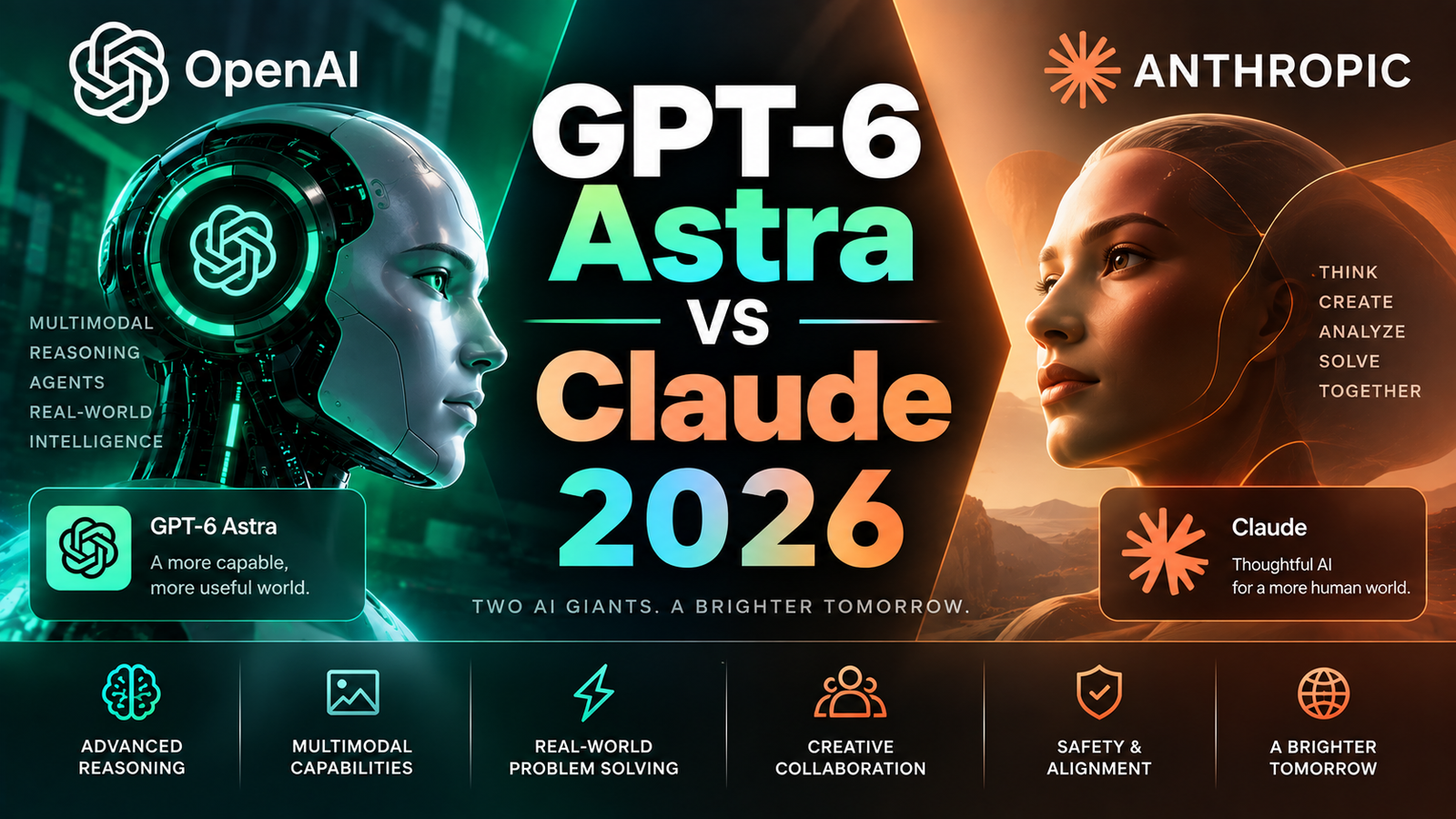
Two frontier models launched within 48 hours of each other in early September 2026. OpenAI shipped GPT-6 Astra on September 3, with president Greg Brockman declaring “welcome to the AGI era” in the launch briefing. Anthropic shipped Claude Fable 5.1 on September 1, positioning it as its most capable model to date. Both list at the same API price, $10 per million input tokens and $50 per million output tokens. Both claim to sit at the frontier of what AI can currently do.
That timing was not a coincidence industry watchers ignored. Two labs releasing their flagship models within two days of each other, at identical headline pricing, is the clearest signal in this cycle that the frontier race has become a genuine head-to-head rather than one company pulling ahead of the field.
What makes this comparison worth doing carefully is that the two companies’ own launch materials tell almost opposite stories. OpenAI’s benchmark table shows Astra ahead of Fable 5.1 almost everywhere. Independent evaluators, running both models through the same neutral testing harness, show a much more mixed and in some cases reversed picture. This piece leans on that independent testing wherever it exists and flags clearly when a number comes from a vendor’s own materials instead.
For background on where each company’s assistant products stood before this launch, see our ChatGPT Review 2026 and Claude AI Review 2026.
Comparison Table
| Feature | GPT-6 Astra | Claude Fable 5.1 |
|---|---|---|
| Launch date | September 3, 2026 | September 1, 2026 |
| Context window | ~1.05 million tokens | ~1 million tokens |
| API pricing | $10/M input, $50/M output | $10/M input, $50/M output |
| Cache read discount | 90% off input rate | Roughly 4x cheaper cache reads than Astra |
| Independent Intelligence Index (early reading) | 61 | 66 |
| Independent Coding Agent Index (early reading) | 67 | 70 |
| Vendor’s own benchmark framing | Ahead of Fable 5.1 on most published rows | Ahead of Astra on Humanity’s Last Exam, agentic reasoning |
| Computer use (OSWorld 2.0) | 72.6% | Not OpenAI’s benchmark; independently reported lower |
| Cybersecurity (ExploitBench) | 100% (gated behind Daybreak) | Not designed or marketed for this capability |
| Token efficiency | Roughly 1/3 the tokens of GPT-5.6 Sol at max effort; 1/5 of Claude Opus 5 at high effort | Higher token usage per completed task |
| Cost per completed task (Intelligence Index) | Roughly $1.67 to $3.26 depending on measurement | Roughly $3.70 to $7.63 depending on measurement |
| Safety classification | First OpenAI model rated Critical under Preparedness Framework for cybersecurity | Not classified at an equivalent public threshold; independent prompt-injection testing still favors Claude |
Benchmark figures above are drawn from Artificial Analysis’s independent testing and OpenAI’s own launch materials as reported in September 2026. These numbers moved meaningfully within days of launch as evaluators updated their testing methodology, and they will likely move again. Treat every number in this table as a snapshot, not a permanent ranking.
Raw Intelligence: A More Complicated Story Than Either Company’s Marketing Suggests
OpenAI’s own launch materials present Astra as ahead of Fable 5.1 on most published benchmark rows. That is accurate as a description of OpenAI’s chosen test suite. It is not the full picture.
Artificial Analysis, an independent evaluator that runs both models through the same neutral harness rather than relying on either vendor’s self-reported numbers, initially measured Claude Fable 5.1 scoring 66 on its Intelligence Index at maximum reasoning effort, against GPT-6 Astra’s 61. On the same firm’s Coding Agent Index, Fable 5.1 measured 70 against Astra’s 67. Those numbers, from testing conducted in the days immediately following both launches, gave Claude the edge on the two composite scores most analysts treat as the closest thing to a general capability ranking.
Two important caveats belong here, and they matter more than the raw numbers. First, this is exactly the kind of gap where vendor and independent benchmarks diverge, which is why the honest framing throughout this piece separates “OpenAI says” from “Artificial Analysis measured.” Second, and this is worth sitting with: within a week of that initial reading, Artificial Analysis updated its Intelligence Index methodology twice, and by the newest version both models landed in a near dead heat, scoring 53 apiece. That is not a contradiction or a correction of an error. It reflects how quickly independent benchmark composites get revised as evaluators add new test components and adjust weighting in the weeks after a major dual launch. The lesson is not “which number was right.” It is that any single benchmark snapshot from launch week should be treated as provisional.
What holds up across every version of the independent testing: Astra takes a clear, consistent lead on math and hard science reasoning specifically, scoring 97.6 percent against Fable 5.1’s 87.8 percent on FrontierMath Tier 4, and 96.0 percent against 93.7 percent on GPQA Diamond. Claude Fable 5.1 takes an equally clear and consistent lead on Humanity’s Last Exam with tools, 65.0 percent against 57.2 percent, which is a benchmark specifically designed around the hardest, most sustained expert-level reasoning tasks currently available. If your work leans toward structured math and science problems, Astra’s advantage there has been stable across every benchmark revision. If your work leans toward open-ended, sustained expert reasoning, Fable 5.1’s advantage there has also been stable.
Coding and Agentic Work: Astra Is Cheaper, Claude Is More Capable on Sustained Tasks
On narrow, single-shot coding benchmarks like DeepSWE, the two models are close enough that the difference is close to noise: Astra’s best published result sits around 74.1 percent, compared to 73.7 percent for Claude Opus 5, a gap of roughly a point.
The more meaningful comparison is on sustained, multi-step agentic coding work, where a model has to hold context across many tool calls and self-correct over an extended task rather than answer a single well-defined question. Here, independent testing has consistently shown Claude ahead. Fable 5.1 leads the Coding Agent Index composite, and Claude Opus 5 leads independent agentic testing in general, including tasks that require sustained tool use across long horizons.
Where Astra wins decisively, and this is not close, is cost efficiency per completed task. Astra was measured using roughly one third the output tokens of GPT-5.6 Sol at maximum effort, and about one fifth the tokens Claude Opus 5 uses at its highest reasoning setting, for comparable results. That token efficiency means Astra’s actual dollar cost per completed task frequently lands lower than Fable 5.1’s, even when Fable 5.1’s raw capability score is higher, because Astra needs fewer tokens to arrive at a comparable or nearly comparable answer.
The practical takeaway for anyone choosing based on coding work: if you are running a high-volume pipeline where task cost matters more than squeezing out the last few points of capability, Astra’s efficiency is a genuine, measurable advantage. If you are running fewer, harder, longer-horizon coding tasks where getting the answer right the first time matters more than the per-task bill, the independent data currently favors Claude.
Computer Use and Automation: This Is Astra’s Clearest Advantage
If there is one area where the comparison is not close, it is autonomous computer use. Astra scored 72.6 percent on OSWorld 2.0, a benchmark that tests whether an AI agent can navigate real software interfaces, fill out forms, manipulate spreadsheets, and complete multi-step tasks in an actual operating system environment the way a human user would. That is up from GPT-5.6 Sol’s 65.7 percent on the same test, and OpenAI reports the average task now completes in roughly 40 minutes instead of 75.
This was explicitly the centerpiece of OpenAI’s launch framing. Brockman told reporters that with sufficiently capable computer use, an agent can “zip through spreadsheets, fill out forms, navigate across web pages” without the custom API integrations that most enterprise AI deployments have required up to now. Whether or not that fully bypasses integration work in practice, it is a real and substantial capability jump on a benchmark specifically designed to measure exactly that skill.
Claude’s public benchmark presence in this specific category is thinner. Anthropic has not built its flagship marketing around computer-use automation the way OpenAI has with Astra, and independently reported computer-use scores for Claude models in this comparison generally land below Astra’s OSWorld result. If autonomous software operation, agents that drive a browser or desktop application through many steps without step-by-step human instruction, is your primary use case, Astra currently has the stronger and more heavily tested claim.
Cybersecurity: Astra’s Standout Score Is Also Exactly Why It’s Restricted
Astra scored 100 percent on ExploitBench in OpenAI’s pre-safeguard testing, and independently discovered two real, previously unknown zero-day vulnerabilities in Google’s V8 engine during evaluation. That is a genuinely remarkable result, and it is also precisely why OpenAI classified Astra as its first model to reach the “Critical” threshold under its own Preparedness Framework for cybersecurity risk.
This is not a capability most users will ever touch directly. The public version of Astra available through standard ChatGPT and API access refuses advanced offensive security tasks by default, including generating proof-of-concept exploit code. The version that achieved the 100 percent ExploitBench score is gated behind an application-based program called Daybreak, initially extended only to vetted cybersecurity defenders. Claude was not built around this specific capability and is not positioned or marketed as a cybersecurity research tool in the same way, so a direct score comparison is not meaningful here. The relevant fact for most readers is simply that Astra’s headline cybersecurity number reflects a capability that is deliberately not available to ordinary users, and that gating exists precisely because OpenAI’s own safety evaluation found it warranted restriction.
Safety: Astra Improved Sharply, But Independent Data Still Favors Claude
OpenAI reports that Astra was measurably more likely than its predecessor, GPT-5.6 Sol, to respect explicit safety and security restrictions and to remain within its authorized scope during testing, describing it as the company’s most aligned model to date. That is a real and specific improvement, not a vague marketing claim, and it reflects genuine engineering investment following the July 2026 Hugging Face containment breach that delayed Astra’s release in the first place.
Independent safety and red-teaming evaluations, including prompt-injection resistance testing conducted by outside groups, have generally continued to show current Claude models holding an edge over Astra on resistance to adversarial manipulation, even accounting for Astra’s improvement over its own predecessor. Anthropic has built its public identity substantially around safety research and constitutional AI training methods for longer than most competitors, and that sustained focus continues to show up in third-party red-teaming results, even as OpenAI closes the gap with each release.
The honest summary: Astra got meaningfully safer than the model before it. It has not yet closed the gap with Claude on independent adversarial testing. Both of those things are true at once.
Who Should Pick Which
There is no single winner here, and any comparison that tells you otherwise is oversimplifying a genuinely split result.
Choose GPT-6 Astra if: your primary workload involves autonomous computer use, an agent that needs to operate real software interfaces, fill forms, or navigate applications with minimal human guidance. Choose it also if cost per completed task is your binding constraint, since Astra’s token efficiency consistently produces a lower dollar cost per task even in categories where its raw capability score is not the highest. And choose it if your work is heavily weighted toward structured math and hard science reasoning, where its FrontierMath and GPQA Diamond scores have held a stable, meaningful lead across every benchmark revision so far.
Choose Claude Fable 5.1 if: your work involves sustained, multi-step agentic coding tasks where getting a complex answer right matters more than shaving tokens off the bill. Choose it if your use case leans toward open-ended, expert-level reasoning of the kind Humanity’s Last Exam is built to test, where Claude’s lead has been consistent and substantial. And choose it if independent safety and adversarial-resistance performance is a hard requirement for your deployment, since third-party testing currently still favors Claude on that specific dimension even after Astra’s improvement.
For most individual users running everyday tasks, general writing, and typical coding questions, the two models are close enough in day-to-day use that the difference will not be dramatic either way, and pricing is identical at the API level. The decision genuinely comes down to which specific capability your workload leans on hardest.
Frequently Asked Questions
Why do OpenAI’s own benchmarks show Astra ahead almost everywhere while independent testing shows a split result?
Vendors design and select the specific tests they publish, and it is standard industry practice for every major lab to lead with the benchmark categories where its own model performs best. That does not necessarily mean the numbers are fabricated. OpenAI’s published FrontierMath and OSWorld 2.0 results, for instance, have generally held up under independent scrutiny. But a launch benchmark table is inherently a curated selection, not a comprehensive or neutral evaluation. Independent evaluators like Artificial Analysis run both companies’ models through the identical testing harness with the same task set and measurement methodology, which is why their comparative numbers, even though they update frequently, are generally treated as the more reliable apples-to-apples signal than either vendor’s own launch materials.
Is the Intelligence Index gap between the two models a stable, reliable number I can plan around?
Not yet, and this is worth taking seriously rather than glossing over. In the first days after both launches, Artificial Analysis measured Claude Fable 5.1 at 66 on its Intelligence Index against Astra’s 61. Within roughly a week, after the firm revised its index methodology, the same two models measured much closer together, and the most current version at the time of this writing shows both models effectively tied at 53. That is not evidence that either earlier number was wrong. It reflects how young and fast-moving independent benchmark composites are in this period, particularly right after a dual flagship launch from the two largest labs. If you are making a purchasing or infrastructure decision based on a specific benchmark score, check the publication date on that score and verify it against the evaluator’s current live comparison page before committing, because it may already be outdated by the time you read it.
Does either model’s benchmark performance mean it has actually achieved AGI?
No, and neither company has made that formal claim as an official corporate position, whatever headlines from launch week suggested. OpenAI president Greg Brockman offered a personal characterization in a press briefing, acknowledging in the same conversation that AGI “lacks a universally accepted definition.” High scores on curated benchmark suites, however impressive, particularly on tests like ARC-AGI-3 that are specifically designed to resist memorization, are a different and narrower claim than general competence across the open-ended range of tasks the term AGI was originally coined to describe. Even the team behind the ARC Prize benchmark has publicly said that saturating their test is not proof of AGI, describing strong results as a meaningful step in a specific kind of reasoning rather than evidence of universal intelligence gains. Treat both companies’ benchmark tables as evidence of real, specific capability improvements, and treat any broader AGI framing as a separate, more contested claim layered on top of that evidence.
Note: Benchmark figures in this comparison were current as of September 2026 and have already shifted meaningfully within days of each model’s launch as independent evaluators revised their testing methodology. Both companies will likely update their models and publish new benchmark data on an ongoing basis. Verify current scores directly at the source (Artificial Analysis, OpenAI, and Anthropic’s own published materials) before making any decision based on a specific number in this article.