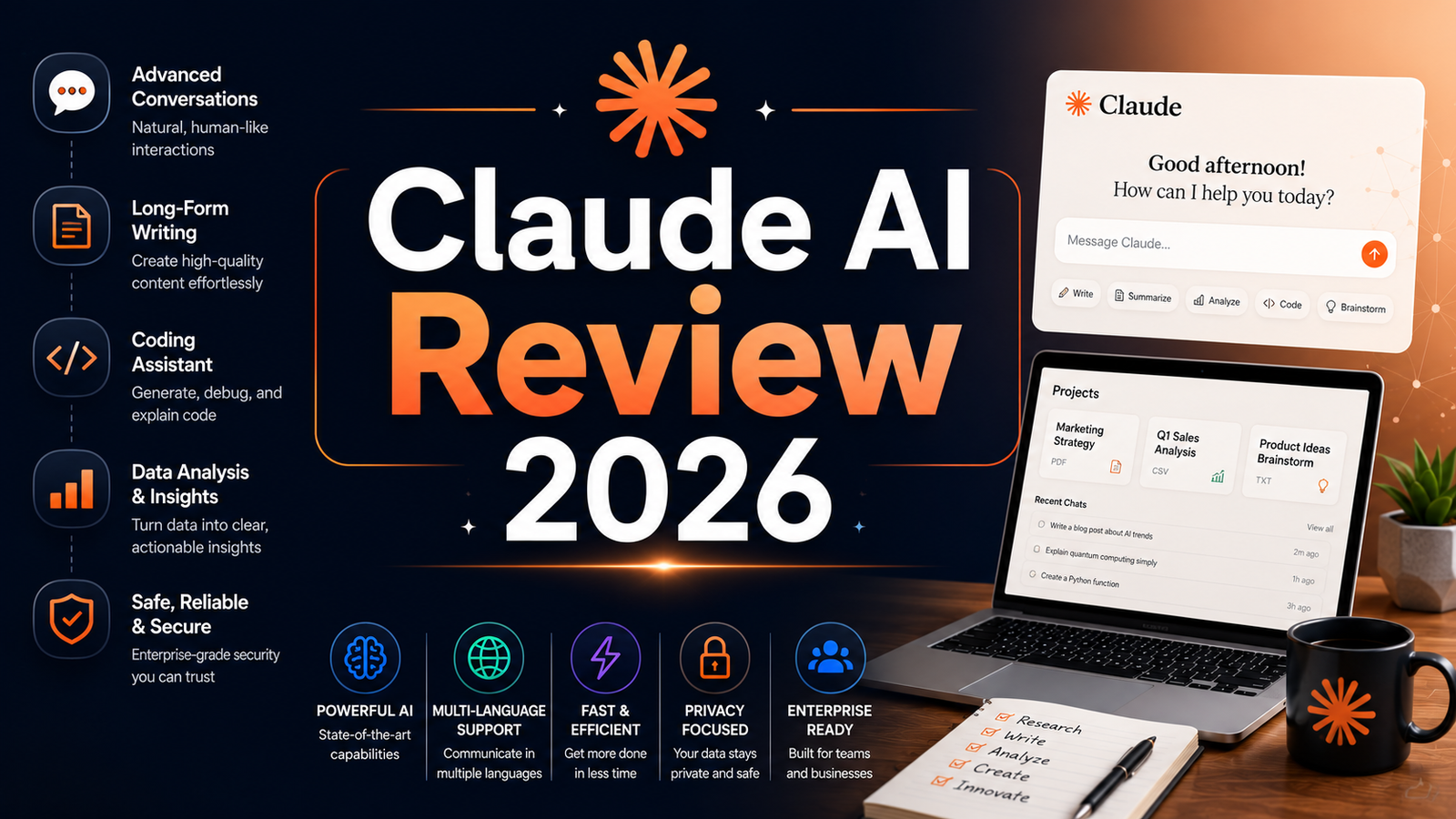
Claude AI Review 2026: Anthropic’s Contender for the Best AI Assistant
Anthropic is no longer the scrappy AI safety startup operating in OpenAI’s shadow. In February 2026, the company closed a $30 billion Series G funding round at a $380 billion post-money valuation, the second-largest private financing round in tech history. Its annualized revenue has reached approximately $14 billion, up from $3 billion in mid-2025. Claude Code alone is generating around $2.5 billion in annualized revenue. Business subscriptions have quadrupled since the start of the year.
Behind those numbers is an AI assistant that has quietly earned a devoted professional user base, not through the broadest feature set or the largest marketing budget, but through what it actually does well: writing with genuine quality and precision, following complex instructions reliably, reasoning through difficult problems with care, and handling long documents better than almost anything else on the market.
Our Take: ChatGPT may be the most popular AI assistant, but Claude often feels like the most reliable. Its combination of reasoning, writing quality, coding capabilities, and long context understanding makes it one of the few AI tools that consistently delivers professional grade results.
What Claude AI Is and Who It Is For
Claude is a family of AI models built by Anthropic, an AI safety company founded in 2021 by Dario Amodei (CEO), Daniela Amodei (President), and other former OpenAI researchers. The models are accessible via claude.ai on web, iOS, Android, and desktop, through a developer API, and across integrated platforms including AWS Bedrock, Google Vertex AI, and Microsoft Foundry.
The current model family as of April 2026 consists of three tiers. Claude Opus 4.6 is Anthropic’s most capable model, optimized for complex multi-step reasoning, sophisticated analysis, and agentic coding tasks. Claude Sonnet 4.6 is the workhorse, balancing speed and capability for professional everyday use. Claude Haiku 4.5 is the speed and cost tier, designed for high-volume classification, extraction, and simple tasks where response time matters more than depth.
Claude is built on Anthropic’s Constitutional AI framework, a safety approach that trains the model to be helpful, harmless, and honest through a set of principles rather than pure reinforcement from human feedback. This shapes Claude’s character in ways users notice: it tends to acknowledge uncertainty rather than confidently fabricate, it refuses certain requests more gracefully than competitors, and it follows nuanced instructions more precisely across long conversations.
The users who get the most from Claude are:
Writers, editors, and content professionals who need AI that produces prose with natural cadence and genuine quality. Claude’s writing output is consistently ranked above competitors in blind evaluations, producing stronger paragraph structure, better tonal consistency, and more faithful adherence to stylistic instructions.
Developers and software engineers who use Claude Code for agentic coding tasks. Claude Code has become a standard tool in many engineering teams, with Claude Opus 4.6 consistently ranking at or near the top of coding benchmarks including SWE-bench and Terminal-Bench.
Researchers, lawyers, and analysts working with long documents. Claude’s ability to reliably process and reason across very large context windows, up to 1 million tokens on the API, makes it the strongest tool available for tasks requiring synthesis across entire codebases, legal documents, research corpora, or book-length content.
Organizations with privacy and safety requirements. Anthropic’s Public Benefit Corporation structure, Constitutional AI safety approach, and no-training-by-default policy for paid subscribers make Claude a natural fit for regulated industries where AI governance and data handling practices face scrutiny.
Key Features
Multi-model family for different workloads. The Opus, Sonnet, and Haiku model tiers allow developers and businesses to match model capability and cost to the specific task. Opus for complex reasoning and high-stakes output, Sonnet for the majority of professional tasks at a significantly lower cost, and Haiku for fast, affordable volume processing. This tiered architecture is more explicit and practically useful than competitors that primarily offer one flagship model with minor variants.
Industry-leading long-context processing. Claude Sonnet 4.6 and Opus 4.6 support context windows up to 1 million tokens on the API. Critically, independent testing consistently confirms that Claude actually uses context across the full window rather than degrading on content positioned in the middle or late sections of a long document. For tasks involving entire codebases, multi-document legal review, or research synthesis across dozens of papers, this reliability is the most important practical differentiator from competitors.
Claude Code. Anthropic’s command-line agentic coding tool allows Claude to autonomously plan, write, test, and iterate on software projects. Claude Code has reached approximately $2.5 billion in annualized revenue and is widely regarded as the most capable agentic coding tool available in 2026, powering the majority of Cursor’s backend and used extensively by individual developers and enterprise engineering teams.
Projects for persistent context. Projects allow users to maintain persistent memory and context across multiple conversations with Claude. Document libraries, custom instructions, and conversation history within a Project give Claude the context of an ongoing working relationship rather than starting fresh with each session. This feature is available on Pro and above.
Web search and research. Claude includes real-time web search on paid plans, enabling current information retrieval within conversations. The Research feature on Pro performs multi-step research tasks autonomously, browsing multiple sources and synthesizing findings into structured reports.
Claude for Google Workspace and Microsoft integrations. Claude integrates directly with Gmail, Google Docs, and Google Drive on Pro plans, enabling in-context AI assistance within existing productivity workflows. Microsoft Foundry integration extends Claude availability to enterprise teams already in the Microsoft ecosystem.
Agentic computer use. Claude can control a browser via the Claude Chrome extension and perform computer-level file operations through Claude Cowork, Anthropic’s desktop tool for non-developers. Among the major AI assistants, Claude Cowork is currently the only consumer-facing option that operates on the computer’s local file system rather than solely in the browser.
Pros and Cons
Pros:
- Best-in-class writing quality across multiple independent blind evaluations, with stronger tonal consistency and instruction adherence than major competitors
- Most reliable long-context processing available: 1 million token context window that performs consistently across the full document rather than degrading on middle content
- Claude Code is the leading agentic coding tool in 2026, widely adopted by individual developers and enterprise engineering teams
- Constitutional AI safety approach produces more consistent refusals with less collateral damage on legitimate edge cases
- Projects feature enables persistent context across sessions for ongoing professional workflows
- No-training-by-default policy on paid plans is a genuine advantage for privacy-sensitive professional and enterprise use
- Anthropic’s PBC legal structure and no-training guarantee simplify compliance conversations in regulated industries
- Free tier requires no credit card and provides genuine access to a capable model
Cons:
- No native image generation: Claude understands and analyzes images but cannot produce them, requiring a separate tool for any image creation workflow
- Voice mode is significantly weaker than ChatGPT’s Advanced Voice Mode for natural spoken conversation
- Daily usage limits on the free and Pro tiers are tighter than competitors; heavy users consistently report hitting limits faster than with ChatGPT or Gemini
- Multimodality is limited to image understanding; no native video or audio comprehension without workarounds
- The web interface is more minimal than ChatGPT’s feature-rich canvas environment
- The $100 to $200 per month Max plans create a significant cost jump between the Pro tier and maximum capacity
Pricing Breakdown
Anthropic offers subscription plans for individual users, team plans for organizations, and API access for developers. All prices are in USD.
Free: $0. Access to Claude Sonnet 4.6 with daily usage limits that reset on a rolling basis. Includes web, iOS, Android, and desktop access, file uploads, image analysis, web search, and basic Projects. No credit card required. Usage limits are intentionally unpublished and vary based on message length, conversation complexity, and current demand, but are sufficient for light professional use and thorough evaluation.
Pro: $20/month. Approximately five times the usage capacity of the free plan. Includes access to Claude Opus 4.6, Claude Sonnet 4.6, and Claude Haiku 4.5 models, Claude Code, the Research feature for autonomous multi-step research, unlimited Projects, priority availability during peak hours, Google Workspace integration, and access to Claude for Excel and PowerPoint beta features.
Max: $100/month or $200/month. Designed for heavy daily users who consistently reach Pro limits. The $100/month tier provides approximately five times Pro capacity. The $200/month tier provides approximately 20 times Pro capacity. Both tiers include Claude Code and are positioned for developers and professionals who interact with Claude models for several hours per day.
Team: $25/seat/month (billed annually, minimum 5 users). Adds centralized billing, team administration, higher usage limits than individual Pro, expanded context window access, and collaboration features for organizations. Data from Team plan conversations is not used to train Anthropic models by default.
Enterprise: Custom pricing. Negotiated directly with Anthropic’s sales team. Includes SSO, admin controls, custom system prompts, guaranteed service levels, expanded compliance documentation, and the option for dedicated capacity. Enterprise pricing has shifted in 2026 to a lower headline seat fee plus mandatory consumption commitments, a structure change that requires enterprise buyers to model total cost carefully before signing.
API: Pay-per-token. Claude Sonnet 4.6 is priced at $3 per million input tokens and $15 per million output tokens. Claude Opus 4.6 is priced at $15 per million input tokens and $75 per million output tokens. Claude Haiku 4.5 is priced at $1 per million input tokens and $5 per million output tokens. Prompt caching reduces input costs by up to 90 percent on cache hits. The Batch API provides a 50 percent discount on both input and output tokens for asynchronous processing with a 24-hour turnaround. As of March 2026, Anthropic eliminated long-context surcharges, meaning a 900,000-token request costs the same per-token rate as a 9,000-token request.
“Pricing is subject to change. Always verify current pricing on the tool’s official website before purchasing.”
How It Compares to ChatGPT and Gemini
Claude vs ChatGPT
ChatGPT is the most widely used AI assistant in the world, serving over 500 million weekly users across consumer and enterprise contexts. Its strengths are breadth and ecosystem: GPT-4o handles text, images, audio, and code in a single interface, DALL-E image generation is built in, Advanced Voice Mode produces genuinely natural spoken conversation, and the plugin ecosystem and Custom GPT library extend its capabilities across hundreds of specific use cases.
Claude wins on writing quality and instruction-following. Independent blind tests and head-to-head evaluations consistently place Claude above ChatGPT on writing tasks involving tonal precision, stylistic adherence, and complex instruction sets. Claude also wins on long-document processing: the 1-million-token context window outperforms ChatGPT’s 128,000-token limit, and the performance across the full window is more consistent. For software engineering specifically, Claude Code outperforms ChatGPT on SWE-bench and Terminal-Bench coding benchmarks.
ChatGPT wins on multimodal breadth, voice capability, image generation, daily usage limits, and ecosystem maturity. For users who need a single tool that handles the widest variety of tasks with the most integration options, ChatGPT remains the stronger all-in-one choice. For users whose primary work involves writing, coding, or long-document analysis, Claude’s specific advantages are meaningful.
Claude vs Gemini
Gemini, powered by Google’s DeepMind research, occupies a distinct position. Its most notable technical feature is a 1-million-token context window natively available on the consumer Gemini Advanced tier, and up to 2 million tokens in certain configurations. It leads all three platforms on multimodal capability, with native video, audio, and image understanding that Claude does not match.
Gemini’s advantages are strongest for users embedded in the Google ecosystem. Deep integration with Google Workspace, Google Drive, and Google Search makes it the most natural choice for teams whose entire workflow runs through Google products. The free Gemini tier is available to students for one year in certain regions, and the consumer plan starts at a lower monthly price than Claude Pro or ChatGPT Plus.
Claude wins over Gemini on coding reliability, agentic task consistency, and instruction-following precision. Independent evaluations of complex coding tasks consistently place Claude above Gemini, and agentic tool-use reliability, where the model must execute multi-step tasks without deviation, favors Claude across professional use cases. On writing tasks, Claude’s output is also more consistently regarded as higher quality than Gemini’s.
The practical framework across all three: ChatGPT for general-purpose versatility and the widest tool ecosystem. Claude for coding, writing, and long-document tasks where reliability and quality are the primary metrics. Gemini for Google-native workflows, multimodal tasks involving video and audio, and speed-sensitive applications.
Frequently Asked Questions
Does Claude AI train on my conversations?
On paid plans (Pro, Max, Team, and Enterprise), Claude does not use your conversations to train Anthropic’s models by default. On the free tier, conversations may be used to improve Anthropic’s models, though Anthropic’s privacy controls allow opting out of training data use in account settings. Enterprise plans include explicit contractual protections against training data use. Anthropic’s Public Benefit Corporation status and its published model card and usage policies provide additional transparency that is relevant for organizations evaluating AI governance. For healthcare, legal, and financial services teams with strict data handling requirements, the Team or Enterprise plan with explicit data processing agreements is the appropriate starting point.
How does Claude handle the daily message limit on the free plan?
The free plan’s usage limit is not expressed as a fixed number of messages per day, and Anthropic does not publish specific message counts. The limit is dynamically determined based on message length, attached files, conversation context size, and current server demand. A single complex request with long context or multiple file attachments consumes significantly more capacity than a short text question. In practice, light to moderate users typically find the free tier sufficient for casual and occasional professional use. Heavy daily users, particularly those working on extended writing projects, code review, or document analysis, will hit the limit and need the Pro plan’s roughly five-times-higher capacity. If you find yourself hitting free plan limits during your first week of use, Pro at $20 per month is the appropriate tier.
Is Claude better than ChatGPT for professional writing?
For most writing tasks requiring tonal precision, nuanced style adherence, and complex instruction-following, Claude consistently outperforms ChatGPT in blind evaluations conducted by independent researchers and practitioners. In one 134-person blind test conducted in early 2026, Claude won four of eight evaluation rounds, while ChatGPT won one. Reviewers who selected Claude’s outputs most frequently cited natural paragraph rhythm, better adherence to specific formatting instructions, and outputs that felt less generic than alternatives. ChatGPT’s writing is capable and often excellent, but it tends toward a cleaner and somewhat more predictable style that experienced writers often describe as polished but slightly flat. The practical difference matters most on high-stakes writing: client communications, marketing copy requiring precise brand voice, long-form editorial content, and any project where the AI’s default stylistic choices are perceptible in the final output. For casual writing assistance, both tools deliver comparable value.
Final Verdict
Claude AI has earned its position as the strongest AI assistant available in 2026 for the specific set of tasks it was built to excel at: writing with genuine quality, following complex and detailed instructions with precision, processing long documents reliably, and powering sophisticated agentic coding workflows through Claude Code.
It is not the most versatile consumer product in the category. ChatGPT’s image generation, Advanced Voice Mode, and broader plugin ecosystem make it the stronger single-tool choice for users who want one AI to handle everything. Gemini’s Google Workspace integration and native multimodal video and audio capabilities give it advantages that matter specifically within Google-native workflows.
But for knowledge workers who write, analyze, and build code as their primary professional activity, Claude’s specific advantages are not marginal. The writing quality difference is consistently verifiable in blind tests. The long-context reliability is technically superior and practically meaningful for document-heavy work. Claude Code’s agentic coding capability is the most capable in the market.
The free plan provides genuine capability at zero cost for evaluation and light use. The Pro plan at $20 per month covers most professional daily use cases. The Max tiers at $100 to $200 per month serve developers and power users who need maximum capacity.
Anthropic has built the AI assistant that rewards users who are serious about the quality of their outputs. If that description matches how you work, Claude is very likely the right tool.
Rating: 4.6 / 5
“Pricing is subject to change. Always verify current pricing on the tool’s official website before purchasing.”