
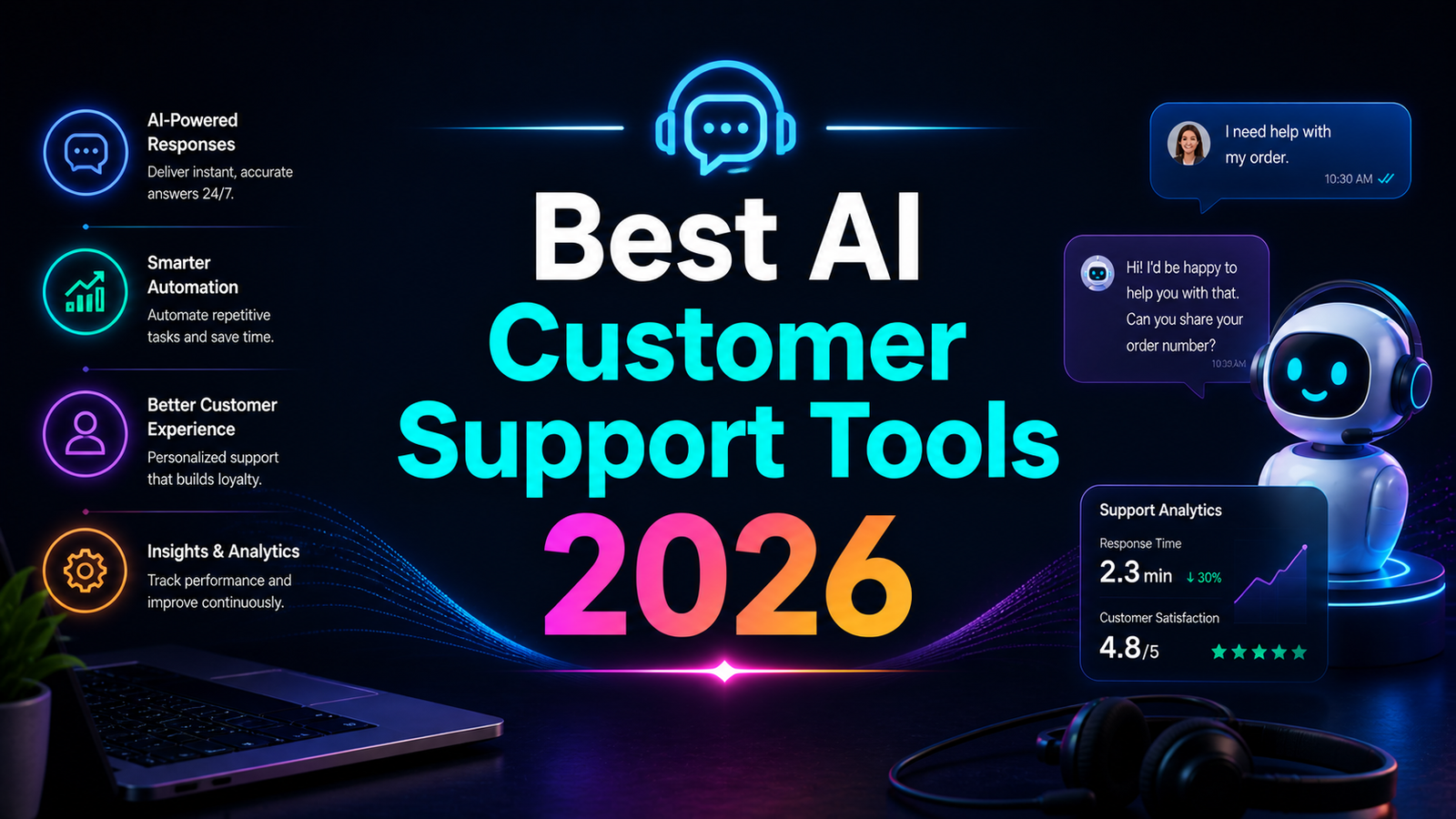
Best AI Customer Support Tools 2026: Ranked, Reviewed and Compared
Customer support has always been the most visible place where companies either earn loyalty or lose it. In 2026, AI Customer support has fundamentally changed the economics of that transaction. What previously required a support team scaling headcount proportionally with customer volume can now be achieved with AI handling 30 to 60 percent of all tickets at under $3 per resolution, compared to $13.50 per agent-assisted contact.
The numbers from this year are concrete. According to Zendesk’s 2026 Customer Experience Report, 87 percent of support teams report that customer expectations have increased over the past year. Customers now expect sub-four-hour first replies, seamless channel switching, and personalized interactions that reference their history. AI tools are the mechanism by which support teams meet those expectations without hiring proportionally to demand.
According to Salesmate’s 2026 data, 65 to 70 percent of routine service tasks can now be automated with properly implemented AI tools. The critical qualifier is “properly implemented.” AI customer support built on a thin knowledge base, without clear human escalation paths, or deployed on emotional conversations like billing disputes and cancellation requests fails reliably. AI support built on comprehensive documentation, with visible human handoff, and trained to recognize when context requires empathy delivers measurable CSAT improvements while reducing cost per ticket.
The tools in this guide span the full spectrum from accessible startup-friendly plans to enterprise-grade AI resolution platforms. Each is reviewed for its AI depth, real-world resolution capability, pricing transparency, and fit across different team sizes and use cases.
Comparison Table: Best AI Customer Support Tools 2026
| Tool | Best For | Starting Price | Free Plan |
|---|---|---|---|
| Intercom | SaaS teams wanting the highest AI resolution rates with proactive engagement | $29/month (Essential) + $0.99/AI resolution | 14-day trial |
| Zendesk AI | Enterprise teams already invested in the Zendesk ecosystem | $19/agent/month (Suite Team) + $50 AI add-on | 14-day trial |
| Freshdesk AI | Growing teams wanting strong AI at the best value price point | Free (2 agents) / $15/agent/month (Growth) | Yes |
| Tidio | E-commerce businesses needing fast AI chat setup with Shopify integration | Free / $29/month (Starter) | Yes |
| Drift | B2B sales and marketing teams using AI for pipeline acceleration | Custom pricing | No |
| ChatGPT | Teams needing flexible AI for drafting responses and knowledge base content | Free / $20/month (Plus) | Yes |
| Zoho Desk AI | Budget-conscious teams wanting built-in AI with no surprise add-on costs | Free / $7/agent/month (Express) | Yes |
| Help Scout AI | Email-centric small teams wanting a human-first approach with AI assistance | Free (up to 50 contacts) / $22/user/month | Yes |
“Pricing is subject to change. Always verify current pricing on the tool’s official website before purchasing.”
Detailed Reviews
1. Intercom
Best for SaaS companies and growth-stage teams that want the highest AI resolution rates and proactive customer engagement in one platform.
Intercom’s Fin AI is the most capable autonomous AI support agent available in 2026, achieving 96 percent answer accuracy according to its published metrics. The platform processes customer questions by pulling from your knowledge base, support articles, and past conversations, and resolves them directly without agent involvement when confidence is high. Fin’s voice capability enables AI-powered phone support, making it one of the only tools in the category that covers chat, email, and voice AI from a single platform.
The per-resolution pricing model at $0.99 per AI-handled ticket is transparent and predictable for teams that know their ticket volume. At 500 AI-resolved tickets per month, that adds $495 to the base plan cost. Teams running high volumes should model this carefully before committing.
Key Features: Fin AI with 96% answer accuracy and voice support, proactive messaging and product tours, omnichannel support across web, mobile, email, and social, Fin performance report dashboard for resolution rate tracking, Fin preview for testing AI responses before going live, and conversation monitoring for real-time quality oversight.
Pros:
- Highest published AI resolution rates in the category; genuinely resolves complex queries, not just FAQ deflection
- Voice AI support covers phone alongside chat and email in a single platform
- Proactive engagement tools support customer success and onboarding alongside reactive support
- 14-day free trial provides genuine evaluation before committing
Cons:
- $0.99 per AI resolution adds up significantly at scale; model total cost before committing
- Higher complexity and learning curve than simpler tools like Tidio or Help Scout
- Full automation capabilities require meaningful knowledge base investment before deployment
- Essential plan at $29 per seat per month before resolution fees is the highest starting base in this comparison
Pricing:
- Essential: $29/seat/month, + $0.99 per AI resolution
- Advanced: $85/seat/month, + $0.99 per AI resolution
- Expert: $132/seat/month, + $0.99 per AI resolution
- Fin AI standalone: Available without full Intercom subscription
2. Zendesk AI
Best for enterprise teams already invested in the Zendesk ecosystem who need deep workflow automation and the broadest third-party integration library available.
Zendesk is the dominant enterprise customer support platform, and its AI layer reflects the depth of that position. The Advanced AI add-on at approximately $50 per agent per month adds generative AI reply drafting, agent copilot for real-time guidance, intelligent triage and sentiment assessment, and AI-powered workflow automation on top of Zendesk’s existing robust ticketing and omnichannel infrastructure.
The platform integrates with nearly 2,000 third-party tools, more than any other support platform on this list. For organizations running complex tech stacks where the support platform must connect to CRM, ERP, e-commerce, and analytics systems simultaneously, Zendesk’s integration depth is often the deciding factor.
Key Features: AI-powered ticket routing, triage, and prioritization, generative AI reply drafting for agents, agent copilot with context-aware response suggestions, Advanced AI add-on for intelligent automation, nearly 2,000 third-party integrations, and AI trained on billions of real support interactions.
Pros:
- Most comprehensive enterprise support platform; deepest integration ecosystem available
- AI trained on more real support data than any competitor through Zendesk’s scale
- Suite Team starting at $19 per agent per month (before AI add-on) is accessible for the feature set
- 14-day free trial across all Suite plans
Cons:
- Advanced AI add-on at approximately $50 per agent per month adds meaningfully to total cost
- Complexity and configuration overhead; new teams often need several weeks to reach productive deployment
- SMS support not natively available; requires integration workaround
- Total cost of ownership at enterprise scale is among the highest in the category
Pricing:
- Suite Team: $19/agent/month (billed annually)
- Suite Growth: $55/agent/month (billed annually)
- Suite Professional: $89/agent/month (billed annually)
- Advanced AI add-on: approximately $50/agent/month across all plans
3. Freshdesk AI
Best for growing teams that need strong AI capabilities at the most accessible price point in the category, with the second-largest integration marketplace available.
Freshdesk’s Freddy AI brings ticket routing, sentiment analysis, agent copilot assistance, knowledge base-powered chatbot, and AI-generated response suggestions to one of the most value-oriented pricing structures in the category. The free plan for up to two agents is genuinely functional for early-stage teams testing support workflows before committing to paid plans.
Freddy Copilot, the agent-facing AI assistant, provides real-time response drafting, relevant article suggestions, and next-step guidance directly within the ticket interface. Freddy Self Service, the customer-facing bot, deflects common queries by pulling from the knowledge base and past resolved tickets. The Growth plan at $15 per agent per month makes Freshdesk the most affordable full-featured AI support platform on this list.
Key Features: Freddy AI with agent copilot and self-service bot, intelligent ticket routing and prioritization, sentiment analysis for CSAT-risk flagging, knowledge base integration for bot response grounding, 700-plus third-party integrations, and a free plan for teams of up to two agents.
Pros:
- Most affordable full-featured plan at $15 per agent per month with Freddy AI included
- Free plan is genuinely functional for small teams and evaluation
- 700-plus integrations is the second-largest integration library in the category
- Fast setup; teams moving from email-based support find Freshdesk the most accessible migration
Cons:
- Different interfaces for different channels creates a fragmented agent experience for omnichannel teams
- Reporting is less comprehensive than Zendesk or Intercom for enterprise analytics requirements
- Help center content editing is less intuitive than competitors per user reviews
- AI capabilities on lower plans are more limited than on Professional and above
Pricing:
- Free: Up to 2 agents, basic ticketing and AI features
- Growth: $15/agent/month (annual), Freddy AI included
- Pro: $49/agent/month (annual), advanced AI and omnichannel
- Enterprise: $79/agent/month (annual), custom AI and security
4. Tidio
Best for e-commerce businesses needing fast AI chat setup with Shopify integration and strong chatbot resolution rates.
Tidio’s Lyro AI Agent achieves a 67 percent resolution rate based on published data, which places it ahead of many tools in this category for the specific use cases it is built for: e-commerce queries about order status, product information, shipping, and returns. The Shopify integration enables Lyro to access real order data, provide accurate shipping updates, and process common requests directly without agent intervention or manual lookup.
The platform combines live chat, Lyro AI chatbot, and a ticketing inbox in one interface, reducing the tool-switching overhead common in support stacks where chat and tickets sit in different systems. The free plan supports 50 AI conversations per month, which is enough to evaluate Lyro’s quality before committing to a paid tier.
Key Features: Lyro AI Agent with 67% resolution rate on e-commerce queries, Shopify and WooCommerce native integration for real-time order data access, multichannel support across chat, WhatsApp, Instagram, and Messenger, Smart Actions for automated order updates and returns processing, real-time conversation monitoring with manual override capability, and free plan with 50 monthly AI conversations.
Pros:
- Shopify integration gives Lyro real order data for accurate, actionable responses without knowledge base gaps
- 67% AI resolution rate is among the highest documented for consumer-facing e-commerce support
- Free plan with 50 monthly AI conversations allows genuine evaluation
- Setup time measured in hours rather than days or weeks
Cons:
- Less powerful for non-e-commerce use cases; built for retail and direct-to-consumer contexts
- Lyro AI is an add-on beyond base Tidio plans; pricing structure requires careful evaluation
- Voice support not available natively
- Enterprise analytics and reporting depth trails Zendesk and Intercom for complex support operations
Pricing:
- Free: 50 Lyro AI conversations, 50 handled conversations
- Starter: $29/month, expanded Lyro access, live chat
- Growth: $59/month, full Lyro access and team features
- Tidio+: $749/month, unlimited conversations, dedicated support
5. Drift
Best for B2B companies using conversational AI to qualify leads, book meetings, and accelerate pipeline alongside customer support.
Drift is not primarily a customer support tool. It is a conversational marketing and sales platform that includes AI-powered support capability alongside its core use cases of lead qualification, pipeline acceleration, and meeting booking. For B2B organizations where the support team and sales development team have overlapping conversations with website visitors, Drift’s unified approach eliminates the tool-switching between a support chatbot and a sales bot that many B2B stacks require.
Drift’s AI engages every website visitor intelligently, qualifying intent, answering product questions, routing support issues to the appropriate team, and booking meetings with sales representatives. The Drift Conversational AI layer understands context across a visitor’s full history with the company, enabling personalized responses that reflect previous interactions.
Key Features: AI-powered chat with lead qualification and meeting booking alongside support deflection, Drift Conversational AI for context-aware personalized engagement, Account-Based Marketing (ABM) targeting for prioritizing high-value visitor conversations, real-time notifications for sales team engagement on qualified leads, and CRM integration for full visitor history visibility.
Pros:
- Unified platform for support and sales conversations eliminates tool fragmentation for B2B teams
- ABM capabilities enable personalized experiences for target account visitors
- Strong CRM integration ensures sales teams have full context before engaging
- Reduces the number of visitors that bounce from self-service to disengaged
Cons:
- Custom pricing with no public rates makes budget planning difficult without a sales conversation
- Primarily optimized for B2B SaaS use cases; less appropriate for e-commerce or high-volume B2C support
- Not a full help desk platform; lacks the ticketing depth of Zendesk, Freshdesk, or Intercom
- No free plan or publicly accessible trial
Pricing:
- Custom pricing; contact Drift directly for current rates
- Best suited for B2B companies with mid-market and enterprise budgets
6. ChatGPT
Best for support teams that need flexible AI for drafting responses, building knowledge bases, and training content without a purpose-built integration.
ChatGPT’s role in customer support is complementary rather than direct. It does not join your Zendesk ticket queue or operate as an autonomous support agent. What it does is handle every writing and research task around the support function: drafting knowledge base articles, writing response templates, generating troubleshooting guides, producing training materials for new agents, and summarizing long customer conversation threads for faster context-switching.
Support managers use Custom GPTs loaded with product documentation and common issue patterns to build team-specific writing assistants that generate consistent response drafts for agents. At $20 per month for Plus or $25 to $30 per user per month for Team with data privacy controls, this capability represents the lowest-cost AI investment in the support stack.
Key Features: Knowledge base article drafting, agent response template generation, customer communication personalization by tone and channel, file upload for processing customer feedback and conversation logs, Custom GPTs for building support-specific writing assistants, and Advanced Data Analysis for reviewing CSAT and ticket volume data.
Pros:
- Lowest-cost AI tool for support writing tasks; Plus at $20 per month covers most team needs
- Custom GPTs eliminate repeated context for recurring knowledge base and response template tasks
- No integration complexity; output is pasted into existing support workflows
- Free tier is capable for occasional support writing support
Cons:
- Not a support platform; cannot receive tickets, route conversations, or engage customers directly
- No native integration with help desk platforms; output requires manual transfer
- Cannot access real customer data or ticket history without manual context provision
Pricing:
- Free: GPT-5.x with daily limits, no credit card required
- Plus: $20/month, full GPT-5.4, web browsing, file analysis, Custom GPTs
- Team: $25 to $30/user/month, shared workspace, data privacy controls
7. Zoho Desk AI
Best for budget-conscious teams and Zoho ecosystem users who want built-in AI with no surprise add-on costs.
Zoho Desk’s Zia AI assistant is included in paid plans rather than sold as an add-on, which is the most important pricing characteristic for teams evaluating total cost of ownership. Zia handles automated ticket tagging and routing, answer bot responses from the knowledge base, sentiment analysis on incoming tickets, AI-generated summaries of long ticket threads, and content generation that converts ticket resolutions into new knowledge base articles.
For businesses already using Zoho CRM, Zoho Analytics, or other Zoho products, Zoho Desk’s integration with the broader Zoho suite makes it the most natural support platform choice. At $7 per agent per month on the Express plan and $14 on Standard, it is the most affordable paid entry point on this list.
Key Features: Zia AI for automated ticket routing, answer bot, sentiment analysis, AI summaries, and content generation, all included in paid plans, community forums for self-service deflection, integration with the full Zoho product ecosystem, anomaly prediction for detecting unusual ticket volume spikes, and automatic field prediction for faster ticket triage.
Pros:
- AI included in all paid plans; no separate add-on cost unlike Zendesk and Intercom
- Most affordable paid plans in the category starting at $7 per agent per month
- Community forums for customer self-service available at lower price tiers than competitors
- Natural fit for teams already running Zoho CRM or other Zoho tools
Cons:
- Fragmented agent interface; different views for chat, phone, and ticketing require context switching
- Customer support quality has received mixed reviews in independent user surveys
- Less customizable than Zendesk for complex enterprise-specific workflow requirements
- Reporting depth trails enterprise-tier competitors
Pricing:
- Free: Up to 3 agents, basic ticketing
- Express: $7/agent/month (annual), includes Zia AI basics
- Standard: $14/agent/month (annual), full Zia AI
- Professional: $23/agent/month (annual), advanced automation
- Enterprise: $40/agent/month (annual), custom AI and security
8. Help Scout AI
Best for small teams and email-centric support operations that prioritize a clean, human-first experience with AI assistance rather than heavy automation.
Help Scout is built on a fundamentally different philosophy from every other tool in this comparison: it treats AI as assistance for humans rather than a replacement for human interaction. The result is a support platform that prioritizes clean, personal, relationship-focused communication with customers, using AI to help agents work faster and smarter without creating the bot-first experience that frustrates customers on other platforms.
The AI features in Help Scout assist agents with reply drafts, conversation summarization, and knowledge base suggestions rather than deflecting customers to automated flows. The Beacon chat widget maintains a human presence even when using automation. For small teams where the personal touch of the support interaction is a brand differentiator, Help Scout’s approach is the most appropriate in the category.
Key Features: AI reply drafting and conversation summarization for agents, Beacon chat widget for embedded self-service and live chat, shared inbox for team-based email support management, knowledge base integration for self-service article suggestions, approximately 90 third-party integrations, and a free plan for teams of up to 50 contacts.
Pros:
- Human-first design philosophy produces higher customer satisfaction for relationship-driven support
- Free plan available for evaluation with up to 50 contacts
- Cleanest, most intuitive interface in the category; minimal training required
- $22 per user per month Standard plan is accessible for small teams
Cons:
- Integration marketplace with approximately 90 integrations is the smallest on this list
- Reporting and analytics depth trails enterprise competitors for teams requiring detailed performance insights
- Less suitable as primary support platform for high-volume, automation-first operations
- AI features are assistive rather than autonomous; not appropriate for teams needing significant ticket deflection
Pricing:
- Free: Up to 50 contacts, basic features
- Standard: $22/user/month (annual), AI features, Beacon, knowledge base
- Plus: $44/user/month (annual), advanced features and reporting
- Pro: $65/user/month (annual), enterprise security and customization
Frequently Asked Questions
What resolution rate can I realistically expect from AI customer support in 2026?
Well-implemented AI customer support typically resolves 30 to 60 percent of tickets without human involvement. The range is wide because resolution rates depend more on knowledge base quality than on the platform itself. Simple, repetitive queries with clear answers, order status, password resets, standard policy questions, reach resolution rates of 60 to 70 percent. Complex, multi-step technical issues, emotionally charged conversations about billing disputes, and queries requiring judgment calls or account exceptions see much lower AI resolution rates. Intercom Fin publishes 96 percent answer accuracy on the queries it attempts to answer, but the queries it declines to attempt autonomously represent a significant portion of real support volume. The honest benchmark for planning purposes is 40 to 50 percent deflection for a business with a comprehensive knowledge base and clear escalation paths, during the first 90 days of deployment.
What is the most important factor in AI support success that most teams overlook?
Knowledge base quality determines AI success more than platform selection. According to independent reviews and practitioner consensus, 80 percent of AI support implementation effort should go into documenting policies, procedures, product details, and common resolutions before the AI is activated. An AI system with access to 200 well-written, regularly updated help articles resolves more queries at higher accuracy than a premium AI platform trained on 30 outdated articles. The second most overlooked factor is the human escalation path. Customers who cannot find a visible and accessible way to reach a human agent within two interactions abandon the conversation and potentially the brand. AI should reduce agent volume, not eliminate human access. Setting up visible, fast escalation at any point in the AI conversation prevents the customer experience degradation that turns AI support from a cost-saving measure into a churn driver.
How should teams choose between outcome-based pricing (per resolution) and per-seat pricing?
Outcome-based pricing like Intercom’s $0.99 per AI resolution is financially favorable when your AI resolution rate is high relative to your ticket volume. If 5,000 monthly tickets and a 50 percent AI resolution rate means 2,500 AI-resolved tickets at $0.99 each, that is $2,475 per month in resolution fees plus the base platform cost. At that volume, per-seat pricing with a flat rate and unlimited AI usage may cost less depending on agent headcount. Per-seat pricing is more predictable for budgeting and typically becomes more cost-effective as ticket volume scales while agent headcount remains stable. Outcome-based pricing rewards high resolution rates and is more appropriate for teams in early deployment who are not yet sure what their AI resolution rate will be. Model both pricing structures against your actual or projected ticket volume and resolution rate before selecting a platform, and ask vendors for pricing calculators that reflect your specific usage patterns.
Final Recommendation
The right AI customer support tool in 2026 depends on company size, support volume, primary channel, and whether AI-first deflection or human-first assistance is the core philosophy.
For SaaS companies and growth-stage teams with meaningful ticket volume, Intercom Fin delivers the highest AI resolution rates in the category and the most sophisticated autonomous support capability. Model the per-resolution cost against your expected volume before committing, and budget for the knowledge base investment required to reach its documented resolution rates.
For enterprise teams already on Zendesk, the Advanced AI add-on at $50 per agent per month is the most practical path to AI capability without platform migration. The integration library depth is unmatched for complex enterprise tech stacks.
For growing teams balancing capability and cost, Freshdesk at $15 per agent per month with Freddy AI included is the strongest value proposition in the category. The free plan provides a genuine evaluation path before any financial commitment.
For e-commerce businesses on Shopify, Tidio’s Lyro AI Agent integrates with real order data for accurate, actionable automated responses that generic chatbots cannot match.
For small teams and email-centric operations where customer relationships are a brand differentiator, Help Scout’s human-first AI assistance approach produces better customer satisfaction outcomes than automation-first alternatives.
For budget-conscious teams and Zoho users, Zoho Desk includes AI in all paid plans at the lowest per-agent cost in the category with no surprise add-ons.
Every team regardless of platform should invest in knowledge base quality before expecting meaningful AI resolution rates. The platform matters, but the documentation behind it matters more.
photovoltaik anbieter nahe kerpen
Anmeldung PV-Anlage