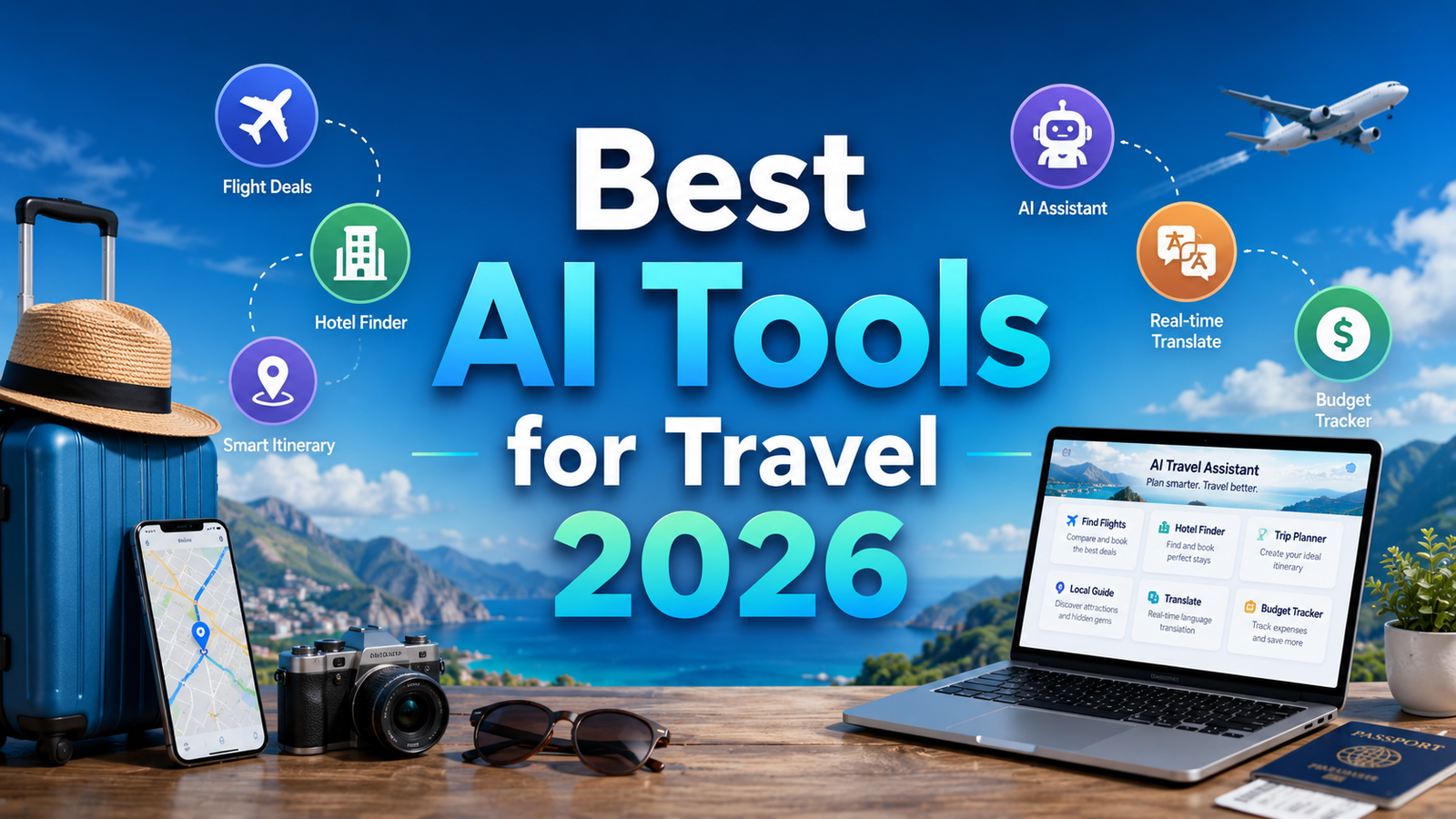
Best AI Tools for Travel 2026: Ranked, Reviewed and Compared
Travel planning used to mean hours of browser tabs. Searching flight comparison sites, reading hotel reviews across multiple platforms, cross-referencing travel forums, building a spreadsheet itinerary, checking visa requirements on government websites, and hoping the resulting plan actually made geographic sense. For a two-week international trip, the planning process could consume 20 to 30 hours before a single booking was made.
AI has compressed that timeline dramatically. In independent testing published in 2025, a trip to Japan that previously consumed weeks of planning took 90 minutes using AI trip planning tools, producing a result that reviewers described as arguably better organized than the manually planned version. That time compression is not marginal. For frequent travelers, professionals planning business trips, and families coordinating complex multi-destination itineraries, AI tools have become the default starting point for travel planning in 2026.
The travel AI category has also diverged into distinct types that serve different needs. General AI assistants like ChatGPT and Claude handle flexible, conversational trip planning with unlimited customization. Purpose-built AI itinerary tools like Wonderplan and Roam Around generate structured day-by-day plans from minimal input. OTA-embedded AI like Expedia and Kayak combine planning with real-time booking data. Platform-integrated AI like Google Travel and TripAdvisor connects planning to review data and booking infrastructure.
The critical caveat that applies to every AI travel tool: AI recommendations can be outdated. Restaurants close, opening hours change, visa requirements shift, and transportation schedules are revised. Every AI-generated travel plan requires human verification of operationally critical details before departure.
Comparison Table: Best AI Tools for Travel 2026
| Tool | Best For | Starting Price | Free Plan |
|---|---|---|---|
| ChatGPT | Flexible, conversational, fully customizable trip planning from scratch | Free / $20/month (Plus) | Yes |
| Claude | Complex multi-destination itineraries requiring careful reasoning and long documents | Free / $20/month (Pro) | Yes |
| Kayak AI | Flight and hotel search with AI-powered price predictions and deal alerts | Free | Yes |
| Expedia AI | Full-trip booking with AI-guided itinerary building and social media inspiration | Free | Yes |
| Google Travel AI | Google ecosystem users who want AI-assisted trip research and booking in one place | Free | Yes |
| Wonderplan | Budget-focused travelers wanting a complete AI itinerary from minimal input | Free | Yes |
| Roam Around | Travelers who want a quick, clean AI itinerary outline to build from | Free | Yes |
| TripAdvisor AI | Travelers who want AI recommendations grounded in millions of real traveler reviews | Free | Yes |
“Pricing is subject to change. Always verify current pricing on the tool’s official website before purchasing.”
Detailed Reviews
1. ChatGPT
Best for travelers who want maximum flexibility, conversational iteration, and deeply personalized trip planning that adapts to unlimited specific requirements.
ChatGPT is the most powerful travel planning tool available precisely because it is not specialized. Its conversational interface allows building a trip from any starting point: a destination you have dreamed of, a budget constraint, a physical limitation, a travel style, or a specific interest like slow travel, culinary tourism, or historical sites. Describe your preferences and refine through natural conversation over multiple turns until the result reflects exactly what you want.
In independent testing, ChatGPT consistently produces the most personalized travel plans because it can hold the context of unusual requirements across a long conversation. Planning a vegetarian-friendly Japan itinerary that avoids major tourist crowds, starts in Osaka rather than Tokyo, and includes a day trip to a specific rural region is a request that specialized AI trip planners handle poorly and ChatGPT handles naturally.
The Plus plan’s web browsing adds a genuinely useful capability for travel research: real-time information about visa requirements, current travel advisories, local event calendars, and seasonal conditions can all be incorporated into planning sessions. Custom GPTs pre-loaded with specific regional travel expertise provide even more focused guidance.
Key Features: Conversational itinerary building adaptable to any requirement or constraint, web browsing for current visa requirements, travel advisories, and local conditions on Plus, Custom GPTs for destination-specific travel expertise, Advanced Data Analysis for processing uploaded travel documents, multi-destination routing and logistics planning, budget estimation and optimization, and memory for building on previous travel preferences across sessions.
Pros:
- Most flexible AI travel tool; handles any combination of requirements, constraints, and travel style preferences
- Conversational iteration allows refining the plan until it exactly matches what you want
- Web browsing on Plus incorporates current visa and advisory information into planning
- Free tier is sufficient for comprehensive trip planning for most destinations
Cons:
- No real-time flight or hotel pricing; all accommodation and transport options require separate booking research
- Outputs require more verification than specialized tools for operationally critical details like opening hours
- More effort required to produce a structured, formatted itinerary compared to purpose-built trip planners
Pricing:
- Free: GPT-5.x with daily limits, no credit card required
- Plus: $20/month, full GPT-5.4, web browsing, file analysis, Custom GPTs, memory
2. Claude
Best for travelers planning complex multi-destination itineraries, long overland journeys, or trips requiring careful reasoning about logistics across many constraints simultaneously.
Claude’s 200,000-token context window makes it specifically better than ChatGPT for the complexity category of travel planning: a six-country itinerary with 20 separate destinations, specific accommodation categories at each stop, dietary requirements that shift what restaurants are viable, transport connections with specific timing constraints, and weather considerations at each destination simultaneously. Claude holds all of these factors coherently and reasons carefully about trade-offs rather than oversimplifying.
For travelers who provide Claude with a destination guide PDF, a travel blog post about a specific region, or a list of accommodation they are considering, Claude synthesizes that uploaded information into planning assistance that is grounded in specific, provided sources rather than potentially outdated training data. The no-training-by-default policy on paid plans means uploaded personal travel documents and booking details are not used for model training.
Key Features: 200,000-token context for reasoning about complex multi-destination trip logistics simultaneously, careful multi-constraint reasoning for itineraries with many competing requirements, document synthesis from uploaded travel guides and planning resources, Projects for maintaining persistent context across a multi-week trip planning project, and precise instruction-following for specific formatting requirements in itinerary output.
Pros:
- Best reasoning about complex multi-destination logistics with many simultaneous constraints
- Large context window handles uploading complete travel guides for destination-grounded planning
- Projects feature maintains trip planning context across multiple planning sessions over weeks
- No-training policy protects uploaded personal travel details and booking information
Cons:
- No real-time pricing, flight data, or booking integration
- Daily message limits on Pro can frustrate intensive planning sessions for complex long trips
- Less conversational and playful than ChatGPT for casual exploratory trip brainstorming
Pricing:
- Free: Claude Sonnet 4.6 with daily limits, no credit card required
- Pro: $20/month, Opus 4.6, 200K context, Projects
3. Kayak AI
Best for travelers who want AI-powered flight and hotel search with price predictions, deal alerts, and booking integration from a platform with real-time travel data.
Kayak’s AI assistant, built on OpenAI technology, bridges the gap between planning conversation and actual booking data. Ask Kayak’s AI for flights from Miami to Tokyo in October under $900 and it returns real options with actual current pricing rather than general guidance about what flights might cost. Ask it about the best time to book to find the lowest prices and it draws on Kayak’s historical pricing database to give predictions specific to that route.
The Trips feature organizes saved searches, booking confirmations, and travel research into a single itinerary view. For travelers who want the conversational planning experience of ChatGPT combined with real booking data they can act on immediately, Kayak’s AI provides the closest available integration between the two. The price alert system notifies users when prices on specific routes drop below their target threshold, replacing the manual checking that previously required daily browser visits.
Key Features: AI-powered natural language flight and hotel search returning real-time pricing, price prediction model forecasting whether to book now or wait, price alert notifications for tracked routes, Kayak Trips organizing confirmations and research in one itinerary, hotel price comparison across major OTAs from a single search, explore feature for destination discovery based on departure point and budget, and integration with major airline and hotel booking systems.
Pros:
- Real-time flight and hotel pricing connects AI planning to actual booking data
- Price prediction model uses historical route data to advise on timing
- Price alerts replace manual fare monitoring without daily checking
- Free to use with no subscription required for core AI and search features
Cons:
- AI conversation is more limited in scope than ChatGPT; better for search queries than comprehensive itinerary planning
- Recommendations skew toward Kayak’s partner inventory, which may not surface all available options
- Less useful for planning activities, restaurants, and local experiences beyond transport and accommodation
Pricing:
- Free: Core AI search and price alerts
- No paid subscription required for most features
4. Expedia AI
Best for travelers who want AI itinerary building connected directly to Expedia’s booking infrastructure, including social media inspiration-to-booking workflows.
Expedia’s AI features in 2026 cover two distinct use cases that make it distinctive in the travel AI category. The conversational itinerary builder connects AI-generated trip plans directly to Expedia’s hotel and activity inventory, allowing travelers to move from AI-suggested itinerary to booked accommodations without switching platforms. The Instagram integration is the more novel feature: send a travel Reel or photo to Expedia’s Instagram account and the AI generates a concrete itinerary inspired by the visual content, complete with hotel recommendations and booking links.
For travelers whose trip inspiration comes from social media rather than formal destination research, the Instagram-to-itinerary pipeline removes the friction of translating visual inspiration into a concrete bookable plan. Expedia’s loyalty program integration means Expedia One Key rewards points apply to AI-assisted bookings.
Key Features: Conversational AI itinerary building connected to Expedia’s hotel and activity booking inventory, Instagram-to-itinerary feature converting social media inspiration into structured bookable plans, hotel recommendations with ratings, reviews, and direct booking buttons within the AI conversation, One Key rewards points on AI-assisted bookings, flight search integration connecting itinerary to transport options, and AI refinement allowing pace and intensity adjustments to generated itineraries.
Pros:
- Direct booking integration connects AI planning to actual reservations without platform switching
- Instagram-to-itinerary pipeline is a genuinely distinctive feature with no equivalent in competing tools
- One Key rewards integration provides loyalty value on AI-assisted travel bookings
- Free to use with no subscription required
Cons:
- AI recommendations prioritize Expedia inventory; independent hotels and activities outside Expedia’s network may not surface
- Instagram feature is still maturing and can produce occasional odd activity-to-accommodation matches
- Less customizable for complex itineraries with unusual requirements than ChatGPT or Claude
Pricing:
- Free: Full AI features, no subscription required
5. Google Travel AI
Best for Google ecosystem users who want AI-assisted trip research, flight search, and hotel comparison in one place connected to Google Search and Maps.
Google Travel integrates AI assistance throughout the travel research and booking workflow for users already operating in the Google ecosystem. Gemini AI within Google Travel answers destination questions, suggests itinerary ideas, and connects research directly to Google Flights and Google Hotels for real-time pricing. The integration with Google Maps means suggested attractions, restaurants, and activities link directly to map locations, reviews, and operating hours within the same interface.
For travelers who start trip planning with Google Search anyway, the AI layer in Google Travel removes the need to re-enter context across multiple tools. A Google account connects research, saved places, booking confirmations, and Maps into a coherent trip planning environment without the fragmentation of assembling the same information across separate platforms.
Key Features: Gemini AI destination research and itinerary suggestions within the Google Travel interface, Google Flights integration for real-time fare comparison and price tracking, Google Hotels integration for accommodation search and comparison, Google Maps connectivity for saved attractions and navigation, trip organization with saved places and itinerary, price tracking alerts on specific routes and dates, and Google account sync for seamless cross-device access.
Pros:
- Zero additional cost for Google account holders; no new platform or subscription required
- Google Flights integration provides one of the most comprehensive real-time fare comparison tools available
- Maps integration connects AI-suggested places directly to navigation and reviews
- Familiar interface for users who already live in the Google ecosystem
Cons:
- AI planning depth is more limited than specialized trip planners or conversational AI tools for complex itineraries
- Recommendations can skew toward highly reviewed, well-known destinations and restaurants over hidden gems
- Less effective for off-the-beaten-path destinations where Google’s content database is thinner
Pricing:
- Free: Full Google Travel features with Google account; Gemini AI features may require Google One AI Premium at $19.99/month for advanced capabilities
6. Wonderplan
Best for budget-conscious travelers who want a complete AI itinerary from minimal input without any cost or registration requirement.
Wonderplan generates comprehensive day-by-day itineraries from a few simple inputs: destination, travel dates, trip length, budget level, travel party composition, and interest categories. The platform handles the itinerary construction entirely, producing a structured plan with activities, dining recommendations, and accommodation suggestions calibrated to the stated budget. For travelers who want a complete starting point without research investment, Wonderplan delivers a usable itinerary faster than any tool that requires conversational back-and-forth to build the same structure.
The platform’s budget optimization is its most distinctive feature: rather than requiring the traveler to manually filter results to a budget, Wonderplan’s AI allocates across accommodation, dining, and activities to maximize experience within the stated cost envelope. PDF download for offline access makes it useful for destinations with unreliable connectivity.
Key Features: One-click itinerary generation from destination, dates, and preference inputs, budget optimization allocating across accommodation, activities, and dining within stated cost constraints, day-by-day structured itinerary output with specific recommendations, PDF download for offline access, interest-based customization across categories like adventure, culture, food, and relaxation, and free access with no registration required for basic use.
Pros:
- Fastest path from zero to a complete itinerary for a specific budget; under 2 minutes from input to full plan
- Budget optimization specifically serves travelers for whom cost management is the primary planning concern
- PDF download enables itinerary access without connectivity at the destination
- Completely free with no registration required
Cons:
- Less depth and nuance than conversational tools for complex or highly personalized requirements
- Recommendations can be generic for popular destinations; works best as a starting point rather than a final plan
- Less effective for unusual destinations or travel styles outside the platform’s training content
- No real-time pricing or booking integration; all accommodation and transport require separate research
Pricing:
- Free: Core itinerary generation, PDF download, basic features
- Premium tier: Check current pricing at wonderplan.ai
7. Roam Around
Best for travelers who want a quick, visually presented AI itinerary outline as a starting point for their own refinement.
Roam Around describes itself as the world’s largest AI travel planner by user volume, and its positioning as a quick outline generator is accurate and appropriate. Enter a destination and trip length and Roam Around produces a structured multi-day itinerary in seconds with suggested activities organized by day. The output is clean, easy to read, and useful as a skeleton that travelers then supplement with their own research and preferences.
Independent reviewers consistently describe Roam Around as great for “I have 3 days in Rome, give me something quick” but too shallow for serious planning. This is an accurate characterization rather than a criticism: if the use case is generating a quick starting framework rather than a complete detailed plan, Roam Around delivers exactly that with the least friction of any tool in this comparison.
Key Features: Fast itinerary generation from destination and duration inputs, clean visual presentation of day-by-day activity suggestions, interactive map showing suggested attractions, basic customization options for pace and interests, free access with no registration for basic itinerary generation, and PDF export for offline reference.
Pros:
- Fastest time-to-itinerary for popular destinations; results appear in seconds
- Clean, readable output that works well as a planning skeleton
- Map integration provides spatial context for suggested activities
- Completely free for basic use
Cons:
- Shallow depth for complex or unusual travel requirements; best as a starting point rather than a complete plan
- Recommendations for popular destinations can be predictable and heavily tourist-oriented
- Limited customization for off-the-beaten-path travel, dietary requirements, or unusual travel styles
- No real-time pricing, booking integration, or verification of current operating status
Pricing:
- Free: Core itinerary generation
- Check current pricing for any premium features at roamaround.ai
8. TripAdvisor AI
Best for travelers who want AI recommendations backed by millions of verified reviews and photos from real travelers worldwide.
TripAdvisor’s AI layer draws on a review database that no general AI travel tool can replicate: millions of verified reviews from real travelers who visited specific restaurants, hotels, and attractions at specific times. When TripAdvisor’s AI recommends a restaurant in a specific city, that recommendation is grounded in current traveler sentiment from people who ate there recently, not just training data from unknown sources. This review-grounded approach addresses the most common failure mode of AI travel recommendations: confident suggestions for businesses that have closed, declined in quality, or never matched their description.
The AI trip planning feature connects recommendation generation to TripAdvisor’s review infrastructure, producing suggestions with quality signals that general AI tools cannot match for popular destinations with rich review coverage. For travelers who want recommendations they can trust without independent verification, TripAdvisor’s review foundation is a meaningful differentiator.
Key Features: AI recommendations grounded in TripAdvisor’s real traveler review database, review-backed hotel, restaurant, and attraction suggestions with direct access to traveler photos and comments, itinerary building with review-quality signals for each recommendation, price comparison integration for hotels within the planning interface, “Best of” lists curated from traveler reviews for destination overviews, and forum access for destination-specific questions answered by experienced travelers.
Pros:
- Review foundation provides quality signals that no general AI training data can replicate
- Millions of current traveler photos and reviews ground recommendations in real recent experiences
- Reduces the verification burden for restaurant and attraction quality relative to AI tools without review grounding
- Free to use with no subscription required
Cons:
- Review coverage varies dramatically by destination; popular cities have excellent coverage, less-visited destinations have sparse data
- AI planning interface is less flexible and conversational than ChatGPT for complex customized itineraries
- Recommendation bias toward heavily reviewed, popular choices over hidden gems with fewer but equally valid reviews
- Hotel pricing and booking integrations may not surface all available inventory
Pricing:
- Free: Core AI features and planning tools
- TripAdvisor Plus subscription: $99/year for hotel discounts (travel subscription, not AI-specific)
Frequently Asked Questions
How accurate are AI travel recommendations, and what should travelers always verify independently?
AI travel tools are accurate for conceptual and structural recommendations: suggesting which neighborhoods to stay in, which attractions align with specific interests, how many days to allocate to each destination, and what transportation options connect cities. They are unreliable for operationally time-sensitive details that change frequently. Independent testing across seven AI travel planning tools consistently found mistakes in opening hours, incorrect descriptions of restaurants that had closed or changed format, and distance estimates that were occasionally significantly off. Before any trip departure, travelers should verify visa and entry requirements directly on official government websites, confirm opening hours and reservations for key restaurants and attractions directly with the venues, and check current travel advisories from their government’s foreign affairs department. For medical or security concerns at a destination, official sources are non-negotiable; AI tools can surface the right questions to research but cannot replace authoritative current sources for safety-critical information.
Should I use a specialized AI trip planner like Wonderplan or a general AI like ChatGPT for planning?
The most effective approach combines both for different stages. Specialized AI trip planners like Wonderplan and Roam Around are better at generating a complete structured itinerary quickly from minimal input, and they produce cleanly formatted output that is easy to read and share. General AI tools like ChatGPT and Claude are better at handling unusual requirements, iterating through refinements, synthesizing constraints, and reasoning about logistics for complex multi-destination trips. A practical workflow that independent travel planning reviewers consistently recommend: use Wonderplan or Roam Around to generate a complete baseline itinerary quickly, then use ChatGPT to refine specific sections, resolve logistics problems, and customize based on your actual preferences. This combination produces better results faster than using either tool exclusively, and the baseline from a specialized planner gives ChatGPT a concrete structure to improve rather than building from nothing.
What is the best free AI travel planning stack for a budget traveler with no paid subscriptions?
A combination of three free tools covers the full travel planning workflow without any paid subscription. Wonderplan generates a complete budget-optimized day-by-day itinerary from minimal input at no cost. ChatGPT’s free tier refines the itinerary for specific requirements, handles unusual destination questions, and produces packing lists and logistics planning. Google Travel with Google Flights provides real-time flight pricing comparison and hotel search with price tracking alerts. For booking, Kayak’s free AI search adds price prediction on whether to book now or wait. For verification, TripAdvisor’s review database is free and allows checking the quality of specific restaurants and hotels before committing. This five-tool free stack covers ideation, itinerary generation, refinement, pricing research, and quality verification end-to-end for zero monthly cost. The first paid upgrade that meaningfully improves the workflow is ChatGPT Plus at $20 per month, which adds web browsing for real-time visa and advisory research that the free tier cannot access.
Final Recommendation
The right AI travel planning stack in 2026 depends on trip complexity, the traveler’s planning style, and whether booking integration is a priority.
For most leisure travelers planning standard international trips, the free combination of Wonderplan for initial itinerary generation and ChatGPT for refinement and unusual requirements covers the entire planning workflow effectively. Add Google Flights for pricing research and TripAdvisor for recommendation quality verification before finalizing bookings.
For complex multi-destination trips with many simultaneous constraints, Claude Pro at $20 per month provides the best reasoning about logistics, budget allocation, and competing requirements. The 200,000-token context window allows Claude to hold the full complexity of a 20-stop itinerary without losing coherence.
For travelers who want AI planning connected directly to real-time booking infrastructure, Kayak’s AI search provides the best combination of conversational planning and actual fare data. Expedia AI adds the Instagram-to-itinerary pipeline for travelers whose inspiration comes from social media.
For travelers who prioritize recommendation quality over planning sophistication, TripAdvisor’s review-grounded AI provides the highest-confidence recommendations for popular destinations with rich review coverage.
For quick-reference itinerary outlines that serve as planning starting points without requiring deep research, Roam Around produces clean, fast, visual results that are ideal as a skeleton for further refinement.
The consistent principle: start with a free tool that generates a complete itinerary structure quickly, refine it through conversational AI for your specific requirements, verify critical operational details independently before departure, and treat every AI travel recommendation as a well-informed starting point rather than a confirmed fact.