Poe AI Review 2026: Is $20 a Month for Every AI Model Actually a Good Deal?
Every major AI chatbot now costs $20 per month. ChatGPT Plus is $20. Claude Pro is $20. Perplexity Pro is $20. For users who want access to all of them, the math gets expensive fast. Poe, built by Quora, exists to solve that specific problem: one subscription, access to over 100 AI models, no separate accounts to manage.
The pitch is clean. The reality is more nuanced. Poe does not give you unlimited access to flagship models. It gives you a credit-based system that allows limited use of premium models and unlimited use of lighter ones. The comparison that matters is not “Poe versus individual subscriptions” but “what do I actually get from Poe at $19.99 per month versus what I get from a single direct subscription at the same price.”
After testing across the free tier, the Subscriber plan, and the bot-building tools, here is the full picture.
Plan Comparison Table
| Plan | Best For | Starting Price | Free Trial |
|---|---|---|---|
| Free | Casual users evaluating the platform with basic model access | $0 | Yes |
| Subscriber | Power users who need multi-model access and bot creation across 100-plus AI models | $19.99/month ($199.99/year) | Free tier only |
| Teams | Organizations needing shared access, admin controls, and team bot management | $249.99/month | No |
“Pricing is subject to change. Always verify current pricing on the tool’s official website before purchasing.”
What Poe AI Is
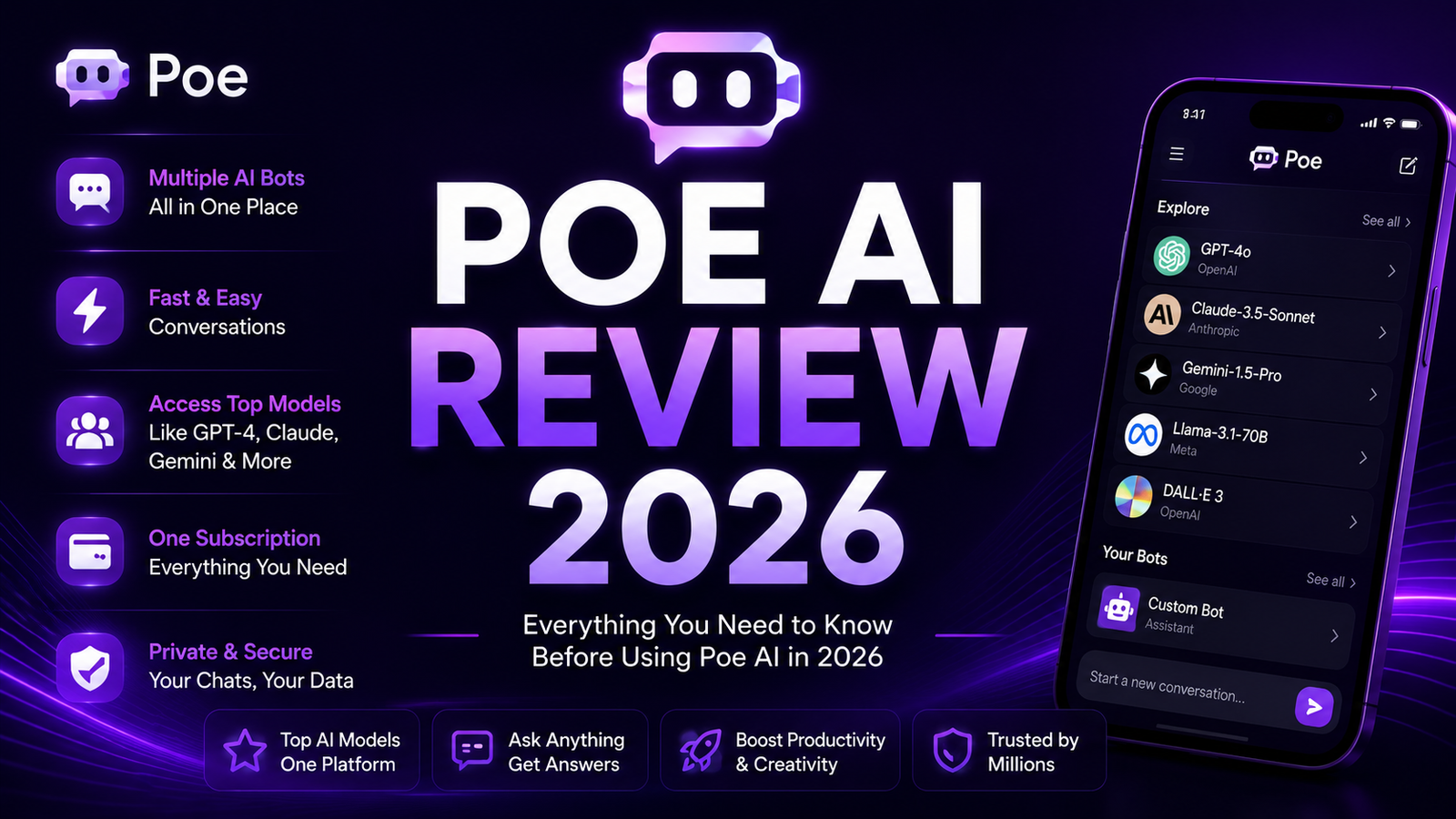
Poe, short for Platform for Open Exploration, is an AI chatbot aggregator developed by Quora. Launched in late 2022 and made publicly available in early 2023, it was built by Adam D’Angelo and the Quora team as a single interface providing access to AI models from multiple providers, including OpenAI, Anthropic, Google, Meta, Mistral, and hundreds of community-built custom bots.
Poe does not build its own AI models. It is a platform layer that connects to other companies’ models via their APIs, wraps them in a unified interface, and charges a single subscription that covers access to all of them. In 2026, the platform supports over 100 models including GPT-5.x, Claude Opus 4.6, Gemini Pro, Llama 3, Mistral, DeepSeek, and dozens of specialized bots built by the creator community.
The platform is available on iOS, Android, MacOS, Windows, and web browsers. It has a community component where bot creators can publish their custom bots and, through the Creator Monetization program, earn revenue from user interactions with those bots.
The core use case is model comparison and breadth. If you regularly need to run the same prompt through multiple AI models to see which produces the best output for a specific task, Poe is the only tool that makes that workflow frictionless. For users who have settled on one primary AI assistant for their daily work, the case for Poe over a direct subscription is weaker.
Key Features
Multi-model access from one interface. The central feature. Subscriber plan holders can switch between GPT-5.x, Claude Opus 4.6, Gemini Pro, Llama 3, Mistral, and others within the same session. No separate login, no separate billing, no context switching between applications. For researchers, developers evaluating models for deployment, and curious power users who genuinely use multiple models regularly, this convenience has real value.
Multi-bot chat for simultaneous comparison. The Multi-Bot Chat feature sends the same prompt to multiple AI models simultaneously and displays the responses side by side. For users who want to compare how different models approach the same question, this is the fastest evaluation tool available. Running Claude, GPT-5, and Gemini on the same prompt simultaneously takes seconds rather than the minutes it takes to repeat the prompt across three separate applications.
Bot creation without code. Users can create custom bots by setting a system prompt, selecting a base model, and defining the bot’s behavior and persona. No programming required. Created bots can be kept private or published to the Poe community. Published bots that gain traction generate revenue for their creators through the monetization program. For prompt engineers who have developed specialized assistants, Poe provides a distribution and monetization layer without requiring a separate product.
Access to boutique and experimental models. Beyond the flagship models, Poe provides access to Mistral variants, Qwen, experimental builds, and community-created fine-tuned bots that are not available as standalone consumer products. For AI researchers and developers who want to evaluate less prominent models without managing separate API credentials, Poe covers this breadth more conveniently than any alternative.
Mobile app. The Poe mobile app on iOS and Android is consistently described in 2026 reviews as well-designed and fast. Cross-device sync keeps conversations accessible across all platforms, and the app supports the full feature set including multi-bot comparison and bot creation.
Point-based access system. Each model consumes a different number of points per message based on its computational cost. Flagship models like Claude Opus 4.6 and GPT-5.x consume significantly more points per message than lighter models like Claude Instant or Llama 3. Subscriber plan holders receive a monthly point allocation that covers a certain volume of premium model usage plus unlimited access to free models. This credit system is both Poe’s primary value mechanism and its primary source of user frustration.
Pros and Cons
Pros:
- Most efficient way to access 100-plus AI models without maintaining separate accounts, billing, and logins for each provider
- Multi-Bot Chat for simultaneous side-by-side model comparison is a genuinely unique capability with no direct equivalent in any single-model platform
- Bot creation and monetization provides a pathway for prompt engineers to distribute and earn from specialized AI assistants
- Access to boutique and experimental models that are not available as standalone consumer products
- Strong mobile app with full feature parity and fast performance
- Annual plan at $199.99 per year ($16.67 per month) offers meaningful savings versus monthly billing
- Community bot ecosystem covers specialized use cases across hundreds of pre-built expert assistants
Cons:
- The credit-point system limits premium model usage; heavy users of Claude Opus or GPT-5 will exhaust their monthly allocation before the billing cycle resets
- Response latency varies unpredictably across models and times of day; connection drops and incomplete responses during high-traffic periods are a documented reliability concern
- Poe does not replicate the deep tool integrations of direct subscriptions: no ChatGPT memory that compounds over sessions, no Claude Projects with persistent context, no Perplexity Spaces
- Conversation context can break when switching models mid-chat, requiring users to re-establish context rather than carrying it seamlessly
- Free tier is genuinely restrictive for evaluating premium model quality; 5 daily messages on paid models is not enough to reach a confident conclusion about output quality
- Image generation quality through Poe is limited compared to dedicated tools like Midjourney
- International users pay the listed USD price converted at exchange rates, which adds 30 to 35 percent for Canadian users and equivalent premiums in other currencies
Pricing Breakdown
Free: $0. Unlimited access to free models including Claude Instant, Llama 3, and Mistral. Approximately 5 daily messages on premium paid models. The free tier is functional for evaluating Poe’s interface and exploring the community bot ecosystem, but insufficient for serious evaluation of flagship model quality. Once the daily premium message limit is reached, the session is effectively limited to lighter models until the next day.
Subscriber: $19.99/month or $199.99/year ($16.67/month). Unlimited access to all free models, expanded point allocation for premium model usage, priority queue during high-traffic periods, early access to new models as they launch on the platform, and full bot creation capabilities. This is the plan where Poe’s multi-model value proposition actually works. The annual plan at $199.99 saves $40 versus monthly billing and is the appropriate commitment level for users who are confident the multi-model workflow fits their needs.
Teams: $249.99/month. Shared team access with admin controls, team bot management, and centralized billing. Designed for organizations that want multiple members accessing Poe’s model library from managed accounts. For teams where comparing model outputs across projects is a regular workflow, this plan provides the oversight layer that individual subscriptions do not.
One important note on point consumption: premium models like Claude Opus 4.6 and GPT-5.x consume significantly more points per message than standard models. Heavy users of these specific flagship models will exhaust their monthly Subscriber allocation before the billing cycle ends. If your primary use is one premium model used intensively every day, a direct subscription to that model is almost certainly more cost-effective than Poe. If your use is spread across multiple models at moderate volume, the Subscriber plan typically covers the workflow without hitting limits.
How It Compares to ChatGPT and Claude
For a full breakdown of how ChatGPT and Claude compare directly with each other, see our ChatGPT vs Claude 2026 comparison. Here we focus on how Poe fits into that picture.
Poe vs ChatGPT
At $19.99 per month, Poe and ChatGPT Plus cost effectively the same. ChatGPT Plus provides native first-party access to GPT-5.4 with Advanced Voice Mode, GPT Image 1.5, memory that compounds across sessions, Custom GPTs, Advanced Data Analysis with Python execution, and the most coherent first-party product experience available from OpenAI. Poe provides GPT-5.x access via the API alongside 100 other models, without memory, without Advanced Voice Mode, without native image generation at GPT quality, and without Custom GPT ecosystem integration.
The math only works in Poe’s favor under one specific condition: you genuinely use multiple models regularly and the combined value exceeds what a single ChatGPT Plus subscription provides. For single-model users or for anyone whose primary AI work happens inside the ChatGPT product ecosystem, ChatGPT Plus is the more capable choice at the same price.
Poe vs Claude
The same logic applies to Claude. Claude Pro at $20 per month provides full Opus 4.6 access with 5x the usage limits of the free tier, Projects for persistent context across ongoing work, Claude Code for agentic coding, and the strongest writing quality available from any AI assistant. Poe provides Claude Opus 4.6 access within its point system, without Projects, without Claude Code, and without the persistent context management that makes Claude Pro genuinely powerful for sustained professional work.
For users who want Claude as their primary AI and ChatGPT as a secondary, Poe’s Subscriber plan at $19.99 is significantly cheaper than paying $40 per month for both direct subscriptions. That is the genuine savings case: if you previously paid $20 for ChatGPT Plus and $20 for Claude Pro and can replace both with Poe at $19.99 while still covering your core use cases, you save $20 per month. Whether the reduced functionality in each model versus its direct subscription version is an acceptable trade-off depends entirely on how deeply you depend on each platform’s native features.
Frequently Asked Questions
Is Poe worth it if I already pay for ChatGPT Plus?
Only if you regularly use Claude or other models alongside ChatGPT. If your AI workflow is primarily inside ChatGPT, adding Poe creates a redundant payment with credit limitations that make it a worse experience than your existing subscription. Poe’s value compounds when you are currently paying for multiple AI subscriptions and Poe can consolidate them. If you pay $20 for ChatGPT Plus and $20 for Claude Pro, switching to Poe at $19.99 saves $20 monthly while covering both models, though with less depth in each platform’s native features. For single-model users, the direct subscription is almost always the better product at the same price.
How do the daily point limits actually affect heavy users of premium models?
Point consumption on flagship models is higher than most new Poe subscribers expect. Claude Opus 4.6 and GPT-5.x consume significantly more points per message than standard models, meaning a user who sends 50 messages per day to a premium model will exhaust their Subscriber plan allocation long before the monthly billing cycle resets. When points run out, access falls back to free models only until the next billing period. Heavy users of a single premium model should model their expected monthly message volume against Poe’s point allocation before assuming the Subscriber plan covers their workflow. For intensive daily use of one specific flagship model, a direct subscription to that model typically provides more usage volume for the same or lower cost.
Can I use Poe to build and share specialized AI bots, and is the monetization program worthwhile?
Yes on both counts, with realistic expectations. Poe’s bot creation tools are genuinely accessible: configure a system prompt, select a base model, set the bot’s behavior, and publish it to the community without writing any code. Bots that gain significant usage generate revenue for their creators through the Creator Monetization program. In practice, monetization is meaningful for bot creators whose bots serve specific, high-demand use cases within the Poe community and accumulate substantial monthly interactions. For most individual creators building specialized assistants, the primary value of Poe’s bot tools is the ability to create persistent, pre-configured AI assistants for personal or team use rather than income generation. The distribution benefit is real: a published Poe bot is accessible to anyone on the platform without the creator managing infrastructure or API costs.
Final Verdict
Poe is the right tool for one specific user profile: power users who genuinely use multiple AI models regularly and for whom the convenience and cost savings of consolidated access justify the reduced functionality versus direct subscriptions.
For that user, the case is solid. A user currently paying $20 for ChatGPT Plus and $20 for Claude Pro can consolidate to Poe at $19.99 per month, save $20 monthly, and still access both flagship models alongside 100 others. The trade-off is that they lose native features: ChatGPT’s memory and Custom GPTs, Claude’s Projects and Code, the persistent ecosystems that make direct subscriptions compelling for sustained professional work.
For everyone else, the math is less favorable. Single-model users are better served by a direct subscription at the same price with more features. Users whose primary workflow depends on native integrations like Claude Projects, ChatGPT memory, or Perplexity Spaces will find those workflows unavailable through Poe. And casual users who want to try a capable AI at no cost will find Poe’s free tier frustratingly limited on premium models compared to the free tiers of ChatGPT or Claude directly.
The clearest use cases where Poe adds genuine value with no meaningful downside: model comparison research, building and distributing custom prompt-engineered bots, accessing boutique or experimental models without API credentials, and consolidating two or more existing AI subscriptions into one lower-cost payment. Start on the free tier to evaluate the interface and community bot ecosystem. Upgrade to Subscriber only when you have confirmed that multi-model access is actually how you use AI, not just how you think you might use it.
Rating: 4.0 / 5