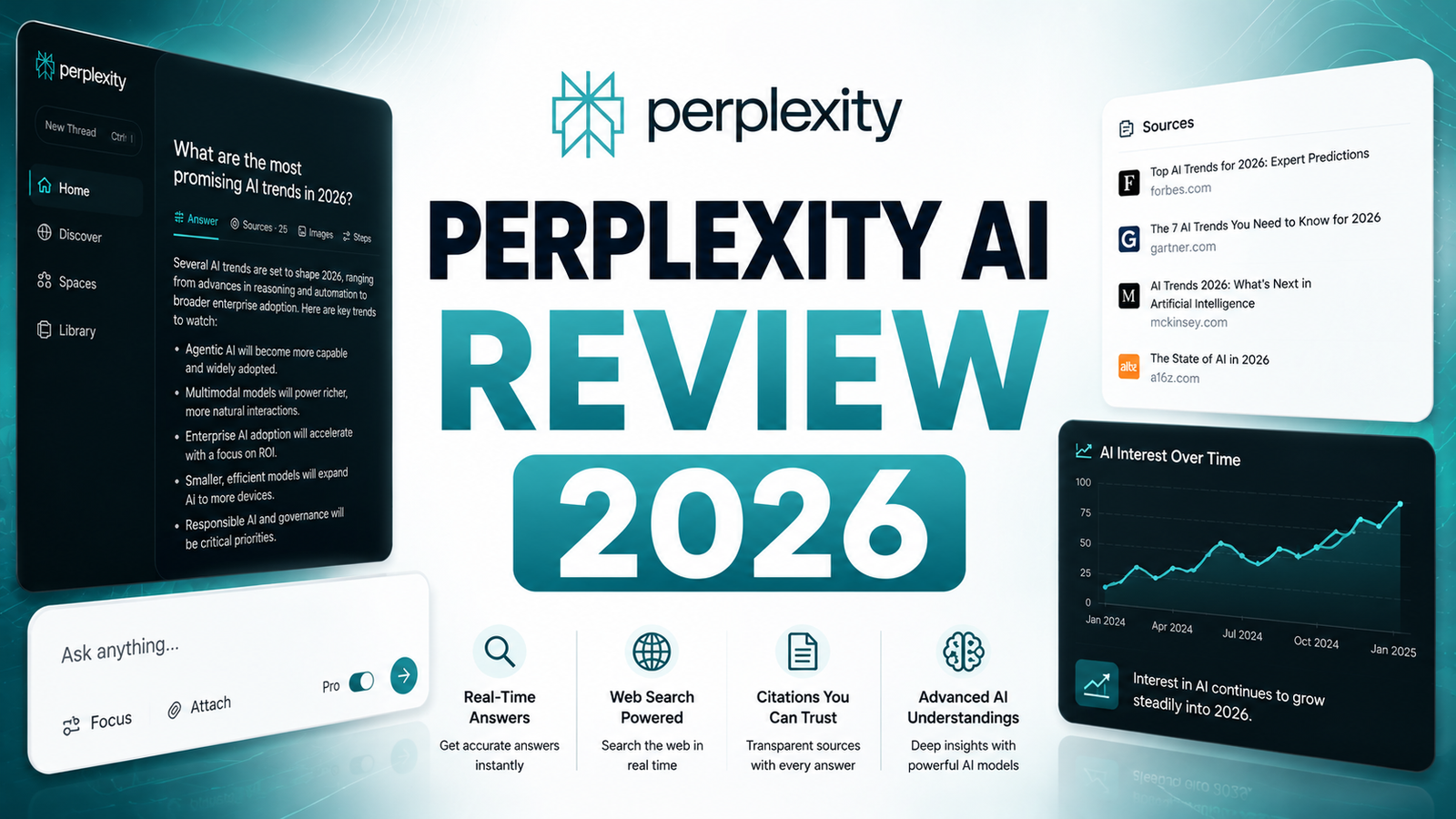
Perplexity AI Review 2026: The Smarter Way to Search
Most AI tools ask you to choose between two things: a search engine that shows you links, or a chatbot that answers from memory. Perplexity AI does neither. It combines real-time web search with large language model reasoning to deliver direct, cited answers to complex questions without making you wade through ten blue links or worry about outdated training data.
Since launching in 2022, Perplexity has grown into one of the most-used AI research tools in the world. Its premise is deceptively simple: ask a question in natural language, get a synthesized answer pulled from live sources, with every claim traceable back to where it came from. In practice, that combination solves a problem that neither Google nor ChatGPT handles cleanly on its own.
This review covers everything you need to know about Perplexity AI in 2026, including what it does, who it serves best, how the pricing tiers break down, and how it stacks up against the two tools it most frequently gets compared to.
Our Take: Perplexity remains one of the best AI research tools in 2026, combining conversational AI with real time web search. It may not replace ChatGPT for every task but it’s often the fastest way to find accurate, sourced information.
What Perplexity AI Is and Who It Is For
Perplexity AI is an AI-powered answer engine that uses large language models combined with live web search to generate conversational, citation-backed responses to natural language queries. Rather than presenting a list of links for the user to evaluate and synthesize manually, Perplexity reads across multiple sources in real time, synthesizes the most relevant information, and presents a structured answer with inline citations showing exactly which source each claim came from.
The core use case is research. When the question is factual, time-sensitive, or requires synthesizing multiple sources, Perplexity is faster and more verifiable than asking ChatGPT from memory and more direct than sifting through Google results manually.
It is built for a specific kind of user rather than a general audience. The people who get the most value from Perplexity are:
Researchers and students who need cited, verifiable answers quickly and cannot afford to build arguments on AI hallucinations or outdated training data. The inline source citations make every claim checkable.
Journalists and analysts who track fast-moving topics, need live information, and want to pull together a coherent summary of what multiple sources are saying without spending an hour on it.
Knowledge workers and professionals who regularly need to understand new topics, summarize reports, or get up to speed on a subject quickly as part of their daily workflow.
Developers who want programmatic access to Perplexity’s cited search infrastructure to build research features into their own products.
Perplexity is not the best tool for creative writing, coding assistance, or generative tasks that do not require live web data. Those use cases are better served by ChatGPT or Claude. Perplexity’s advantage is narrow but deep: for research-oriented questions where accuracy and source transparency matter, it consistently outperforms general-purpose chatbots.
Key Features
Pro Search with advanced reasoning. Standard search handles most factual questions quickly. Pro Search is qualitatively different: it breaks complex questions into sub-queries, searches across multiple angles, and synthesizes a deeper, more nuanced answer. Pro subscribers get unlimited Pro Searches; free users get approximately five per day. For any serious research workflow, the difference is meaningful.
Inline citations on every response. Every claim in a Perplexity answer is linked to the source it came from. This is the feature that separates Perplexity most clearly from general-purpose chatbots. Instead of trusting the AI and hoping it is right, users can click through to verify any specific claim in seconds. For academic, journalistic, or professional use, this alone justifies the tool.
Multi-model access on paid plans. Perplexity Pro subscribers can choose which underlying AI model handles their query. Options include Claude Opus, GPT-4o, Mistral Large, and others. This means users can route research-heavy questions to one model and analytical tasks to another, all within the same interface, without managing separate subscriptions.
File and document analysis. Pro subscribers can upload PDFs, spreadsheets, and documents and ask Perplexity to analyze, summarize, or cross-reference them against live web data. This is particularly useful for researchers reviewing academic papers, professionals reading reports, or anyone who wants to combine private document context with real-time web search in a single workflow.
Perplexity Labs (file and app creation). Labs allows Pro and Max subscribers to generate spreadsheets, dashboards, presentations, and simple web applications directly from research queries. Pro users get limited Labs access; Max subscribers get unlimited usage. This expands Perplexity from a research tool into a lightweight productivity layer.
Perplexity Computer (Max tier). Launched in February 2026, Perplexity Computer is a cloud-based AI agent that orchestrates 19 different AI models to handle complex, multi-step workflows autonomously. A user describes a goal, such as researching a market or building a report, and the system breaks it into subtasks, assigns each to the best-suited model, and works in the background until complete. It is included in the Max subscription at $200/month and represents the most ambitious product Perplexity has shipped to date.
Spaces for organized research. Spaces allow users to organize research into dedicated projects, save threads, and maintain context across multiple sessions on a single topic. For users tracking ongoing research or recurring topics, this makes Perplexity significantly more useful than starting fresh with each query.
Education Pro at a discount. Verified students and faculty can access everything in the Pro plan for $10/month through SheerID verification, making Perplexity one of the most affordable premium AI research tools available for academic users.
Pros and Cons
Pros:
- Real-time web access with inline citations on every response makes answers verifiable in a way that no offline chatbot can match
- Pro Search delivers genuinely deep, multi-angle synthesis for complex research questions
- Multi-model access on Pro allows routing different task types to the best-suited AI model within one subscription
- Free tier provides ongoing access to standard search with citations, not just a limited trial
- Education Pro at $10/month is among the lowest-cost premium AI subscriptions available for students
- Perplexity Labs adds lightweight document creation directly on top of research output
- Spaces enable organized, ongoing research projects rather than isolated one-off queries
- Clean, fast interface with minimal friction from query to answer
Cons:
- Not suited for creative writing, coding, or generative tasks where ChatGPT or Claude are stronger
- Free tier limits Pro Searches to approximately five per day, which is a real constraint for daily research users
- No dedicated team tier for small businesses; teams must use individual Pro subscriptions or move to Enterprise
- Perplexity Computer and full Labs access require the $200/month Max tier, a significant jump from $20/month Pro
- Voice and mobile features are less developed than competitors
- Occasional source quality issues: Perplexity pulls from whatever is ranking, which can include low-quality or promotional content if not reviewed carefully
Pricing Breakdown
Perplexity operates across five main tiers in 2026, ranging from a permanently free plan to a $200/month premium individual tier and custom enterprise pricing.
Free: Basic standard search with citations, limited Pro Searches (approximately five per day), no access to advanced AI models, no image generation, no file uploads. Sufficient for occasional research questions; not workable as a daily professional tool.
Pro: $20/month ($200/year, approximately $16.67/month annual billing). The core paid tier. Includes unlimited Pro Searches, access to Claude Opus, GPT-4o, Mistral Large, and other frontier models, file and document uploads, AI image generation via DALL-E and SDXL, limited Labs access, and API access. This is the right plan for the majority of individual users who use Perplexity regularly for research, writing, or daily information needs.
Max: $200/month ($2,000/year). Built for power users who need the highest level of AI productivity. Max includes everything in Pro plus unlimited Labs usage, Perplexity Computer (the 19-model AI agent), Sora 2 Pro video generation with 12-second audio-enabled clips in 16:9 format, the Comet AI browser, early access to all new Perplexity features, and priority access to the latest frontier models including GPT-5.2, Claude Opus 4.6, and Gemini 3 Pro. At $200/month, this tier competes with premium enterprise software and is designed for professionals who depend on AI as core daily infrastructure.
Enterprise Pro: $40/user/month ($400/year). Designed for business teams and organizations. Adds workspace collaboration, team-wide search history, admin controls, data security, SCIM provisioning, and audit logs for organizations with 50 or more members.
Enterprise Max: $325/user/month ($3,250/year). The highest-tier enterprise offering, combining Enterprise Pro security and collaboration features with Max-level AI access, unlimited Labs and Research modes, and priority support.
Education Pro: $10/month with verified student or faculty status through SheerID. Includes everything in the Pro plan.
“Pricing is subject to change. Always verify current pricing on the tool’s official website before purchasing.”
How It Compares to ChatGPT and Google
Perplexity vs. ChatGPT
These tools are frequently compared but serve genuinely different primary use cases. ChatGPT is a general-purpose AI assistant that excels at writing, coding, reasoning from provided context, brainstorming, and creative tasks. It is the better tool when the task starts from scratch or requires generating original output. Its limitation for research is that its training data has a cutoff, and while ChatGPT Plus includes web browsing, it was not designed with citation transparency as a core feature.
Perplexity was built specifically for research that requires live data and source traceability. Its citations are embedded in every response by design, not added as an afterthought. For factual, time-sensitive questions where accuracy matters more than creativity, Perplexity delivers more reliable and verifiable output.
The practical comparison for most users: ChatGPT Plus at $20/month and Perplexity Pro at $20/month serve different primary workflows. ChatGPT is the better daily writing and coding assistant. Perplexity is the better daily research tool. Many serious users subscribe to both for exactly this reason, using each where it is strongest.
Perplexity vs. Google
Google Search shows you where to look. Perplexity tells you what the answer is. For straightforward lookup queries, “what is the capital of France” or “hours for a specific business,” Google’s speed and precision are hard to beat. For complex, multi-part research questions that require synthesizing information across multiple sources, Perplexity consistently delivers a more immediately useful response.
The key difference is the output format. Google presents ten links and leaves synthesis to the user. Perplexity synthesizes across sources and presents a structured answer with citations, then allows follow-up questions within the same thread for deeper exploration. For information gathering that would previously have required opening five to ten browser tabs and reading across all of them, Perplexity compresses that process into a single, navigable answer.
Google’s AI Overviews attempt to close this gap, but they lack the model selection, depth of Pro Search, document analysis capabilities, and the interactive research thread that Perplexity provides. For users who regularly conduct serious research rather than simple lookups, Perplexity represents a genuine upgrade over Google as a primary information tool.
Frequently Asked Questions
Is the Perplexity AI free tier actually useful?
Yes, but with meaningful limits. The free tier provides ongoing standard search with citations, which is genuinely useful for occasional factual questions where real-time sourcing matters. The hard limit is approximately five Pro Searches per day. Pro Search is where Perplexity’s real capability shows up on complex, multi-part questions. For users who ask one or two straightforward questions per day, the free tier covers them adequately. For anyone doing regular daily research, the five Pro Search cap becomes a real friction point quickly, and the $20/month Pro upgrade makes practical sense within the first week of active use.
How is Perplexity different from just Googling something?
Google returns a list of links ranked by relevance and authority, leaving the user to click through, read across multiple pages, and synthesize the information manually. Perplexity synthesizes that information in real time, presents a structured answer with inline citations showing exactly which source each claim came from, and allows follow-up questions within the same thread to explore the topic further without starting over. For simple lookups, the difference is modest. For complex research questions that would require reading across five or more sources, Perplexity compresses hours of work into minutes. The citations also make the output verifiable in a way that a plain AI-generated answer is not.
Can Perplexity replace a research assistant?
For many standard research tasks, yes. Perplexity Pro handles literature surveys, competitive intelligence, market summaries, document analysis, and synthesis of complex topics with accuracy that matches what a capable research assistant would produce in a fraction of the time. The key limitation is judgment: Perplexity pulls from whatever sources are ranking for a query, which can occasionally surface lower-quality or promotional content. A human researcher applies editorial judgment about source credibility in a way Perplexity cannot replicate fully. The practical workflow for most professionals is to use Perplexity for first-pass synthesis and speed, then apply their own judgment to verify claims from primary sources when the stakes are high.
Final Verdict
Perplexity AI is one of the most useful AI tools available in 2026 for a specific but common use case: research that requires live, verifiable information. The combination of real-time web search, inline citations, multi-model access, and a clean conversational interface puts it in a category that neither general-purpose chatbots nor traditional search engines occupy cleanly.
The free tier is a genuine product, not a stripped trial. The Pro plan at $20/month delivers meaningful value for anyone who regularly researches topics, summarizes sources, or needs AI-assisted answers they can actually verify. The Max tier at $200/month is priced for professionals and power users who depend on AI as daily infrastructure and need the full breadth of Perplexity’s most advanced features.
For daily researchers, journalists, analysts, and knowledge workers who spend significant time gathering and synthesizing information, Perplexity Pro is one of the most defensible $20/month AI subscriptions available. Pair it with ChatGPT or Claude for writing and coding tasks, and you have a research and productivity stack that covers most professional AI needs at a predictable monthly cost.
Rating: 4.5 / 5
“Pricing is subject to change. Always verify current pricing on the tool’s official website before purchasing.”