DeepSeek Review 2026: The ChatGPT Rival That Came Out of Nowhere
In January 2025, a Chinese AI research lab nobody outside the industry had heard of released a reasoning model that matched OpenAI’s o1 at a fraction of the cost. NVIDIA’s stock dropped $600 billion in a single day. The AI industry spent a week recalibrating its assumptions about what frontier AI actually costs to build.
That was DeepSeek R1. In 2026, it has become a platform, a model family, a developer ecosystem, and a genuine open-source alternative to the Western AI stack. DeepSeek V4 Pro, released April 24, 2026, scores 80.6 percent on SWE-bench Verified, within 0.2 points of Claude Opus 4.6, and costs $3.48 per million output tokens versus Claude’s $25. That is a 7x price gap at near-identical coding benchmark performance.
This is no longer a curiosity. DeepSeek is a legitimate consideration for any developer or organization that uses AI at meaningful scale. This review covers what it does, what it costs, where the real trade-offs are, and who should actually use it.
Plan Comparison Table
| Plan | Best For | Starting Price | Free Trial |
|---|---|---|---|
| Web Chat (Free) | Individual users wanting free access to DeepSeek’s models via browser | $0 | Yes (no limits) |
| API Pay-as-you-go | Developers building applications who want the cheapest frontier model pricing | $0.14/M tokens (V4 Flash) | Yes (5M free tokens) |
| Self-hosted (Open Source) | Organizations wanting full model control with zero per-token cost | Infrastructure cost only | Yes |
“Pricing is subject to change. Always verify current pricing on the tool’s official website before purchasing.”
What DeepSeek Is
DeepSeek is a Chinese AI research company headquartered in Hangzhou, founded in 2023 as a subsidiary of the quantitative hedge fund High-Flyer Capital Management. Unlike OpenAI, Anthropic, and Google, which built closed proprietary models, DeepSeek releases its models as open source under permissive MIT licenses. Anyone can download, modify, fine-tune, and self-host the weights without paying per-token costs.
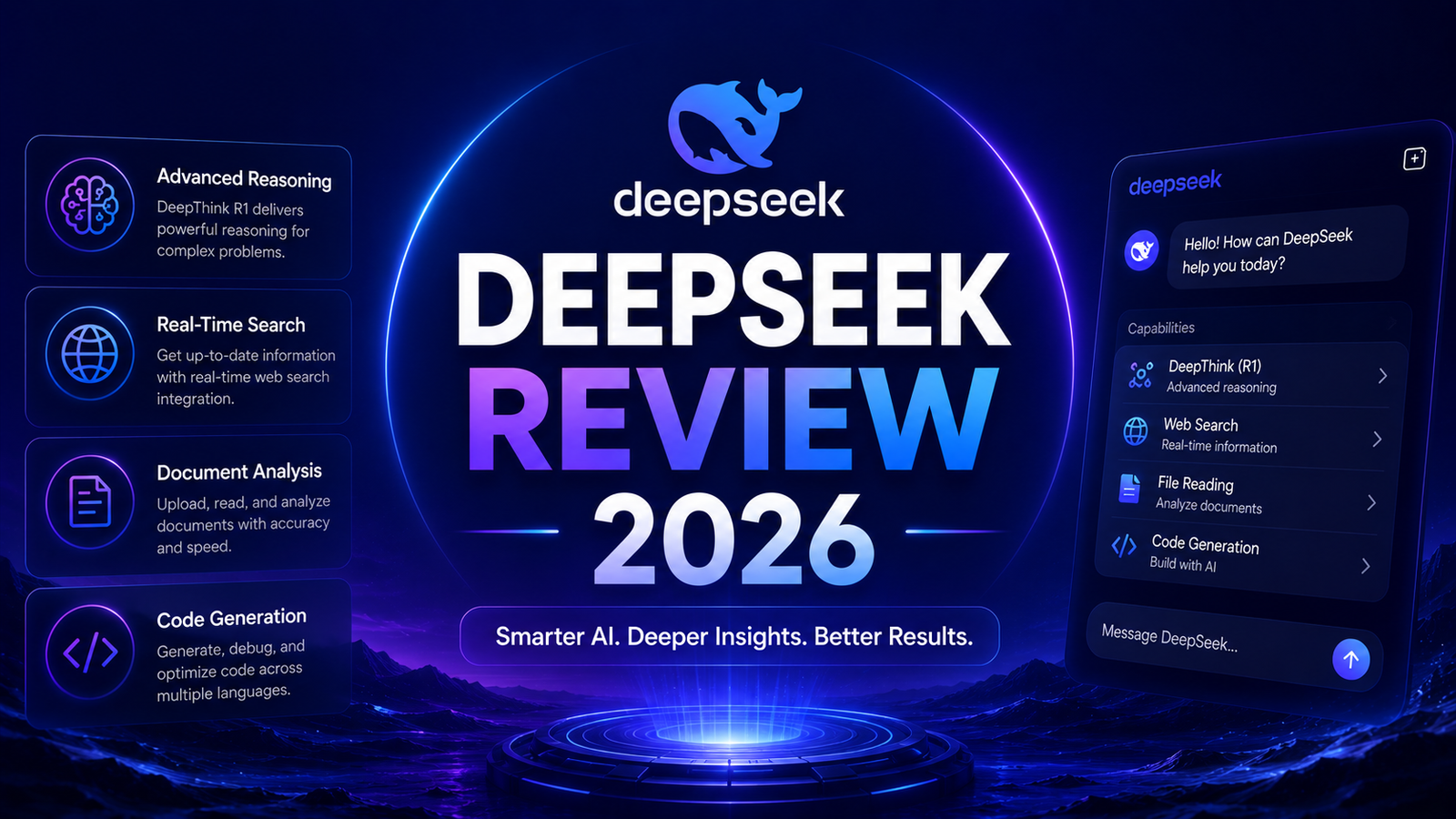
The model family in 2026 covers two distinct use cases. The V-series models (V3.2, V4 Flash, V4 Pro) are general-purpose chat and coding models optimized for speed, versatility, and cost efficiency. The R-series models (R1, R1-0528) are reasoning models that generate full chain-of-thought reasoning steps before delivering a final answer, optimized for mathematics, complex logic, and multi-step problem solving.
The web chat interface at chat.deepseek.com is free with no daily message limits for individual users. The API uses pay-per-token pricing with no monthly subscription requirement. New API accounts receive 5 million free tokens as an initial credit. Both the open-source weights and the API are available, giving developers the choice between managed access and full self-hosting.
Key Features
Open-source weights under MIT license. Every DeepSeek model is released with full weights. Organizations with the infrastructure to run inference can download V4 Pro, a 1.6 trillion parameter Mixture-of-Experts model, and operate it without any per-token cost. For high-volume workloads where cloud API costs are the primary constraint, self-hosting eliminates the per-token expense entirely after the infrastructure investment is made.
DeepSeek V4 Pro (released April 24, 2026). The flagship model is a 1.6 trillion parameter Mixture-of-Experts architecture that activates 49 billion parameters per token, giving it the efficient per-query cost of a smaller model with the quality of a much larger one. It scores 80.6 percent on SWE-bench Verified, supports a 1 million token context window, and costs $3.48 per million output tokens during the standard pricing period. A 75 percent promotional discount applies until May 31, 2026, reducing output costs to $0.87 per million tokens.
DeepSeek R1 and R1-0528 reasoning models. The R1 series uses visible chain-of-thought reasoning, showing every intermediate reasoning step before delivering a final answer. This transparency lets developers and users verify that the reasoning path is coherent, not just the conclusion. R1-0528 costs $0.50 per million input tokens and $2.15 per million output tokens. For mathematics, proof generation, complex coding, and multi-step logical reasoning, R1 consistently outperforms equivalent-cost alternatives from Western providers.
DeepThink hybrid reasoning mode (V3.1). The V3.1 model introduced a hybrid “Think and Non-Think” mode accessible via a DeepThink toggle. This allows the same model to switch between fast standard responses and slower chain-of-thought reasoning within the same conversation, depending on the complexity of the task. This flexibility reduces the cost overhead of reasoning mode on simple queries while retaining it for complex ones.
Free web chat with no daily limits. Unlike ChatGPT‘s free tier, which caps usage and shows ads, and Claude‘s free tier, which limits daily messages, DeepSeek’s web chat at chat.deepseek.com is genuinely free with no published daily usage cap for standard queries. For individual users who want capable AI without paying, this is one of the most accessible free options among frontier-quality models.
API pricing 35 to 100 times cheaper than Western equivalents. At $0.14 per million input tokens for V4 Flash and $3.48 per million output tokens for V4 Pro, DeepSeek dramatically undercuts OpenAI, Anthropic, and Google at every tier. GPT-5.4 costs $1.75 per million input tokens. Claude Opus 4.6 costs $5 per million input tokens. For developers running high-volume production workloads where API cost is the binding constraint, DeepSeek’s pricing changes the economic model of AI deployment.
Pros and Cons
Pros:
- Most cost-efficient frontier-quality API available; V4 Pro at $3.48 per million output tokens versus Claude Opus 4.6 at $25 is a 7x price advantage at near-identical SWE-bench performance
- Open-source MIT license enables full self-hosting with zero per-token cost for organizations with infrastructure capacity
- Free web chat with no daily limits is the most accessible free frontier model experience available for individual users
- Visible chain-of-thought reasoning in R1 models provides transparency into how the model arrived at an answer
- V4 Pro’s 1 million token context window matches the largest available among major frontier models
- 5 million free API tokens for new accounts allows genuine production-scale evaluation before financial commitment
- Mixture-of-Experts architecture provides large-model quality at efficient per-query compute costs
Cons:
- Data privacy is the most serious documented concern: DeepSeek routes data through servers in China, and Chinese law requires companies to cooperate with government data requests without the ability to disclose this to users. Italy temporarily banned DeepSeek over data protection concerns. For any content that is confidential, legally sensitive, or subject to data residency requirements, this is a hard stop rather than a consideration
- Content censorship is documented and specific: DeepSeek filters politically sensitive queries related to Chinese government policy, Tiananmen Square, Taiwan independence, and similar topics. The model deflects or declines rather than answering. For research or journalism that touches these areas, this is a material capability limitation
- API reliability during peak demand is a consistent documented complaint. DeepSeek’s infrastructure has experienced outages and degraded response times during high-traffic periods, which creates production risk for applications requiring consistent uptime
- Creative writing quality trails ChatGPT and Claude noticeably; DeepSeek’s training optimization toward reasoning and coding shows in its less sophisticated handling of stylistic nuance and emotional tone
- No voice mode, no image generation, no multimodal input in the consumer interface; the feature surface is narrower than Western alternatives at comparable quality tiers
Pricing Breakdown
DeepSeek uses pay-per-token API pricing with no monthly subscription model. All prices are in USD per million tokens.
Web Chat: Free. Full access to DeepSeek V3.2 and R1 models via the browser interface at chat.deepseek.com. No account required for basic use. No daily message cap published for standard queries. The DeepThink toggle activates reasoning mode within the same interface. This is one of the genuinely most useful free AI tools for individual users in 2026, with no meaningful paywall for standard use.
API: Pay-as-you-go. No monthly commitment. New accounts receive 5 million free tokens. Pricing as of May 2026:
- V4 Flash: $0.14/M input, $0.28/M output (1M token context)
- V4 Pro (promotional until May 31, 2026): $0.435/M input, $0.87/M output
- V4 Pro (standard): $1.74/M input, $3.48/M output (1M token context)
- R1-0528: $0.50/M input, $2.15/M output
- V3.2: $0.28/M input, $0.42/M output
Off-peak hours (16:30 to 00:30 UTC) have historically provided 50 to 75 percent additional discounts. This pricing is subject to change; always verify current rates at api-docs.deepseek.com before budgeting.
Self-hosted (open source): Infrastructure cost only. V4 Pro weights are available on Hugging Face under MIT license. Organizations with the GPU infrastructure to run a 1.6 trillion parameter MoE model can eliminate per-token costs entirely. For research institutions, large enterprises, and organizations with data residency requirements that preclude cloud API usage, self-hosting is both technically feasible and economically compelling at sufficient scale.
How It Compares to ChatGPT and Claude
For a detailed head-to-head between ChatGPT and Claude, see our ChatGPT vs Claude 2026 comparison. Here the focus is where DeepSeek fits in relation to both.
DeepSeek vs ChatGPT
On raw coding benchmarks, V4 Pro at 80.6 percent on SWE-bench is competitive with GPT-5.4’s equivalent performance, at approximately 10 times lower API cost. For developers who primarily use AI for code generation and are running significant token volumes, this cost differential is the entire story. For users who need image generation, voice mode, memory, Custom GPTs, or the broader ChatGPT product ecosystem, DeepSeek’s narrower feature surface and data privacy concerns make it a poor substitute for a daily AI assistant. ChatGPT Plus at $20 per month provides a more complete product. DeepSeek provides a more cost-efficient coding engine.
DeepSeek vs Claude
The Claude comparison is the most interesting in 2026 because DeepSeek V4 Pro’s 80.6 percent SWE-bench score lands within 0.2 points of Claude Opus 4.6 at 7x lower API cost. For enterprise developers optimizing coding pipeline costs, this benchmark proximity at dramatically different price points is a genuine procurement consideration. The decisive factors against DeepSeek for most enterprise deployments are the China data routing concern and the documented content censorship, both of which are disqualifying for most Western enterprise security and compliance teams regardless of price. Claude‘s writing quality, nuanced instruction-following, and Anthropic’s enterprise compliance posture serve use cases that DeepSeek cannot match on quality or governance grounds.
Frequently Asked Questions
Is DeepSeek safe to use for business or professional work?
The data privacy situation requires direct and honest disclosure. DeepSeek routes API requests through servers in China. Chinese national security law requires Chinese companies to cooperate with government intelligence requests without the ability to disclose this cooperation to users. This is not a theoretical risk; it is a documented structural characteristic of operating under Chinese jurisdiction. Italy’s data protection regulator temporarily banned DeepSeek over these concerns. For any use case involving confidential business information, client data, legally privileged material, personal information subject to GDPR or similar regulations, or content with national security implications, DeepSeek should not be used via the cloud API. Organizations with strict data residency requirements who want to use DeepSeek models should evaluate the self-hosted open-source option, which keeps all data on infrastructure they control and eliminates the China data routing concern.
How does the reasoning model R1 differ from the standard V4 model, and when should I use each?
The practical decision is straightforward: use V4 Flash or V4 Pro for most tasks and switch to R1 only when the task genuinely requires multi-step reasoning. V4 models respond faster, cost less per query, and handle everyday coding, writing, summarization, and general chat more efficiently. R1 generates a full chain of thought before its final answer, which means each request produces significantly more output tokens and costs proportionally more. A single R1 request on a complex mathematics problem might generate 5 times more output tokens than the same prompt to V4. The quality improvement R1 provides is real and meaningful for mathematics, formal logic, theorem proving, and complex multi-step coding challenges. It is unnecessary and expensive for straightforward tasks that V4 handles well. The DeepThink toggle in V3.1 offers a hybrid approach: activate reasoning mode selectively within the same conversation based on the complexity of individual queries.
Can I run DeepSeek models without sending data to Chinese servers?
Yes, through self-hosting. All DeepSeek models including V4 Pro are released under MIT license with open weights available on Hugging Face. Organizations with GPU infrastructure capable of running a large MoE model can download the weights and operate the model entirely on their own servers with no data leaving their infrastructure. This eliminates the China data routing concern entirely and removes per-token API costs at the expense of infrastructure investment and management overhead. For organizations that want DeepSeek’s pricing efficiency without the data routing risk, self-hosting is the path. Third-party inference providers including AWS Bedrock and Azure also offer DeepSeek model access through their own compliance-controlled infrastructure, which provides another option for organizations that need managed access without direct DeepSeek API dependency.
Final Verdict
DeepSeek is a genuine breakthrough for developers and organizations for whom API cost is the primary constraint on AI adoption. V4 Pro at 80.6 percent on SWE-bench at $3.48 per million output tokens is one of the most compelling price-to-performance ratios in the AI market. The open-source MIT license is the most permissive of any frontier-quality model. The free web chat with no daily limits is more accessible than any Western alternative at comparable quality.
The data privacy concern is not a minor footnote. It is the most important factor for most professional and enterprise use cases, and it rules DeepSeek out of any workflow involving confidential, regulated, or sensitive content when used via the cloud API. The documented content censorship limits its utility for research touching politically sensitive topics. The reliability gaps during peak demand create production risk that mature enterprise applications cannot accept without fallback routing infrastructure.
The right user profile for DeepSeek is a developer who needs the cheapest frontier-quality model for high-volume coding tasks, a researcher running experiments with open-source models, or an individual user who wants capable free AI access without paying for ChatGPT Plus or Claude Pro. For any of those use cases, DeepSeek is legitimately the best option available in 2026.
For daily AI assistance, writing quality, data privacy assurance, feature breadth, and enterprise compliance, Claude and ChatGPT remain the more complete and professionally appropriate choices.
Rating: 4.0 / 5 — Best price-to-performance ratio in AI. Significant data privacy and censorship concerns rule it out for many professional use cases.