Sloyd Review 2026: The AI 3D Tool Built for Game-Ready Assets?
Every AI 3D generator makes the same implicit promise: describe what you want, get a 3D model back. The problem with that promise in practice is unpredictability. Two prompts that are semantically identical produce outputs that look completely different. Topology varies. Polycount varies. Whether the mesh is suitable for real-time use in a game engine varies. For a game developer who needs 200 building variants for a city level, that unpredictability creates a quality control problem that eats back the time savings the tool promised.
Sloyd takes a different approach to that problem. Unlike fully “black-box” generators that produce unpredictable outputs, Sloyd allows users to refine models in real time using sliders, templates, and structured parameters while still supporting text-to-3D and image-to-3D workflows.</cite> The parametric template system means you select a category of asset, adjust its parameters within the constraints the template defines, and get consistent, clean geometry every time. The trade-off is that you are working within a template library rather than generating anything from an open-ended prompt.
That trade-off is the central question this review addresses: for the specific things Sloyd is built for, does the control and predictability it provides outweigh the creative constraints it imposes?
Plan Comparison Table
| Plan | Best For | Starting Price | Free Plan |
|---|---|---|---|
| Starter (Free) | Platform evaluation and limited export testing | $0 (30 export credits) | Yes |
| Plus | Individual game developers needing unlimited exports and production workflows | $11/month (annual) / $15/month (monthly) | No |
| Pro | Studios needing API access, SDK, private generators, and team workflows | $50/month/user | No |
| Studio / Enterprise | Larger teams needing custom credits, plugins, and priority support | Custom pricing | No |
“Pricing is subject to change. As of April 28, 2026, Sloyd’s pricing page lists Starter free, Plus at $11/month annually or $15/month monthly, Pro at $50/month. Commercial 3D printing rights are not included by default and require license verification. Marketplace resale rights are restricted on standard plans. Always verify current license terms and pricing at sloyd.ai before purchasing.”
What Sloyd Is
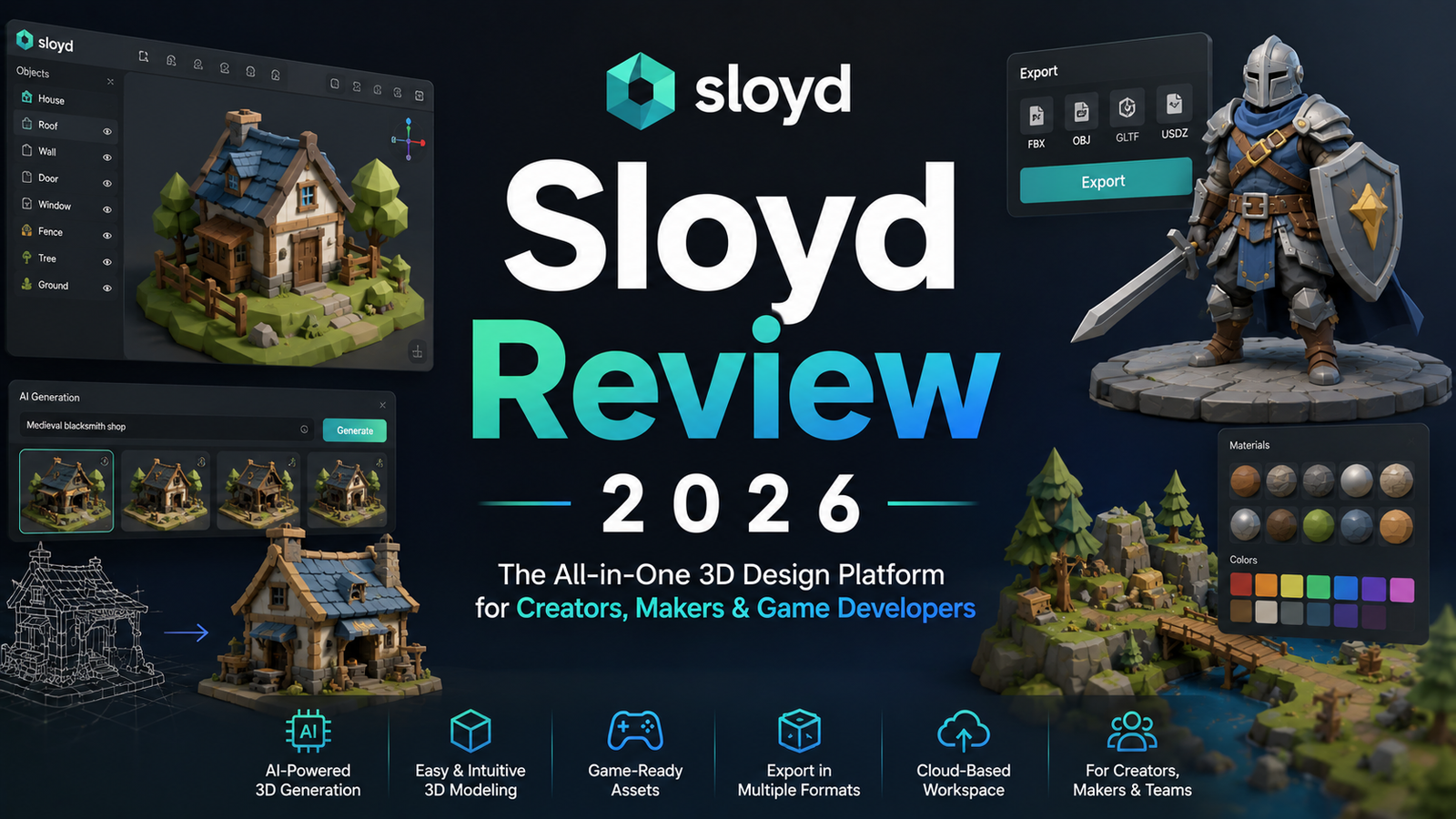
Sloyd is a browser-based AI 3D creation platform that combines generative AI with a parametric template editor. <cite index=”52-1″>It creates game-ready assets from text or images, lets you customize hundreds of parametric templates with sliders, and exports formats like GLB and FBX so teams can prototype props fast without full modeling.</cite>
The platform offers three creation paths. Text-to-3D generates a novel model from a description. Image-to-3D converts a reference image into a 3D starting point. The parametric template editor, which is Sloyd’s most distinctive capability, starts from handcrafted 3D structures covering categories like architecture, furniture, sci-fi props, nature assets, and vehicles, then exposes adjustment controls for shape, proportions, style, and level of detail through sliders and AI prompt assistance.
Sloyd 2.0 has been equipped with usability upgrades including render images, lighting and background controls, visual WACK widget, and quick palettes. These updates aim to make the creative flow more seamless.</cite> The key operational change in Sloyd 2.0 for paid subscribers: there will be no more credit limits on parametric generators, which means you can download as many assets as you want if you are on a paid plan.</cite>
Sloyd targets indie game developers who need fast prop generation for level design, technical artists who need predictable geometry without manual modeling, and prototypers who want to explore many design variations before committing to a final asset direction.
Key Features
Parametric template library with slider-based customization. <cite index=”53-1″>Start from handcrafted, parametric 3D templates and customize using simple controls or AI assistance. The best option when you need predictable geometry, variations, or production-ready assets. Handcrafted templates designed for control and consistency. Adjust shapes, proportions, and details with sliders.</cite>
This parametric approach is the feature that produces the consistent user feedback that distinguishes Sloyd from diffusion-based generators: <cite index=”42-1″>No AI slop. Because of the use of templates, the structures created look good from the start and do not have odd slop around them.</cite> A building template generates buildings that look like buildings. A vehicle template generates vehicles with correct proportional relationships. The constraint is that the catalog defines what categories are available; if your game needs an asset type not in the library, you are working outside the parametric system.
Unlimited parametric generation on paid plans. <cite index=”42-1″>Wonderful product. I enjoy that it is not credit based so you can keep generating what you like as much as you want.</cite> For game developers who need to explore hundreds of variations of the same prop type before selecting the final design direction, unlimited iteration without credit anxiety is the most practically useful pricing feature in the AI 3D category. Diffusion-based competitors charge per generation attempt, which creates a budget management overhead that Sloyd’s paid plan eliminates for parametric generation.
Game-ready topology with automatic level of detail. Sloyd’s template-based approach produces structured geometry rather than the dense triangle mesh that diffusion-based generators often produce. <cite index=”43-1″>Sloyd works different from other 3D generators and uses better geometry than its competitors.</cite> Automatic level of detail controls allow targeting specific polygon budgets appropriate for different rendering contexts, from hero assets to distant background geometry, without manual retopology.
Text-to-3D and image-to-3D alongside parametric generation. Beyond the template system, Sloyd supports text-to-3D generation for novel object creation outside the template library. <cite index=”53-1″>Describe an object and generate a 3D model using AI. Ideal for fast ideation, exploring variations, and creating unique objects you can refine further.</cite> Image-to-3D converts a photo, sketch, or reference image into a textured model based on the source’s shape and proportions.
Engine-direct export with Unity, Unreal, and Blender plugins. <cite index=”53-1″>Use our plugins to easily generate 3D assets in the webapp and send them to Unity, Unreal, Blender, or other apps with just a single click.</cite> GLB, FBX, OBJ, and STL export formats cover the major game engine and DCC tool pipelines. The single-click engine send reduces the export-import friction that adds overhead to high-volume asset production workflows.
API and SDK for automated pipeline integration. The Pro plan provides API and SDK access for programmatically integrating Sloyd’s generation into automated development pipelines. For studios that want to trigger asset generation from a build pipeline or connect Sloyd to other tools in their workflow, the API enables that integration without requiring the webapp for each generation.
Pros and Cons
Pros:
- <cite index=”54-1″>Template-based workflow is perfect for standard asset types. Unlimited generation. Iterate endlessly before exporting. Parametric control. Fine-tune shape, style, and polycount. Game-specific optimizations. Automatic LODs. Fixed monthly cost. Predictable $15 per month rather than per-credit billing.</cite>
- Unlimited parametric generation on paid plans eliminates the credit management overhead that affects high-volume prop production on diffusion-based platforms
- Consistent, predictable geometry from templates without the unpredictability of diffusion-based generation; reliable for the categories the library covers
- Growing template library across architecture, furniture, sci-fi props, nature assets, and vehicles with Sloyd 2.0 improvements
- Single-click engine export to Unity, Unreal, and Blender reduces workflow friction on high-volume production
- Plus plan at $11 per month annually is the most affordable unlimited-generation 3D tool in this comparison
Cons:
- <cite index=”43-1″>While Sloyd offers a growing library, it still lacks variety in niche or highly specialized models</cite>; if the required asset category is not in the template library, the parametric approach is unavailable and text-to-3D must cover the gap
- Complex characters with anatomical accuracy for 3D-printed miniatures or game hero characters are documented as weak: <cite index=”44-1″>the models lacked the level of detail and anatomical accuracy I needed, especially for 3D-printed miniatures. The results were low quality despite multiple prompt adjustments, and key features like faces, hands, and clothing were poorly defined</cite>
- <cite index=”43-1″>Texturing of objects generated from images can be a bit rough around the edges still, giving strange results at times</cite>
- Commercial 3D printing rights are not included by default and require license verification before commercial print use; marketplace resale rights are also restricted on standard plans
- Text-to-3D quality outside the template library is less consistent than the parametric generation, and the product is strongest when used within the template framework
- <cite index=”43-1″>Some edit features that are missing: smoothing surface, hollowing mesh Boolean, not being able to re-generate the same image you created without having to type the same info in again</cite>
Pricing Breakdown
<cite index=”42-1″>As of April 28, 2026, Sloyd’s pricing page lists a free Starter plan, Plus pricing at $11 per month per user billed yearly or $15 per month billed monthly, Pro at $50 per month per user, and custom Studio and Enterprise options.</cite>
Starter: $0. 30 export credits, access to the generate library, themed materials, AI prompt creation, and editing. <cite index=”41-1″>Free plan with access to templates and limited exports.</cite> Sufficient for evaluating the generation quality and template library coverage before payment commitment.
Plus: $11/month (annual) or $15/month (monthly). Everything in Starter plus 200 paid credits per month and monthly credit rollover. On parametric generators specifically, unlimited downloads on paid plans as per the Sloyd 2.0 update. This is the plan where Sloyd’s unlimited iteration advantage manifests: generate as many parametric variations as needed without tracking credit consumption. The 25% annual discount makes Plus $11 per month annually, the most affordable unlimited-generation 3D platform in the AI tools landscape.
Pro: $50/month/user. Everything in Plus plus API and SDK access, private generators, game engine plugin, and priority support. For studios integrating Sloyd into automated development pipelines or requiring private generation capacity for IP protection.
Studio and Enterprise: Custom pricing. Custom credits, additional seats, dedicated support, and tailored features. Contact Sloyd for current rates.
License caveats that belong in the pricing section: <cite index=”42-1″>Commercial use for art, games, and animation is covered, but redistribution, marketplace resale, commercial 3D printing, and AI-training rights have separate restrictions and should be checked against the current license before publishing or reselling assets.</cite> For game developers who create assets in Sloyd and deploy them in games sold commercially, standard commercial use is covered on paid plans. For developers who want to sell the assets themselves on the Unity Asset Store or Fab, redistribution rights need specific verification.
How It Compares to Tripo AI and Meshy AI
See our full Tripo AI Review 2026 and Meshy AI Review 2026 for complete breakdowns.
The most useful framing comes from an independent comparison: <cite index=”54-1″>Sloyd’s template-based workflow is perfect for standard asset types and urban/architectural assets. Only need 3D generation without image and video AI tools. Fixed monthly cost. Predictable $15 per month for 200 exports.</cite> Tripo AI and Meshy AI win on unique custom assets not limited to templates, image-to-3D from concept art, and versatile workflows for describing anything from arbitrary text prompts.
Sloyd vs Tripo AI
Tripo’s Smart Mesh P1.0 generates structured quad topology from any text prompt in approximately 10 seconds with 300 free monthly credits. For game developers who need to generate assets from arbitrary descriptions and do not know in advance what the template library contains, Tripo’s open-ended generation is more flexible. For game developers building a city environment who need 200 variations of buildings, street furniture, and props, Sloyd’s parametric building templates let you generate unlimited variations at $11 to $15 per month without credit management.
The decision rule: use Tripo AI when the asset type is unknown or arbitrary and the prompt could describe anything. Use Sloyd when the asset category is a standard prop type that the template library covers, and unlimited variation generation without credit overhead is more important than creative freeform range.
Sloyd vs Meshy AI
No 3D background? Start with Meshy.ai. Text-to-3D requires nothing beyond a clear description. If you have a 3D artist on staff, Sloyd’s parametric approach will give them more precise, controllable output.</cite> Meshy AI covers the complete pipeline including auto-rigging and 500-plus animation presets that Sloyd does not offer. For animated characters specifically, Meshy is the more complete platform.
Sloyd’s advantage over Meshy on the specific use case it was designed for: unlimited parametric generation at a lower monthly cost with more predictable geometry for high-volume standard prop production. For building and populating a game level with 50 to 200 consistent prop variations, Sloyd’s parametric control produces more reliable batch quality than Meshy’s diffusion-based generation at equivalent prompt specificity.
Frequently Asked Questions
Who specifically benefits most from Sloyd’s parametric approach, and who should use a diffusion-based generator instead?
<cite index=”52-1″>Sloyd fits best for indie studios, developers, and designers who need many variations fast, and for teams that want a repeatable way to generate and customize assets, export to common formats, and then finish materials, topology checks, and optimization in their normal DCC or engine pipeline.</cite> The most documented successful use case is level design prototyping with environmental props: buildings, furniture, vehicles, and architectural details where the template library covers the asset category and consistent geometry matters more than unique creative output. <cite index=”52-1″>Sloyd is strongest for rapid drafts and consistent variations via templates, while manual modeling remains better for hero assets and complex topology control. Many teams use Sloyd for bases, then refine in standard 3D tools.</cite> For assets outside the template library, particularly complex organic characters, unique creature designs, and fantastical objects without precedent in the library, diffusion-based generators like Tripo and Meshy provide the creative range that parametric templates cannot.
Does Sloyd’s unlimited generation on paid plans apply to all generation modes?
The unlimited export claim applies specifically to parametric generator use on paid plans as per the Sloyd 2.0 update. Text-to-3D and image-to-3D generations operate under a different credit model, with the 200 monthly credits on the Plus plan covering those generation modes. For users whose workflow is primarily parametric template customization, the Plus plan provides unlimited volume at $11 per month annually. For users whose primary workflow is text-to-3D or image-to-3D rather than parametric, the 200 monthly credits on Plus apply and the unlimited-generation framing does not cover those workflows. Verify the current credit costs for each generation mode on the Sloyd pricing page before modeling your monthly workflow against the Plus plan.
Can I use Sloyd assets in commercial games and sell those games without additional licensing?
Standard commercial use for games, art, and animation is covered on paid Sloyd plans. A game developer who generates assets in Sloyd and deploys them in a commercial game sold on Steam, the App Store, or other platforms is within the standard commercial use terms. The restrictions that require separate verification are redistribution and resale: selling the Sloyd-generated assets themselves on the Unity Asset Store, Fab, or other marketplace platforms falls under redistribution rights that are restricted by default on standard plans. Commercial 3D printing rights are similarly restricted by default. For any use case beyond direct deployment in your own game, read the current Sloyd license terms at sloyd.ai before distribution.
Final Verdict
Sloyd in 2026 earns a specific and genuine recommendation for the use case it was designed for: game developers who need high-volume, consistent, parametrically-controlled prop generation at unlimited export volume without per-credit billing anxiety. The Plus plan at $11 per month annually is the most affordable unlimited-generation 3D platform in the category, and the template-based geometry that produces clean, consistent results without the “AI slop” that Capterra and G2 reviewers describe in other platforms is a genuine quality advantage for the asset categories the library covers.
The honest limitation that belongs in the same sentence: Sloyd’s creative range is defined by its template library. <cite index=”54-1″>Unique custom assets are not template-limited in freeform generators; image-to-3D can convert concept art to models; and versatile workflows allow describing anything.</cite> For those capabilities, Tripo AI and Meshy AI cover the freeform generation range that Sloyd’s template system cannot match. For complex organic characters with anatomical accuracy, documented user feedback is clear that Sloyd falls short of what dedicated diffusion-based generators deliver.
The practical recommendation: use Sloyd for the high-volume standard prop categories where its template library is well-represented, and use Tripo AI or Meshy AI for the freeform generation and animated character workflows that require more creative range than parametric templates provide.
Rating: 4.1 / 5 — Best parametric 3D generator for consistent game-ready prop production at unlimited export volume. Template library scope limits freeform creative range.
Disclosure: This article contains affiliate links.