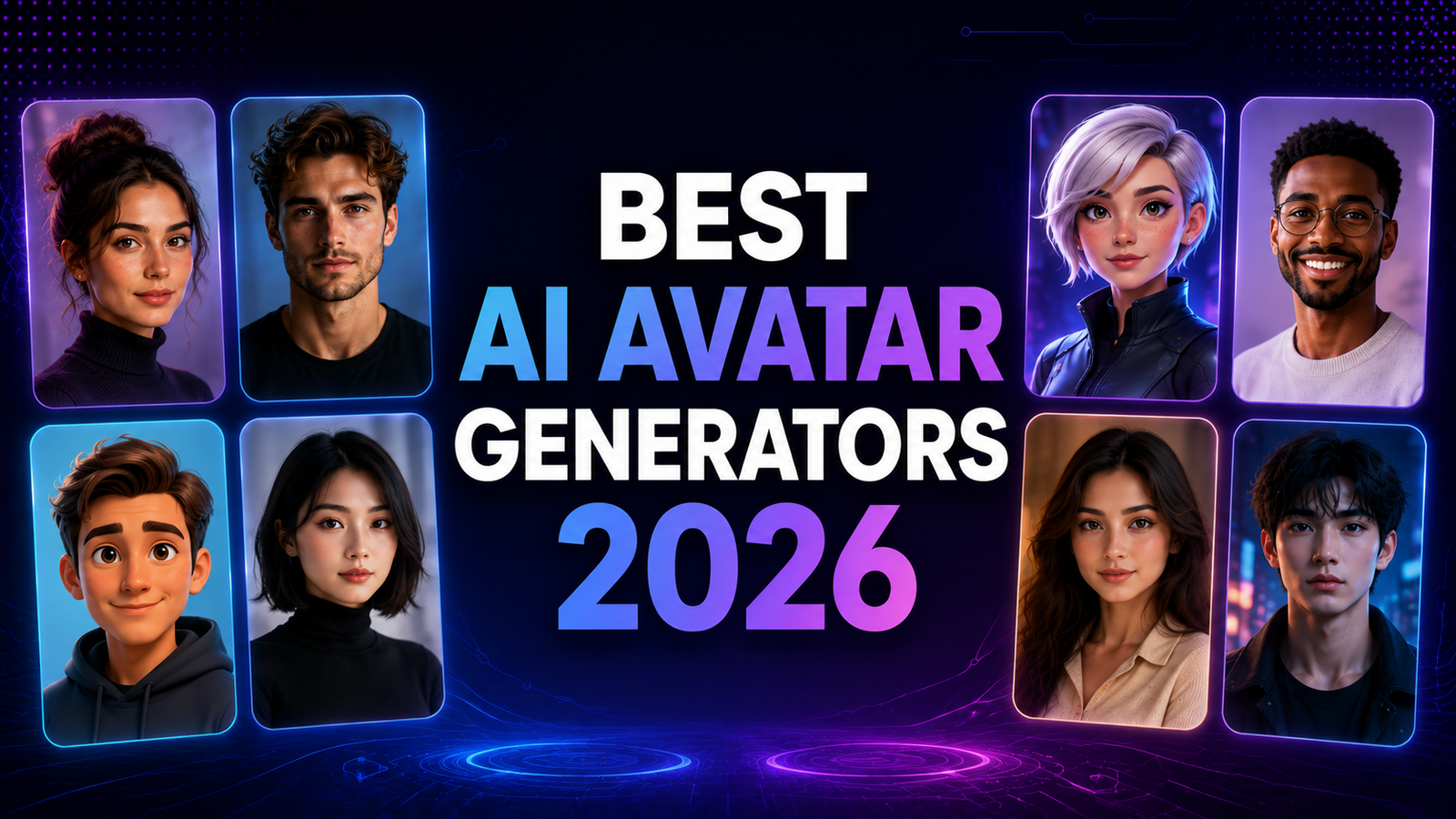
Best AI Avatar Generators 2026: Ranked and Tested
AI avatar generators have crossed a threshold in 2026. What started as a novelty for profile pictures has become production infrastructure. Marketing teams run UGC-style ad campaigns without filming. Corporate L&D teams produce multilingual training videos without actors. Creators publish daily video content without ever appearing on camera. And over 40 million professionals used AI-generated headshots on LinkedIn in 2025, a 300 percent increase from the year before.
The category has also split into genuinely different tool types. Some generate talking head videos with AI presenters. Some animate still photos into lip-synced video clips. Some create stylized portrait images from selfies. Some build full 3D interactive avatars for gaming and metaverse environments. These are not the same product. Choosing the right one means knowing which type of avatar you actually need.
This guide covers eight tools across the full avatar category spectrum, from enterprise video production to social profile generation, with clear use-case guidance on each.
Comparison Table: Best AI Avatar Generators 2026
| Tool | Best For | Starting Price | Free Trial |
|---|---|---|---|
| HeyGen | Talking head video production, multilingual lip-sync, and digital twin avatars | $24/month (Creator) | Limited free tier |
| Synthesia | Enterprise training videos at scale with 230-plus avatars and SCORM export | $18/month (Starter, annual) | No (demo) |
| Tavus | B2B sales outreach with personalized one-to-one AI video generation at scale | $39/month (Starter) | No |
| D-ID | Animating still photos into talking avatar videos with real-time conversational agents | $5.90/month | 14-day free trial |
| Canva AI | Light avatar and presentation creation inside an existing design workflow | Free / $15/month (Pro) | Yes |
| Ready Player Me | Cross-platform 3D gaming and metaverse avatars from a selfie | Free | Yes |
| Picsart AI | Stylized social profile avatars with integrated editing tools | Free / $7/month | Yes |
| Lensa AI | Artistic portrait packs from selfies for social media and profile images | Free (limited) / $7.99/month | Yes (limited) |
“Pricing is subject to change. Always verify current pricing on the tool’s official website before purchasing.”
Detailed Reviews
1. HeyGen
Best for creators and businesses producing talking head video content, multilingual distribution, and brand-consistent video at scale.
HeyGen is the benchmark platform for AI talking avatar videos. The Custom Avatar feature generates a photorealistic digital twin from a short video recording of the user, same face, same voice, same natural gestures, deployable across video content in over 300 languages with frame-accurate lip-sync. This is the feature that distinguishes HeyGen from every other tool on this list: you record yourself once, and HeyGen replicates you for any future video in any language.
The Video Translation feature is HeyGen‘s second major differentiator. Upload any video and HeyGen translates and re-voices it in target languages with lip-sync that matches the new audio. For content creators producing multilingual content without native speakers and for businesses localizing marketing materials, this workflow compresses what previously required professional translation and re-recording into a matter of minutes.
Key Features: Digital twin avatar creation from short video recording, 300-plus language video translation with lip-sync, Streaming Avatar API for real-time interactive deployments, 100-plus stock avatars for immediate use without custom recording, and ElevenLabs voice integration for premium voice quality.
Pros:
- Industry benchmark for talking avatar fidelity; competitors are measured against HeyGen‘s quality
- Video translation with lip-sync supports content localization that no other single tool matches
- Streaming Avatar API enables live, interactive avatar applications for customer support and events
- 300-plus language support covers nearly every global content distribution need
Cons:
- February 2026 credit transparency update: Avatar IV costs 20 credits per minute; users should budget accordingly before production
- Custom digital twin creation requires 2 to 5 minutes of clean video recording; suboptimal input produces suboptimal clones
- Creator plan at $24/month is functional but high-volume production requires higher tiers at significantly more cost
Pricing:
- Free: Limited credits, watermarked output
- Creator: $24/month (annual), 15 video credits/month
- Team and Enterprise: Higher tiers with expanded credits and custom avatars
2. Synthesia
Best for enterprise L&D teams, HR departments, and corporate communications needing scalable, multilingual training videos with SCORM export.
Synthesia is the enterprise standard for AI avatar video in corporate environments. The platform provides 230-plus diverse AI avatars, 140-plus language support, and a template library built specifically for training modules, onboarding videos, and internal communications. SCORM export connects Synthesia videos directly to LMS platforms without additional integration work, which is the feature that makes it the default choice for structured corporate training.
Where HeyGen leads on fidelity and multilingual lip-sync for external marketing, Synthesia leads on structured workflow, compliance-appropriate content controls, and the enterprise documentation that regulated industries require before deploying AI-generated content in employee communications.
Key Features: 230-plus diverse AI avatars covering multiple ethnicities, ages, and presentation styles, SCORM and xAPI export for LMS integration, 140-plus language voice support, custom avatar creation from video recording, branching scenario support for interactive training, and enterprise security and compliance documentation.
Pros:
- Enterprise gold standard for corporate training; most validated platform for structured L&D content
- SCORM export is the decisive feature for organizations whose training content lives in LMS platforms
- Content controls and compliance documentation satisfy regulated industry requirements
- 41 percent of Fortune 500 companies use Synthesia according to company data
Cons:
- Starter plan at $18/month caps at limited video minutes; meaningful production volume requires Creator at $64-plus/month
- Less suitable for highly personalized one-to-one video use cases where Tavus is purpose-built
- Avatar realism for external marketing campaigns can feel slightly formal compared to HeyGen
Pricing:
- Starter: $18/month (annual), limited minutes
- Creator: $64-89/month (annual), higher minutes, personal avatar
- Enterprise: Custom pricing
3. Tavus
Best for B2B sales teams that need personalized AI videos generated at scale for one-to-one prospect outreach.
Tavus solves a specific and high-value problem: personal video outreach does not scale. You can record one genuine video per prospect or send a generic video to everyone. Tavus creates a third option. Record one video once, and Tavus generates personalized versions for each recipient that mention their company, role, and specific challenges. Same avatar, customized script. Each prospect receives what appears to be an individually recorded video.
For B2B sales teams in high-ticket industries where a meaningful lift in response rates justifies the cost, Tavus delivers a workflow that no other tool on this list supports.
Key Features: Personalized video generation at scale using one base avatar recording, CRM integration for pulling prospect data into video scripts, replica API for embedding personalized video into sales workflows, and real-time conversational video agents for interactive customer experiences.
Pros:
- Purpose-built for one-to-one personalized outreach at scale; no tool does this more specifically
- CRM integration connects prospect data directly to video personalization without manual scripting
- Replica API enables building personalized video into proprietary sales tools and workflows
Cons:
- Starter pricing at $39 to $59/month and Growth plans at $300 to $600/month are the highest on this list for individual use cases
- ROI requires that personalization meaningfully lifts response rates; lower-ticket or mass market campaigns do not justify the cost
- Not suitable for general video production, training content, or social media where other tools are more cost-efficient
Pricing:
- Starter: $39-59/month
- Growth: $300-600/month for larger teams with CRM integration
- Enterprise: Custom pricing
4. D-ID
Best for animating existing still photos into talking avatar videos and for real-time conversational AI agent applications.
D-ID takes a fundamentally different approach from HeyGen and Synthesia: rather than creating avatars from scratch, it animates photos that already exist. Upload any portrait image, attach a script or audio file, and D-ID produces a talking head video where that person’s mouth and expressions move naturally to match the audio. This makes it uniquely accessible for use cases where a specific person’s likeness is already captured in a photograph.
The real-time conversational AI agents, released in 2025 and expanded in 2026, enable interactive digital human experiences that respond in real time to user input. For retail virtual assistants, interactive training characters, and live virtual spokespersons, this conversational layer extends D-ID beyond one-way video production.
Key Features: Still photo animation into talking avatar video with natural lip-sync, real-time conversational AI agents for interactive applications, multilingual video generation in 100-plus languages, API access for programmatic video generation workflows, and expressive AI trained on real human performances for natural emotion rendering.
Pros:
- Unique still photo animation capability; works with any portrait that does not need to be recorded
- Conversational AI agents support interactive use cases that pre-recorded video platforms cannot address
- Tiered plans starting at $5.90/month are the most affordable entry among professional talking avatar tools
- 14-day free trial allows genuine evaluation before payment
Cons:
- Animation quality from still photos can produce subtle uncanny valley effects for very expressive or complex speech
- Less suitable than HeyGen for high-fidelity custom digital twin creation where matching a real person’s gestures matters
- Credit system limits production volume at lower tiers
Pricing:
- Lite: $5.90/month (annual), basic video generation
- Pro: $16/month, expanded credits, API access
- Advanced and Enterprise: Custom pricing for higher volume
5. Canva AI
Best for designers, marketers, and non-technical users who want avatar and presenter functionality inside an existing Canva design workflow.
Canva AI is not a dedicated avatar platform. It is a design suite with AI avatar and video presentation features built in, making it the right choice for users who are already in Canva for their broader design work and want basic avatar functionality without adopting a separate tool.
The AI presenter feature generates talking-head style videos directly within Canva, using AI avatars as video narrators for presentations, explainers, and social content. For teams already paying for Canva Pro, this functionality is included in the subscription rather than requiring an additional avatar-specific subscription.
Key Features: AI presenter avatars for narrated video creation within Canva designs, Magic Studio AI image and content generation, Brand Kit for visual identity consistency across avatar-inclusive content, and direct export to video formats suitable for social media distribution.
Pros:
- Included in Canva Pro at $15/month; no additional subscription for basic avatar video functionality
- Easiest workflow for non-technical users already familiar with Canva’s design interface
- Covers basic avatar narration alongside all other Canva design work in one subscription
Cons:
- Avatar fidelity and customization significantly trail dedicated platforms like HeyGen and Synthesia.
- Not suitable for high-volume training video production or personalized sales outreach
- Avatar functionality is a secondary feature within a design tool, not the primary product
Pricing:
- Free: Core features, limited Magic Studio credits
- Pro: $15/month, full Magic Studio including AI presenter avatars
6. Ready Player Me
Best for game developers, metaverse builders, and gamers who need a cross-platform 3D avatar from a selfie that works across hundreds of virtual environments.
Ready Player Me is the only tool on this list purpose-built for gaming and metaverse 3D avatars. Users take a selfie, and Ready Player Me generates a customizable 3D avatar that works across 10,000-plus apps and games without needing to recreate the avatar for each platform. For developers building avatar-enabled applications, the SDK provides cross-platform avatar infrastructure without building character creation systems from scratch.
Key Features: 3D avatar generation from a selfie, cross-platform compatibility with 10,000-plus apps and games, full body avatar with outfit and accessory customization, free SDK for developers integrating cross-platform avatars into their applications, and browser-based avatar creation without app installation.
Pros:
- Completely free for individual users with no paid tier required for personal use
- Cross-platform compatibility is unique; create once, use everywhere across the ecosystem
- Developer SDK is the fastest path to embedding avatar systems in new applications
- Gaming and metaverse use case coverage that video-focused tools cannot address
Cons:
- Stylized 3D aesthetic is not appropriate for professional video production or business communications
- Does not produce talking head videos, animated video content, or photo-realistic portrait images
- Less visual realism than photographic or AI-generated portrait tools for professional appearances
Pricing:
- Free: Full avatar creation, cross-platform access
- Developer SDK: Free tier available; enterprise licensing for high-volume applications
7. Picsart AI
Best for social media creators who want stylized avatar packs from selfies integrated with a broader creative editing suite.
Picsart is a well-established mobile editing app whose AI avatar generator is integrated into its broader creative ecosystem. Generate a stylized avatar pack from uploaded selfies and immediately use those images across Picsart’s templates, filters, and editing tools. The integration is the key advantage: creators who already use Picsart for social content production can generate avatars and immediately apply them to posts, stories, and profile updates without switching applications.
Key Features: AI avatar pack generation from selfie uploads with 20-plus style options, integration with Picsart’s broader editing and template library, AI image generation tools alongside avatar creation, mobile-first iOS and Android apps with web access, and free tier with credits for evaluation.
Pros:
- Integrated creative suite means avatar images are immediately usable in broader content production within the same app
- Free tier allows evaluation; paid plans starting at $7/month are accessible for individual creators
- Style variety across 20-plus AI avatar types suits diverse creative social content needs
Cons:
- Avatar quality is optimized for social media rather than professional headshots or business use
- Less customization control than dedicated portrait AI tools for specific output requirements
- Credit-based system limits generation volume at lower tiers
Pricing:
- Free: Limited credits for avatar generation
- Plus: $7/month (annual), expanded credits and editing features
8. Lensa AI
Best for individuals who want artistic, stylized portrait packs from selfies for social media profiles and creative personal branding.
Lensa AI, developed by Prisma Labs, is the mobile-first app that brought AI avatars into mainstream awareness with its viral Magic Avatars feature. Users upload 10 to 20 selfies and Lensa generates dozens of stylized portraits across themes including cosmic, fantasy, anime, cyberpunk, and painterly styles. The output is artistic and visually distinctive, designed for social media engagement rather than photorealistic professional representation.
Lensa does not generate talking head videos, 3D avatars, or business-appropriate realistic headshots. It is a portrait art generator that applies AI style transformation to photos of the user. This is a specific, narrow use case that it executes better than most competitors.
Key Features: Magic Avatars generating dozens of stylized portraits from 10 to 20 selfies, 20-plus artistic style themes from anime to cosmic to portrait painting, one-time in-app pack purchases for individual avatar sets, subscription plan for ongoing photo editing tools, and mobile-first iOS and Android apps with no desktop requirement.
Pros:
- Best artistic range of any avatar tool on this list; style variety is the platform’s primary strength
- Completely mobile-native workflow from capture to download
- One-time pack purchase model suits users who want occasional avatar creation without a subscription
- Results are consistently more visually distinctive than the generic outputs from mass-market avatar tools
Cons:
- Artistic style does not serve professional headshot, business, or corporate communication use cases
- Data privacy criticism: Lensa has faced scrutiny over its privacy policy regarding image data storage and training
- Pricing for avatar packs varies dynamically by platform and region; costs can be higher than expected
- No control over specific output; results require generating multiple packs to find preferred images
Pricing:
- Magic Avatar packs: Variable, typically $3.99 to $9.99 per pack depending on platform and region
- Subscription: $7.99/month or $29.99/year for broader photo editing features
- Limited free editing features
Frequently Asked Questions
What is the difference between an AI talking avatar and an AI portrait avatar?
These are genuinely different products that get grouped under the same label. Talking avatars generate video content: a digital person speaks, with synchronized lip movement, natural gestures, and AI-generated voice. HeyGen, Synthesia, Tavus, and D-ID all produce talking avatars. Portrait avatars generate static images: stylized or photorealistic versions of a person’s face that work as profile pictures, social media content, or visual identity. Lensa, Picsart, and similar tools produce portrait avatars. Ready Player Me occupies a third category: interactive 3D avatars for gaming and metaverse environments. Many buyers research avatar generators looking for one type and receive another. Match the tool to the output format you need before evaluating any specific platform.
Which AI avatar tool is best for creating a digital clone of myself for video content?
HeyGen‘s Custom Avatar feature is the strongest consumer-accessible digital twin tool for talking head video as of 2026, producing the most natural replica of a real person’s face, voice, and gestures from a short recording. The recording quality is the critical input variable: a well-lit, quiet environment with consistent framing produces a clone that holds up across extended video content. Synthesia’s personal avatar feature covers the same use case with slightly less fidelity but stronger enterprise workflow integration for organizations producing structured training content. For sales personalization at one-to-one scale, Tavus is the purpose-built option. For a free digital twin test of animated portrait video rather than full digital clone, D-ID’s 14-day trial is the lowest-barrier starting point.
Are AI-generated avatars appropriate for professional use in 2026?
For most professional contexts, yes, with transparency. AI-generated talking head videos are used by Fortune 500 companies for internal training, customer service, and marketing, and the quality has reached a threshold where viewers often do not distinguish them from filmed content. HeyGen explicitly reports that 41 percent of Fortune 500 companies use Synthesia for corporate video. The important professional consideration is disclosure: some platforms, audiences, and use cases have expectations or regulatory requirements about disclosing AI-generated content. Content Credentials and similar provenance documentation tools are available on some platforms. For individual professional headshots, the AI-generated portrait market has normalized significantly, with over 40 million professionals using AI headshots on LinkedIn in 2025.
Final Recommendation
The right avatar generator in 2026 depends entirely on what you need the avatar to do.
For the highest-fidelity talking avatar video production, multilingual content distribution, and digital twin creation, HeyGen is the benchmark platform. For enterprise training and corporate L&D with SCORM export and LMS integration, Synthesia is the established enterprise standard.
For B2B sales teams where personalized one-to-one video outreach justifies the premium cost, Tavus has no direct equivalent. For animating existing photos into talking clips at the lowest entry cost, D-ID’s 14-day free trial and $5.90 starting price make it the most accessible professional talking avatar tool.
For designers who want avatar video inside an existing workflow without a new subscription, Canva AI covers basic needs as part of the Pro plan. For gaming and metaverse 3D avatars that work across thousands of applications for free, Ready Player Me is the only reasonable choice. For stylized social portrait packs, Picsart integrates generation into a broader creative workflow, and Lensa delivers the most artistically distinctive outputs for personal branding.
For most individual creators, the decision is simple: if you need talking video, start with HeyGen. If you need a stylized portrait, start with Lensa or Picsart. If you need a 3D gaming avatar, Ready Player Me is free.