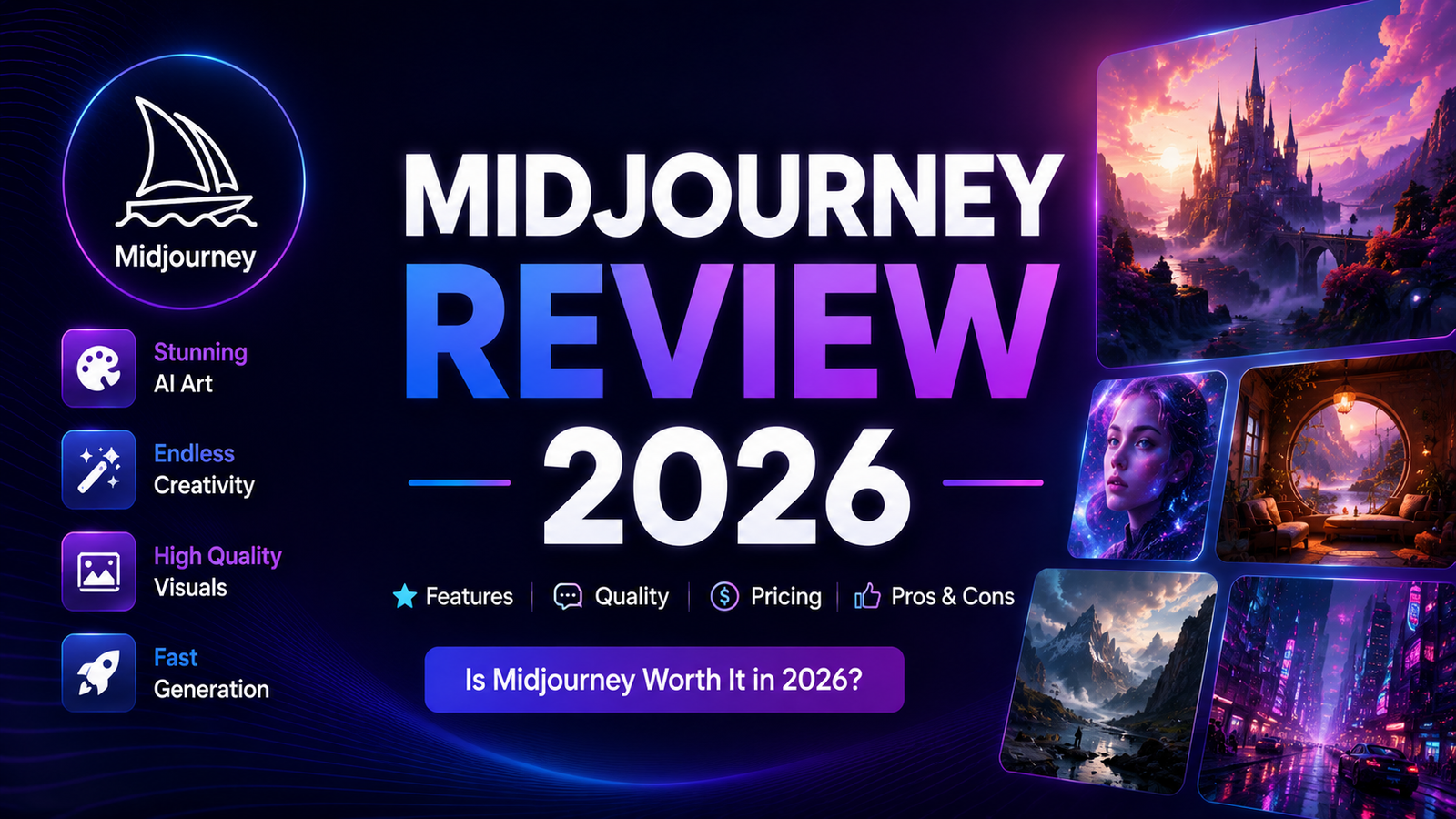
Midjourney Review 2026: Still the Gold Standard for AI Image Quality?
Midjourney launched in 2022 as a Discord bot that surprised people. By 2026 it has become a full web application, a growing video pipeline, and the benchmark every other AI image generator is measured against for artistic quality. The question in 2026 is not whether Midjourney makes impressive images. It does, and it has for years. The question is whether its premium pricing, closed ecosystem, and zero free tier are still justified when competition has tightened significantly.
After testing across the Basic, Standard, and Pro plans, including the V8.1 model released April 30, 2026, here is the honest verdict.
Plan Comparison Table
| Plan | Best For | Starting Price | Free Trial |
|---|---|---|---|
| Basic | Individuals testing Midjourney or occasional creative projects | $10/month ($8/month annual) | No |
| Standard | Active creators who want unlimited Relax Mode generation | $30/month ($24/month annual) | No |
| Pro | Professional creators who need Stealth Mode and higher Fast GPU hours | $60/month ($48/month annual) | No |
| Mega | Studios and agencies requiring maximum volume and priority generation | $120/month ($96/month annual) | No |
“Pricing is subject to change. Always verify current pricing on the tool’s official website before purchasing.”
What Midjourney Is
Midjourney is a subscription-based AI image generator that converts text prompts into visual art. It was built from the start with a specific aesthetic philosophy: cinematic lighting, rich textures, professional composition, and the kind of photographic or painterly quality that makes images look considered rather than generated.
The platform runs at midjourney.com as a full web application. Discord access is still available but the web app is now the primary interface and supports the full feature set. Midjourney does not have a public API, which means it cannot be integrated programmatically into external applications or workflows.
The current model lineup as of May 2026:
- V8.1 (released April 30, 2026): The latest and fastest model, rendering standard jobs 4 to 5 times faster than earlier versions. HD mode is now the default, generating native 2K (2048×2048) images without a separate upscale step. V8.1 requires unlocking a Global V7/V8 Personalization Profile.
- V8.0 Alpha (launched March 17, 2026): The initial V8 release on the rewritten codebase. 5x faster generation, native 2K via –hd, improved text rendering, –q 4 quality mode. Premium features (–hd, –q 4, style references) cost 4x more GPU time than standard jobs.
- V7 (default stable model): Released April 2025, became the default June 2025. Introduced Omni Reference for character and style consistency, Draft Mode for rapid iteration at half the GPU cost, and noticeably improved coherence for details like hands, eyes, and reflections.
- Niji 7 (January 2026): The specialized anime and illustration model with improved coherency and sharper line work.
Key Features
V8.1 speed and HD quality. The April 30 V8.1 release made HD mode practical for daily use, not just occasional high-stakes outputs. Standard jobs render at 4 to 5 times the speed of earlier Midjourney versions. HD generation costs 1.33 GPU minutes compared to under 1 minute for standard, which means the quality premium is now modest rather than expensive. A new “Run as HD” button re-renders any standard image at higher resolution without retyping the prompt.
Omni Reference for character consistency. Introduced in V7 and carried into V8, Omni Reference allows uploading a reference image and generating new images that maintain the same character, object, or visual element across multiple generations. For commercial work, brand content, and narrative projects where a consistent subject needs to appear across multiple scenes, this is Midjourney’s most practically significant professional feature.
Style References and Personalization Profiles. Midjourney’s personalization system learns aesthetic preferences over time from image ratings, generating outputs that increasingly match the user’s taste without requiring extensive prompt engineering. Style reference codes allow applying the exact aesthetic of a specific generated image to new prompts. Both features are backward compatible from V7 to V8.
Draft Mode for rapid iteration. V7’s Draft Mode generates images at half the GPU cost of standard quality, enabling faster and cheaper ideation sessions before committing to full-quality renders. For professionals who generate dozens of concept variations before selecting a direction, Draft Mode meaningfully extends the practical output per subscription tier.
Video generation. The V1 Video model animates a generated or uploaded still image into 4 clips of 5 seconds each at 480p/24fps. Video can be extended up to 21 seconds. Pro and Mega tiers include unlimited Relax Mode video generations. For longer, audio-driven, or multi-shot video workflows, Midjourney’s video capability is a starting point rather than a complete solution; dedicated tools like Runway ML and Kling AI handle those workflows more completely.
Text rendering (V8 improvement). AI image generators have historically produced garbled, decorative text rather than readable typography. V8 made meaningful progress on this: when text is placed in quotes within the prompt, the model renders it with significantly improved legibility. It is not yet consistent enough for professional typography use, but it is a genuine improvement over V7 and puts Midjourney ahead of most competitors on this specific capability.
Pros and Cons
Pros:
- Strongest artistic quality and aesthetic output of any AI image generator in independent comparisons; cinematic lighting, rich textures, and compositional sophistication consistently lead the category
- V8.1 is the fastest Midjourney model yet, with standard jobs completing in under 10 seconds and HD mode now practical as a default workflow
- Omni Reference and Style Reference systems enable professional-grade character and aesthetic consistency across multiple generations
- Commercial use rights included on all paid plans; businesses with under $1 million in annual revenue can use all plans commercially
- V7 Personalization Profiles learn aesthetic preferences over time, gradually requiring less prompt engineering for consistent results
- Video generation included in the platform for still-to-video workflows without a separate subscription
- Stealth Mode on Pro and Mega keeps generations private; all lower plans default to public community visibility
Cons:
- No free trial of any kind; the lowest entry point is $10 per month, making pre-purchase evaluation impossible within the platform itself
- No public API; Midjourney cannot be integrated into third-party applications, workflows, or automated pipelines
- Premium V8 features including –hd, –q 4, and Style References cost 4x more GPU time than standard jobs, depleting Fast GPU hours significantly faster for quality-focused workflows
- Relax Mode is not yet available for V8; heavy users generating at high quality levels will exhaust Fast GPU allocations without the unlimited slow-mode fallback that V7 provides
- Public generation by default on Basic and Standard plans; Stealth Mode requires the $60/month Pro plan
- Community-dependent platform; Discord is still part of the experience for many features and users
Pricing Breakdown
Midjourney’s pricing is based on GPU time rather than image count. Each plan provides a monthly allocation of Fast GPU hours, with Standard and above adding Relax Mode for unlimited slower generation.
Basic: $10/month ($8/month annual). 3.3 Fast GPU hours per month. No Relax Mode; all generations use Fast Mode. Suitable for light creative use or evaluation. For V8 with premium features consuming 4x GPU time, 3.3 Fast hours depletes quickly in quality-focused sessions.
Standard: $30/month ($24/month annual). 15 Fast GPU hours plus unlimited Relax Mode generation for V7. The practical choice for most individual creators who want consistent daily use without managing GPU budget closely. Relax Mode for V8 is pending a new server cluster deployment.
Pro: $60/month ($48/month annual). 30 Fast GPU hours, unlimited Relax Mode, and Stealth Mode for private generation. The minimum appropriate plan for professional and commercial work where generation privacy is a requirement. Businesses with over $1 million in annual revenue must use Pro or Mega for commercial use.
Mega: $120/month ($96/month annual). 60 Fast GPU hours, unlimited Relax Mode, Stealth Mode, and higher concurrent generation priority. For studios, agencies, and teams with high-volume generation requirements.
Note on V8 GPU costs: Premium V8 features including –hd (HD mode), –q 4, and Style References with –sv 6 each consume 4x more GPU time than standard V8 jobs. Using –hd with –q 4 together costs 16x more GPU time. On a Basic plan with 3.3 Fast hours, this equates to roughly 12 to 15 premium-quality V8 images per month before the Fast allocation is exhausted.
How It Compares to DALL-E 3 and Adobe Firefly
Midjourney vs DALL-E 3
DALL-E 3 is being replaced by GPT Image 1.5 in May 2026, which changes the competitive picture somewhat. The longstanding comparison was that Midjourney produced superior artistic quality while DALL-E 3 handled text rendering in images more reliably. V8’s improved text rendering has narrowed that gap considerably.
The more relevant distinction in 2026 is ecosystem fit. DALL-E 3 and its GPT Image 1.5 successor are included in ChatGPT Plus at no additional cost, making them the default choice for users who already pay for ChatGPT. For purely artistic, editorial, and creative work where the aesthetic quality of the output is the primary success criterion, Midjourney still leads. GPT Image 1.5 is better for users who want deep ChatGPT integration, text-accurate image generation, and conversational editing without managing a separate subscription.
Midjourney vs Adobe Firefly
The comparison between Midjourney and Adobe Firefly resolves quickly on one key dimension: commercial rights and copyright indemnification. Firefly was trained exclusively on licensed Adobe Stock content and offers enterprise commercial indemnification that Midjourney cannot match on equivalent legal terms. For agency work, client deliverables, and any commercial application where IP clarity is a contractual requirement, Firefly is the only tool that provides documented legal protection.
Midjourney leads on artistic quality, aesthetic sophistication, and the breadth of creative styles achievable through its personalization and style reference systems. Firefly leads on legal defensibility, Creative Cloud integration, and Photoshop’s Generative Fill for editing existing images. They serve different professional profiles: Midjourney for creative-quality-first workflows, Firefly for legally protected commercial production.
Frequently Asked Questions
Is there any way to try Midjourney for free before subscribing?
No. Midjourney discontinued its free trial in 2023 and has not reinstated it. The only way to evaluate the product is through a paid subscription. The Basic plan at $10 per month is the lowest entry point. If pre-purchase evaluation is important, some third-party platforms and API aggregators offer access to Midjourney-quality models through their own free credits, though these do not use Midjourney’s actual infrastructure. The most practical evaluation path within the platform is starting with the Basic plan for one month, which is a lower financial commitment than most comparable creative software trials.
What happens to V7 now that V8 is available? Can I still use V7?
Yes. V7 remains available as the stable default model as of May 2026, and most plans can switch between V7 and V8.1 freely in the model selector. The two models serve different creative purposes: V8.1 is strongest for photorealistic product rendering, brand imagery, architectural visualization, and any work where prompt adherence and fine detail matter. V7 is still preferred by many professional users for moody concept art, atmospheric exploration, and workflows that rely on the aesthetic characteristics that V8 has not yet replicated. Midjourney’s own documentation acknowledges that V8 is an entirely new model with unique strengths and weaknesses that may require different prompting approaches. The practical advice from experienced users is to keep both in the workflow and switch based on the specific creative goal.
Does Midjourney’s commercial license actually cover professional agency work?
For most agencies, yes, with one important threshold. All paid Midjourney plans include commercial use rights for businesses generating under $1 million in annual gross revenue. Businesses above that threshold are required to use the Pro or Mega plan for commercial use. For agency work where the images are being produced for clients rather than the agency itself, the relevant revenue threshold applies to the agency, not the client. Midjourney’s terms specify that users generally own the assets they create, subject to the plan rules and revenue requirements. For enterprise-level clients or situations where formal IP indemnification is required by contract, Adobe Firefly remains the only major consumer AI image tool that offers explicit enterprise copyright protection. Midjourney’s commercial terms cover use rights but do not provide the same level of third-party copyright indemnification that Adobe explicitly offers for Firefly-generated content.
Final Verdict
Midjourney V8.1 is the best version of Midjourney ever shipped. Faster, sharper, better at following complex prompts, and with native 2K resolution now practical as a daily workflow rather than an occasional premium output. The cinematic quality that made Midjourney the creative industry benchmark has not diminished; it has accelerated.
The honest caveats are equally real. No free trial means the purchase decision is made on faith or borrowed screenshots rather than personal evaluation. No public API means Midjourney stays inside its own platform. The premium V8 features that produce the most impressive outputs cost 4x the GPU time of standard generations, which meaningfully constrains the practical monthly output on lower-tier plans. And the competition has genuinely tightened; GPT Image 1.5, Imagen 4, and Flux 2 are all capable alternatives that some workflows will favor for specific reasons.
For designers, concept artists, creative directors, photographers, and brand teams where the aesthetic quality and artistic sophistication of AI-generated imagery is the primary criterion, Midjourney remains the standard against which everything else is measured. At $30 per month for Standard with unlimited V7 Relax Mode, the value case is strong for consistent daily creative use.
For users who primarily need image generation as a feature within a broader AI workflow, who require commercial copyright indemnification, or who need programmatic API access, Adobe Firefly and GPT Image 1.5 via DALL-E 3‘s successor are more appropriate fits.
Midjourney is not the only choice in 2026. It is still the best choice if artistic quality is the metric that matters most.
Rating: 4.5 / 5