
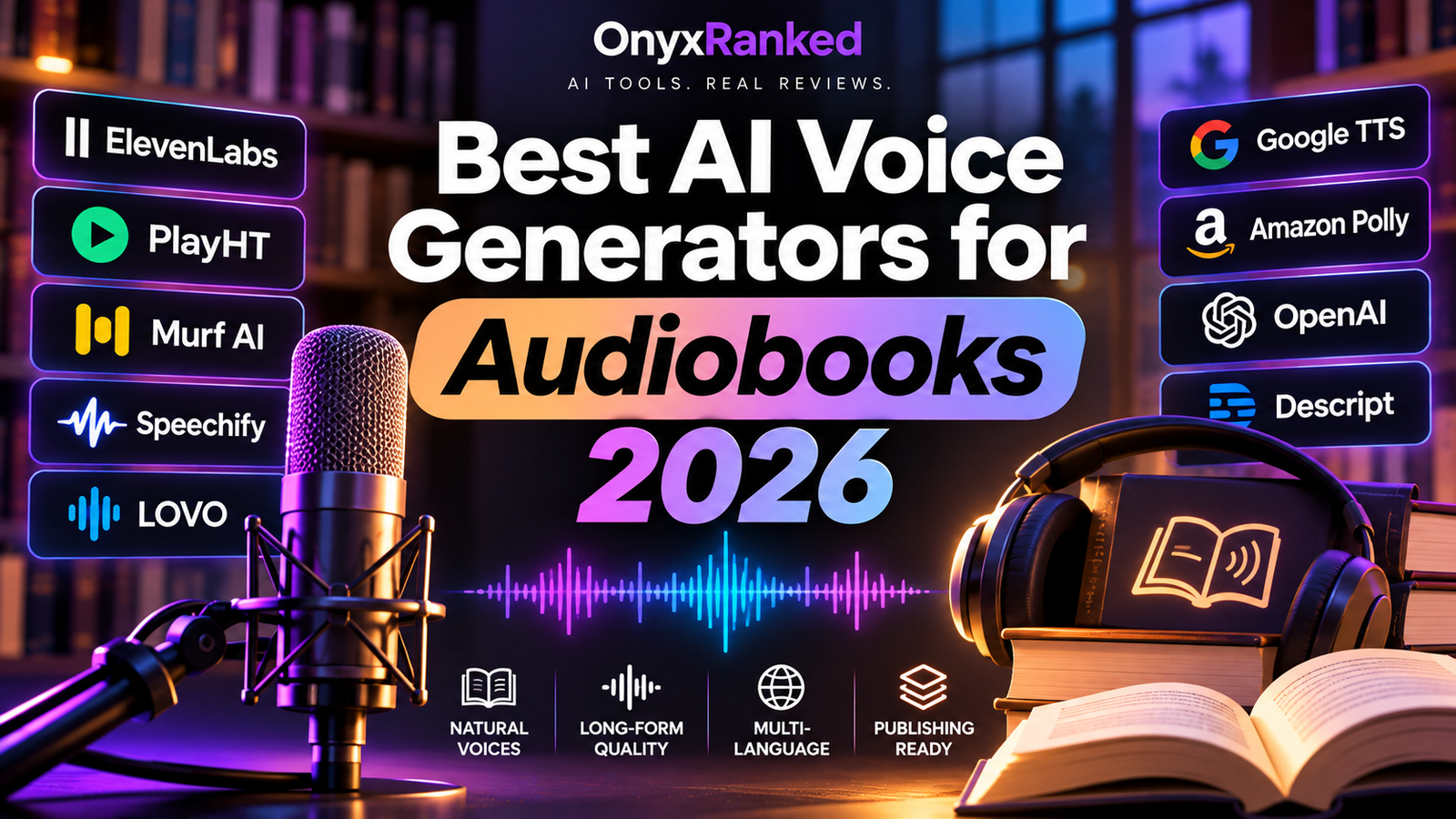
Best AI Voice Generators for Audiobooks 2026: Narrate a Book Without a Studio
Audiobooks are one of the fastest-growing corners of publishing, and self-published authors want in. The barrier has always been cost. A professionally narrated book can run well over a thousand dollars once you pay for a narrator, studio time, and editing. In 2026, AI narration has closed much of that gap. The best voices now handle long-form pacing, dialogue, and emotional shifts well enough that many listeners cannot tell the difference in a casual listen.
The catch is distribution. Platform rules around AI narration are still moving. ACX, the audiobook marketplace tied to Audible, requires human narration for standard submissions unless a title is specifically authorized, and it has run a limited beta for narrator voice replicas in the US. Amazon’s KDP Virtual Voice is a separate, invitation-style program where Amazon generates the narration itself. Other retailers and distributors, including Google Play Books, Kobo, and Spotify’s audiobook channels, have been more open to AI narration with disclosure, but their terms change often. Treat everything here as a starting point and check each platform’s current help pages before you publish.
With that in mind, here are the seven tools worth considering for turning a manuscript into audio.
Quick Comparison
| Tool | Best For | Starting Price | Free Plan |
|---|---|---|---|
| ElevenLabs | Most realistic long-form narration | $6/month | Yes |
| Murf AI | Polished voices with a studio editor | $19/month (annual) | Yes (limited) |
| Speechify | Affordable, fast narration for nonfiction | Around $24/month (annual) | Limited |
| Amazon KDP Virtual Voice | Authors publishing inside Amazon | Free to eligible authors | N/A |
| WellSaid Labs | Clean, professional business-style reads | Around $50/month (annual) | Trial only |
| Amazon Polly | Developers and bulk, low-cost generation | Pay per character | Free tier |
| Descript | Editing and cleaning finished audio | $16/month (annual) | Yes |
Pricing changes frequently. Always confirm current plans and limits on each provider’s official site before subscribing.
A Note on Play.ht and Lovo
If older roundups point you to Play.ht, skip them. Meta acquired Play.ht in 2025 and the service shut down at the end of that year. Lovo AI, another former go-to for narration, has also reportedly gone dark amid a bankruptcy filing. Neither is a safe place to build an audiobook workflow, so neither is reviewed here. It is a good reminder to keep your finished audio files and source text stored locally rather than only inside a vendor’s account.
1. ElevenLabs: Best Overall for Realistic Long-Form Narration
ElevenLabs is the benchmark for AI voice realism in 2026, and it is the tool most audiobook authors reach for first. Its voices carry natural breathing, pacing, and emphasis across long passages, and its character voices hold up in dialogue-heavy fiction. Our full ElevenLabs Review 2026 covers it in depth.
Key features:
- Highly expressive voices with strong long-form consistency
- A large library of narrator-style voices plus voice design tools
- Instant and professional voice cloning, so you can narrate in your own voice
- A dedicated long-form projects workspace that splits a manuscript into chapters
- Pronunciation controls for names, places, and invented words
Pros:
- The most human-sounding output of any tool on this list
- Chapter-level workflow fits how audiobooks are actually built
- Commercial license on paid plans
Cons:
- Credits burn quickly on a full-length book, so budget for a higher tier
- Re-generating lines to fix pacing takes patience
Pricing: Free plan available. Starter is $6 per month ($5 billed annually), with Creator around $22 per month and higher tiers above that. A full novel usually needs Creator or higher.
Best for: Fiction and nonfiction authors who want the most convincing narration and are willing to polish the result.
2. Murf AI: Best for Polished Voices With a Studio Editor
Murf AI is built around a studio-style editor where you can adjust pitch, speed, and emphasis line by line. That makes it a strong fit for nonfiction, business books, and educational titles where a steady, professional tone matters more than dramatic range. See our Murf AI Review 2026 for the full breakdown.
Key features:
- Large catalog of studio-quality voices across accents and languages
- Per-sentence control over pitch, pace, and pauses
- Voice changer and cloning options on higher plans
- Collaboration tools for review and approvals
Pros:
- Easy editor that rewards small tweaks
- Consistent, clean tone for long informational reads
- Generous voice variety
Cons:
- Less emotional range than ElevenLabs for fiction
- Hour caps on plans can limit very long books
Pricing: Creator is about $19 per month on annual billing with roughly 24 hours of voice generation per year. Business is about $66 per month annually with around 96 hours.
Best for: Nonfiction authors and educators who want a controllable, professional sound.
3. Speechify: Best for Affordable, Fast Nonfiction Narration
Speechify started as a text-to-speech reader and has grown into a capable voice studio. Its newer voice models sound smoother than they used to, and the price is friendly for authors producing several titles. Read our Speechify Review 2026 for more.
Key features:
- Natural-sounding voices in many languages
- Voice cloning and a simple studio for longer projects
- Fast generation, handy for drafting and proofing by ear
- Apps across web and mobile
Pros:
- Budget-friendly annual pricing
- Great for proofreading your manuscript by listening
- Quick turnaround
Cons:
- Less fine control than Murf or ElevenLabs
- Fiction character work is a step below the leaders
Pricing: Studio plans run roughly $288 to $456 per year depending on tier, with a limited free option.
Best for: Authors who want fast, affordable narration for nonfiction and for proofing.
4. Amazon KDP Virtual Voice: Best for Authors Publishing Inside Amazon
KDP Virtual Voice is Amazon’s own AI narration program for eligible KDP authors. You do not choose from a marketplace of third-party voices. Amazon generates the audio, and the title is sold through Audible and Amazon. Availability has been restricted, and reports indicate Amazon retains the audio files and royalty rates can be lower than a traditional route.
Key features:
- Amazon-generated narration with no upfront production cost
- Review and approval step before the audiobook goes live
- Distribution directly through Amazon’s storefronts
Pros:
- Zero production cost for eligible authors
- The simplest path to getting a book onto Audible
Cons:
- Limited availability and limited voice choice
- You do not keep the audio files, and royalties may be lower
- Exclusive to Amazon’s ecosystem
Pricing: No upfront cost for eligible authors, with revenue handled through Amazon’s royalty terms.
Best for: Authors who are already all in on Amazon and want audio with no budget.
5. WellSaid Labs: Best for Clean, Professional Reads
WellSaid Labs focuses on reliability and a polished business tone. Its voices are consistent and pleasant, which suits corporate, training, and how-to titles. It is less suited to expressive fiction.
Key features:
- Studio-grade voices designed for commercial use
- Pronunciation and respelling tools
- Team features and a clean, simple editor
Pros:
- Steady quality across long scripts
- Strong commercial licensing posture
Cons:
- Higher price than most alternatives
- Plan structure has shifted in 2026, so figures vary between sources
Pricing: Reported plans start around $50 per month on annual billing, with business tiers above that. Confirm current tiers on the official site.
Best for: Business and instructional audiobooks that need a dependable corporate sound.
6. Amazon Polly: Best for Developers and Bulk, Low-Cost Generation
Amazon Polly is a pay-as-you-go text-to-speech service from AWS. It is not a friendly authoring tool, but for technically minded authors it is by far the cheapest way to generate audio at scale.
Key features:
- Standard, Neural, Generative, and Long-Form voice engines
- Pay per character with no monthly commitment
- API access for automating chapter-by-chapter generation
Pros:
- Extremely low cost per book
- Flexible and scriptable
Cons:
- No editor, so you handle structure and assembly yourself
- Voices are less natural than ElevenLabs or Murf
Pricing: Roughly $4 per million characters for Standard, $16 for Neural, $30 for Generative, and $100 for Long-Form. An 80,000-word book is about 450,000 characters, so Neural costs around $8 and Long-Form around $48.
Best for: Developers and cost-focused authors comfortable with some setup.
7. Descript: Best for Editing and Cleaning Finished Audio
Descript is not a narrator by itself. It is the editor that makes narration better. You edit audio by editing a transcript, which makes fixing a mispronounced name or a clumsy pause fast. Our Descript Review 2026 goes deeper.
Key features:
- Transcript-based editing: delete a word and it disappears from the audio
- Studio Sound for cleaning up recordings
- Overdub style voice features for patching small mistakes
- Multi-track editing and export
Pros:
- Fastest way to fix individual lines
- Useful for hybrid projects where you record some parts yourself
Cons:
- Not a standalone narrator for a full book
- Learning curve for multi-track projects
Pricing: Free plan with limited transcription. Hobbyist is about $16 per month, Creator about $24, and Business about $50 on annual billing.
Best for: Authors who want a clean final polish and easy line-level fixes.
Frequently Asked Questions
Will Audible, ACX, and other platforms accept AI-narrated audiobooks, and who owns the rights?
It depends on the platform. ACX’s current submission requirements call for human narration unless a title is specifically authorized, and Amazon offers its own Virtual Voice program separately. Google Play Books, Kobo, and several distributors have been more welcoming of AI narration with disclosure, but their rules change often. For rights, your tool’s license matters. Paid plans on tools like ElevenLabs and Murf include commercial use, while free plans often do not. Read each provider’s terms and each retailer’s current policy before you upload.
How much does it cost to narrate a book with AI?
An average audiobook hour is about 9,000 words, so an 80,000-word novel runs close to nine hours. With Amazon Polly that can cost under $50. With ElevenLabs or Murf, plan for a month or two of a mid-tier subscription, typically $20 to $100 total depending on how many regenerations you need. That compares with $1,000 or more for a human narrator and studio.
What is the best workflow for producing an audiobook with AI?
Clean your manuscript first and spell out tricky names with pronunciation controls. Generate one chapter at a time so you can fix problems without redoing the whole book. Listen to every chapter, patch mistakes in an editor like Descript, and normalize volume across chapters. Add the opening and closing credits your target platform requires, then export in the format the retailer asks for.
Final Recommendation: ElevenLabs Is the Top Pick
For most authors, ElevenLabs is the best AI voice generator for audiobooks in 2026. Its narration sounds the most natural over long stretches, its chapter workflow matches how books are built, and its paid plans include commercial rights. Pair it with Descript for line-level fixes and you have a studio-quality pipeline for a fraction of the traditional cost. Murf AI is a strong pick for nonfiction, Speechify wins on budget, and Amazon Polly is the cheapest route if you are comfortable with a little setup. If you want to explore the top choice further, read our ElevenLabs Review 2026, then try it yourself.
Disclosure: This article contains affiliate links.