HubSpot AI Review 2026: Is the Most Popular CRM Also the Best AI One?
HubSpot is used by over 205,000 companies in 120-plus countries. Its CRM is genuinely free. Its name recognition in the SMB and mid-market space is second to none. When HubSpot launches an AI suite, the question is not whether people will try it. The question is whether it actually delivers, or whether it uses the platform’s installed base as a distribution channel for features that do not hold up under scrutiny.
The honest answer in 2026 is: it depends on where you are starting from. If your team already lives in HubSpot and your CRM data is clean, Breeze AI adds meaningful productivity without requiring anyone to learn a new system. If you are not already a HubSpot customer and you are evaluating whether Breeze justifies adopting the platform, the economics are more complicated than the marketing suggests. And if you are an existing customer trying to figure out what Breeze actually costs, the credit system and per-hub seat requirements require more careful reading than HubSpot’s pricing page provides.
This review covers what Breeze AI actually does, what it actually costs, and whether the most popular CRM is also the best AI-powered one.
Plan Comparison Table
| Plan | Best For | Starting Price | Free Trial |
|---|---|---|---|
| Free CRM | Individuals and startups exploring HubSpot with basic Breeze features | $0 | Yes (permanent) |
| Starter | Small teams needing core email, deals, and basic Breeze AI access | $20/seat/month | Free CRM tier |
| Professional | Growing teams needing automation, sequences, and full Breeze AI Agents | $100/seat/month (Sales/Service) | No |
| Enterprise | Large organizations needing advanced AI controls and custom reporting | $130/seat/month (Sales/Service) | No |
“Pricing is subject to change. Always verify current pricing on the tool’s official website before purchasing.”
What HubSpot AI Is
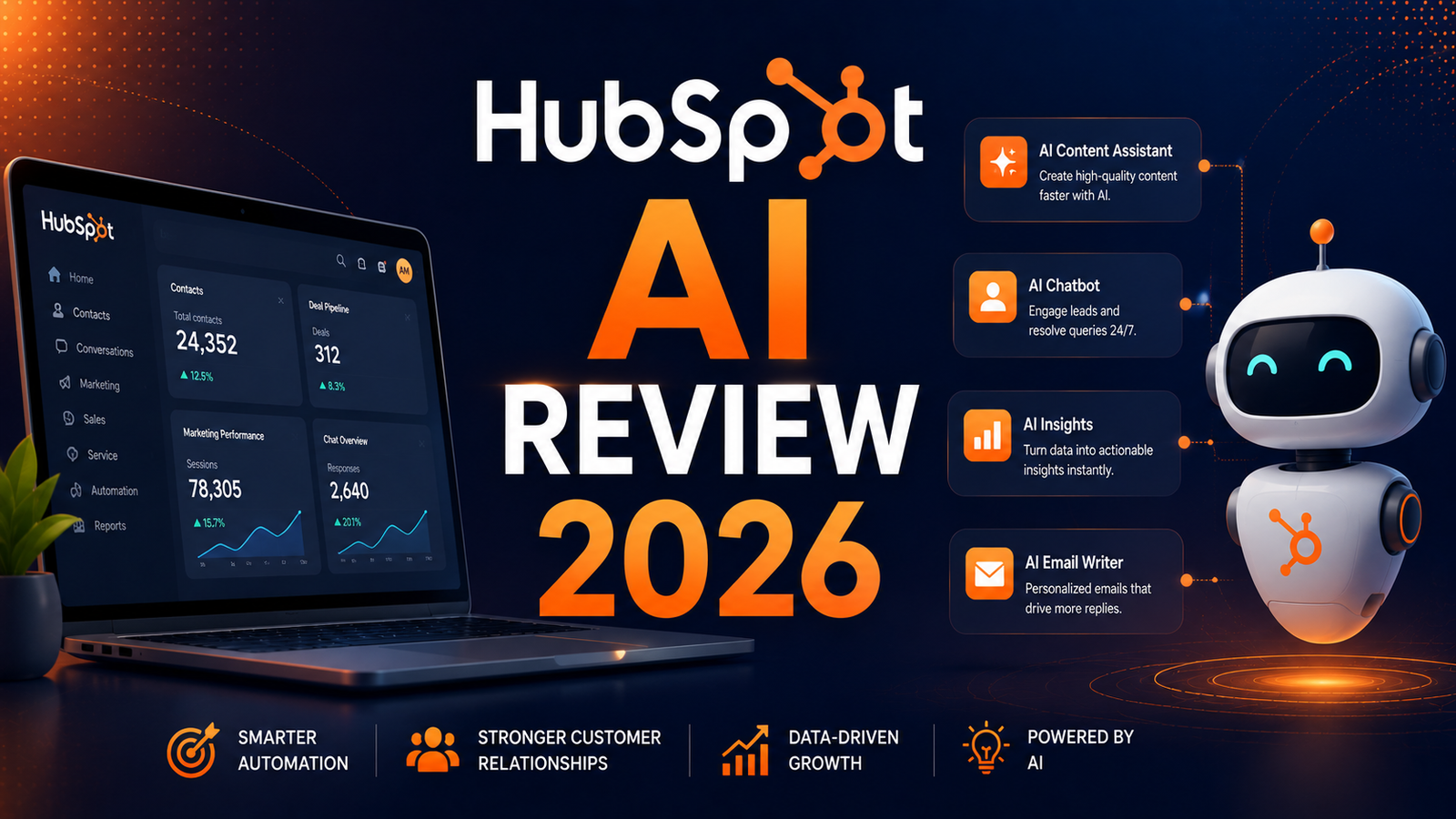
HubSpot Breeze is HubSpot’s unified AI suite, embedded across its Marketing Hub, Sales Hub, Service Hub, and CMS. Rather than functioning as a separate product, Breeze operates as an AI layer woven throughout the platform: drafting emails inside the inbox, enriching contact records in the CRM, automating customer service conversations, and running prospecting outreach without manual intervention.
The suite has four main components that address different workflow categories.
Breeze Copilot is the conversational AI assistant. It summarizes CRM records, drafts content, answers questions, and helps users prepare for meetings inside the HubSpot interface. Studio agents in 2026 have been upgraded to default to GPT-5, up from GPT-4.1, and HubSpot introduced Audit Cards, timestamped records of every AI action for accountability.
Breeze Agents are the autonomous AI workers. Four specialized agents handle distinct functions: the Customer Agent resolves support questions automatically, the Prospecting Agent identifies and initiates outreach to qualified leads, the Content Agent generates blog posts and social media content, and the Social Media Agent manages publishing and engagement. Breeze Agents require Professional or Enterprise plan access.
Breeze Intelligence is the data enrichment layer, powered by HubSpot’s acquisition of Clearbit. It automatically updates contact and company records, identifies intent signals from website visitor behavior, and shortens form fields by pre-filling known information. This is the most immediately valuable component for sales teams whose CRM data decay is a documented problem.
Breeze Studio is the configuration environment for building and managing AI agents. Teams set up Knowledge Vaults (document repositories that agents reference for accurate responses), define tools the agents can use (including CRM data retrieval and API calls), and monitor agent performance. The April 14, 2026 pricing update changed Customer Agent from $1.00 per conversation to $0.50 per resolved conversation, a meaningful improvement in how the value proposition is structured.
Key Features
Breeze Intelligence data enrichment. Powered by the Clearbit acquisition, Intelligence automatically enriches contact and company records with current firmographic data, job titles, LinkedIn profiles, and intent signals. For sales teams whose outbound effectiveness depends on data accuracy, this removes the manual data hygiene work that consumes SDR time. The unified credit pool (as of the April 2026 update) means Intelligence credits now draw from the same pool as other Breeze features rather than a separate allocation.
Customer Agent at $0.50 per resolved conversation. The outcome-based pricing shift from $1.00 per conversation to $0.50 per resolved conversation is one of the most significant pricing changes in the HubSpot AI story in 2026. Previously, teams paid whether or not the AI actually solved the customer’s problem. Now the pricing event is tied to resolution. For service teams running high volumes of routine inquiries, this changes the per-unit economics and the incentive alignment between HubSpot and its customers.
Prospecting Agent for autonomous outreach. The Prospecting Agent researches target accounts, identifies contact information, and initiates personalized outreach sequences without requiring a human to initiate each step. For sales teams where pipeline generation velocity is the primary constraint, this represents a genuine shift in how much a single rep can cover.
Unified credit system. HubSpot Credits power every Breeze AI feature from a single pool: $10 per 1,000 credits monthly or $9 per 1,000 credits annually. Each plan includes a starting credit allocation. Beta features are currently free but HubSpot has committed to 30 days notice before beta features begin consuming credits.
Pros and Cons
Pros:
- Deepest native CRM integration of any AI suite; AI operates on actual customer data without external connectors or data syncing overhead
- Outcome-based Customer Agent pricing at $0.50 per resolved conversation incentivizes resolution quality rather than conversation volume
- Breeze Intelligence powered by Clearbit provides reliable, automatically refreshed contact data that improves outbound effectiveness without manual research
- Studio agents upgraded to GPT-5 default in 2026 represent a meaningful quality improvement over previous Breeze output
- Audit Cards provide timestamped records of every AI action, addressing compliance and accountability requirements for regulated industries
- Unified credit pool simplifies budget management versus the previous fragmented credit system
- Free CRM provides a genuine no-cost starting point for small teams
Cons:
- Full Breeze AI Agents require Professional plan at $100 per seat per month; for a 5-person sales team, that is $500 per month before credits
- Service Hub requires a minimum $50 per seat per month before Customer Agent AI is even accessible
- Credit consumption requires active monitoring; teams that set up automations and do not track credit usage can encounter unexpected charges as beta features exit free status
- Breeze AI only references HubSpot-hosted content; if your team’s knowledge is spread across Confluence, Google Docs, or Notion, agents cannot draw from those sources without external integrations
- Complex pricing structure across hubs, seats, and credit pools makes accurate total cost calculation difficult without a detailed inventory of expected usage
- Less suitable for complex multi-entity sales organizations or companies requiring deep customization; Salesforce AI leads in those environments
Pricing Breakdown
HubSpot’s pricing structure involves multiple variables that compound together, and understanding the actual cost requires mapping three separate layers: hub subscriptions, seat counts, and credit consumption.
Hub subscriptions are the base platform costs. Each hub (Marketing, Sales, Service, CMS) is licensed separately. A team using Sales Hub Professional pays $100 per seat per month. A team using both Sales Hub Professional and Service Hub Professional pays $200 per seat per month.
Seat costs scale with team size. Five Sales Hub Professional users costs $500 per month. Twenty users costs $2,000 per month.
HubSpot Credits are the AI usage layer on top of subscriptions. The credit pool costs $10 per 1,000 credits monthly or $9 per 1,000 credits annually. Each plan includes a starting credit allocation:
- Breeze Copilot draft generation: credits consumed per output
- Customer Agent: $0.50 per resolved conversation (post-April 14, 2026)
- Prospecting Agent: $1 per qualified lead enrolled
- Content Agent: credits per piece generated
- Intelligence enrichment: credits per record enriched
The honest total cost picture: a 5-person sales and service team on Professional hubs, actively using Breeze Agents and Intelligence, typically runs $1,000 to $2,000 per month in subscription costs plus variable credit consumption depending on volume. Teams evaluating HubSpot AI should model expected credit consumption before signing annual contracts.
How It Compares to Salesforce AI and Monday.com
HubSpot AI vs Salesforce AI (Einstein)
Salesforce Einstein is the appropriate comparison for mid-market and enterprise organizations choosing between the two CRM ecosystems. Einstein is more powerful for complex, multi-object data relationships, advanced territory management, and the deep customization that large enterprises require. HubSpot Breeze is more immediately usable, faster to activate, and more accessible for teams without a dedicated Salesforce admin. The standard industry comparison is that Salesforce is better for large enterprise complexity and HubSpot is better for growth-stage and mid-market teams that need to move fast. In 2026 that distinction has become more nuanced: HubSpot’s Breeze Agents and GPT-5 upgrade have closed the feature gap, while Salesforce Agentforce offers agentic AI capabilities that HubSpot has not yet fully matched.
For teams already on Salesforce, switching for Breeze AI is rarely justified. For teams choosing a CRM for the first time below 500 employees, HubSpot’s lower activation cost, faster time-to-value, and included free CRM make it the more pragmatic starting point.
HubSpot AI vs Monday.com
Monday.com is not a CRM competitor. It is a work management and project tracking platform with AI features that automate task management, generate workflow summaries, and provide reporting assistance. The comparison is relevant because some teams use Monday.com as a lightweight CRM alternative for managing deals and client relationships without the full HubSpot platform investment.
For teams that genuinely need CRM functionality including contact management, deal pipelines, email sequences, and revenue reporting, HubSpot’s purpose-built CRM depth exceeds what Monday.com can provide regardless of AI features. For teams that primarily need project and task coordination with some client tracking, Monday.com’s lower per-seat cost and simpler workflow tools may better match the actual need. The AI comparison is secondary to the platform fit question.
Frequently Asked Questions
Does the HubSpot free CRM actually include Breeze AI, and what are the real limits?
The free CRM includes Breeze Copilot for basic drafting and record summarization, which is genuinely useful for small teams. It does not include Breeze Agents (Customer Agent, Prospecting Agent, Content Agent, Social Agent), which require Professional or Enterprise plan access. It does not include Breeze Intelligence at meaningful volume. And the Customer Agent specifically requires a Service Hub seat at minimum $50 per month before it is accessible. The free CRM is an excellent starting point for evaluating whether HubSpot’s interface and workflow fit your team’s needs. It is not an adequate evaluation of whether Breeze AI’s most valuable features are worth paying for, because those features require paid hub subscriptions to access.
How does the credit system work in practice, and how do I avoid unexpected charges?
Every Breeze AI feature draws from the same unified credit pool as of the April 2026 update. Plans include a starting credit allocation; credits beyond that are purchased in blocks of 1,000 at $10 monthly or $9 annually. The risk of unexpected charges is highest for two scenarios: beta features that are currently free but will begin consuming credits after a 30-day notice period, and automations that run continuously without usage monitoring. The practical mitigation is to set credit consumption alerts in HubSpot’s usage dashboard and review the beta features list quarterly. HubSpot has committed to 30 days advance notice before beta features exit free access, but teams that have not opted in to those notifications often miss the transition. Map expected monthly usage volume to credit consumption rates before activating Agents at scale to avoid billing surprises in month two.
Is HubSpot AI worth the Professional plan upgrade from Starter?
The answer depends on which Breeze features are core to your use case. If your primary need is AI-assisted email drafting, record summarization, and content generation, Breeze Copilot is functional on Starter plan access. If your primary need is autonomous Agents, specifically the Customer Agent for support automation or the Prospecting Agent for outbound pipeline generation, these require Professional. For a 3-person team, upgrading from Starter to Professional adds approximately $240 per month in subscription cost. The ROI calculation requires estimating how much time the Customer Agent or Prospecting Agent will save per week at your team’s fully-loaded hourly rate. For teams handling more than 200 support conversations per month or prospecting into more than 100 accounts per week, the time savings from Agents typically exceed the plan upgrade cost within the first quarter.
Final Verdict
HubSpot Breeze AI in 2026 is genuinely the best AI CRM suite for the audience HubSpot has always served: growth-stage and mid-market teams that want AI productivity without the implementation complexity of enterprise platforms. The GPT-5 upgrade, Audit Cards for accountability, and especially the outcome-based Customer Agent pricing at $0.50 per resolved conversation represent meaningful product improvements that make Breeze more compelling than it was a year ago.
The limitations are real and require honest evaluation before purchase. The per-hub seat structure plus credit consumption makes the total cost substantially higher than the headline prices suggest for teams using multiple hubs and Agents at meaningful volume. Breeze is only as good as the HubSpot-hosted data it can access, which means teams with knowledge distributed across external tools need additional integrations to unlock full AI value. And the Professional plan requirement for Agents means the features most buyers evaluate Breeze for are not available at the Starter tier where the price looks most attractive.
The verdict: if you are already on HubSpot Professional or Enterprise and your CRM data is reasonably clean, Breeze AI adds real productivity across marketing, sales, and service without requiring any new tools. If you are evaluating HubSpot primarily because of Breeze AI, do the full cost model including hub subscriptions and projected credit consumption before committing.
Rating: 4.3 / 5