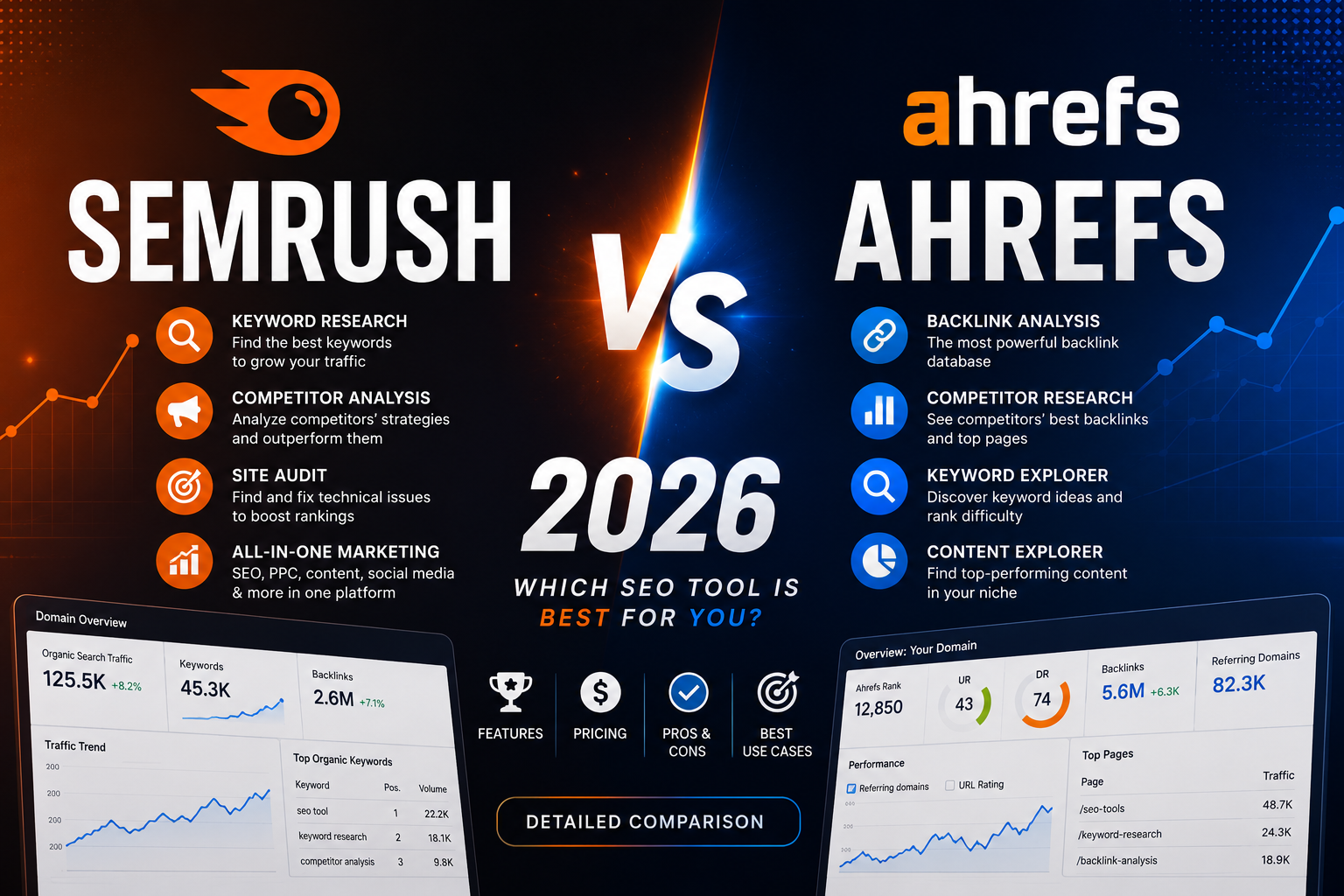
SEMrush vs Ahrefs 2026: Which SEO Tool Wins?
Two tools have defined professional SEO for over a decade. Semrush and Ahrefs sit at the top of nearly every SEO software comparison list, and for good reason: both offer the depth of data, range of features, and reliability that serious organic search work demands. Between them, they cover keyword research, backlink analysis, technical site audits, rank tracking, and competitive intelligence at a level that smaller tools simply cannot match.
But they are not interchangeable. Semrush is an all-in-one digital marketing platform with over 55 tools spanning SEO, PPC, content marketing, social media, and local SEO. Ahrefs is a focused SEO toolkit that has built arguably the best backlink database in existence and a highly respected interface for organic research. Choosing between them is not about which is objectively better. It is about which one matches your actual workflow and priorities.
Our Take: After comparing both platforms, Semrush feels like the better choice for most marketers, while Ahrefs feels like the better choice for most SEOs. Semrush wins on breadth, Ahrefs wins on depth, and that distinction ultimately matters more than individual features.
Side-by-Side Comparison Table
| Feature | Semrush | Ahrefs |
|---|---|---|
| Keyword database | 27.9 billion keywords, 142 locations | 28.7 billion keywords, 217 locations |
| Backlink index | 43 trillion links, 390M referring domains | 35 trillion links, 500M referring domains |
| Free tier | Yes (limited, no card required) | Webmaster Tools only (verified sites) |
| Starting paid price | $139.95/month (Pro) | $129/month (Lite) |
| Free trial | 14 days (Semrush One) | No (Starter plan at $29/month available) |
| PPC / Paid search tools | Yes, comprehensive | No |
| Social media tools | Yes | No |
| Content marketing platform | Yes (Guru plan and above) | Basic (Content Explorer) |
| Local SEO tools | Yes | Limited |
| AI visibility tracking | Yes (AI Visibility Toolkit) | Yes (Brand Radar, $199/month add-on) |
| Rank tracking update frequency | Daily (Pro and above) | Weekly (Lite), Daily (Standard and above) |
| Best for | All-in-one digital marketing teams | Backlink analysis and organic SEO specialists |
“Pricing is subject to change. Always verify current pricing on the tool’s official website before purchasing.”
Semrush: Detailed Breakdown
What It Does
Semrush is the broadest SEO and digital marketing platform available, covering organic search, paid advertising, content marketing, social media management, local SEO, and competitive intelligence across all channels from a single interface. Founded in 2008, it now serves over 10 million users globally with a database of 27.9 billion keywords across 142 geographic locations, 43 trillion backlinks, and historical data going back to 2012.
For marketing teams that manage multiple channels simultaneously, Semrush’s consolidation value is significant. Rather than subscribing separately to a keyword tool, a site audit tool, a social scheduler, and a PPC research platform, Semrush covers all of those functions. Whether that breadth justifies the cost depends on how much of it you actually use.
Key Features
Keyword Magic Tool accesses 27.9 billion keywords with intent classification, keyword difficulty scoring, seasonal trend data, and content clustering. For the US market specifically, Semrush provides 3.8 billion keyword variations, more than Ahrefs’ US coverage.
Semrush Copilot and AI Visibility Toolkit track brand presence across ChatGPT, Google AI Overviews, Gemini, and Perplexity. The AI Visibility add-on at $99/month addresses GEO (Generative Engine Optimization) concerns that have become increasingly important as AI-generated search results intercept organic traffic. This is meaningfully cheaper than Ahrefs’ equivalent Brand Radar add-on at $199/month.
Site Audit identifies over 140 technical SEO issues categorized by Errors, Warnings, and Notices, with Thematic Reports organizing problems by crawlability, HTTPS, Core Web Vitals, and internal linking. Integration with Google Search Console streamlines the disavow workflow for toxic links.
Content Marketing Platform (Guru plan and above) includes Topic Research for content ideation, the SEO Writing Assistant for real-time optimization guidance in Google Docs or WordPress, ContentShake AI for generating optimized drafts, and a content calendar for team editorial planning.
Pros
- Most comprehensive digital marketing platform available; replaces multiple separate tool subscriptions
- AI Visibility Toolkit at $99/month is significantly cheaper than Ahrefs’ Brand Radar add-on
- Daily rank tracking updates on Pro and above allow immediate response to ranking changes
- PPC research module is unique among the two platforms; essential for paid search teams
- 14-day free trial on Semrush One plans with full feature access enables thorough evaluation
- Local SEO module covers Google Business Profile optimization, local citation management, and location-based rank tracking with no Ahrefs equivalent
Cons
- Starting at $139.95/month, Semrush is the pricier entry point versus Ahrefs Lite at $129/month
- Content marketing tools are gated behind the Guru plan at $249.95/month, significantly above the Pro entry price
- 45-plus tools and multiple toolkits create a steep learning curve; new users regularly report feeling overwhelmed
- For pure backlink analysis depth, Ahrefs’ referring domain index (500 million) exceeds Semrush’s (390 million)
- Adding team members costs $45 to $100 per month per additional seat
Pricing
- Pro: $139.95/month ($117.33/month annual), 5 projects, 500 tracked keywords, 100,000 page crawls
- Guru: $249.95/month ($208/month annual), 15 projects, full content marketing platform, historical data
- Business: $499.95/month ($416/month annual), API access, 40 projects, 5,000 tracked keywords
- Enterprise: Custom pricing, starting around $5,000/month based on user reports
- AI Visibility Toolkit: $99/month add-on for GEO tracking across ChatGPT, Google AI Overviews, and Gemini
Ahrefs: Detailed Breakdown
What It Does
Ahrefs is an SEO-focused toolkit built around what is widely regarded as the most accurate and frequently updated backlink database commercially available. AhrefsBot, the company’s web crawler, is the second most active on the internet after Googlebot, processing approximately 8 billion pages daily to maintain a live link index of 35 trillion backlinks from 500 million referring domains. For link building, competitor backlink research, and organic search intelligence, this database depth is Ahrefs’ defining advantage.
In January 2026, Ahrefs introduced a $29/month Starter plan, lowering the entry barrier significantly from the previous Lite plan minimum. The Starter plan provides limited access to Site Explorer and Keywords Explorer for five projects, positioned as an evaluation tier before committing to the full Lite plan.
Key Features
Site Explorer is the gold standard for competitor backlink research. It provides complete visibility into any domain’s backlink profile, organic keyword rankings, top-performing content, and traffic estimates. The Link Intersect tool identifies sites linking to multiple competitors but not to your domain, generating immediate link building outreach lists. For agencies and consultants who need deep competitive link intelligence, this tool alone justifies Ahrefs.
Keywords Explorer covers 28.7 billion keywords across 217 locations and 10 search engines including Google, YouTube, Amazon, and Bing. Ahrefs’ click data is a unique differentiator: it shows what percentage of searches for a keyword actually result in clicks to organic results, helping users avoid keywords dominated by featured snippets, ads, or People Also Ask boxes where organic traffic is minimal despite apparent search volume.
Content Explorer indexes over one billion web pages and allows filtering by organic traffic, referring domains, social shares, and publication date. This makes it powerful for identifying link building prospects, content gap opportunities, and the most-linked content formats within any topic. Content Explorer is only available from Standard plan upward.
Brand Radar add-on monitors brand mentions across 271 million organic prompts from Ahrefs’ database, tracking brand visibility and share of voice across AI Mode, ChatGPT, AI Overviews, Copilot, Gemini, and Perplexity. At $199/month, it is the most expensive AI visibility feature among major SEO tools but covers the broadest prompt database.
Pros
- Industry’s largest referring domain index at 500 million; backlink data quality and freshness is unmatched
- Cleaner, more intuitive interface than Semrush; easier for non-specialists to navigate for pure organic research
- Click data in Keywords Explorer helps prioritize keywords where organic traffic is actually achievable
- Supports 10 search engines including YouTube and Amazon, covering multi-platform keyword research
- No hard feature gating by plan; all core tools are available on every tier, with limits applied to data volume
- Starter plan at $29/month provides a real evaluation path before committing to Lite
Cons
- No free trial; Starter at $29/month is the cheapest paid evaluation option
- Content Explorer requires Standard plan ($249/month), making meaningful link prospecting unavailable on Lite
- No PPC research, social media tools, or local SEO capabilities
- Each plan includes only one user seat; adding team members costs extra on all tiers
- The credit and usage system on lower-tier plans can limit intensive research workflows
- Brand Radar AI visibility tracking at $199/month is double the cost of Semrush’s equivalent feature
Pricing
- Starter: $29/month (monthly only), limited Site Explorer and Keywords Explorer, 5 projects
- Lite: $129/month ($108/month annual), 5 projects, 750 tracked keywords, 6 months historical data
- Standard: $249/month ($208/month annual), 20 projects, 2,000 keywords, Content Explorer access
- Advanced: $449/month ($374/month annual), 5 user seats, 5,000 keywords, Looker Studio integration
- Enterprise: $1,499/month (annual commitment), unlimited projects, custom limits, dedicated support
- Brand Radar add-on: $199/month
Head-to-Head Comparison
Keyword Research Both tools maintain comparable databases at roughly 28 billion keywords each. Semrush covers more US keyword variations (3.8 billion versus Ahrefs’ 2.5 billion US keywords), making it stronger for US-market content strategies. Ahrefs covers more international locations (217 versus 142) and supports more search engines, giving it an edge for global and multi-platform research. Ahrefs’ click data provides a dimension of search behavior insight that Semrush does not replicate.
Backlink Analysis Ahrefs wins. Its referring domain index is larger (500 million versus Semrush’s 390 million), its crawler updates the index more frequently, and Site Explorer’s competitive backlink research capabilities are consistently described by SEO professionals as the gold standard. Semrush’s backlink raw link count (43 trillion) is higher, and its toxic link identification workflow is strong for audit purposes, but for link building prospecting and competitive analysis, Ahrefs is the better tool.
Technical SEO Auditing Semrush has a slight edge in audit depth, checking 140-plus issues versus Ahrefs’ approximately 100. The Thematic Reports feature in Semrush organizes audit results by issue category rather than presenting a flat list. Both tools provide AI-powered recommendations and Core Web Vitals monitoring. For most teams, either tool’s audit capability is sufficient.
Content Marketing Semrush wins decisively if content marketing tools matter to your workflow. Its content platform includes Topic Research, ContentShake AI, the SEO Writing Assistant, and an editorial calendar, all within the Guru plan. Ahrefs’ Content Explorer is powerful for research and link prospecting but does not extend to content creation or optimization workflows.
Pricing Value Semrush is $10.95/month more expensive at entry level but covers a significantly broader feature set. For teams that use PPC, content marketing, local SEO, and social features alongside organic search, Semrush replaces multiple tool subscriptions and often delivers better per-feature value despite the higher headline price. For pure organic SEO work, Ahrefs delivers more relevant depth per dollar.
AI and GEO Visibility Semrush AI Visibility Toolkit at $99/month is available on current plans and tracks brand presence across major AI platforms. Ahrefs Brand Radar at $199/month covers a larger prompt database (271 million prompts) and more AI platforms, but costs twice as much. Both tools are adding AI visibility features as GEO becomes a more urgent concern for SEO teams.
Who Should Choose Each Tool
Choose Semrush if:
- Your team manages multiple marketing channels beyond organic SEO, including PPC, social media, and local search
- Content marketing is a core part of your strategy and you need content ideation, brief generation, and optimization in one platform
- You are evaluating AI visibility and need GEO tracking without paying a $199/month add-on
- Your business is US-focused and keyword volume in the US market is your primary research priority
- You want a 14-day free trial before committing to a subscription
Choose Ahrefs if:
- Backlink analysis and link building are central to your SEO strategy and you need the most accurate data available
- You work primarily on organic SEO without needing PPC, social, or local SEO tools
- You research across multiple search engines beyond Google, including YouTube and Amazon
- You value a cleaner interface with a shorter learning curve for pure organic research tasks
- You manage international SEO across a wide range of geographic markets
Frequently Asked Questions
Can I use both Semrush and Ahrefs at the same time?
Yes, and many professional agencies do. A common setup is Semrush for content marketing, PPC research, and competitive intelligence across all channels, while maintaining Ahrefs specifically for backlink analysis and link building prospecting where its database depth provides a meaningful advantage. The combined cost at entry plans runs approximately $269 per month, which many agencies justify by spreading it across multiple client retainers. For individual consultants and smaller teams, the overlap in keyword research and site audit capabilities makes running both simultaneously harder to justify financially.
Which tool is better for beginners?
Ahrefs has a more intuitive interface and a cleaner workflow for users new to SEO tools. Its structure is focused enough that new users can reach productive workflows faster without being overwhelmed by 55 tools. Semrush’s breadth is also its challenge for beginners: knowing where to start and which tools to prioritize requires more orientation time. Both tools offer extensive tutorial libraries and documentation. If your primary learning goal is organic SEO fundamentals, Ahrefs’ cleaner interface reduces the learning overhead. If you need to quickly understand competitive digital marketing across multiple channels, Semrush covers that full landscape.
Do either tool offer a meaningful free tier?
Semrush offers a permanently free tier requiring no credit card that includes daily tracking of up to 8 keywords and limited reports from several tools. It is sufficient for occasional checks but not workable as a primary research tool. Ahrefs Webmaster Tools is free for verified site owners and provides meaningful Site Explorer and Site Audit data for your own domains, which is genuinely useful for site owners managing their own properties. Neither free tier provides the competitor research capabilities that make these tools worth paying for. The Ahrefs Starter plan at $29/month is the most accessible evaluation path. Semrush’s 14-day free trial on Semrush One provides full access to evaluate paid features before committing.
Final Verdict
Both tools are best-in-class within their respective strengths, and the decision between them is rarely about quality. It is about scope.
Semrush wins for marketing teams with multi-channel responsibilities. If your work spans organic search, paid advertising, content strategy, local SEO, and social media, Semrush’s breadth replaces multiple separate subscriptions and delivers AI visibility tracking at a reasonable add-on cost. Its 14-day trial makes it easy to evaluate before paying.
Ahrefs wins for organic SEO specialists and link builders. If backlink analysis is central to your daily work, the referring domain index depth and click data in Keywords Explorer are genuine competitive advantages that Semrush does not fully replicate at equivalent price points. The cleaner interface also makes it the better choice for teams where Semrush’s feature breadth would go largely unused.
For most professional SEOs who can justify the cost, maintaining access to both tools for their complementary strengths is the highest-value approach. For teams that need to pick one, let your actual workflow drive the decision: full-funnel marketing points to Semrush, pure organic SEO points to Ahrefs.
Semrush Rating: 4.5 / 5 — Best for marketing teams managing organic, paid, and content strategy from one platform.
Ahrefs Rating: 4.6 / 5 — Best for SEO specialists and link builders who need the deepest backlink intelligence available.
“Pricing is subject to change. Always verify current pricing on the tool’s official website before purchasing.”