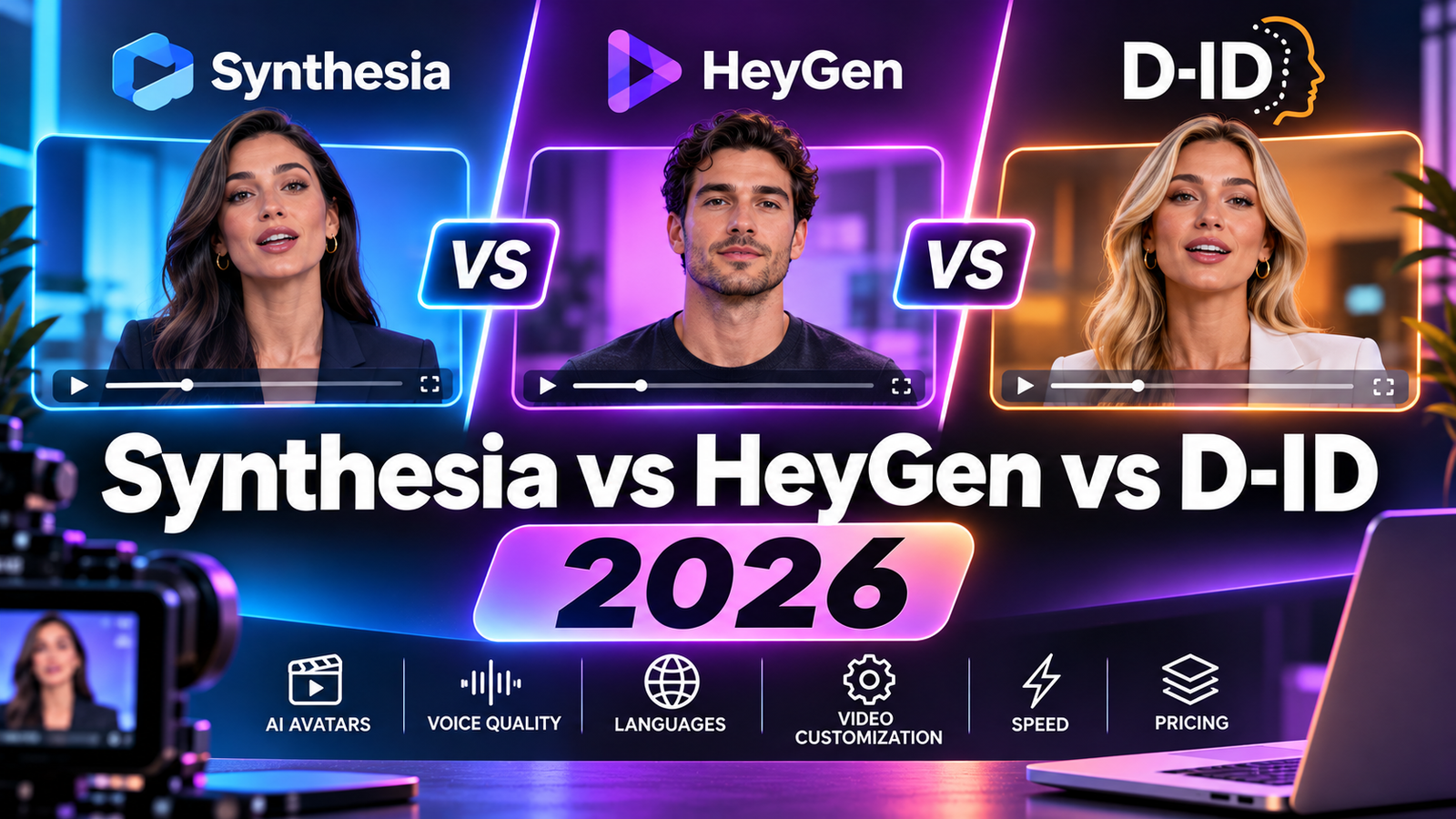
Synthesia vs HeyGen vs D-ID 2026: The AI Avatar Video Showdown
If you shop for an AI avatar video tool, the same three names keep coming up: Synthesia, HeyGen, and D-ID. They all turn a script into a talking presenter, but they are not interchangeable. Each one has a distinct identity. Synthesia is the polished enterprise choice for training and internal communications. HeyGen is the realistic, multilingual pick for creators and marketers who care about how human the avatar feels. D-ID is the budget-friendly option for quick talking-photo clips and for developers who want an API.
We compared them on realism, use case fit, languages, editing, and price. Here is how the showdown plays out.
Meet the Contenders
Synthesia is the veteran of the group and the tool most large companies shortlist for training video. It focuses on consistency, governance, and a workflow that non-video people can learn in an afternoon. Teams use it for onboarding, compliance, product walkthroughs, and internal updates. Our full Synthesia Review 2026 covers it in depth.
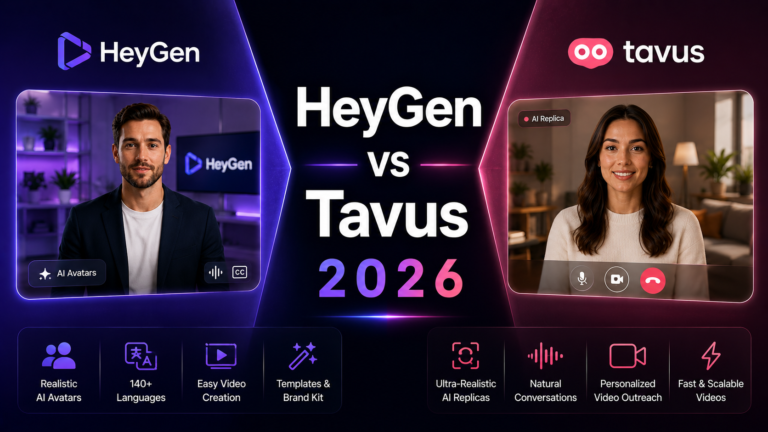
HeyGen grew up serving marketers and creators, and it shows. The product is built around speed, realism, and localization, with custom avatars, video translation, and a steady stream of new avatar models. Our HeyGen Review 2026 goes through the details.
D-ID started with a simple idea: make a still photo talk. It has since added video avatars, conversational agents, and a developer-friendly API, but its identity is still low cost and flexibility. Read our D-ID Review 2026 for the full picture.
Quick Comparison Table
| Feature | Synthesia | HeyGen | D-ID |
|---|---|---|---|
| Core strength | Enterprise training and corporate video | Realistic multilingual marketing and creator video | Cheap talking-photo clips and API use |
| Avatar realism | Very good, polished and consistent | Best in class, very natural motion | Good for photos, behind on full avatars |
| Languages | 140+ | 175+ | 30+ for video translation (broader for text-to-speech) |
| Editing | Slide-style editor, templates, brand kits | Scene editor, video translation, avatar customization | Simple studio, limited timeline control |
| API | Available on higher plans | Available, credit-based | Included on every plan |
| Starting price | Around $18/month billed annually ($29 monthly) | Around $29/month (Creator) | $5.90/month ($4.70 annual) |
| Free tier | Yes, 3 minutes per month | Yes, limited | 14-day trial with watermark |
Pricing and plan limits change often, and sources sometimes disagree. Always confirm current details on each official site before you subscribe.
Avatar Realism: HeyGen Leads, Synthesia Close, D-ID Behind
Realism is where the three tools separate most clearly.
HeyGen currently has the most convincing avatars. Its Avatar IV model handles facial micro-expressions, head movement, and lip sync with a natural feel that holds up on close-ups. Gestures look less rehearsed than they do on most competitors. For anything customer-facing, such as ads, social clips, or sales outreach, that extra realism matters.
Synthesia is a close second. Its avatars are clean, steady, and professional, with strong lip sync and a calm delivery that suits training content. They can feel slightly more reserved than HeyGen, but that restraint is a feature when the goal is clear instruction rather than persuasion.
D-ID sits behind the other two on full-avatar realism. Its strength is animating a still photo into a talking head, and the results can be impressive for the price. But motion is more limited, and the uncanny feeling shows up sooner on longer clips.
Winner: HeyGen
Use Case Fit: Training vs Marketing vs Budget and API
Training and internal communications: Synthesia is built for this. Templates, brand kits, consistent avatars, and team collaboration make it easy to produce a library of onboarding, compliance, and how-to videos. Enterprise features such as SSO, security controls, and large avatar libraries round it out.
Marketing, ads, and creator video: HeyGen is the better fit. Realistic avatars, strong video translation, custom avatars from a short recording, and quick iteration all serve people who ship content often. Marketers can localize one video into many languages without reshooting.
Budget clips and API integration: D-ID is the value pick. Animating a photo costs little, and API access is included on every plan, which makes it attractive for developers building chat agents, interactive kiosks, or automated personalized video.
Winner: depends on the job, and the breakdown below covers it
Languages: HeyGen 175+, Synthesia 140+, D-ID 30+
Language coverage is a major differentiator for global teams.
HeyGen leads with 175+ languages and dialects, plus strong video translation that preserves the speaker’s voice and syncs lips to the new language. Synthesia supports 140+ languages for voices, which is plenty for most multinational training programs, though one-click translation features are tied to higher tiers. D-ID’s video translation covers 30+ languages. It advertises a broader set of languages for text-to-speech, but the translation workflow is narrower than the other two.
Winner: HeyGen
Interactivity and Editing
Synthesia offers a slide-style editor that feels familiar to anyone who has built a presentation. You can add text, images, screen recordings, and branded elements, then organize scenes in a clean timeline. It also supports interactive elements in some workflows, which helps for training modules.
HeyGen’s editor is more flexible for creative work. You can combine scenes, change avatars, adjust backgrounds, and use the translation tools in the same project. It also offers interactive avatar features for live, conversational use cases.
D-ID’s studio is the simplest of the three. It is quick for a single clip, but it lacks the scene-based control of Synthesia and HeyGen. Where D-ID shines is its conversational agent tools and API, which let developers build interactive experiences programmatically.
Winner: Synthesia for structured editing, HeyGen for creative flexibility, D-ID for developers
Pricing and Value
Pricing structures differ, so compare carefully.
Synthesia has a free plan with 3 minutes per month. Paid Starter pricing is reported at about $29 per month, or roughly $18 per month billed annually, with around 10 minutes of video. The Creator tier is higher and adds API access. Enterprise pricing is custom. Expect to pay more as team size and minutes grow.
HeyGen moved to a credit-based model in 2026 and retired its unlimited plans. The Creator plan is about $29 per month with roughly 600 credits, which works out to around 30 minutes of top-quality Avatar IV video. Higher tiers add more credits and team features. Heavy users should model their monthly usage before committing.
D-ID is the cheapest at entry. Lite is $5.90 per month ($4.70 annually) with about 10 minutes, Pro is about $29 per month ($16 annually) with 15 minutes and a commercial license, and Advanced is about $196 per month ($108 annually) with 100 minutes. API usage draws from the same minute allowance. Free usage is a 14-day trial with watermarks, so it is for testing only.
On pure price, D-ID wins. On value per dollar for realistic video, HeyGen is hard to beat. On value for teams that need governance and polish, Synthesia earns its premium.
Winner: D-ID on price, HeyGen on realism per dollar
Output Quality in Practice
Specs only tell part of the story, so it helps to think about what each tool feels like on a real project.
On a ten-minute compliance course, Synthesia keeps every scene visually consistent. The presenter looks the same from module to module, brand colors carry through, and a reviewer can update a single slide without rebuilding the video. That repeatability is the real selling point for training teams, because content libraries change constantly and updates need to be cheap.
On a thirty-second paid social ad, HeyGen’s realism pays off. Viewers decide in a second or two whether a presenter feels trustworthy, and subtle eye movement and natural pacing tip that decision. Localizing the same ad into Spanish, French, and Portuguese takes minutes rather than a new shoot, which lets small teams test markets quickly.
On a quick explainer where budget is tight, D-ID gets you a usable clip for very little money. It also fits automation well. Developers can send text to the API and receive a personalized video or a live conversational avatar, which suits onboarding bots, support kiosks, and outreach at scale.
Common Limitations to Watch
Every tool here has tradeoffs worth knowing before you commit.
Synthesia’s per-minute plans can feel restrictive for high-volume teams, and some features such as one-click translation and API access sit on higher tiers. HeyGen’s credit model means heavy users can burn through a plan faster than expected, so estimate your monthly minutes before choosing a tier. D-ID’s lower price comes with watermarks on entry plans, a smaller translation language set, and less editing control. In all three cases, test with your own script and your own audience in mind before you move a whole workflow over.
Which One for Which Job
- Corporate training and onboarding: Synthesia
- Marketing videos and ads: HeyGen
- Social media and creator content: HeyGen
- Multilingual localization: HeyGen
- Quick talking-photo clips: D-ID
- Developer projects and API automation: D-ID
- Compliance and enterprise security: Synthesia
- Smallest budget: D-ID
Frequently Asked Questions
Which AI avatar tool looks the most realistic?
HeyGen currently has the most natural-looking avatars, thanks to its Avatar IV model and fluid facial motion. Synthesia is a close second with a more polished, composed look. D-ID is best for animating still photos, but its full-avatar realism trails the other two.
Which is best for a small business on a tight budget?
D-ID has the lowest entry price, and it works well for short promotional clips and simple explainers. If you need more realistic avatars for ads or sales video, HeyGen’s Creator plan is a better investment. Synthesia makes the most sense once you are producing training content regularly or need team features.
Can I use these tools commercially and through an API?
Yes, but plans differ. D-ID includes API access on every plan and offers a commercial license on Pro and above. HeyGen offers API access with credit-based pricing. Synthesia offers API access on higher tiers. Read each provider’s terms on commercial use, avatar likeness rights, and watermark rules before you publish.
Final Verdict: A Pick for Every Use Case
There is no single winner in this showdown, because each tool is designed for a different job.
- Best for realism and multilingual marketing: HeyGen. It has the most realistic avatars and the widest language coverage. Read our HeyGen Review 2026.
- Best for enterprise training: Synthesia. It offers the most polished workflow for teams building a library of training videos. Read our Synthesia Review 2026.
- Best for budget clips and API use: D-ID. It is the cheapest way to animate a photo or wire avatars into your own app. Read our D-ID Review 2026.
If you can only choose one for general-purpose video, we recommend HeyGen. If you run a company with a training library, pick Synthesia. If you are a developer or you only need quick, cheap talking-photo clips, start with D-ID.
Disclosure: This article contains affiliate links.