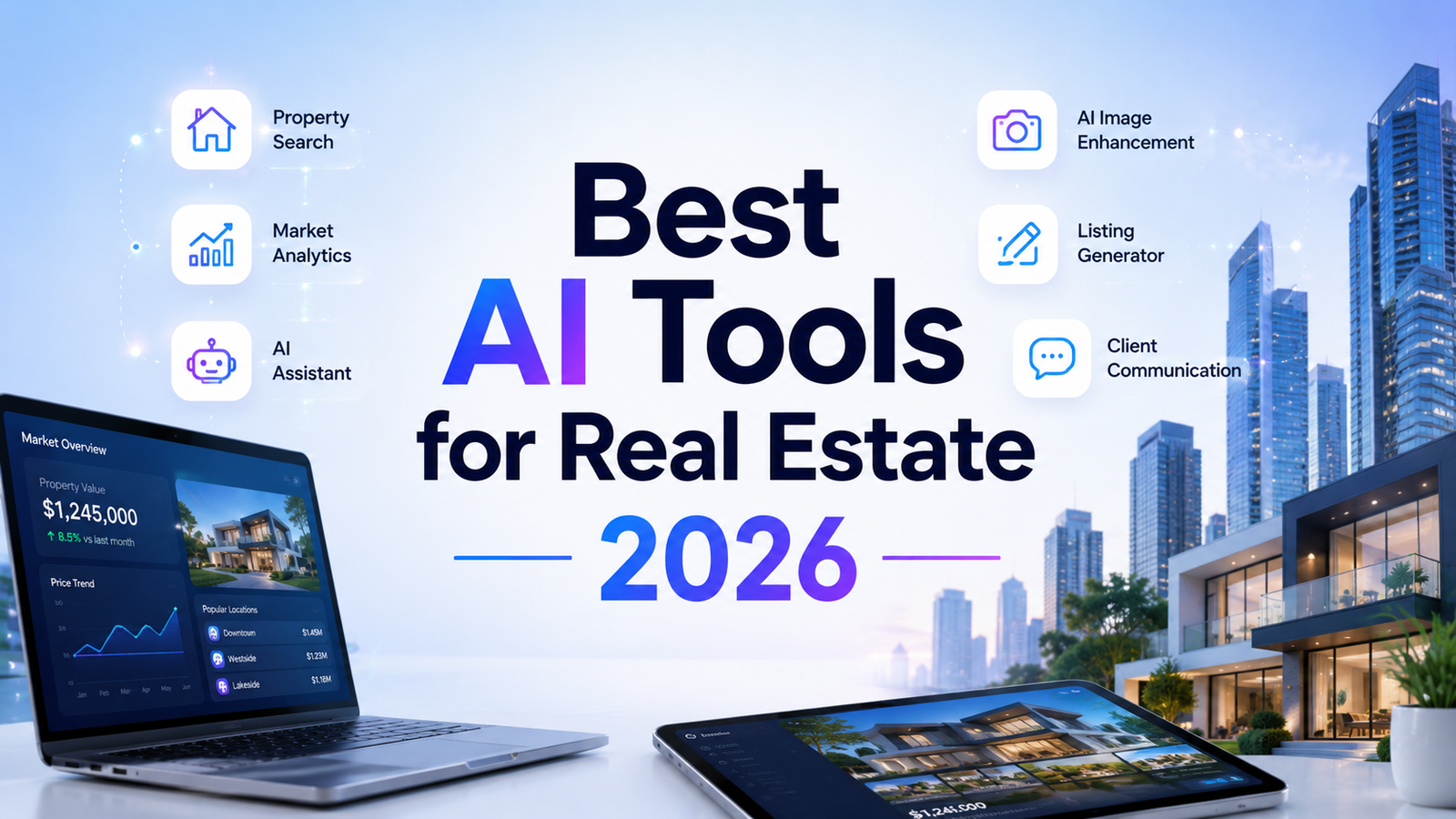
Best AI Tools for Real Estate 2026: The Platforms Agents Actually Use
AI adoption in real estate accelerated quickly once agents realized the technology was not replacing relationships but reducing administrative workload. The best AI tools in 2026 are the ones that help agents move faster without making client interactions feel automated or impersonal.
The numbers reflect the shift. According to the National Association of Realtors, 72 percent of agents now consider AI tools part of their daily workflow. Delta Media reports that over 87 percent of brokerages and agents are using real estate AI tools daily in 2026. JLL found that over 90 percent of real estate firms report active interest in artificial intelligence. The technology is no longer experimental. It is operational infrastructure for agents who want to compete at the top of their market.
The practical challenge is that “AI tools for real estate” covers a dozen different problems. Writing tools compress listing copy from an hour to five minutes. Lead qualification tools engage inquiries at midnight while agents sleep. Valuation platforms analyze 136 million properties in seconds. Virtual staging tools fill an empty room for a fraction of what a photographer charges. Choosing the right tool requires knowing which bottleneck you need to solve first.
This guide covers eight tools across those categories, with honest assessments of what each one does well, where the limitations are, and who gets the most value from each.
Comparison Table: Best AI Tools for Real Estate 2026
| Tool | Best For | Starting Price | Free Plan |
|---|---|---|---|
| ChatGPT | Listing copy, email drafts, market research, and general productivity | Free / $20/month (Plus) | Yes |
| Jasper | On-brand listing descriptions and marketing copy at volume | $59/month (Pro) | 7-day trial |
| Canva AI | Listing flyers, social media posts, and property marketing visuals | Free / $15/month (Pro) | Yes |
| Zillow AI | Automated property valuations via Zestimate and market trend data | Free (consumer) / Premier Agent for agents | Yes |
| HouseCanary | Institutional-grade property valuations and market forecasting | $10/report (Property Explorer) / Custom enterprise | No |
| Rechat | AI-powered brokerage operating system with CRM, marketing, and transactions | Custom (brokerage-level pricing) | No |
| Structurely | Automated lead qualification via AI text and voice conversations | $179/month (Starter) | No |
| REimagineHome | Virtual staging, room redesign, and property visualization | $14/month (30 credits) | No |
“Pricing is subject to change. Always verify current pricing on the tool’s official website before purchasing.”
Detailed Reviews
1. ChatGPT
Best for agents who want a flexible AI assistant for writing, research, and communication at the lowest cost.
ChatGPT is where most real estate professionals start their AI journey, and many find they never need to go beyond it for their writing and communication needs. The Plus plan at $20 per month gives access to GPT-5.4, the current flagship model, along with web browsing for live market research, file upload for analyzing comps or contract documents, and memory that builds context about your clients and communication style over time.
The agent-specific use cases are wide-ranging. ChatGPT writes listing descriptions from a bullet list of property features in under a minute. It drafts personalized follow-up emails for buyer and seller leads. It generates social media captions for listings across every platform. It explains complex contract clauses in plain language for clients who need more context. It researches neighborhood amenities, school ratings, and market trends in real time using web browsing.
Key Features: GPT-5.4 with real-time web browsing for live market research, file analysis for uploading comps and contracts, memory for building persistent client context, Custom GPTs for creating specialized real estate assistants with pre-loaded instructions, and image generation for simple visual content.
Pros:
- Free tier is genuinely capable for light professional use; Plus at $20/month is exceptional value
- Web browsing enables current market research without leaving the conversation
- Custom GPTs allow building a pre-configured real estate assistant for recurring tasks
- The broadest versatility of any tool on this list, covering writing, research, and analysis
Cons:
- No MLS integration; property data must be manually provided in the prompt
- Fair Housing compliance checking requires careful prompting; the tool does not automatically flag problematic language
- Output depends heavily on prompt quality; agents who do not learn effective prompting see limited results
Pricing:
- Free: GPT-5.x with daily limits, basic functionality
- Plus: $20/month, full GPT-5.4 access, web browsing, file analysis, memory, Custom GPTs
- Team: $25 to $30/user/month for shared workspace and admin controls
2. Jasper
Best for teams producing listing descriptions and marketing copy at scale who need consistent brand voice.
Where ChatGPT is general-purpose, Jasper is purpose-optimized for volume content production with brand consistency. The Brand Voice feature trains on your existing marketing materials and ensures every listing description, email campaign, and social post generated by any team member maintains the same tone, vocabulary, and style. For brokerages where multiple agents contribute to marketing but brand consistency matters, this structural enforcement is the feature that justifies Jasper over a general AI tool.
The Surfer SEO integration within the Jasper editor enables real-time optimization of listing website content and blog posts for search visibility, a differentiator for agents who invest in organic lead generation through content. The 50-plus templates cover every standard real estate content type: listing descriptions, open house announcements, just-sold social posts, market report emails, and buyer and seller guide outlines.
Key Features: Brand Voice trained on existing marketing content for consistency across agents, 50-plus real estate-applicable templates, Surfer SEO integration for website content optimization, campaign workflow for generating aligned assets from a single brief, and API access on Business plans for custom content pipelines.
Pros:
- Best brand voice consistency of any AI writing tool for teams managing multiple contributors
- 7-day free trial gives full access to evaluate whether output quality justifies the price
- Campaign workflow reduces the time to produce a complete listing’s marketing package significantly
- Strong for high-volume listing agents managing 20-plus active properties
Cons:
- $59/month starting price is the highest writing tool on this list; harder to justify for part-time or low-volume agents
- No MLS integration; property details must still be manually entered for each listing
- Primarily a writing tool; it does not address lead qualification, valuation, or visual production
Pricing:
- Pro: $59/month (annual) / $69/month (monthly), 1 seat, 2 Brand Voices
- Business: Custom pricing, unlimited Brand Voices, AI Agents, API access
3. Canva AI
Best for agents who need professional-looking listing materials and social content without a design background or budget.
Every listing needs visual marketing: flyers, social graphics, email headers, just-listed announcements, and open house promotions. Canva’s Magic Studio AI suite produces all of these from templates in minutes, with Brand Kit storing your agency colors, fonts, and logo for automatic application across every design. Magic Resize adapts any flyer to every social media format in one click. Magic Write generates property descriptions and social captions directly within the design interface.
For real estate teams, Canva’s Brand Kit enforcement means every agent can produce on-brand materials without a graphic designer reviewing their work. The $15 per month Pro plan covers an individual agent’s complete visual content production needs, and the Teams plan at $10 per user per month extends brand control across an entire office.
Key Features: Magic Studio AI suite including background removal, image generation, Magic Eraser for cleaning listing photos, Magic Resize for multi-platform adaptation, Brand Kit for logo, color, and font management across team designs, and 140 million-plus premium templates including real estate-specific layouts.
Pros:
- Most accessible professional design tool available; no design experience required
- Brand Kit for teams ensures every agent’s materials look consistent with brokerage branding
- Pro at $15/month is exceptional value for individual agents replacing design software or freelancer spend
- Directly integrates listing photo editing with marketing design in one workflow
Cons:
- AI image generation quality is below dedicated generators for photorealistic property renders
- 500 shared AI credits per month on Pro can deplete for agents producing high volumes of generated imagery
- Not a listing copy or lead generation tool; serves marketing design exclusively
Pricing:
- Free: Core templates and limited Magic Studio credits
- Pro: $15/month, full Magic Studio, Brand Kit, 1TB storage, commercial rights
- Teams: $10/user/month (3-user minimum), shared brand controls and team collaboration
4. Zillow AI (Zestimate)
Best for agents who want free, instant access to automated property valuations as a starting point for client conversations.
Zillow’s Zestimate is the most widely recognized AI property valuation in the consumer market. The underlying AI draws on 136 million property assessments, hundreds of millions of transaction records, and county data across 3,140 counties, producing valuations with a median error of approximately 6 percent and coverage of 99 percent of the US population. For buyers and sellers who arrive at listing appointments having already checked Zillow, understanding how the Zestimate is calculated and where it typically errs is practical professional knowledge.
For agents, Zillow’s Premier Agent platform integrates AI-powered lead routing with Zestimate data, connecting agents with active buyer and seller leads based on geographic and price-range targeting. The AI-driven comparative market analysis tool generates CMA reports drawing on recent comps and market trend data, compressing manual research time.
Key Features: Zestimate automated valuation updated daily for 136 million properties, AI-powered CMA generation with comp selection and market trend analysis, Premier Agent lead routing with buyer and seller intent signals, and integration with the Zillow listing ecosystem for maximum consumer-facing visibility.
Pros:
- Free access to Zestimate data for any property in the US, with no subscription required
- Consumer brand recognition means clients already trust and reference Zestimate data
- CMA tool compresses comparative analysis from hours to minutes for routine valuations
- Premier Agent lead integration connects listing agents with active, intent-driven buyers
Cons:
- Zestimate accuracy varies by market; rural, unique, and luxury properties frequently show higher error rates than the 6 percent median
- Premier Agent pricing is competitive and volume-based; cost-per-lead can be high in dense metro markets
- Not a substitute for professional appraisal or broker price opinion in contested valuations
- Limited data transparency; agents cannot audit the specific comps driving a Zestimate
Pricing:
- Zestimate: Free for all users
- Premier Agent: Variable pricing based on market, ZIP code, and lead volume commitment
5. HouseCanary
Best for investors, lenders, and agents who need institutional-grade property valuations with portfolio-level forecasting.
HouseCanary is not a consumer tool. It is a professional analytics platform built for institutions, investors, lending professionals, and enterprise brokerage teams that need accuracy and confidence intervals beyond what consumer Zestimate data provides. Its automated valuation models carry approximately 2.5 percent accuracy on well-modeled markets and cover 136 million US residential properties with 36-month forward-looking forecasts.
The CanaryAI feature, described by HouseCanary as the first generative AI assistant specifically for real estate valuation, allows users to query the entire 136 million-property database using plain English: “Show me properties in Brickell with cap rates above 5 percent that sold in the last six months” or “What is the forecasted appreciation for single-family homes in zip code 33315 over the next 18 months?” This conversational research capability compresses hours of manual data analysis to minutes for the investment and lending use cases where HouseCanary is most deployed.
Key Features: Automated valuation models with approximately 2.5 percent median error and confidence intervals, 36-month forward market forecasts at the property and zip code level, CanaryAI generative interface for plain-English database queries, portfolio analytics for bulk property assessment, and API integration for embedding valuations in lending and investment workflows.
Pros:
- Most accurate consumer-accessible AVM available for residential property, significantly outperforming consumer tools
- 36-month forecasting provides forward visibility that comparable platforms do not offer
- CanaryAI dramatically reduces research time for investors analyzing large property sets
- API availability makes it embeddable in custom institutional workflows
Cons:
- Enterprise pricing is not publicly listed and requires direct engagement with the HouseCanary sales team
- Property Explorer at $10 per report serves individual property lookups but is cost-prohibitive at volume without a subscription
- Primarily relevant for investors, lenders, and high-volume agents; overkill for agents doing occasional individual valuations
- Consumer-grade Zestimate data is sufficient for most standard residential listing appointments
Pricing:
- Property Explorer: $10 per report (individual property valuation)
- Portfolio and enterprise: Custom pricing based on volume and API usage
6. Rechat
Best for brokerages and enterprise-level agents who want to consolidate CRM, marketing, and transaction management in one AI-integrated platform.
Rechat is designed to replace the multi-tool stack that most brokerages manage: separate CRM, marketing design platform, MLS integration, and transaction management software all requiring separate logins, billing, and training. The platform consolidates all of these into what it calls a Super App for real estate, with AI running throughout via Lucy, Rechat’s built-in AI assistant.
Lucy drafts emails, creates marketing campaigns, manages listings, and answers operational questions from within the Rechat interface. The AI Memo feature, launched April 2026, captures every client conversation and converts it into structured data attached to the contact record: meeting notes, commitments, and follow-up items extracted automatically without manual logging. For brokerages where follow-through failures are the primary source of lost deals, this automatic conversation capture addresses a genuine operational gap.
Key Features: Lucy AI assistant for email drafting, campaign creation, and listing management across the entire platform, AI Memo for automatic conversation capture and CRM logging (April 2026), full marketing design studio with branded social, email, and print production, MLS integration across nationwide boards, deal tracking and transaction management with checklists and contract coordination, and a mobile-first design for agents working primarily from their phones.
Pros:
- Consolidates CRM, marketing, and transactions into one platform with 45-second live support response time
- AI Memo solves the real-world problem of lost follow-up from unlogged client conversations
- MLS integration across 320-plus boards provides comprehensive listing data access
- Mobile-first design is genuinely suited to how most agents work in the field
- T3 Sixty rated Rechat as “Best in Class” for brokerage technology in recent evaluations
Cons:
- Brokerage-level pricing is not publicly listed and requires direct contact with Rechat’s sales team
- Most relevant as a brokerage-wide deployment; less practical for individual agents not affiliated with Rechat-integrated brokerages
- Platform depth has a learning curve; realizing full value requires meaningful onboarding investment
Pricing:
- Custom brokerage pricing; contact Rechat directly for current rates
- Individual agent access typically requires brokerage-level adoption
7. Structurely
Best for teams handling high lead volume who need 24/7 AI qualification conversations that hand off to agents at the right moment.
The lead response problem in real estate is well documented: the probability of qualifying a web lead drops dramatically within five minutes of inquiry, yet most agents cannot realistically respond to every lead within that window, especially leads arriving at 10 PM on a Saturday. Structurely addresses this directly with an AI that conducts realistic text and voice conversations with incoming leads, asks qualifying questions about timeline, budget, and motivation, and transfers the conversation to a live agent the moment the lead reaches a threshold of readiness.
According to Structurely’s published performance data, the platform reduces staffing costs by 50 percent while increasing qualified connections by 17 percent versus unaugmented lead follow-up. The 12-plus month nurturing cadence handles leads who are not ready to transact yet, maintaining contact automatically until their timeline aligns with action.
Key Features: AI text and voice conversations for lead qualification with natural language processing and emotional intelligence, live call transfer to agents when qualification threshold is reached, 12-plus month automated nurturing for long-timeline leads, integration with major real estate CRMs including Follow Up Boss, Lofty, and Sierra Interactive, and multilingual conversation capability for diverse markets.
Pros:
- Solves the speed-to-lead problem at scale; AI responds instantly at any hour
- Verified user reviews frequently describe the AI language as natural enough that leads initially believe they are speaking with a person
- Long-term nurturing automation maintains pipeline contact without agent effort
- CRM integrations log all conversations automatically for agent context before handoff
Cons:
- $179/month Starter plan requires significant lead volume to generate positive ROI; solo agents with fewer than 50 leads per month likely cannot justify the cost
- Customer support quality receives mixed reviews, including documented cases of billing disputes and communication failures post-cancellation
- Canadian market users have reported integration issues with US-based phone number assignments
- Not useful as a standalone tool without a functioning lead generation source feeding it
Pricing:
- Starter: $179/month (1 seat, 50 leads/month)
- Growth: $299/month (10 seats, 125 leads/month)
- Build: $499/month (30 seats, 225 leads/month)
- Alternative: $3 per lead pricing model for variable volume needs
8. REimagineHome
Best for listing agents who need affordable virtual staging and property visualization to make vacant or dated listings more marketable.
Virtual staging has a documented impact on listing performance. NAR data shows that 81 percent of buyers report that staging helps them visualize living in a home, and staged properties see one to five percent increases in offer prices on average. The challenge for individual agents has always been cost: traditional virtual staging runs $100 to $400 per room, making full property staging prohibitively expensive for mid-range listings.
REimagineHome delivers AI-powered virtual staging for vacant rooms, style transformations for dated interiors, virtual decluttering for occupied homes, and before-and-after comparison renders suitable for listing websites and marketing materials. Results are returned within hours in most cases, and the platform supports multiple design style options so agents can present buyers with contemporary, traditional, minimalist, and luxury aesthetics for the same space.
Key Features: AI virtual staging for empty rooms across multiple design styles, virtual decluttering and depersonalization for occupied properties, style transformation for existing furnished rooms, 3D room planner for layout visualization, before-and-after comparison renders for listing marketing, and high-resolution output suitable for MLS and print production.
Pros:
- Dramatically more affordable than traditional virtual staging, with pricing starting at $14/month for 30 credits
- Multiple design style options per room allow agents to match buyer demographic preferences
- Results within hours compress marketing production timelines for faster listing launches
- Before-and-after presentation format is highly shareable for social media marketing
- NAR data supports measurable buyer engagement improvement from staged listing photos
Cons:
- Credit consumption varies by room complexity; high-detail or large rooms may cost more than standard credit estimates
- AI staging quality for highly complex or architecturally unusual spaces can require multiple attempts
- Platform does not integrate with MLS listing management; images must be downloaded and uploaded separately
- Pay-per-use model can become expensive for agents who stage many rooms per month at volume
Pricing:
- Pay-per-use starting at $14/month for 30 credits
- Higher tier plans available; credit consumption varies by feature and room complexity
Frequently Asked Questions
Will AI replace real estate agents?
No, and the industry data consistently supports this conclusion. Real estate transactions involve the highest-value and highest-stakes decisions most people make in their lives, and they require negotiation skill, local market judgment, emotional intelligence, and trust-based relationships that AI tools cannot replicate. What AI is replacing is the administrative and production overhead around those human functions: the hours spent writing listing copy, following up on leads manually, building marketing materials from scratch, and conducting market research that could be automated. The agents most likely to lose ground to competitors are not those replaced by AI but those who choose not to use AI tools while competing against agents who do. Delta Media found that 87 percent of brokerages are using AI tools daily in 2026. The competitive risk is not automation replacing agents but AI-augmented agents outperforming those who work manually.
Which AI tool should a solo agent invest in first?
For most solo agents, the starting point should be ChatGPT Plus at $20 per month. It covers the writing, research, and communication workflows that consume the most time for individual agents without requiring specialized integrations, real estate-specific training, or brokerage-level commitment. Agents who learn to prompt ChatGPT effectively for listing descriptions, buyer and seller emails, and social captions typically recover the $20 monthly cost within the time saved on the first listing. The second investment depends on primary bottleneck: Canva Pro at $15 per month for agents who spend significant time on visual marketing materials, REimagineHome for listing agents whose properties regularly benefit from virtual staging, or Structurely for agents with a lead generation source producing more inquiries than they can manually follow up. Valuation tools like HouseCanary are relevant primarily for agents working with investors or lenders rather than standard residential clients.
Are AI-generated listing descriptions legal and compliant with Fair Housing rules?
This requires care, but AI-generated listing descriptions are legal and compliant when reviewed before publication. The Fair Housing Act prohibits language that implies preference, limitation, or discrimination based on race, color, religion, national origin, sex, disability, and familial status. AI tools including ChatGPT can and do produce listing copy that inadvertently includes proximity references, neighborhood descriptors, or lifestyle language that could be interpreted as code for protected class preferences. The standard professional practice in 2026 is to use AI for the initial draft and review the output for Fair Housing compliance before publishing to MLS. Most MLS platforms do not yet have automated Fair Housing screening for AI-generated content, so agent review remains the primary quality control step. Jasper and some real estate-specific writing tools include Fair Housing prompting guidance that reduces the risk of initial drafts containing problematic language, but no AI tool currently provides guaranteed compliant output without human review.
Final Recommendation
Real estate AI adoption delivers the highest return when it targets specific, measurable bottlenecks rather than adopting tools without clear workflow purpose.
For the majority of individual agents, two tools address the highest-leverage problems at the lowest combined cost. ChatGPT Plus at $20 per month handles all writing, research, and communication tasks. Canva Pro at $15 per month handles all visual marketing production. Combined at $35 per month, these two tools replace hours of manual work weekly and produce professional-quality output that previously required freelancer spend.
For listing agents with vacant or dated properties, adding REimagineHome at $14 per month for virtual staging addresses a specific, ROI-positive listing problem. For agents with an active lead generation source producing more inquiries than they can manually follow up, Structurely’s lead qualification automation justifies its higher price point at sufficient lead volume.
For brokerages looking to standardize their technology stack and eliminate the multi-tool fragmentation that hurts agent adoption and brand consistency, Rechat’s consolidated platform addresses the organizational challenge that individual tool purchases cannot solve at scale.
Start with the tool that solves your most urgent bottleneck. Build that workflow into daily practice before adding the next. The agents who get the most from AI in 2026 are not the ones with the most tools. They are the ones who use two or three tools consistently and well.