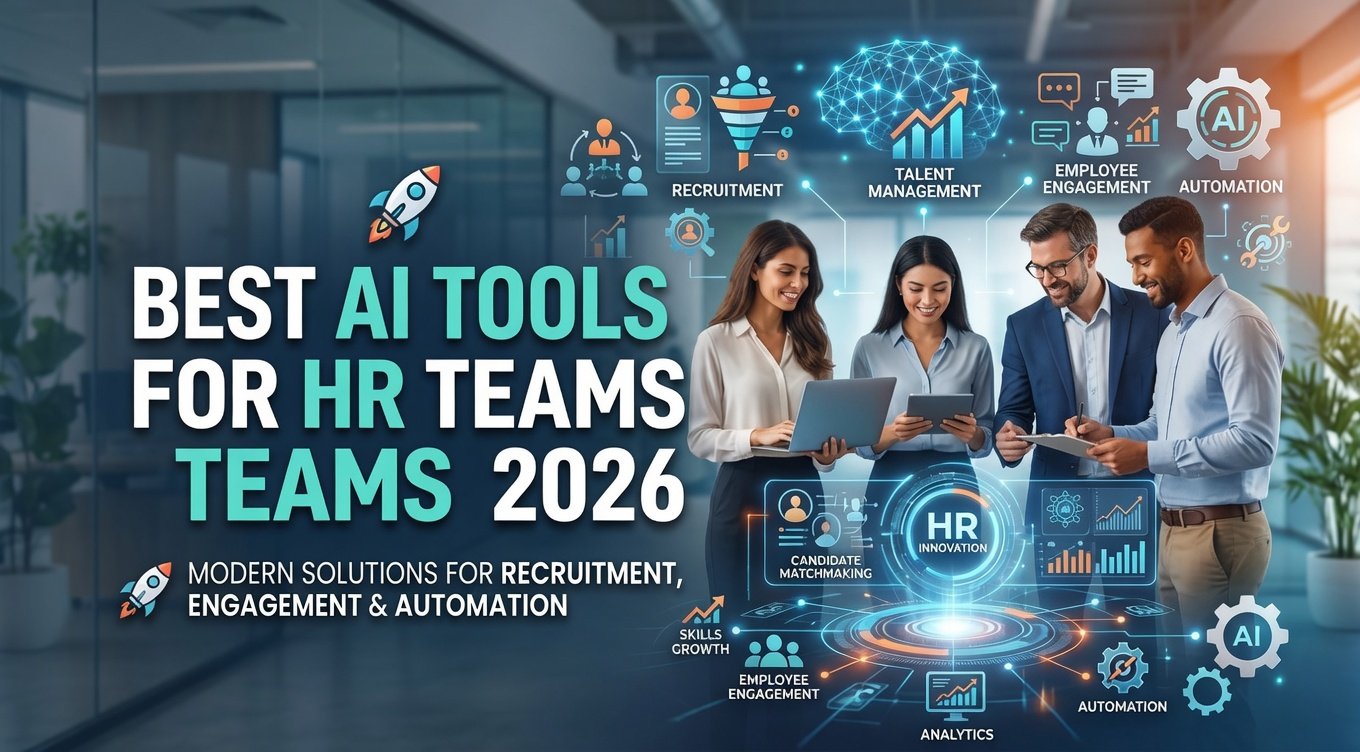
Best AI Tools for HR Teams 2026: Ranked, Reviewed and Compared
Human resources has never been a department short on administrative work. Job descriptions, screening thousands of resumes, scheduling interviews, answering the same policy questions dozens of times per week, onboarding paperwork, performance reviews, and compliance documentation are all essential and all enormously time-consuming. In 2026, AI tools are systematically automating every one of those tasks, and the HR teams adopting them are redirecting that recovered capacity toward the higher-leverage work that actually drives employee experience and organizational performance.
The adoption numbers reflect the shift. According to SHRM, 79 percent of HR professionals now use AI tools in some capacity. Companies using AI recruitment tools report 50 percent faster hiring cycles, 30 to 40 percent reductions in cost-per-hire, and measurable improvements in the quality and consistency of hiring decisions. Gartner reports that 65 percent of enterprises are now prioritizing skills-based hiring, a methodology that AI talent intelligence platforms make operationally feasible at scale.
The 2026 HR AI landscape has also matured beyond simple automation into what the industry calls agentic AI: tools that do not just answer questions but execute multi-step workflows autonomously. A recruiter no longer just gets a list of screened candidates; the AI schedules the interviews, sends the reminders, collects the assessments, and routes qualified candidates to the right hiring manager. An employee no longer submits a leave request through a form; they tell the AI assistant in a Slack message and the AI applies the leave, updates payroll, and notifies the manager simultaneously.
This guide reviews eight tools spanning the full HR workflow, from talent acquisition and onboarding to employee service and workforce planning, with honest assessments of where each one delivers and where the limitations are real.
Comparison Table: Best AI Tools for HR Teams 2026
| Tool | Best For | Starting Price | Free Trial |
|---|---|---|---|
| Workday AI | Enterprise HCM with agentic AI across the full employee lifecycle | Custom enterprise pricing | No |
| BambooHR | Small to mid-size businesses needing an all-in-one HRIS with AI insights | Custom (per-employee) | Yes (7-day) |
| Leena AI | Enterprise HR service desk automation and employee query management | Custom (from ~$3/user/month) | No |
| HireVue | High-volume video interviewing and structured candidate assessment | Custom enterprise pricing | No |
| Paradox | Conversational AI recruiting for high-volume, fast-turnaround hiring | Custom enterprise pricing | No |
| Eightfold AI | Skills-based talent intelligence, matching, and internal mobility | $7-10/employee/month+ (custom) | Limited agent trial |
| ChatGPT | Flexible AI assistant for HR writing, policy drafting, and communication | Free / $20/month (Plus) | Yes |
| Notion AI | HR knowledge base, documentation, onboarding content, and team workflows | Free workspace / $20/month (Business) | Yes (workspace) |
“Pricing is subject to change. Always verify current pricing on the tool’s official website before purchasing.”
Detailed Reviews
1. Workday AI
Best for large enterprises that want agentic AI embedded throughout their existing HR and finance infrastructure.
Workday is not an AI tool built on top of an HRIS. It is an HRIS where AI has been woven into every major function: recruiting, performance management, workforce planning, payroll, reporting, and employee development. The 2026 version of Workday’s AI agents can execute complete workflows rather than just surfacing recommendations. A hiring manager can prompt the AI with “find qualified candidates for our open data engineering role, screen for Python and cloud infrastructure experience, and schedule first-round interviews with our three top matches,” and the agent handles the execution end to end.
Workday’s unified data architecture is its core competitive advantage. Because HR, finance, and workforce data all live in the same system, the AI can generate insights that siloed tools cannot: predicting flight risk using compensation benchmarking against current market rates, modeling the financial impact of headcount changes against current budget, or identifying which employees are candidates for internal promotion based on skills profiles and career trajectory data.
Key Features: Agentic AI workflows across recruiting, onboarding, performance, and workforce planning; AI-powered predictive analytics for attrition risk, skills gaps, and compensation equity; natural language interface for HR reporting and data queries; Workday Illuminate for document processing and contract analysis; and integration with every major HRIS and finance system.
Pros:
- Unified data across HR and finance enables insights no standalone AI tool can replicate
- Agentic workflows execute multi-step tasks rather than just providing recommendations
- Enterprise compliance, SOC 2 Type II, GDPR, and global data residency options
- Continuous model updates integrated directly into the platform without separate deployments
- Best-in-class workforce planning and scenario modeling for complex organizations
Cons:
- Significant implementation cost and timeline; not suitable for organizations without dedicated implementation resources
- Per-module pricing means comprehensive AI functionality often requires substantial licensing investment
- Overkill for organizations under 1,000 employees; complexity exceeds benefit at smaller scale
- Interface can feel dense; adoption requires meaningful change management investment
Pricing:
- Custom enterprise pricing based on employee count and modules
- Significant implementation investment is standard; typically requires a Workday partner
2. BambooHR
Best for small to mid-size businesses that want a complete HR platform with AI-powered insights at an accessible price.
BambooHR is the HRIS that most small and mid-size businesses graduate to when spreadsheets and disconnected apps become unmanageable. The 2026 version adds meaningful AI capabilities on top of its core strength as the most accessible HR platform in the market: AI-powered analytics that surface actionable insights from employee data, predictive turnover risk identification, compensation equity analysis, and automated onboarding workflows that guide new hires through their first 90 days without HR team intervention.
Where BambooHR’s AI earns its place is not in sophisticated agentic workflows but in making good HR data visible and actionable for teams who do not have data analysts. The platform analyzes workforce patterns, identifies employees showing early risk signals for voluntary departure, and flags compensation anomalies, all without requiring HR teams to build custom reports or understand data modeling.
Key Features: AI-powered HR analytics with turnover risk prediction and compensation equity analysis, automated onboarding workflows with e-signature and task management, time-off and performance management modules, optional US payroll add-on, an applicant tracking system for SMB recruiting workflows, and employee self-service for common HR tasks.
Pros:
- Most accessible HRIS in the market for teams without technical implementation resources
- AI analytics surface retention risks and equity gaps without requiring custom reporting
- Onboarding workflows reduce new hire paperwork overhead significantly for small HR teams
- 7-day free trial allows genuine evaluation before committing
- Strong integration ecosystem including Slack, LinkedIn, and payroll platforms
Cons:
- AI features are assistive rather than agentic; the platform surfaces insights but does not execute actions autonomously
- Payroll is a paid add-on rather than included, increasing total cost for full-service HR
- Limited customization for organizations with complex, non-standard HR workflows
- Reporting capabilities trail enterprise platforms for complex multi-variable analysis
Pricing:
- Per-employee monthly pricing with a minimum base; exact rates require a quote
- Payroll, performance management, and benefits tracking are available as add-ons
- 7-day free trial available
3. Leena AI
Best for enterprises that want to dramatically reduce HR service desk ticket volume through an AI colleague that handles employee queries autonomously.
Leena AI addresses one of the most persistent HR team pain points: the constant volume of routine employee questions. Policy clarifications, leave balance inquiries, payslip retrieval, expense submission guidance, and onboarding FAQs consume enormous HR bandwidth while requiring minimal judgment. Leena AI’s conversational AI colleague, deployed via Slack, Microsoft Teams, WhatsApp, and web, handles all of these autonomously, executing the underlying actions in connected systems rather than just directing employees to find answers themselves.
The platform’s agentic architecture is built on what Leena calls WorkLM, which breaks complex employee requests into multi-step workflows and routes each sub-task to the appropriate integrated system. When an employee asks “I need to take a parental leave starting next month, what do I need to do?”, Leena does not just explain the policy: it initiates the leave request in the HRIS, surfaces the required documentation, notifies the manager, and tracks completion of each step.
Deployed across more than 300 enterprises serving over 3 million employees globally, Leena integrates with Workday, SAP SuccessFactors, ADP, Oracle, ServiceNow, Slack, Microsoft Teams, and more than 1,000 additional enterprise systems.
Key Features: 24/7 conversational AI employee support via Slack, Teams, WhatsApp, web, and voice; agentic workflow execution including leave applications, payslip retrieval, and expense submissions; intelligent case management with automated routing and resolution tracking; employee engagement surveys with sentiment analysis and attrition prediction; multi-language support across 100-plus languages; and Orchestrator for coordinating multi-step workflows across systems.
Pros:
- Consistent user reports of 40 percent or greater reduction in HR ticket volume after deployment
- Agentic execution handles complete workflows rather than just answering questions
- 1,000-plus enterprise integrations covers virtually any existing HR tech stack
- Multilingual support suits global workforces without additional localization investment
- 24/7 availability removes the time-zone constraint for global HR teams
Cons:
- Enterprise-focused pricing is custom and headcount-based; mid-market organizations may find total cost challenging to forecast
- Implementation and workflow customization requires vendor involvement; not a plug-and-play deployment
- Complex initial setup; realizing full automation depth requires meaningful configuration investment
- Technical issues and software glitches appear in a subset of verified user reviews
Pricing:
- Custom enterprise pricing based on employee headcount and modules selected
- Published starting points indicate approximately $3/user/month; actual enterprise quotes vary significantly based on scope
- No free plan; enterprise contracts are standard
4. HireVue
Best for enterprises conducting high-volume structured interviewing where assessment consistency and compliance documentation are requirements.
HireVue pioneered AI-powered video interviewing and remains the most proven platform for organizations that need to screen large candidate volumes with consistent, defensible evaluation criteria. The platform delivers pre-recorded interview questions to candidates who record responses asynchronously, then applies AI assessment aligned to I-O psychology validated scoring frameworks to evaluate word choice, response structure, pacing, and content against benchmarks from successful hires in the same role.
The compliance architecture distinguishes HireVue from newer entrants in the video interview space. The platform maintains rigorous bias auditing dashboards, provides explainable scoring that can withstand EEOC scrutiny, and is compliant with the EU AI Act’s requirements for transparency in algorithmic hiring decisions. For financial services, healthcare, government, and other regulated employers where hiring decisions face legal review, this compliance posture is not optional.
HireVue is trusted by Unilever, Goldman Sachs, Hilton, and more than 700 enterprise customers globally, reflecting genuine adoption in organizations with the most demanding compliance requirements.
Key Features: Asynchronous video interviewing with standardized question delivery, AI assessment scoring validated by I-O psychology frameworks, bias-resistant evaluation focusing on verbal content and response structure, game-based and coding challenge assessments for technical roles, live interview scheduling and facilitation tools, and audit trails and bias auditing dashboards for compliance documentation.
Pros:
- Most compliance-ready AI interview platform available; aligns with EEOC and EU AI Act requirements
- Eliminates scheduling friction for high-volume roles with asynchronous candidate recording
- Consistency of evaluation criteria across all candidates removes individual interviewer bias
- Game-based assessments and coding challenges extend beyond video for technical role screening
- Proven at enterprise scale across regulated industries
Cons:
- Candidate sentiment toward AI video interviews is mixed; some research indicates that candidates find asynchronous AI-assessed interviews impersonal and drop out at higher rates
- Primarily a front-end screening tool; does not automate downstream hiring workflow or CRM
- Enterprise pricing and implementation requirements make it inaccessible for smaller organizations
- No publicly listed pricing; requires direct engagement with HireVue’s sales team
Pricing:
- Custom enterprise pricing; most mid-market tools in this space cost $150 to $300/month per recruiter seat
- Enterprise deployments including HireVue typically run $50,000/year and above
5. Paradox
Best for high-volume hiring in retail, hospitality, and healthcare where speed and candidate experience are the primary success metrics.
Paradox’s conversational AI assistant Olivia operates where speed matters most: roles that need to be filled quickly, applicant volumes that are too high for manual follow-up, and candidate experiences that determine whether qualified applicants complete the application or drop out midway. Olivia engages candidates via SMS, web chat, and WhatsApp, screens for basic qualifications, schedules interviews directly from the conversation, sends reminders, collects pre-employment information, and can initiate background checks, all without a recruiter touching the process.
For industries like retail, hospitality, and healthcare where open roles number in the thousands and time-to-fill directly impacts operations, Paradox reduces scheduling from days to minutes. Independent testing confirms 100 percent response rates to candidate inquiries through Olivia, compared to the significant drop-off that occurs when candidates wait for human recruiter follow-up. The platform supports conversations in 100-plus languages, making it viable for multinational hiring operations without localization overhead.
Key Features: Olivia AI assistant for 24/7 candidate engagement via SMS, web, WhatsApp, and chat; automated screening with qualification questions and scoring; self-serve interview scheduling that eliminates recruiter calendar management; reminder and re-engagement sequences for candidates who go quiet; background check initiation and pre-employment information collection; and integration with major ATS platforms.
Pros:
- Reduces scheduling time from days to minutes for high-volume roles
- 24/7 availability captures candidates at the moment of intent, including evenings and weekends
- 100-plus language support handles multilingual candidate pools without additional tooling
- 100 percent response rate to applicant inquiries through automated engagement
- Natural conversational interface produces better candidate experience than traditional applicant tracking
Cons:
- Primarily a candidate-facing tool; it does not address post-hire HR workflows, workforce planning, or employee experience
- Heavy customization required to match specific recruiting workflows and compliance requirements
- Effectiveness depends on integration with an existing ATS; Paradox augments rather than replaces hiring infrastructure
- Enterprise pricing and contract structure may be challenging to justify for organizations with low or seasonal hiring volume
Pricing:
- Custom enterprise pricing; contact Paradox directly for current rates
- Best value for organizations hiring 50-plus candidates per month consistently
6. Eightfold AI
Best for enterprises committed to skills-based hiring and internal talent mobility who want the deepest talent intelligence platform available.
Eightfold AI operates the world’s largest talent intelligence platform, built on a deep learning model trained on more than 1.6 billion career profiles. The platform’s core capability is skills inference: rather than matching candidates based on job title keywords, Eightfold builds a holistic skills graph for every person in the database, inferring adjacent skills from career trajectory, identifying potential based on growth patterns, and predicting candidate success probability based on comparable career paths.
For CHROs and talent leaders who have committed to skills-based hiring, Eightfold is the most sophisticated implementation of that philosophy available. The internal mobility module applies the same skills intelligence to existing employees, identifying which people within the organization are the strongest internal candidates for open roles and which employees are at risk of churning because they have outgrown their current position without visibility into internal opportunities.
Eightfold reports 90-plus percent accuracy on potential mapping across its career profile database and 40 percent improvement in hire quality among its enterprise clients.
Key Features: Deep learning skills graph mapping for external candidates and internal employees, AI-powered internal mobility recommendations, diversity hiring analytics with bias reduction through skills-first matching, 36-month workforce planning and skills gap forecasting, integration with Workday, SAP SuccessFactors, Greenhouse, and Lever, and an explainable AI scoring framework for compliance documentation.
Pros:
- Most sophisticated skills-based matching available; 90-plus percent accuracy on potential assessment
- Internal mobility module reduces recruiting cost by surfacing existing employees for open roles
- Explainable scoring supports compliance with EEOC and EU AI Act requirements
- Workforce planning capabilities extend value beyond recruiting into strategic HR decision-making
- Used by Chevron, Nutanix, and Vodafone; proven at global enterprise scale
Cons:
- Enterprise pricing and contract scope makes it inaccessible for organizations under 500 employees
- Implementation requires significant data integration work with existing HRIS and ATS
- Value maximized over time as the skills graph learns from organizational data; early adoption period shows less value than mature deployment
- Not a complete HR platform; best positioned as a talent intelligence layer alongside an existing HRIS
Pricing:
- Starting at $7 to $10 per employee per month for mid-tier plans; enterprise deals can exceed $100,000 per year
- Custom pricing based on employee count, modules, and implementation scope
7. ChatGPT
Best for HR teams who want a flexible AI assistant for writing, policy documentation, communication, and operational support without specialized integrations.
ChatGPT is not an HRIS or a recruiting platform. What it is is the most versatile AI writing and research tool available, and HR teams produce an enormous volume of written content: job descriptions, offer letters, onboarding guides, policy updates, performance review frameworks, disciplinary documentation templates, employee communications, and benefits explainers. ChatGPT handles all of these at a quality level that significantly exceeds most HR teams’ previous baseline, in a fraction of the time.
Custom GPTs configured with HR-specific system prompts, company policies, and brand voice guidelines allow HR teams to build pre-configured assistants for recurring writing tasks without repeating context in every conversation. The file analysis capability enables uploading survey results, engagement data, or policy documents for AI-generated analysis and recommendations.
Key Features: Flexible content generation across all standard HR document types, Custom GPTs for building specialized HR assistants pre-loaded with company context, file upload for analyzing engagement surveys and policy documents, web browsing for current compensation benchmarking and labor market research, and memory for maintaining organizational context across sessions.
Pros:
- Free tier is capable for occasional HR writing tasks; Plus at $20/month covers most professional needs
- Fastest path from HR writing task to polished draft for any document type
- No implementation, onboarding, or integration required; immediate productivity from day one
- Custom GPTs enable specialized HR assistants for recurring workflows without repeated prompting
- Useful for teams of any size, from solo HR managers to large HR departments
Cons:
- No HRIS integration; cannot access employee data, benefits systems, or payroll
- HR-specific judgment (tone in disciplinary communications, legal compliance in employment documents) requires human review before any document reaches employees
- Not a replacement for purpose-built HR platforms in recruiting, performance management, or workforce analytics
Pricing:
- Free: GPT-5.x with daily usage limits, no credit card required
- Plus: $20/month, full access, web browsing, file analysis, Custom GPTs, memory
- Team: $25 to $30/user/month for shared workspace and data privacy
8. Notion AI
Best for HR teams who want a centralized knowledge base with AI that can answer questions from existing HR documentation.
HR teams maintain extensive documentation: employee handbooks, benefits guides, onboarding materials, compliance policies, interview question libraries, and department-specific procedures. That documentation frequently sits in disconnected folders, outdated SharePoint pages, or email threads, making it practically inaccessible when employees or managers need it. Notion AI turns your HR documentation into a queryable knowledge system.
The Ask Notion AI feature answers questions using the content your team has already written in the workspace, with inline citations to the specific source documents. New employee onboarding materials can be built as interactive Notion pages. Interview scorecards, job description templates, and performance review frameworks live in shared databases. AI summaries compress meeting notes into action items before they leave the meeting. For HR teams that invest in building their Notion workspace, the productivity compound over time is substantial.
Key Features: Natural language Q&A over your HR documentation with source citations, AI-generated summaries of meeting notes and HR documents, database templates for job descriptions, onboarding checklists, and performance frameworks, collaborative editing for multi-person HR team documentation, and Projects for organizing HR initiatives with task management and timelines.
Pros:
- Free workspace is fully functional for building an HR knowledge base without AI subscription
- AI that references your actual documentation produces more relevant answers than generic AI responses
- Students and verified .edu email users get the Plus plan free; relevant for HR teams at educational institutions
- Highly flexible; works equally well for a two-person HR team and a 200-person HR department
- Strong mobile app for HR team members who need access to documentation on the go
Cons:
- Full Notion AI requires the Business plan at $20/user/month following the May 2025 restructure; free and Plus users receive approximately 20 trial AI responses
- Valuable only if the team invests in building and maintaining the workspace; a poorly organized Notion workspace produces poor AI outputs
- No HRIS integration; Notion is a documentation and knowledge management tool, not an HR system of record
Pricing:
- Free: Unlimited pages and blocks for individuals, approximately 20 trial AI responses
- Plus: $10/month (annual), free for verified students; limited AI access
- Business: $20/user/month (annual), full Notion AI, unlimited AI responses
- AI add-on: 50% off ($5/month) for students for the first 12 months
Frequently Asked Questions
Does AI in recruiting create legal liability for discriminatory hiring decisions?
This is the most important compliance question for HR teams evaluating AI recruiting tools in 2026, and the answer requires care. AI recruiting tools that screen or score candidates using protected class characteristics, or that are trained on historical data reflecting past discriminatory hiring patterns, can expose organizations to EEOC liability and EU AI Act violations. Tools like HireVue and Eightfold AI address this directly with bias auditing dashboards, explainable AI scoring frameworks, and regular third-party bias audits. The standard professional practice in 2026 is to require any AI recruiting vendor to provide evidence of third-party bias testing on their models, documentation of how protected class attributes are excluded from scoring, and audit trail capabilities that allow you to demonstrate non-discriminatory decision-making in regulatory review. Human oversight at every hiring decision remains both a legal protection and an ethical requirement regardless of AI tool capability.
What is the most cost-effective AI HR tool combination for a company with under 100 employees?
For small organizations, the highest return comes from two affordable tools that cover the most time-consuming HR workflows. BambooHR at a per-employee monthly rate (typically $6 to $10 per employee per month depending on modules) provides the foundational HRIS, basic AI analytics, and onboarding automation that eliminate most administrative overhead for small HR teams. ChatGPT Plus at $20 per month handles all HR writing tasks: job descriptions, policy documentation, employee communications, and offer letters. That combination at well under $50 per month total covers the primary productivity bottlenecks for small HR teams without enterprise implementation complexity or cost. Enterprise-grade tools like Workday, HireVue, and Eightfold AI deliver genuine value but require scale and implementation investment that small organizations cannot absorb productively.
How should HR teams maintain human oversight when AI is making or influencing hiring decisions?
The principle is straightforward even when the implementation varies: AI in hiring should inform human decisions, not replace them. In practice this means establishing clear policies for which decisions AI can automate (scheduling, screening for minimum qualifications, sending reminders) versus which require human review before action (advancing candidates to final rounds, making offers, rejecting candidates after an interview). For assessment tools like HireVue, HR teams should regularly audit AI scoring distributions to verify no demographic group is being systematically scored lower without explainable, skills-relevant reasons. For talent intelligence tools like Eightfold, reviewing the skills graph regularly ensures the model is learning accurate skills associations rather than perpetuating historical patterns. SHRM recommends that HR teams designate an AI governance owner responsible for ongoing model auditing, bias monitoring, and maintaining documentation sufficient for regulatory review. This is not a one-time implementation task but an ongoing operational responsibility.
Final Recommendation
The right AI HR stack in 2026 depends on organization size, primary bottleneck, and implementation capacity.
For enterprises above 1,000 employees with complex HR and finance workflows already running on Workday, investing in Workday’s full AI agent suite is the highest-leverage path because it operates on unified data that standalone AI tools cannot access. Adding HireVue for high-volume structured interviewing and Eightfold for skills-based talent intelligence builds out the talent acquisition layer with tools proven at comparable scale.
For high-volume industries like retail, hospitality, and healthcare where speed to fill is the primary operational constraint, Paradox delivers the most direct ROI by eliminating the scheduling bottleneck that causes qualified candidates to drop out of the funnel.
For mid-size organizations between 100 and 1,000 employees, BambooHR as the HRIS foundation combined with Leena AI for employee service desk automation covers both the system-of-record and the HR service delivery layer at a cost structure mid-market organizations can manage. Add ChatGPT Plus for the writing overhead that BambooHR and Leena do not address.
For small HR teams under 100 employees, BambooHR and ChatGPT Plus at a combined cost well under $1,000 per year represents the highest-return starting stack. Build from there as hiring volume and team complexity justify additional investment.
The consistent principle across every size and use case: start with the tool that addresses your most acute bottleneck, build the workflow, measure the outcome, and expand only when the first tool has proven its value. Tool proliferation without consistent adoption is the most common reason HR AI investments underdeliver.