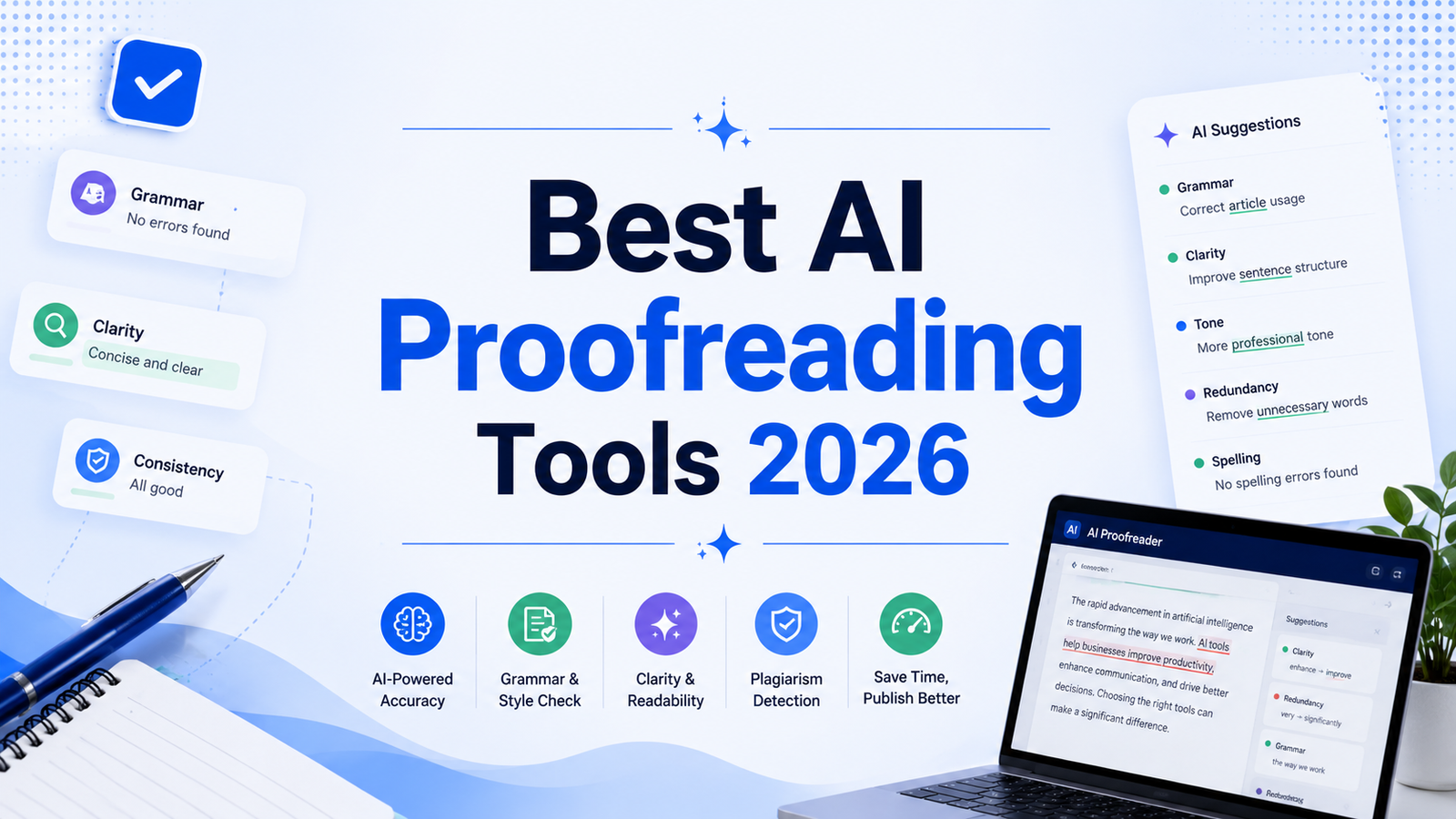
Best AI Proofreading Tools 2026: Ranked, Reviewed and Compared
A misspelled word in a job application. An incorrect subject-verb agreement in a client proposal. A passive construction that buries accountability in a press release. Proofreading errors carry costs that are disproportionate to the effort required to prevent them, and most people have neither the time nor the attentiveness to catch every mistake in their own writing. AI proofreading tools exist to address that gap systematically.
The category has expanded significantly in 2026. Modern AI proofreaders catch 85 to 95 percent of common grammar, spelling, and punctuation errors in independent testing, compared to roughly 60 percent for the basic spellcheckers built into word processors. The best tools now layer corrections with style suggestions, tone detection, readability analysis, paraphrasing, plagiarism detection, and AI content identification in single integrated platforms.
What the category has also developed is meaningful specialization. Grammarly and LanguageTool excel at real-time cross-platform correction. ProWritingAid provides the deepest manuscript-level analysis for serious writers. Hemingway Editor focuses exclusively on readability. Wordtune specializes in sentence rewriting. QuillBot leads on paraphrasing. Ginger targets multilingual writers. PaperRater serves student academic submissions. Each tool is genuinely strongest at a specific job, and matching the tool to the task produces better outcomes than choosing the most popular option regardless of fit.
Our Take: Grammarly is the default but it’s not always the best choice. ProWritingAid goes deeper for long form content. QuillBot is better for paraphrasing. Which one you need depends entirely on what you’re writing.
Comparison Table: Best AI Proofreading Tools 2026
| Tool | Best For | Starting Price | Free Plan |
|---|---|---|---|
| Grammarly | Real-time cross-platform correction with tone detection | Free / $12/month (Pro, annual) | Yes |
| ProWritingAid | Deep manuscript analysis and structural editing for serious writers | Free (limited) / $10/month (Premium, annual) | Yes |
| QuillBot | Paraphrasing, academic reformulation, and citation generation | Free (125 words) / $8.33/month (Premium, annual) | Yes |
| Hemingway Editor | Readability scoring and sentence simplification | Free (web) / $19.99 one-time (desktop) | Yes |
| LanguageTool | Multilingual proofreading across 30-plus languages at the lowest paid price | Free (10K chars) / $5/month (Premium) | Yes |
| Wordtune | AI sentence rewriting and tone adjustment beyond grammar correction | Free (10 rewrites/day) / $9.99/month (Pro, annual) | Yes |
| Ginger | Grammar correction and translation for multilingual and non-native writers | Free / $13.99/month (Premium) | Yes |
| PaperRater | Academic proofreading and plagiarism checking for students | Free / $14.99/month (Premium) | Yes |
“Pricing is subject to change. Always verify current pricing on the tool’s official website before purchasing.”
Detailed Reviews
1. Grammarly
Best for professionals who want always-on writing quality monitoring across every surface they write on.
Grammarly is the most widely adopted AI proofreading tool in the market with over 40 million users and deployments at 50,000-plus organizations. The browser extension activates across Gmail, Google Docs, Microsoft Word, Outlook, LinkedIn, Slack, WordPress, and essentially every web-based text field after a single installation. Grammar, punctuation, clarity, and tone corrections appear in real time without requiring any workflow change.
The 2026 Pro plan, which merged the previous Premium and Business tiers in the May 2025 restructure, provides full advanced writing suggestions, tone detection, GrammarlyGO AI rewrites (2,000 prompts per month), plagiarism detection, Brand Voice for teams, and an AI Humanizer feature for converting AI-generated text toward more natural phrasing. For business professionals and teams producing high volumes of client-facing communications, the combination of ubiquitous platform coverage and brand consistency tools justifies the subscription.
Key Features: Real-time grammar, punctuation, and clarity correction across 500-plus integrated platforms, tone detection for professional and client communications, GrammarlyGO with 2,000 monthly rewrite prompts on Pro, plagiarism detection, Brand Voice for team-wide style consistency, AI Humanizer with voice training, and desktop app for Windows and Mac.
Pros:
- Unmatched cross-platform coverage; works everywhere professionals write with no workflow interruption
- Tone detection catches unintentional communication register problems before messages are sent
- Pro plan at $12 per month (annual) is accessible for individual professionals
- 40 million-plus users means the most extensive community documentation and support resources
Cons:
- Desktop app has documented performance issues including high RAM consumption and occasional system slowdowns on older hardware
- Auto-renewal billing at full rate after promotional pricing has generated consistent user complaints; set a calendar reminder
- Not the strongest tool for manuscript-level structural analysis; pairs with ProWritingAid for that need
- Monthly billing at $30 per month is expensive; annual commitment required for the reasonable per-month rate
Pricing:
- Free: Basic grammar and spelling, 100 AI prompts/month
- Pro: $30/month ($12/month annual), full AI suite, plagiarism detection, Brand Voice
2. ProWritingAid
Best for authors, serious writers, and anyone producing long-form content who needs the deepest editorial analysis available beyond real-time correction.
ProWritingAid is the structural editor that Grammarly is not. Its 20-plus in-depth writing reports cover pacing, sentence length variation, dialogue authenticity, cliche density, readability across different audiences, overused words, passive voice patterns, and the Virtual Beta Reader feature that provides fiction-level story structure feedback. For authors, non-fiction writers, and content professionals producing documents above 2,000 words, these structural reports surface quality issues that sentence-level correction tools cannot identify.
The lifetime plan at $399 is the most important pricing detail: it provides all current and future Premium features at a one-time cost that becomes more economical than Grammarly’s annual subscription within three years. For committed writers who know they will use a writing tool indefinitely, this lifetime option removes the ongoing subscription overhead that makes tool fatigue common.
Key Features: 20-plus in-depth writing reports including pacing, consistency, dialogue, and readability, Virtual Beta Reader for fiction structure feedback, real-time in-document corrections in Scrivener, Word, and Google Docs, plagiarism checker with 16 billion-word comparison database, style guide enforcement, and lifetime plan option.
Pros:
- Deepest manuscript analysis available; 20-plus reports cover quality dimensions that Grammarly does not reach
- Virtual Beta Reader is uniquely valuable for fiction writers seeking story-level structural feedback
- Lifetime plan at $399 eliminates ongoing subscription costs for committed writers
- Scrivener integration is uniquely valuable for fiction writers using that workflow
Cons:
- Steeper learning curve than Grammarly; interface density can overwhelm new users
- Less effective for short-form professional communications where Grammarly’s real-time cross-platform coverage is more practical
- Premium plan at $10 per month (annual) is cheaper than Grammarly but still limited compared to the lifetime value of the one-time purchase
Pricing:
- Free: Limited daily usage, basic suggestions
- Premium: $10/month (annual), full 20-plus reports
- Premium Pro: $24/month (annual), additional features
- Lifetime: $399 one-time, all current and future Premium features
3. QuillBot
Best for academic writers, students, and content professionals who need sophisticated paraphrasing alongside grammar and plagiarism checking.
QuillBot’s paraphraser is the strongest purpose-built paraphrasing engine in the market, and for the specific academic and content use case of reformulating text while preserving meaning, it outperforms any alternative at comparable pricing. The ten paraphrasing modes, including Academic, Formal, Simple, Creative, and Shorten, cover every reformulation need. The synonym slider controls how extensively the output diverges from the source, and freeze words lock terms that must not change.
The Citation Generator in APA, MLA, Chicago, and other academic formats from DOI or URL is genuinely unique on this list and alone provides significant value for students producing research papers. Combined with the plagiarism checker bundled in Premium rather than sold as an add-on, QuillBot provides the most complete academic writing toolkit at its price point.
Key Features: Paraphraser with ten modes and synonym slider, Citation Generator across APA, MLA, Chicago, and other formats, plagiarism checker included in Premium subscription, Summarizer with Custom Mode, AI Content Detector, Grammar Checker, and Chrome extension and Word add-in for inline operation.
Pros:
- Best paraphrasing quality for controlled text transformation on the market
- Citation Generator is unique among proofreading tools and provides significant academic value
- Premium at $8.33 per month (annual) is 31 percent cheaper than Grammarly at comparable tier
- Plagiarism checker bundled in Premium rather than sold as a separate add-on
Cons:
- Free plan’s 125-word paraphrasing cap is too restrictive for practical professional use
- Grammar checker is less comprehensive than Grammarly or ProWritingAid for pure correction depth
- November 2025 privacy policy change allows storage of desktop text inputs; use with caution for sensitive content
- Not a real-time cross-platform correction tool; primarily a deliberate rewriting application
Pricing:
- Free: 125 words/session for paraphrasing, basic grammar
- Premium: $19.95/month ($8.33/month annual), unlimited paraphrasing, all ten modes, plagiarism checker
- Student: Approximately $74.95/year with student verification
4. Hemingway Editor
Best for writers who want to evaluate and improve the readability and clarity of their prose without AI generating replacement text.
Hemingway Editor operates on a distinct philosophy: it does not suggest corrections. It surfaces problems and lets the writer decide. The grade-level readability score shows whether a text reads at grade 6 or grade 16. Color-coded highlights identify hard-to-read sentences (yellow), very hard-to-read sentences (red), adverbs that could be cut (blue), passive voice constructions (green), and overly complex words with simpler alternatives (purple). The writer then rewrites manually using the highlighted guidance.
This manual-improvement approach makes Hemingway uniquely effective for writers who want to develop their own editing instincts rather than rely on AI substitutions. For persuasive writing, business communications, and journalism where clear, direct prose is the professional standard, the readability analysis produces measurable improvement in final output quality.
The web-based version is completely free. The desktop app at $19.99 is a one-time purchase with no subscription, making it the best lifetime value per feature on this list.
Key Features: Grade-level readability scoring, color-coded sentence difficulty highlighting, passive voice identification, adverb flagging, complex word suggestions, word and sentence count tracking, and direct publishing to WordPress and Medium from the desktop app.
Pros:
- Web version is completely free with full readability functionality
- Desktop app at $19.99 is a one-time purchase with no subscription; the best long-term value on this list
- Readability scoring develops the writer’s own editing judgment rather than substituting AI text
- Color-coded highlights make problem identification visually immediate
- No account required for the web version; paste and check in 30 seconds
Cons:
- Does not catch grammar errors, spelling mistakes, or punctuation issues; requires pairing with a grammar tool
- No cross-platform integration or browser extension; content must be pasted into the editor
- AI suggestions are limited in the desktop version; the tool is primarily an analysis interface
- Strict readability rules can flag intentional stylistic choices; use judgment rather than following every suggestion
Pricing:
- Web version: Free, full readability analysis, no account required
- Desktop app: $19.99 one-time purchase, offline use, WordPress/Medium integration
5. LanguageTool
Best for multilingual writers and international teams who need grammar checking in 30-plus languages at the lowest paid price in the category.
LanguageTool is the most cost-effective proofreading tool in this comparison at $5 per month for Premium, less than half the annual rate of Grammarly’s Pro plan. For multilingual users who write professionally in German, French, Spanish, Portuguese, Dutch, or any of 30-plus supported languages, LanguageTool catches language-specific errors that English-only tools cannot identify. The browser extension covers Chrome, Firefox, and Edge; integration with LibreOffice and MS Word handles desktop documents.
The open-source foundation is relevant for privacy-conscious users: LanguageTool offers an on-premise enterprise deployment option that processes text locally without cloud transmission, which is the only such option among major proofreading tools. For organizations with data residency requirements, this is a meaningful differentiator.
Key Features: Grammar, style, and punctuation checking across 30-plus languages with dedicated language rules, browser extension for Chrome, Firefox, and Edge, LibreOffice and Microsoft Word integration, on-premise deployment option for enterprise privacy requirements, style guide enforcement on Premium, and AI-powered paraphrasing features that continue to mature in 2026.
Pros:
- Best multilingual proofreading support; 30-plus languages with dedicated grammar rules rather than translation
- Premium at $5 per month is less than half the price of Grammarly at comparable annual rates
- On-premise deployment option is unique among major proofreading tools for data privacy needs
- Free tier handles 10,000 characters per check, functional for shorter documents
- Open-source foundation provides transparency about language rules and an active community
Cons:
- Style suggestions less comprehensive than Grammarly or ProWritingAid for advanced English writing quality
- AI paraphrasing features are still maturing compared to QuillBot or Wordtune
- Interface is functional but less intuitive and visually polished than Grammarly
- English grammar checking accuracy is slightly below Grammarly in independent comparisons
Pricing:
- Free: 10,000 characters per check, basic corrections
- Premium: $5/month (individual), full corrections, style guide, advanced rules
- Team: $25/month, team management and shared style guides
6. Wordtune
Best for writers who need AI to help them rewrite sentences to express ideas more clearly, concisely, or in a different tone, beyond traditional proofreading.
Wordtune occupies a distinct position in this category: it is less a proofreader and more a sentence-level writing partner. Where Grammarly identifies errors and LanguageTool flags incorrect constructions, Wordtune takes a grammatically correct sentence and offers multiple alternative ways to express the same idea, with controls for making it shorter, longer, more casual, or more formal. For non-native English speakers, this is particularly valuable: the ability to see five different natural-sounding ways to express an idea builds fluency and confidence in ways that error correction alone does not provide.
The AI Spices feature suggests data points, examples, and elaborations to support a sentence that is factually or evidentially thin. For content writers who struggle with expanding ideas beyond their initial draft, this feature addresses a genuine writing bottleneck that standard proofreaders do not touch.
Key Features: Sentence rewriting with multiple alternative options per sentence, tone controls for more casual or more formal register, length controls for shorter or longer alternatives, AI Spices for suggesting supporting evidence and elaborations, basic grammar and spelling correction, multilingual support across 10-plus languages, and integration with Google Docs, Microsoft Word, and Gmail.
Pros:
- Best sentence rewriting quality for expressing ideas in natural, varied English
- Particularly valuable for non-native speakers who want to see multiple idiomatic options
- AI Spices addresses content development beyond the proofreading use case
- Free plan with 10 rewrites per day allows genuine evaluation before commitment
- Pro at $9.99 per month (annual) is accessible for regular professional use
Cons:
- Grammar checking is secondary to rewriting; not the strongest pure grammar correction tool
- Less suitable than Grammarly for always-on background proofreading across multiple platforms
- AI rewriting adds an active user step; does not operate passively like Grammarly’s extension
- Premium at $24.99 per month for the full feature set is the highest monthly tier on this list
Pricing:
- Free: 10 rewrites/day, basic features
- Pro: $9.99/month (annual), unlimited rewrites, full features
- Premium: $24.99/month (annual), advanced AI and priority features
7. Ginger
Best for non-native English speakers and multilingual professionals who need grammar correction, sentence rephrasing, and translation in one tool.
Ginger Software has positioned itself specifically for multilingual communication, and its translation feature supporting 40-plus languages alongside grammar correction is the combination that makes it most relevant for writers whose primary language is not English. The sentence rephrasing function suggests alternative constructions that improve clarity, similar to Wordtune but with broader language coverage. The text reader converts written content to audio for proofreading by listening, which some writers find more effective for catching errors than visual review.
The mother tongue detection feature, which identifies error patterns associated with speakers of specific primary languages, is particularly helpful for non-native writers who make consistent language-transfer errors that standard grammar tools flag but do not specifically address.
Key Features: Real-time grammar, punctuation, and spelling correction, sentence rephrasing for improved clarity and style, translation across 40-plus languages integrated directly into the editor, text-to-speech for audio proofreading, mother tongue error detection for non-native speakers, Chrome and Firefox extensions, and desktop and mobile apps.
Pros:
- Translation integrated alongside grammar correction is unique on this list for multilingual workflows
- Mother tongue error detection specifically addresses non-native speaker patterns
- Text-to-speech proofreading mode catches errors that visual review misses for some writers
- Mobile app enables correction on the go without a desktop requirement
Cons:
- Grammar correction accuracy trails Grammarly in direct comparisons on independent testing of identical text
- Premium at $13.99 per month is higher than LanguageTool at $5 per month for multilingual support that is the primary value driver
- Interface and extension updates have lagged behind competitors; less polished than Grammarly or Wordtune
- Less suitable than Grammarly for pure English professional writing where translation and mother tongue features are irrelevant
Pricing:
- Free: Basic grammar correction with limited features
- Premium: $13.99/month ($7.49/month annual), full grammar suite, translation, rephrasing
8. PaperRater
Best for students submitting academic work who need grammar checking, plagiarism detection, and writing score assessment optimized for academic contexts.
PaperRater is purpose-built for academic writing evaluation. Upload a document and receive a grammar check, plagiarism report, vocabulary enhancement suggestions, and an overall writing score calibrated to academic standards rather than professional business writing. The plagiarism checker processes against an academic content database that covers journal articles and academic publications alongside general web content, making it specifically relevant for students concerned about accidental similarities to academic source material.
The interface is simple to the point of being minimal, which is appropriate for its primary use case: students who want a quick, accessible academic writing check before submission without learning a complex platform. PaperRater does not install a browser extension or integrate with word processors; it is a web-based submission checker.
Key Features: Academic-calibrated grammar and style checking, plagiarism detection against web and academic content databases, overall writing score on an academic quality scale, vocabulary enhancement suggestions, part-of-speech analysis, and simple file upload or paste interface.
Pros:
- Specifically calibrated for academic writing contexts; appropriate for student submissions
- Plagiarism checking covers academic publication databases relevant to student source concerns
- Simple web-based interface requires no installation or account for basic use
- Free plan provides meaningful functionality for light academic checking
Cons:
- Less comprehensive grammar correction than Grammarly or LanguageTool for professional writing
- Limited to web-based document submission; no real-time correction or cross-platform integration
- Premium at $14.99 per month provides limited additional value over the free plan for casual users
- Better specialized academic tools exist (Paperpal, Trinka) for research-heavy academic writing requiring journal-quality editing
Pricing:
- Free: Basic grammar, plagiarism check, writing score (limited monthly use)
- Premium: $14.99/month ($7.95/month annual), unlimited checks, advanced features
Frequently Asked Questions
Is a free proofreading tool good enough for professional writing?
For casual personal use, the free tiers of Grammarly, LanguageTool, and Hemingway Editor collectively cover the most important quality checks at zero cost. Grammarly Free handles real-time basic grammar across all platforms. Hemingway Free handles readability analysis in the browser. LanguageTool Free checks up to 10,000 characters per session for multilingual needs. The combination addresses grammar, readability, and multilingual correction without spending anything. Free tiers become inadequate when professional requirements include plagiarism checking, deep style analysis, unlimited word counts, tone controls, advanced AI rewriting, or team-level brand consistency enforcement. For individual professionals producing daily client-facing content, the paid tier of at least one tool typically pays for itself in avoided communication failures within the first month. The recommended starting approach is installing Grammarly Free and Hemingway Web for one week on actual professional writing, then evaluating which specific paid features your volume and quality requirements justify before subscribing.
What is the most effective proofreading workflow for professional content?
The three-pass approach recommended by experienced content professionals in 2026 produces consistently better results than running a single tool once. First pass: run a grammar-focused tool such as Grammarly or LanguageTool to correct technical errors. This ensures correctness before evaluating style. Second pass: run a readability check in Hemingway Editor to identify sentences that are too complex for the target audience’s reading level. Simplifying these before the final polish prevents the problem of correct but difficult prose. Third pass: review for tone using Grammarly’s tone detector or Wordtune’s register suggestions to ensure the communication register matches the audience and context. This three-pass sequence catches different categories of quality problems at each stage rather than trying to address everything simultaneously in one review. For high-stakes content like proposals, reports, and important client communications, this sequence takes approximately 10 to 15 minutes and prevents the categories of error that single-pass proofreading consistently misses.
Which proofreading tool is best for non-native English speakers?
LanguageTool and Ginger both specifically address non-native speaker needs, but for different reasons. LanguageTool’s mother tongue error detection identifies patterns associated with speakers of specific primary languages, and its 30-plus language support means multilingual writers who alternate between languages within a workflow get consistent assistance. It is also the cheapest option at $5 per month for Premium. Ginger adds translation support across 40-plus languages integrated directly into the grammar correction interface, which is valuable for writers who need to switch between languages or check that a translated passage reads naturally in English. Wordtune provides a third option with different value: rather than correcting non-native speaker errors, it shows multiple natural ways to express the same idea in English, which builds fluency over time rather than just flagging mistakes. For non-native speakers whose primary goal is writing that sounds native rather than just technically correct, Wordtune’s sentence alternatives provide a different kind of value that error correction cannot replicate.
Final Recommendation
The right proofreading stack in 2026 depends on your writing type, volume, and primary quality goal.
For most professionals and business writers, Grammarly Pro at $12 per month annually is the baseline recommendation. The ubiquitous cross-platform coverage, tone detection, and AI rewriting suite address the widest range of professional writing quality needs without requiring multiple tool subscriptions or workflow changes.
For authors and serious long-form writers, ProWritingAid Premium at $10 per month (or the lifetime plan at $399) provides structural manuscript analysis depth that Grammarly does not reach. The two tools complement rather than duplicate each other for writers who produce both professional communications and long-form creative or non-fiction work.
For students and academic writers, QuillBot Premium at $8.33 per month provides the paraphrasing, citation generation, and plagiarism checking combination that addresses the specific workflow of academic writing. The student annual plan at approximately $74.95 per year is the most cost-effective option for regular academic use.
For multilingual writers and international teams, LanguageTool Premium at $5 per month is the clearest recommendation on value and feature fit. No competing tool covers 30-plus languages with dedicated grammar rules at that price.
For writers focused on developing clearer, more direct prose rather than just correcting errors, the Hemingway Editor web version is free and should be in every professional writer’s toolkit regardless of which other tools are in use.
The practical starting point: install Grammarly Free and use Hemingway Editor online for two weeks on actual writing tasks. Upgrade Grammarly to Pro when the feature ceiling of the free tier becomes a consistent constraint. Add ProWritingAid for long-form work when structural analysis beyond grammar correction becomes a documented quality need.