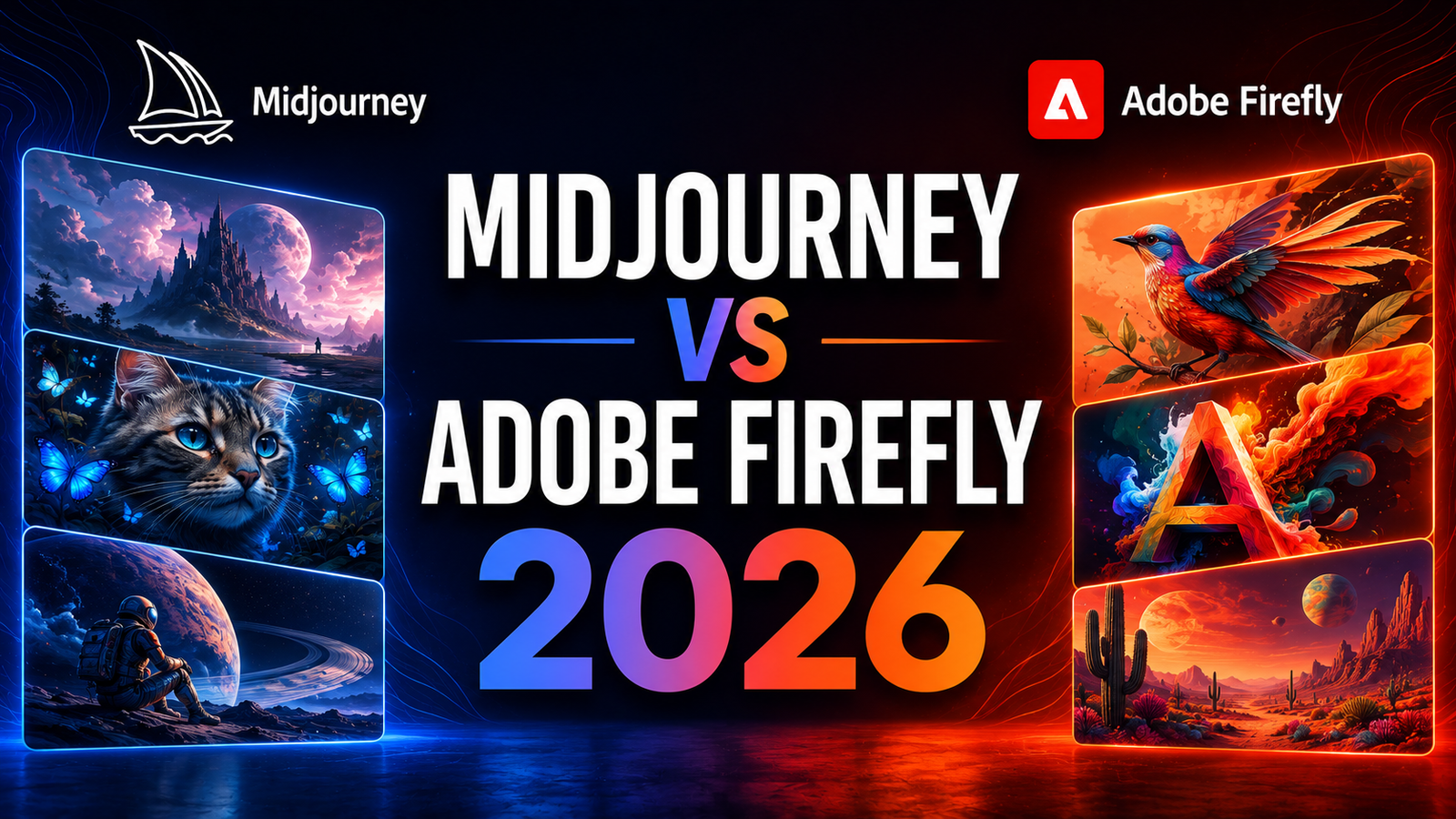
Midjourney vs Adobe Firefly 2026: Which AI Image Generator Is Worth Your Money?
Two tools. Two completely different philosophies. One question that runs through every design team in 2026: which one earns a place in a professional workflow?
Midjourney and Adobe Firefly are not competing to do the same thing. They represent fundamentally different answers to what AI image generation is for. Midjourney is built for artistic quality and creative expression. Adobe Firefly is built for commercial safety and professional workflow integration. Choosing the wrong one for your use case costs money, or quality, or legal exposure, depending on which mistake you make.
This comparison covers both tools as they stand in 2026 including Midjourney V8.1, launched April 30, 2026, and Firefly’s expanded suite including Quick Cut video editing, Firefly Boards for collaborative ideation, and the multi-model marketplace.
Side-by-Side Comparison Table
| Feature | Midjourney | Adobe Firefly |
|---|---|---|
| Primary strength | Artistic quality and aesthetic depth | Commercial safety and Creative Cloud integration |
| Free tier | No (discontinued April 2023) | Yes (25 credits/month) |
| Starting price | $10/month (Basic, annual) | $9.99/month (Standard) or free with CC subscription |
| Training data | Undisclosed, ongoing litigation | Licensed Adobe Stock + public domain only |
| Commercial indemnification | No | Yes (paid subscribers) |
| Generative Fill in Photoshop | No | Yes |
| Text rendering in images | Improved in V8, still imperfect | Best in class |
| Video generation | Yes (still images to 5-second clips) | Yes (Firefly Video, Quick Cut) |
| Photoshop integration | No | Native |
| Multi-model marketplace | No | Yes (Google, OpenAI, FLUX.2) |
| Content Credentials | No | Yes |
| Stealth Mode (private gen) | Pro plan only ($60/month) | All paid plans |
| API access | No | Yes (Firefly Services) |
| Collaborative canvas | No | Yes (Firefly Boards) |
| Best for | Artists, concept designers, creative studios | Agencies, enterprise, Creative Cloud users |
“Pricing is subject to change. Always verify current pricing on the tool’s official website before purchasing.”
Midjourney: Detailed Breakdown
For the full feature-by-feature review, see our Midjourney Review 2026.
What It Is
Midjourney is the artistic benchmark for AI image generation. V8.1, released April 30, 2026, delivers native 2K resolution, generation speeds 4 to 5 times faster than earlier versions, and meaningfully improved text rendering. Style References allow applying a consistent aesthetic across multiple generations. Omni Reference maintains character identity across separate generations for multi-image projects.
The platform operates at midjourney.com as a full web application, with Discord still available as a secondary interface. There is no API, no Photoshop integration, and no third-party model access. The focus is entirely on generating the highest-quality artistic images from text prompts.
Key Features
V8.1 native 2K resolution at speed. Standard jobs complete in under 10 seconds at native 2K resolution. The “Run as HD” button re-renders any standard image at higher resolution without re-entering the prompt. Premium V8 features including –hd and –q 4 cost 4x more GPU time than standard jobs; understand this before choosing a plan based on credit volume.
Omni Reference for character consistency. Uploading a reference image maintains visual consistency of a character, object, or design element across multiple generations. For commercial creative work requiring a consistent visual subject across a campaign, this is Midjourney’s most practically significant professional feature.
Style Reference system. Style codes and Style References allow one image’s aesthetic to be applied to new prompts. For creators building a consistent visual language across a project, this system reduces the prompt engineering required to maintain aesthetic coherence.
The artistic quality ceiling. Independent testing across AI image tools consistently rates Midjourney highest for cinematic lighting, texture richness, and compositional sophistication. For images where visual impact is the primary metric, nothing else matches its ceiling.
Pros
- Highest artistic quality ceiling of any AI image generator in independent comparisons
- V8.1 native 2K resolution at high generation speed makes the quality premium practical for daily use
- Style Reference and Omni Reference enable professional-grade visual consistency across campaigns
- Standard plan at $30/month with unlimited Relax Mode generation is strong value for high-volume creative work
Cons
- No free trial; $10/month minimum before generating a single image
- No API access; cannot integrate Midjourney programmatically into external workflows
- No commercial copyright indemnification; training data litigation is ongoing
- Stealth Mode for private generation requires the $60/month Pro plan
- No Photoshop or any Adobe integration; requires a separate editing workflow
Pricing
- Basic: $10/month ($8/month annual), 3.3 Fast GPU hours
- Standard: $30/month ($24/month annual), 15 Fast GPU hours plus unlimited Relax Mode
- Pro: $60/month ($48/month annual), Stealth Mode, 30 Fast GPU hours
- Mega: $120/month ($96/month annual), 60 Fast GPU hours, team priority
Adobe Firefly: Detailed Breakdown
For the full feature-by-feature review, see our Adobe Firefly Review 2026.
What It Is
Adobe Firefly has expanded well beyond its original text-to-image roots. In 2026 it functions as a creative AI operating system rather than a single generation tool: text to image, generative video, AI-powered first-cut video editing via Quick Cut, collaborative ideation in Firefly Boards, and a multi-model marketplace that adds partner models from Google, OpenAI, and Black Forest Labs alongside native Firefly models.
The defining characteristic that shapes every other comparison point is the training data. Firefly was trained exclusively on Adobe Stock images with contributor consent, openly licensed content, and public domain works. This is not just an ethical position. It produces a direct practical benefit: Adobe provides commercial copyright indemnification to paid subscribers. Legal teams can approve Firefly outputs. Agencies and enterprises do not have to guess.
Key Features
Commercial copyright indemnification. Adobe accepts legal responsibility for copyright claims on Firefly-generated content used by paid subscribers. This is the only major AI image generator offering this protection. In practice, multiple independent reviewers describe enterprise clients explicitly rejecting Midjourney generated assets during legal review while Firefly output passed without friction. That asymmetry is not theoretical.
Generative Fill and Generative Expand in Photoshop. These in-application editing features allow selecting any area of an existing image and describing changes in natural language: remove an object, replace a background, extend a canvas, add a new element. The integration is native to Photoshop, which means the AI editing happens inside the same application where the rest of the design workflow occurs. Midjourney has no equivalent.
Text rendering. Firefly renders readable text within images more reliably than any other major AI image generator. For social media graphics, marketing materials with copy, and any commercial image requiring legible text as part of the composition, this capability produces usable results where Midjourney still struggles.
Multi-model marketplace. Firefly subscribers can access partner models from Google, OpenAI, and Black Forest Labs (FLUX.2) alongside native Firefly models within a single subscription. For designers who want access to model variety without managing multiple separate subscriptions, this marketplace provides meaningful flexibility.
Quick Cut video editing and Firefly Boards. Quick Cut, launched February 25, 2026, takes uploaded raw footage and assembles a structured first edit automatically. Firefly Boards provides a collaborative AI ideation canvas where teams generate and iterate on images and videos on a shared surface. Neither capability has a Midjourney equivalent.
Pros
- Only major AI image generator with commercial copyright indemnification for paid subscribers
- Generative Fill in Photoshop is transformative for professional photo retouching and composite work
- Best text rendering within images of any tool in this comparison
- Free tier with 25 monthly credits allows genuine evaluation before payment
- Multi-model marketplace access to Google, OpenAI, and FLUX.2 models within one subscription
- Unlimited standard image generations on all paid plans without credit depletion
Cons
- Raw artistic quality for stylized creative work trails Midjourney’s ceiling for cinematic and highly atmospheric images
- Content guardrails restrict certain categories that can create friction in some commercial design workflows
- Full value realized primarily by Creative Cloud subscribers; standalone Firefly users get less from Photoshop-integrated features
- Video generation credits (consumed at 20 credits per second of video) deplete quickly for video-heavy workflows
Pricing
- Free: 25 generative credits/month, basic access
- Standard: $9.99/month, 2,000 credits, unlimited standard generations, commercial rights
- Pro: $19.99/month, 4,000 credits, partner model access, priority generation
- Creative Cloud All Apps: $59.99/month, includes Firefly credits plus all Adobe applications
Head-to-Head Comparison
Artistic Image Quality Midjourney wins. For cinematic lighting, texture depth, atmospheric composition, and the aesthetic sophistication that distinguishes concept art and editorial imagery, Midjourney V8.1 consistently produces more visually striking results than Firefly. This is where Midjourney earns every dollar of its subscription.
Commercial Safety Adobe Firefly wins decisively and without contest. The commercial indemnification that Adobe provides to paid subscribers is a structural legal protection that Midjourney cannot match given its undisclosed training data and ongoing litigation. For agency work, enterprise clients, and any context where legal teams review AI-generated assets, Firefly is the only defensible choice.
Text Rendering Adobe Firefly wins clearly. Midjourney V8 improved text rendering significantly over V7, but Firefly produces reliably legible text in images while Midjourney still produces inconsistent results for text-heavy compositions.
Workflow Integration Adobe Firefly wins for Creative Cloud users. Generative Fill inside Photoshop, Generative Expand, and native editing tools connect AI generation directly to the professional design workflow without tool-switching. For designers not using Creative Cloud, this advantage disappears entirely.
Pricing Accessibility Adobe Firefly wins. The 25-credit free tier allows genuine evaluation before payment. Midjourney requires payment before generating a single image.
Generation Volume Midjourney Standard wins for high-volume creative work. Unlimited Relax Mode on the $30/month plan means effectively unlimited V7 generation without credit caps. Firefly standard image generation is also unlimited on paid plans, but video and premium partner model usage depletes credits.
Who Should Choose Each Tool
Choose Midjourney if:
- Artistic quality and visual impact are the primary criteria for your generated imagery
- You work in concept art, editorial, brand campaigns, or any context where aesthetic sophistication matters more than legal defensibility
- You need character consistency across multiple images through Omni Reference
- You are an individual creator or independent studio whose clients do not require formal IP clearance
- High-volume creative generation is your workflow and Standard’s unlimited Relax Mode covers your needs
Choose Adobe Firefly if:
- Commercial copyright indemnification is required by your clients or your organization’s legal review process
- Your workflow is built around Photoshop, Illustrator, or Adobe Creative Cloud and native integration eliminates tool-switching
- You need reliable text rendering within images for marketing materials, social graphics, or advertising
- You want to evaluate before paying; the 25-credit free tier is meaningful
- Enterprise, agency, or regulated industry compliance requirements make Midjourney’s undisclosed training data legally problematic
Frequently Asked Questions
Can I use Midjourney commercially, and what are the actual risks?
Midjourney’s current terms permit commercial use of generated images for most paid subscribers. The legal risk is not in the commercial use terms; it is in the training data. Midjourney does not disclose its training data sources and faces ongoing lawsuits from artists claiming unauthorized use of their work. For most independent creators and small businesses, this risk is theoretical and manageable. For agencies serving enterprise clients whose legal teams conduct IP reviews, or for organizations in regulated industries, the undisclosed training data creates real compliance friction that Firefly’s indemnification resolves. The honest assessment: millions of creators use Midjourney commercially without legal issue daily. The risk is real, not inevitable, and scales with the commercial stakes of the specific use case.
Do many professionals use both tools, and what does that workflow look like?
Yes, and it is the most commonly recommended approach for creative teams with both artistic and commercial output requirements. The workflow that independent reviewers and practitioners consistently describe: Midjourney for concept exploration, mood boarding, and the visual ideas that are too stylistically ambitious for Firefly’s more constrained training. Adobe Firefly for production assets, client deliverables where IP clearance is required, and any image editing through Photoshop’s Generative Fill that would otherwise require additional software. One practitioner summarized this cleanly: “Midjourney is where ideas are born. Firefly is where deliverables get approved.” At $30 for Midjourney Standard plus $9.99 for Firefly Standard, the combined subscription at $39.99 per month covers both needs with meaningful capability in each lane.
Is Adobe Firefly improving fast enough to close the artistic quality gap with Midjourney?
Firefly has improved substantially and continuously. Skin textures, lighting, and human portrait generation in 2026 are meaningfully better than in 2024. However, the honest independent assessment is that Midjourney’s artistic quality ceiling still leads for highly stylized, atmospheric, and cinematic imagery. Firefly’s training on commercially licensed content, while the source of its legal defensibility, also limits the aesthetic range it can explore. Midjourney’s unconstrained training data is part of why it can produce visuals that feel genuinely surprising and distinctive. The gap is narrowing. It has not closed. For standard commercial photography and product imagery, Firefly is competitive and sometimes preferred for its predictability and text rendering. For the creative work where AI image generation shows what is not possible by conventional means, Midjourney still leads.
Final Verdict
This is the clearest two-tool comparison in AI image generation because the use cases genuinely do not overlap as much as the category description suggests.
Adobe Firefly is the right choice for agencies, enterprise teams, Creative Cloud users, and any professional whose work requires commercial IP protection. The indemnification advantage is structural and decisive for that audience. The Photoshop integration is the best in-workflow AI editing available. The free tier makes evaluation low-risk. For the majority of commercial design work, Firefly is the more professionally appropriate tool.
Midjourney is the right choice for creators whose work is evaluated on visual impact rather than legal defensibility. The artistic quality ceiling has no competitor. V8.1’s speed makes that quality practical for daily production workflows. For concept artists, visual directors, editorial designers, and any creator for whom aesthetically extraordinary output is the goal, Midjourney’s $30 Standard plan remains the most valuable subscription in AI image generation.
The practical advice for most creative teams: use Firefly for production assets requiring legal clearance, use Midjourney for the creative work where quality and artistic ambition are the primary criteria.
Midjourney Rating: 4.5 / 5 — Best for artistic quality and visual impact.
Adobe Firefly Rating: 4.4 / 5 — Best for commercial safety, Creative Cloud integration, and enterprise workflows.