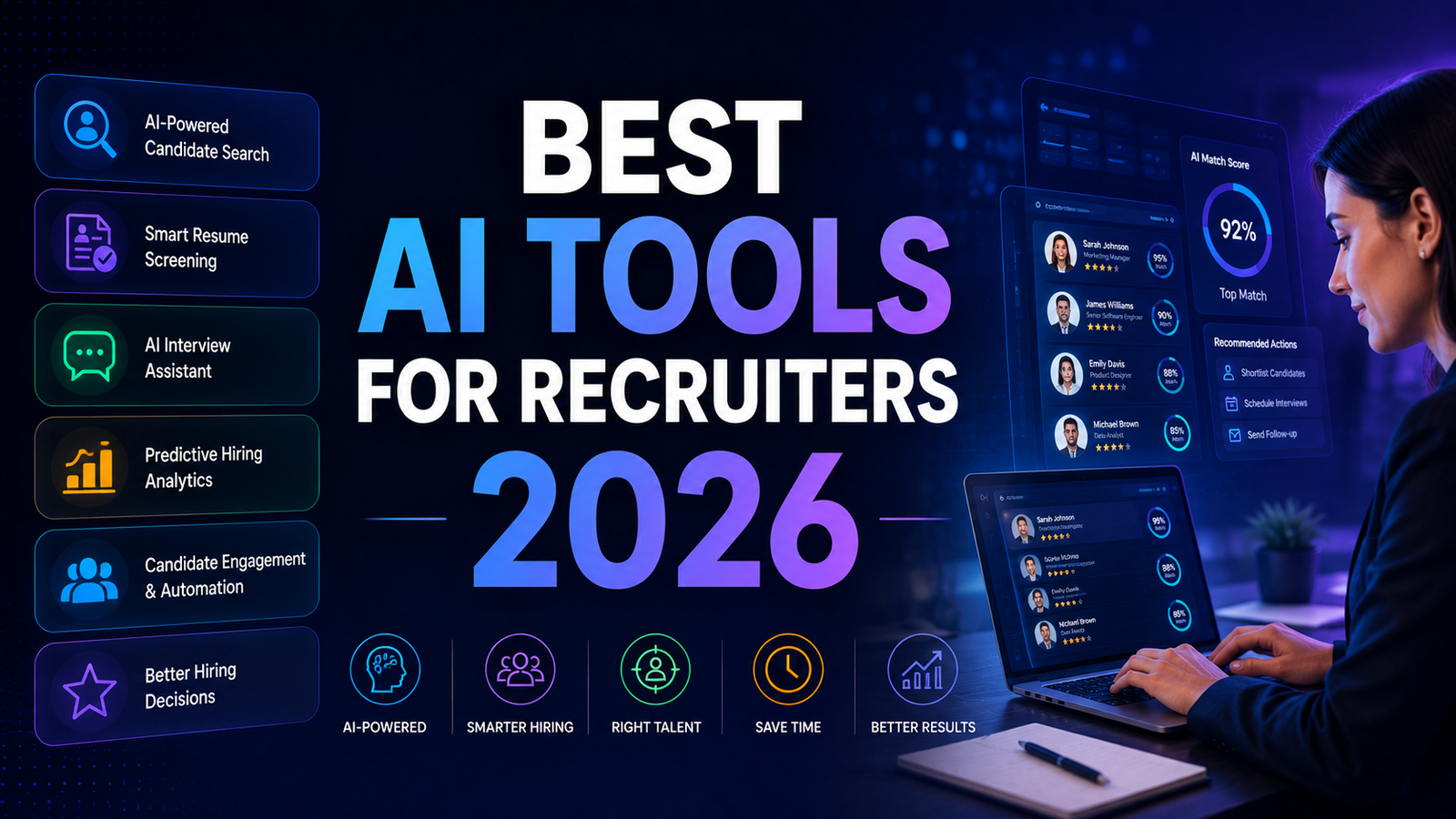
Best AI Tools for Recruiters 2026: Ranked by Someone Who Actually Worked in Recruiting
Recruiting has a speed problem. The average time-to-fill an open role sits at 44 days in 2026. The average recruiter spends 30 percent of their week on scheduling, 25 percent on manual candidate sourcing, and another 20 percent on resume screening that could be automated. That leaves less than one-third of working hours for the relationship-building, candidate assessment, and hiring manager consultation that actually require human judgment.
As someone who’s worked in recruiting for over 10 years, i can tell you first hand that AI is not replacing recruiters. It is absorbing the mechanical overhead that prevents good recruiters from doing what they are actually good at. According to the World Economic Forum Future of Jobs Report, 75 percent of companies plan to adopt AI in hiring by 2027. SHRM research shows nearly one in four organizations already use AI for recruiting tasks. Platforms like Paradox cut recruiter phone screening time by 60 to 80 percent. Eightfold AI has enabled companies to fill 40 percent of open roles with internal candidates they would otherwise have missed. HireVue processes video interviews at scale, applying structured assessment to thousands of candidates consistently.
The tools in this guide cover the full recruiting workflow from sourcing through screening, assessment, scheduling, and the professional communication work that surrounds every hire.
Comparison Table: Best AI Tools for Recruiters 2026
| Tool | Best For | Starting Price | Free Trial |
|---|---|---|---|
| HireVue | Enterprise video interviewing and structured skills assessment at scale | $35,000+/year | No (demo) |
| Paradox (Olivia) | High-volume conversational AI screening, scheduling, and candidate communication | $1,000+/month | No (demo) |
| Eightfold AI | Enterprise talent intelligence across sourcing, internal mobility, and skills-based hiring | $7-10/employee/month | Limited demo |
| Fetcher | Mid-market automated passive candidate sourcing with email outreach sequences | From $379/month | No (demo) |
| Greenhouse AI | Structured, compliant hiring workflows for mid-market to enterprise teams | Custom (ATS pricing) | No (demo) |
| ChatGPT | Job description drafting, candidate communications, and professional recruiting content | Free / $20/month (Plus) | Yes |
| Notion AI | Structured recruiting documentation, candidate pipeline tracking, and team knowledge | Free workspace / $20/month (Business) | Yes |
| LinkedIn Recruiter AI | Passive candidate sourcing with AI matching across the world’s largest professional network | $825/month (Recruiter Lite) | No |
“Pricing is subject to change. Always verify current pricing on the tool’s official website before purchasing.”
Detailed Reviews
1. HireVue
Best for enterprise teams hiring at scale who need consistent, structured video interview assessment across thousands of candidates.
HireVue is the category pioneer in AI-powered video interviewing, used by Unilever, Goldman Sachs, Hilton, and hundreds of other enterprise organizations. The platform presents candidates with standardized interview questions via asynchronous video, then applies industrial-organizational psychology models trained on 30 million-plus data points to evaluate responses against structured criteria. Game-based assessments and coding challenges extend HireVue beyond video into comprehensive pre-hire skills assessment.
The compliance story is important in enterprise recruiting AI. HireVue has been audited for adverse impact and is one of the few platforms with published bias audit documentation. For enterprise legal and HR teams that must defend hiring decisions, this transparency matters.
Key Features: Asynchronous AI video interview assessment, game-based cognitive and behavioral assessments, coding challenge evaluation, structured interview guides with competency scoring, adverse impact auditing and bias documentation, integration with Greenhouse, Workday, SAP SuccessFactors, and major ATS platforms.
Pros:
- Most validated enterprise video assessment platform with documented bias audits and 30M-plus data point training
- Game-based and coding assessments expand beyond video for technical and cognitive evaluation
- Reduces per-candidate assessment time from hours of live interviewing to minutes of asynchronous review
- Strong compliance documentation for enterprise legal review
Cons:
- $35,000-plus annual pricing is enterprise-only; not accessible for small or mid-market recruiting teams
- Candidate experience complaints are documented; some candidates report feeling the AI assessment is impersonal
- Implementation requires ATS integration work and recruiter training before productive deployment
- No self-serve access; full enterprise sales process required before evaluation
Pricing:
- $35,000+/year for enterprise; custom quotes based on volume
- Contact HireVue for current pricing
2. Paradox (Olivia)
Best for high-volume recruiting operations where conversational AI can automate screening, scheduling, and candidate communication across text, chat, and WhatsApp.
Paradox’s AI assistant Olivia sets the standard for conversational recruiting automation. She screens candidates against job requirements via text or web chat, schedules interviews by connecting to recruiter calendars without human involvement, answers candidate questions 24/7, and sends reminders and follow-ups automatically. Voice AI platforms like Paradox cut recruiter phone screening time by 60 to 80 percent and process three to five times more candidates per week than manual screening.
For retail, healthcare, logistics, and hospitality hiring at high volume, where a recruiter might screen 200 candidates per week for similar roles, Olivia handles the mechanical screening work continuously while recruiters focus on candidates who have already passed the initial filter.
Key Features: Conversational AI screening via text, web chat, and WhatsApp, automatic interview scheduling with calendar integration, 24/7 candidate communication and FAQ handling, multi-language support, integration with Workday, SAP, Greenhouse, iCIMS, and major ATS platforms, and analytics dashboards tracking funnel conversion at each screening stage.
Pros:
- 60 to 80 percent reduction in recruiter phone screening time documented across high-volume deployments
- 24/7 availability means candidates in any time zone engage without recruiter availability constraints
- Multi-channel operation across text, web chat, and WhatsApp covers candidate communication preferences
- Dramatically improves candidate experience for high-volume roles where slow response is a documented dropoff cause
Cons:
- $1,000-plus per month pricing requires volume to justify; underpowered for low-volume or specialized recruiting
- Conversational AI quality depends on the quality of role configuration and screening criteria; poorly configured roles produce poor screening results
- Not suitable for executive search, specialized technical roles, or any hiring where nuanced human conversation is required at the screening stage
Pricing:
- $1,000+/month; custom quotes based on hiring volume
- Contact Paradox for current rates
3. Eightfold AI
Best for large enterprises pursuing skills-based hiring who need AI talent intelligence across sourcing, screening, internal mobility, and workforce planning.
Eightfold’s deep-learning Talent Intelligence Platform goes beyond keyword matching. It infers skills from career trajectories, identifies adjacent capabilities that candidates have not explicitly listed, and predicts role fit based on career progression patterns rather than just job title matching. A Fortune 500 tech firm used Eightfold to identify internal candidates for 40 percent of open roles, saving $2 million in external recruiting fees. Eightfold is used by Chevron, Nutanix, and Vodafone for talent acquisition across 100-plus countries.
The 2026 updates focus on agentic workflows: auto-recommending talent pools based on emerging skills gaps before hiring managers have formally opened requisitions. This moves talent acquisition from reactive to predictive, which is the most significant shift in enterprise TA in 2026.
Key Features: Deep-learning skills inference from career trajectory rather than keyword matching, internal mobility matching identifying current employees for open roles, workforce planning and skills gap prediction, agentic talent pool recommendations before requisitions open, integration with Workday and SAP SuccessFactors, and G2 average of 4.7 out of 5 from 200-plus enterprise reviews.
Pros:
- Skills-based matching identifies qualified candidates who would fail keyword-based screening
- Internal mobility capability enables companies to fill roles from existing workforce before external search
- Predictive workforce planning addresses talent needs before they become urgent
- 4.7/5 G2 rating from enterprise users reflects genuine production satisfaction
Cons:
- $7 to $10 per employee per month scaling to $100,000-plus annually for large organizations
- Implementation and onboarding complexity noted consistently in user reviews
- Designed for large enterprises; not appropriate for teams under 500 employees
- Full value requires integration with existing HRIS and ATS, which adds implementation timeline
Pricing:
- $7-10/employee/month for mid-tier plans; custom enterprise pricing above that
- Contact Eightfold for current rates
4. Fetcher
Best for mid-market recruiting teams that need automated passive candidate sourcing and outreach without a dedicated sourcing team.
Fetcher searches across 800 million-plus professional profiles, curates batches of matched candidates against role specifications, and launches automated personalized email outreach sequences. The sourcing plus outreach combination in one workflow is the core value proposition: recruiting teams that previously needed a separate sourcer and a separate outreach tool can consolidate both into Fetcher’s workflow.
For teams filling multiple roles simultaneously where passive sourcing is the bottleneck, Fetcher’s batch curation model delivers a consistent pipeline of qualified candidates with minimal recruiter time investment per role.
Key Features: AI-powered passive candidate sourcing across 800M-plus profiles, automated personalized email outreach sequence management, ATS and email system integration for centralized pipeline tracking, analytics measuring sourcing campaign performance, and expert sourcing support for teams without dedicated sourcing expertise.
Pros:
- Sourcing plus outreach in one workflow eliminates tool-switching between a sourcing platform and an email sequence tool
- 800M-plus profile database competes with major sourcing platforms on coverage
- Automated outreach reduces manual email volume significantly for high-volume sourcing campaigns
- Practical for mid-market teams of 5 to 20 recruiters without dedicated sourcing headcount
Cons:
- Starting at $379/month with per-user pricing that scales, the cost requires sufficient hiring volume to justify
- Email outreach personalization is AI-generated and requires review; bulk AI outreach without human review produces generic-feeling messages
- Less suitable for highly specialized or executive search where standard batch sourcing misses the right candidates
Pricing:
- From $379/month per user; contact Fetcher for current team pricing
5. Greenhouse AI
Best for structured, compliant hiring operations that need consistent process across hiring teams with AI-assisted screening and collaboration.
Greenhouse is the ATS that talent acquisition teams most consistently recommend for structured, defensible hiring processes. The AI layer adds structured interview kits, AI-suggested screening criteria, and consistency scoring across hiring team feedback to reduce the variance in candidate evaluation that creates unfair and legally exposed hiring decisions.
For organizations where compliance, consistency, and hiring manager alignment are the primary concerns, Greenhouse’s AI-augmented structured hiring workflow serves those needs better than sourcing-heavy tools that emphasize pipeline volume over process quality.
Key Features: Structured interview kits with competency-based question banks, AI-assisted candidate screening with configurable criteria, hiring team feedback consistency scoring, Greenhouse Recruiting AI for job description generation and candidate summary, integration with over 500 job boards and HR tools, and EEOC and GDPR compliance documentation.
Pros:
- Most trusted ATS among TA professionals for structured, compliant hiring processes
- AI layer adds screening and consistency features without replacing the workflow most recruiting teams already use
- 500-plus integrations connect Greenhouse to virtually every tool in the recruiting tech stack
- Strong compliance documentation for organizations with legal exposure on hiring decisions
Cons:
- ATS pricing requires direct sales engagement; no published self-serve pricing
- AI features are augmentations to an existing ATS workflow rather than transformative standalone capabilities
- Less powerful than Paradox for high-volume automated screening or Eightfold for talent intelligence
Pricing:
- Custom ATS pricing based on company size and modules; contact Greenhouse for current rates
6. ChatGPT
Best for recruiters who need AI for job description drafting, candidate communications, interview question development, and professional recruiting content.
For the wide range of professional writing that recruiting generates daily, ChatGPT covers the need at $20 per month or from the free tier. Job descriptions, rejection and offer letter templates, sourcing outreach sequences, interview question banks, offer justification narratives, and hiring manager prep materials all benefit from AI assistance and do not require a specialized recruiting tool.
Custom GPTs pre-loaded with company culture, role specifications, and tone guidelines generate consistent, on-brand recruiting content without re-establishing context in every session.
Key Features: Job description drafting with customizable tone and requirements, rejection and offer communication templates, sourcing outreach sequence copy, competency-based interview question generation, offer narrative and compensation justification drafting, and Custom GPTs for company-specific recruiting content assistants.
Pros:
- Free tier covers most occasional recruiting writing tasks without a subscription
- Most versatile productivity tool for the communication overhead that surrounds every hire
- Custom GPTs eliminate repeated context setup for consistent recruiting content across team members
- Covers the professional writing work that specialized recruiting tools leave to recruiters manually
Cons:
- No ATS integration; all output requires manual transfer into recruiting systems
- Cannot access candidate data, pipeline status, or ATS without manual input
- Not a sourcing, screening, or scheduling tool; addresses professional writing only
Pricing:
- Free: GPT-5.x with daily limits
- Plus: $20/month, full features
7. Notion AI
Best for recruiting teams that want structured documentation, candidate pipeline tracking, and shared team knowledge in an AI-searchable workspace.
Notion AI serves the recruiting team’s internal operations: structured candidate tracking databases, interview feedback templates, sourcing research repositories, hiring manager briefing documents, and team knowledge about past roles and hires. The AI layer allows recruiters to query past hiring decisions, surface relevant candidate notes from previous cycles, and generate structured documents from meeting notes.
For lean recruiting teams that currently manage documentation in spreadsheets and email threads, a well-built Notion workspace with AI creates organizational memory that survives recruiter turnover and accelerates future hiring cycles for similar roles.
Key Features: AI-searchable candidate and role documentation, database-driven pipeline tracking, Projects for maintaining context across multi-month hiring projects, AI document generation from meeting notes and intake calls, and team collaboration across recruiting and hiring managers.
Pros:
- Creates organizational memory for recurring roles and historical hiring decisions
- Free workspace is functional for building a recruiting knowledge base before paid AI features are needed
- AI search across workspace surfaces relevant past candidates and hiring decisions faster than manual search
- Projects maintain context across long hiring cycles without losing decision history
Cons:
- Full Notion AI requires Business plan at $20/user/month; significant cost for large recruiting teams
- Not a sourcing, screening, or scheduling tool; purely organizational and documentation value
- Requires initial investment in workspace structure before AI delivers meaningful value
Pricing:
- Free workspace with limited AI
- Business: $20/user/month, full Notion AI
8. LinkedIn Recruiter AI
Best for recruiters who source passive candidates and want AI-assisted matching across the world’s largest professional network.
LinkedIn Recruiter AI adds AI-powered candidate matching, recommended search refinements, and prioritization scoring to LinkedIn’s 1 billion-plus member database. For recruiters who already use LinkedIn as their primary sourcing channel, the AI layer surfaces candidates who match role requirements beyond keyword matching and recommends outreach to members who are more likely to respond based on engagement signals.
The InMail response optimization, which suggests message content improvements to increase response rates, is the most practically useful AI feature for sourcers who send high volumes of cold outreach.
Key Features: AI-matched candidate recommendations beyond keyword search, Recruiter prioritization scoring for outreach likelihood, InMail optimization suggestions for improved response rates, collaborative team access to shared pipeline notes, and integration with major ATS platforms via LinkedIn Talent Hub.
Pros:
- Access to 1 billion-plus member database is unmatched by any dedicated sourcing tool
- AI recommendations surface passive candidates who have not applied or responded to general outreach
- InMail optimization reduces outreach iteration time with data-backed message suggestions
- Native professional network data provides signals that external databases cannot replicate
Cons:
- $825/month for Recruiter Lite is the highest individual tool subscription on this list
- Full Recruiter (not Lite) is significantly more expensive; required for high-volume sourcing teams
- InMail credit allocation creates volume constraints on monthly outreach capacity
- Best value when LinkedIn is already the primary sourcing channel; less cost-efficient if other databases cover the talent pool better
Pricing:
- Recruiter Lite: $825/month, limited InMails and search filters
- Recruiter (full): Custom enterprise pricing; significantly higher than Lite
Frequently Asked Questions
How do AI recruiting tools handle bias, and what should recruiters ask vendors before purchasing?
AI recruiting tools can reduce human bias in some dimensions while introducing algorithmic bias in others if not carefully designed and audited. HireVue and Eightfold AI have both published bias audit documentation, which is the standard any enterprise tool should be able to produce. Before purchasing any AI screening or assessment tool, ask: has the model been audited for adverse impact against protected classes, who conducted the audit, and when was it last updated? Also ask whether the tool’s outputs constitute an employment test under EEOC guidelines in your jurisdiction, because some AI screening tools trigger legal obligations that general productivity tools do not. For job description generation in tools like ChatGPT, the bias risk is lower but real: generating job descriptions using AI that was trained on biased historical data can encode preference language that discourages certain applicants. Review all AI-generated job descriptions specifically for language that implies age, gender, or cultural fit preferences before publishing.
At what hiring volume do specialized AI recruiting tools start to make financial sense?
The industry benchmark from independent analysis is: under 50 hires per month, general-purpose tools like ChatGPT for content and a modern ATS with basic AI features cover most efficiency needs. Between 50 and 200 hires per month, conversational screening tools like Paradox and sourcing automation like Fetcher typically pay for themselves through reduced recruiter hours within the first quarter. Above 200 hires per month, enterprise platforms like Eightfold AI and HireVue deliver ROI that is directly calculable from the reduction in cost-per-hire and time-to-fill. The ROI that matters most depends on where time is being lost: if sourcing is the bottleneck, Fetcher. If screening is the bottleneck, Paradox. If assessment consistency is the bottleneck, HireVue. Match the tool to the documented bottleneck rather than the most impressive vendor demonstration.
How should recruiting teams integrate AI tools with existing ATS systems to avoid data silos?
ATS integration is the non-negotiable evaluation criterion for any recruiting AI tool. A disconnected AI tool creates duplicate data entry and forces recruiters to maintain parallel systems, which eliminates the efficiency gains the tool was supposed to produce. Before any AI recruiting tool evaluation, confirm it has a native two-way integration with your specific ATS at your specific version. Two-way integration means candidate data flows in both directions: the AI tool can pull job requirements from the ATS and push screening results, schedules, and assessment scores back without manual export-import. Platforms with native connectors to Greenhouse, Workday, iCIMS, Lever, and Bullhorn deploy three to four weeks faster than those requiring custom API work. Ask each vendor for a reference at a company using your specific ATS configuration, not just a reference using the same ATS generally.
Final Recommendation
The right recruiting AI stack in 2026 addresses your specific bottleneck rather than covering every function simultaneously.
For enterprise organizations hiring at scale where structured assessment consistency and compliance documentation are the primary requirements, HireVue at $35,000-plus annually is the most validated video assessment platform available. For high-volume hourly and service industry hiring where candidate screening and scheduling absorb recruiter time, Paradox at $1,000-plus per month delivers the highest documented efficiency gain per recruiter hour across the tools in this list.
For enterprise skills-based hiring and internal mobility programs, Eightfold AI’s talent intelligence identifies candidates that keyword-based tools miss and enables the internal mobility that reduces external recruiting spend. For mid-market teams where passive sourcing is the bottleneck, Fetcher’s sourcing-plus-outreach workflow addresses that specific constraint at a manageable price point.
For all recruiting teams regardless of size, ChatGPT at $20 per month covers the professional writing overhead that every hire generates. Start there before any specialized tool investment. For recruiting teams that want to build organizational memory and structured documentation around their hiring process, Notion AI provides the knowledge infrastructure that accelerates repeat hiring cycles for similar roles.
LinkedIn Recruiter AI is justified when passive candidate sourcing on LinkedIn is a primary daily workflow; the data network advantage is real but the cost requires that sourcing volume to pay off.
Start by identifying which stage of your recruiting workflow consumes the most unproductive time. Match one tool to that bottleneck, run a pilot with documented baseline metrics, and expand from demonstrated results rather than theoretical completeness.