Elicit Review 2026: The AI Research Assistant for Serious Work?
The problem academic researchers actually have in 2026 is not finding papers. Semantic Scholar, PubMed, and Google Scholar handle discovery adequately. The problem is reading them. A systematic review that should take six weeks ends up taking six months because someone has to screen 4,000 abstracts, read 400 full texts, extract sample sizes and methodology details from 80 PDFs, and build an evidence table from scratch. That process has historically been impossible to scale without either a large research team or a significant reduction in rigor.
Elicit, built by Ought, a nonprofit AI safety research organization, was designed specifically for that problem. The tool searches 125 million-plus academic papers using semantic understanding rather than keyword matching, extracts structured data from paper content into customizable tables, generates automated research reports with citations, and supports end-to-end systematic review workflows. Over 5 million researchers have adopted it across academia, pharmaceutical R&D, and policy research as of 2026.
This review covers what Elicit actually does, where it excels, where its limitations matter, and whether the price is justified for the researchers it was designed to serve.
Plan Comparison Table
| Plan | Best For | Starting Price | Free Plan |
|---|---|---|---|
| Basic | Occasional research tasks and platform evaluation | $0 | Yes (no credit card required) |
| Plus | Graduate students and independent researchers doing regular literature reviews | $12/month ($10/month annual) | No |
| Pro | Professional researchers conducting systematic reviews and needing full extraction | $49/month ($42/month annual, or $32 with 35% annual discount) | No |
| Team | Research teams, labs, and academic departments needing shared workflows | $79/user/month | No |
“Pricing is subject to change. Elicit offers 35% off with annual billing. Multiple independent sources report varying prices at different tiers. Always verify current pricing directly at elicit.com before purchasing.”
What Elicit Is
Elicit is an AI research assistant built specifically for systematic academic literature review. It is not a general AI assistant that can also search papers. It is a purpose-built research platform that uses large language models on top of Semantic Scholar’s indexed corpus of 138 million academic papers and 545,000 clinical trials. The distinction matters because the tool’s design choices reflect this specialization: every search returns citation-grounded results, every summary links to the source paper with extracted supporting quotes, and the data extraction workflow produces structured tables rather than conversational answers.
The platform is used by graduate students writing thesis literature reviews, evidence synthesis teams conducting systematic reviews for clinical guidelines or policy documents, pharmaceutical R&D scientists scanning for prior art, and research analysts at think tanks synthesizing trial data. It is not designed for market research, competitive intelligence, news synthesis, or general information queries where grey literature, web content, or real-time information are required.
In March 2026, Elicit launched an API providing programmatic access to its paper search, data extraction, and report generation capabilities, enabling organizations to embed Elicit’s functionality into proprietary research workflows.
Key Features
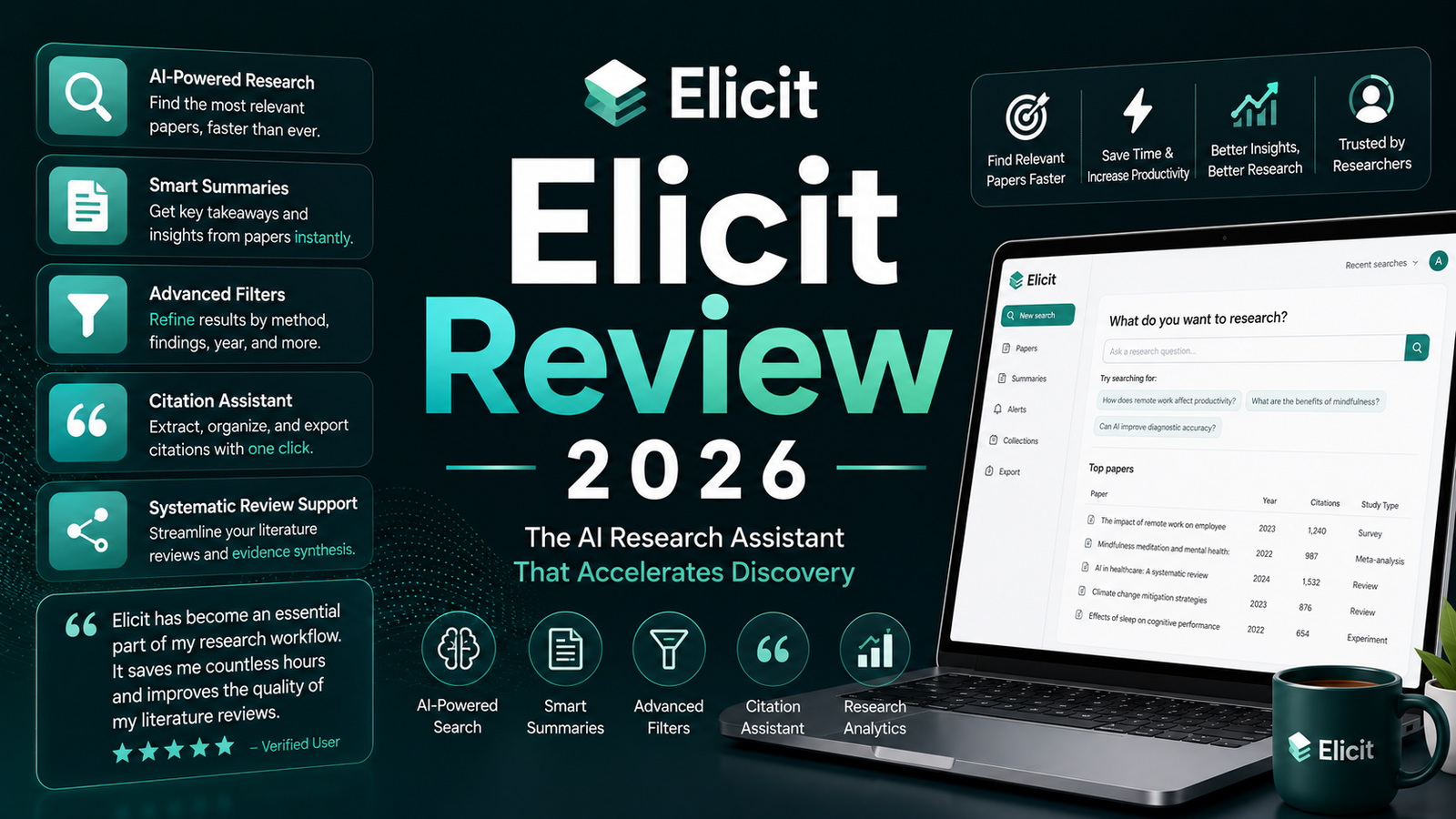
Literature search across 138 million papers with semantic matching. Elicit interprets research questions semantically rather than matching keywords. A query about “cognitive effects of sleep restriction in adolescents” returns papers studying that phenomenon even when the paper uses different vocabulary. The search covers Semantic Scholar’s entire indexed corpus, providing access to papers across biomedicine, psychology, social sciences, education, economics, and other empirical fields. For each returned paper, Elicit displays the title, abstract, citation count, year, and an AI-generated relevance summary.
Data extraction into structured tables. This is the feature that most significantly reduces the labor of systematic review. Users define custom extraction columns: sample size, methodology, outcome measures, control conditions, effect sizes, statistical significance, study limitations. Elicit reads each paper’s full text and populates the defined columns automatically. The extraction is not perfect, with accuracy varying by paper clarity and field specificity, but it replaces hours of manual data extraction with a workflow that requires verification rather than initial extraction. The resulting tables are exportable to CSV for further analysis.
Systematic review automation. The Pro plan supports PRISMA-compliant systematic review workflows including abstract screening against inclusion and exclusion criteria, full-text review, data extraction, and evidence synthesis. For research teams conducting formal systematic reviews, Elicit automates the screening stages that account for the majority of time in traditional systematic review processes. One analysis estimates that a systematic review taking six weeks manually can be completed in hours with Elicit handling the screening and extraction phases, with the research team providing expert judgment on borderline cases and final synthesis.
Automated research reports with citations. Rather than requiring users to assemble findings manually, Elicit generates structured research reports synthesizing the findings across searched papers with citations to source papers for each claim. Every sentence in an Elicit report links to the paper it draws from, directly addressing the hallucination risk that makes general AI tools problematic for research contexts. The citation grounding means outputs can be verified rather than accepted on the AI’s authority.
Paper monitoring alerts. Pro plan users can set monitoring alerts for specific research topics, receiving notifications when new papers matching their criteria are indexed. For researchers in active fields where new literature appears regularly, this replaces manual periodic searches with automated updates.
Research Agents (late 2025 addition). Autonomous research agents conduct multi-step research workflows: defining a search strategy, retrieving papers, screening for relevance, extracting data, and generating a preliminary report. For rapid evidence reviews and scoping reviews where a comprehensive baseline is needed quickly, Research Agents compress what previously required multiple sessions into a single automated workflow.
Pros and Cons
Pros:
- Free plan provides unlimited search across 138 million papers, unlimited summaries, and unlimited paper chat with no credit card required; genuinely functional for occasional research rather than a crippled demo
- Citation grounding on every generated claim significantly reduces the hallucination risk that makes general AI tools problematic for research contexts
- Data extraction into custom-defined structured tables replaces the most labor-intensive stage of systematic review
- PRISMA-compliant systematic review workflow on Pro supports research that meets formal methodological standards for publication
- Research Agents enable rapid evidence synthesis from a single workflow trigger
- API launched March 2026 enables integration into proprietary research systems and products
- Trusted by 5 million-plus researchers in academia, pharmaceutical R&D, and policy research
Cons:
- Focused exclusively on empirical academic literature indexed by Semantic Scholar; cannot search news, web content, industry reports, grey literature, patent databases, or clinical data sources outside the Semantic Scholar corpus
- Theory-heavy humanities and philosophy are poorly served; the extraction and synthesis approach is designed for structured empirical research, not interpretive or philosophical scholarship
- Outputs require human verification before use; Elicit accelerates the review process but does not replace researcher judgment on methodological quality, interpretation, and evidence synthesis
- The interface assumes baseline familiarity with systematic review methodology; new users unfamiliar with PICO frameworks, inclusion/exclusion criteria, or PRISMA reporting standards will face a meaningful learning curve
- Pro plan at $49 per month (or $42 with annual billing) is a meaningful subscription cost for individual researchers at institutions without site licensing
- Integration ecosystem is narrow; native connections are primarily to Zotero and reference managers, with no direct enterprise workflow integrations for tools like Slack, Salesforce, or Notion
Pricing Breakdown
Basic: $0. Unlimited search across 138 million papers, unlimited AI-generated summaries per paper, unlimited chat with papers using full-text access, 2 automated reports per month, and Zotero import. No credit card required. This plan is genuinely functional for undergraduate students, occasional research tasks, and platform evaluation on real research questions. The 2 automated report limit is the primary constraint for active researchers.
Plus: $12/month ($10/month annual). Unlimited automated reports, advanced data extraction with unlimited custom columns, full systematic review tools, unlimited research notebooks, CSV and BibTeX export, clinical trial access, and priority processing. This is the sweet spot for graduate students and independent researchers conducting regular literature reviews. At $10 to $12 per month, the cost is accessible for individual researchers without institutional funding, and the unlimited extraction capability removes the primary constraint of the free tier.
Pro: $49/month ($42/month or $32 with 35% annual discount). Everything in Plus plus Research Agents for autonomous multi-step research workflows, paper monitoring alerts for ongoing topic surveillance, full PRISMA-compliant systematic review support, and bulk extraction across large paper sets. For professional researchers conducting formal systematic reviews, the Research Agent and monitoring capabilities are the primary upgrades. The time savings on a single systematic review typically exceed the annual subscription cost.
Team: $79/user/month. Shared workflows, team collaboration features, centralized management, and team billing. For research labs and academic departments where multiple researchers work on shared projects, the collaborative features justify the per-seat premium over individual Pro plans.
Annual billing provides 35 percent savings across all paid plans, making Pro effective at approximately $32 per month annually. The median verified annual spend from documented purchases is approximately $1,249, consistent with Pro annual billing for individual researchers.
How It Compares to ChatGPT and Perplexity
Elicit vs ChatGPT
The comparison between Elicit and ChatGPT reveals why category matters more than capability level for research use. ChatGPT’s Advanced Data Analysis can process uploaded PDFs and extract information from them. It can answer research questions from its training data. But it cannot search a corpus of 138 million papers in real time, it does not ground every claim in a specific citation, and it cannot run PRISMA-compliant systematic review workflows across hundreds of papers. The hallucination risk in research contexts is also fundamentally different: ChatGPT is capable of generating plausible-sounding citations to papers that do not exist, which in a research context is not a minor inconvenience but a serious integrity problem.
Elicit’s citations are grounded in the Semantic Scholar corpus. When Elicit cites a paper, that paper exists and the cited content is drawn from the paper’s actual text. For any research context where citation integrity is a professional requirement, this is not a marginal difference. Use ChatGPT for drafting, brainstorming, and general writing tasks. Use Elicit for systematic literature search and evidence synthesis.
Elicit vs Perplexity AI
Perplexity AI searches the live web and provides cited answers with inline source links. This makes it an excellent research tool for current events, industry information, general knowledge queries, and any topic where web sources are appropriate. Perplexity’s inline citations are its primary appeal for factual research use cases.
The distinction from Elicit is source type and depth. Perplexity searches web content including news, blogs, Wikipedia, and some academic sources. Elicit searches only the Semantic Scholar academic corpus with access to full-text content of papers, enabling data extraction from the paper’s methodology and results sections rather than just abstract-level summaries. For a policy analyst wanting to know what systematic reviews exist on a public health intervention, Perplexity will find web articles discussing the topic. Elicit will find the actual systematic reviews, extract their findings into a structured table, and generate a synthesis report with paper-level citations. These are different tools serving different research depths.
The practical guidance is the same across both comparisons: use Perplexity for current and general web-based research questions. Use Elicit when the research question requires systematic analysis of academic literature specifically.
Frequently Asked Questions
Is Elicit useful for researchers outside biomedicine and clinical research?
Yes, for empirical fields more broadly, and less so for theory-heavy disciplines. Elicit’s systematic review capabilities were designed with clinical research and public health in mind, and PICO extraction (Population, Intervention, Comparison, Outcome) is the framework its data extraction defaults align with most naturally. However, researchers in psychology, education, economics, political science, environmental science, and social sciences also use it effectively for structured literature reviews where empirical study designs are the primary evidence base. The limitation is for theory-heavy humanities and philosophy where the academic literature consists of interpretive arguments rather than structured empirical studies. Extraction and synthesis of Kant scholarship, literary theory, or philosophical arguments does not fit the structured data table model that makes Elicit powerful for empirical research. Researchers in those disciplines will find Elicit less applicable to their primary work, though literature search and summary features remain useful for any field covered by Semantic Scholar.
How accurate is Elicit’s data extraction, and should I verify its outputs?
Yes, verification is required, and Elicit does not claim otherwise. Data extraction accuracy varies significantly by paper quality, field, and the clarity of the extraction target. Well-structured clinical trial papers with consistent reporting of sample sizes, primary outcomes, and statistical results are extracted most accurately. Papers with idiosyncratic reporting structures, unclear methodology sections, or results presented in non-standard formats produce less reliable extractions. Independent reviewers consistently describe Elicit as dramatically faster at extraction than manual processes, but verification against the source paper remains a professional requirement before relying on extracted data in a systematic review. The correct framing is that Elicit provides a verified starting point for extraction rather than a final verified dataset. Researchers should build their workflow around reviewing Elicit’s extractions against source papers rather than treating the output as a substitute for that review.
What is the practical difference between the Plus and Pro plans, and which one should a graduate student choose?
The practical difference is automated workflow depth and Research Agents. Plus provides unlimited custom extraction columns, unlimited automated reports, and full CSV export, which covers the core literature review workflow for most graduate students writing thesis chapters or seminar papers. Pro adds Research Agents for autonomous multi-step research, paper monitoring alerts, and full PRISMA systematic review support with bulk extraction across large paper sets. Graduate students writing thesis literature reviews who are not conducting formal systematic reviews published as standalone research outputs will find Plus covers their needs at $10 to $12 per month. Graduate students and early-career researchers conducting formal systematic reviews for publication in peer-reviewed journals, where PRISMA reporting and comprehensive extraction are required, will benefit from Pro’s systematic review workflow even at $42 per month. The single most useful test is whether the research project requires PRISMA reporting: if yes, Pro. If not, Plus.
Final Verdict
Elicit in 2026 is the most capable AI research assistant available for systematic academic literature review, and there is no close competitor for the specific workflow it serves. The combination of 138 million-paper semantic search, citation-grounded output, structured data extraction into custom tables, and PRISMA-compliant systematic review automation represents a capability set that general AI tools including ChatGPT and Perplexity do not replicate for serious research contexts.
The free plan is one of the most genuinely useful free research tools available: unlimited semantic search across 138 million papers with unlimited summaries and paper chat requires no credit card and no time limit. For any researcher evaluating the platform, the free plan provides enough capability to assess whether Elicit’s approach fits their research workflow before any payment decision.
The Plus plan at $10 to $12 per month is the accessible entry point for individual researchers who need unlimited extraction and reports. The Pro plan at $32 to $49 per month is justified for researchers conducting formal systematic reviews where the time savings are measurable and the Research Agent and monitoring features provide ongoing value.
The limitations are equally clear: Elicit is not useful for non-academic research questions, theory-heavy humanities disciplines, or any workflow requiring current web sources, grey literature, or real-time information. Its outputs require verification, not blind trust. And the learning curve for systematic review methodology is real for users unfamiliar with the discipline.
For its intended audience, researchers, academics, evidence synthesis teams, and policy analysts working with empirical academic literature, Elicit is not a nice-to-have. It is the tool that converts a six-month systematic review into a six-week project without compromising the methodological rigor that research integrity requires.
Rating: 4.5 / 5 — The definitive AI tool for systematic academic literature review. Less applicable outside empirical research contexts.
Disclosure: This article may contain affiliate links. OnyxRanked may earn a commission on qualifying purchases or subscriptions made through links on this page. This does not affect our editorial recommendations or ratings.