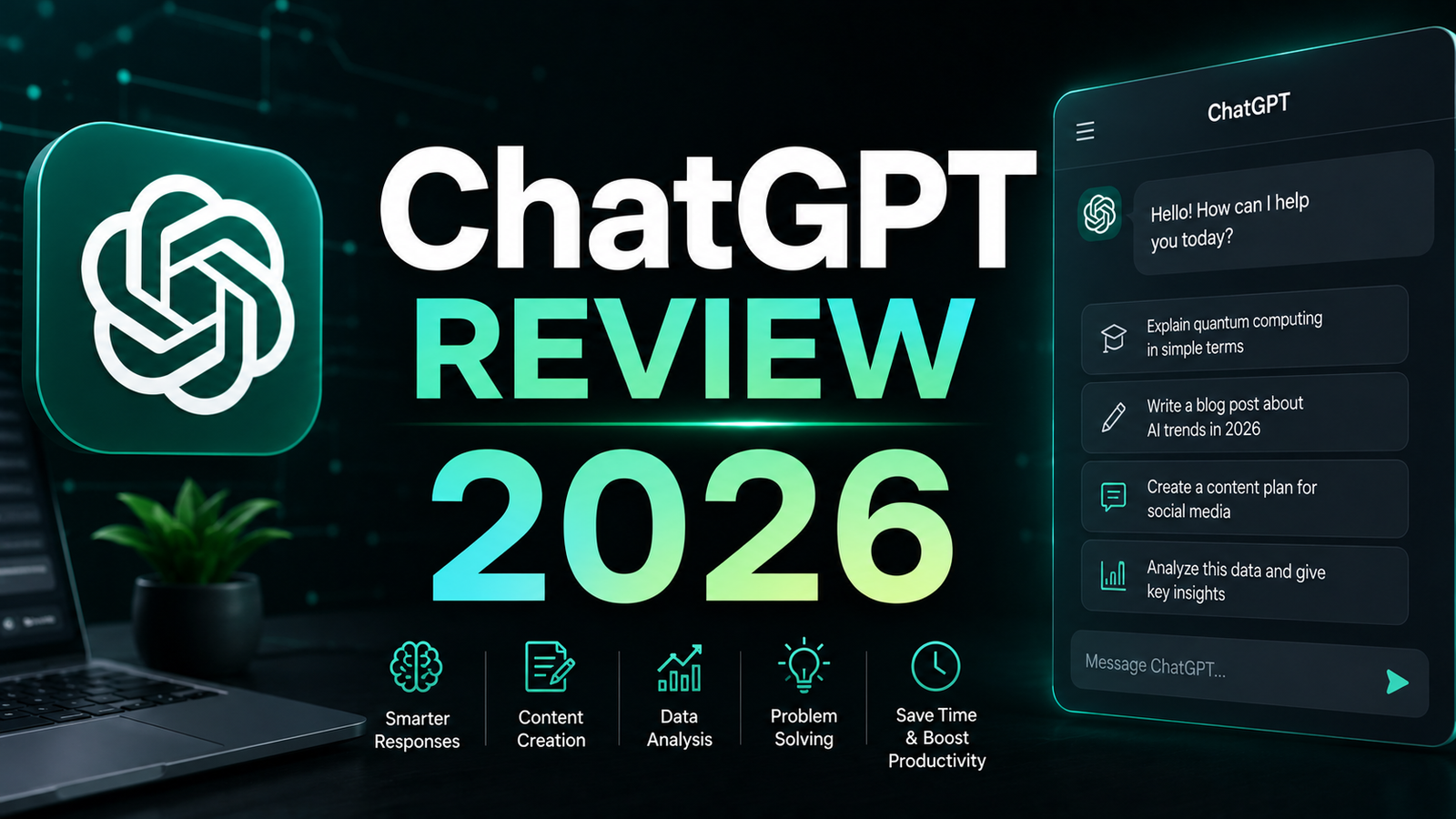
ChatGPT Review 2026: Still the Best AI Assistant or Has the Competition Finally Caught Up?
OpenAI shipped seven distinct model generations in under three years. The latest, GPT-5.5, launched on April 23, 2026, leading Terminal-Bench 2.0 at 82.7 percent accuracy and doubling its long-context reasoning score at one million tokens. The six-week release cadence has become the new normal for OpenAI and shows no signs of slowing.
The competition has tightened substantially. Claude Opus 4.7 scores 87.6 percent on SWE-bench Verified, ahead of GPT-5.5 on coding benchmarks. Gemini 3.1 Pro offers native video understanding and Google Workspace integration that ChatGPT cannot replicate. Grok 4.1 leads the LMSYS Chatbot Arena Elo leaderboard.
So the question the headline asks is a real one in 2026. And the answer is: yes, ChatGPT is still the most complete AI assistant available at $20 per month, but no, it is no longer the best at every individual task. The product has matured into the platform that most people should start with, while specific use cases are now better served by focused alternatives.
Plan Comparison Table
| Plan | Best For | Starting Price | Free Trial |
|---|---|---|---|
| Free | Casual users who need occasional AI assistance | $0 (with ads in US) | Yes (permanent) |
| Go | Light daily users who want more volume without full Plus features | $8/month | Free tier |
| Plus | Professionals who use AI daily and need the full feature set | $20/month | Free tier |
| Pro $100 | Power users who need extended Codex and reasoning without the $200 ceiling | $100/month | No |
| Pro $200 | Research-intensive users needing 250 Deep Research runs and GPT-5.4 Pro | $200/month | No |
| Business | Teams needing data privacy, SSO, and admin controls | $20/user/month (annual) | No |
“Pricing is subject to change. Always verify current pricing on the tool’s official website before purchasing.”
What ChatGPT Is
ChatGPT is OpenAI’s conversational AI assistant, launched in November 2022 and now serving over 100 million weekly active users. It is the product that made AI assistants mainstream, and it has maintained that position through consistent feature expansion and a release cadence that no competitor has matched for sustained output.
The platform in May 2026 is substantially more capable than it was 12 months ago. GPT-5.5, the current flagship, is a natively omnimodal model designed for agentic workflows: autonomous multi-step tasks across coding, browser automation, document creation, data analysis, and computer use without requiring human oversight at every step. It is not an incremental improvement. OpenAI describes it as the first fully retrained base model since GPT-4.5.
The product runs across web, iOS, Android, MacOS, and Windows. Its breadth, covering writing, coding, image generation, voice, data analysis, web research, and autonomous task execution from a single subscription, is still its clearest competitive advantage.
Key Features
GPT-5.5 with agentic multi-step task execution. The April 23, 2026 flagship model leads Terminal-Bench 2.0 at 82.7 percent and has a long-context reasoning score of 74.0 percent at one million tokens on MRCR v2, more than double GPT-5.4’s 36.6 percent. For autonomous multi-step work including complex coding workflows, research synthesis, and computer use tasks, this represents a qualitative leap in what the model can handle without constant human steering.
Codex for agentic coding. Available on Plus and above, Codex enables autonomous software development with terminal access, file system interaction, and iterative debugging. GPT-5.5 powers Codex on all paid plans with a 400K context window. For professional developers, this positions ChatGPT alongside Claude Code as the most capable consumer AI coding agents available. Claude Opus 4.7 edges GPT-5.5 on SWE-bench Verified (87.6 percent versus approximately 82 to 84 percent), but ChatGPT’s broader tool integration and agentic workflow depth make the comparison more nuanced than benchmark scores alone suggest.
ChatGPT Images 2.0. Launched April 21, 2026 as a replacement for GPT Image 1.5, the updated image model introduces Thinking Mode for Plus subscribers and above, applying reasoning and web search to image generation with character consistency across up to eight images. DALL-E 3 retired May 12, 2026, with GPT Image 1.5 as the intermediate step and Images 2.0 as the current default on paid plans.
Deep Research. Autonomous multi-step web research producing structured reports with citations. Plus includes 10 runs per month; Pro $200 includes 250 runs per month. The research quality competes with Perplexity’s Deep Research while operating within the broader ChatGPT ecosystem. For professionals who need both research and generation in the same session, this integration is practically convenient.
Advanced Voice Mode. The strongest consumer AI voice interface available, featuring natural interruption handling, emotional variation, and conversational cadence. Available on Plus and above. For users who rely on spoken AI interaction, no competing product matches this quality.
Persistent memory across sessions. ChatGPT builds context about preferences, projects, and communication style over time. After months of regular use, the model adapts to individual workflows without requiring repeated context setup. This compounding effect is the feature that most distinguishes long-term ChatGPT users’ experience from occasional users.
Custom GPTs and ecosystem. Over 500 native integrations and a Custom GPT library covering thousands of specialized assistants allow teams and individuals to create persistent AI configurations for recurring workflows. No competing platform has developed an equivalent ecosystem at this breadth.
Pros and Cons
Pros:
- Most complete feature set at $20 per month; voice, images, coding, research, agentic workflows, memory, and Custom GPTs from one subscription
- GPT-5.5 leads Terminal-Bench 2.0 and doubles long-context reasoning performance versus GPT-5.4
- Persistent memory compounds in value with sustained daily use, creating increasingly personalized AI assistance
- Advanced Voice Mode is the strongest consumer AI voice interface available
- Custom GPTs and 500-plus integrations represent years of ecosystem development that competitors have not matched
- ChatGPT Images 2.0 Thinking Mode produces more coherent multi-image outputs with character consistency
- Business plan dropped from $25 to $20 per user per month on April 2, 2026, improving team value
Cons:
- Free tier now includes ads in the US as of February 9, 2026
- GPT-5.5 API pricing doubled from $2.50/$15 to $5/$30 per million input/output tokens; OpenAI claims 20 percent net increase after token efficiency, but this is a significant cost jump for high-volume API users
- Claude Opus 4.7 outperforms GPT-5.5 on SWE-bench Verified for complex production coding (87.6 percent versus approximately 82 to 84 percent)
- Gemini’s native video understanding and Google Workspace integration are capabilities ChatGPT does not match
- Deep Research is capped at 10 runs per month on Plus; intensive researchers hit this limit quickly
- Pro $100 tier launched April 9, 2026 with a promotional 10x Codex usage that expires May 31, 2026, reverting to 5x; buyers should evaluate the post-promotion value
Pricing Breakdown
ChatGPT has seven tiers as of May 2026. The meaningful distinctions are at Plus, Pro $200, and Business.
Free: $0. GPT-5.3 with tight message limits and US ads since February 2026. Limited Deep Research, limited image generation. Functional for casual use; inadequate for consistent professional work.
Go: $8/month. 10x more messages than Free. GPT-5.3 Instant. File uploads, image creation, enhanced memory, Custom GPTs. US ads present. The $12 monthly savings over Plus does not justify the model and feature gap for professional daily users. Easy to skip.
Plus: $20/month. The appropriate tier for most professionals. GPT-5.5 access (default), full Deep Research (10 runs/month), Sora for video generation, Codex, Agent Mode, Advanced Voice, ChatGPT Images 2.0 with Thinking Mode, memory, and Custom GPTs. Ad-free. This price has held for three years. For daily professional AI use, the value case is unchanged.
Pro $100/month. Launched April 9, 2026 as a new middle tier. Extended Codex usage (10x Plus through May 31, 2026; 5x after). Suitable for developers who exhaust Plus Codex limits but cannot justify $200. Value depends on Codex usage volume.
Pro $200/month. GPT-5.4 Pro (extra parallel compute for harder problems), 250 Deep Research runs, double context window. For legal review, financial analysis, scientific research, and tasks where high-stakes accuracy justifies the compute cost.
Business: $20/user/month (annual) or $25/month (monthly). Reduced from $25/$30 on April 2, 2026. SOC 2, SAML SSO, 60-plus app integrations, admin controls, data not used for training. For teams needing enterprise governance at accessible cost.
How It Compares to Claude and Gemini
ChatGPT vs Claude
The clearest frame on this comparison: ChatGPT wins on ecosystem breadth and agentic capability. Claude wins on writing quality and coding precision. Claude Opus 4.7 scores 87.6 percent on SWE-bench Verified, ahead of GPT-5.5 for complex multi-file production coding. Claude’s no-training-by-default policy on paid plans is a stronger privacy posture for sensitive professional content. Claude’s writing quality and nuanced instruction-following produce more precise professional prose on equivalent prompts. ChatGPT counters with Voice Mode (no Claude equivalent at the same quality), native image generation, the Custom GPT ecosystem, and the broader integration library. For users who need one tool that covers everything, ChatGPT is more complete. For users whose primary work is writing, analysis, and coding where output precision is the primary criterion, Claude often produces better results.
ChatGPT vs Gemini
Gemini wins two categories without contest: native video understanding and Google Workspace integration. If your workflow involves video content analysis or lives primarily inside Gmail, Docs, and Sheets, Gemini’s embedded AI eliminates tool-switching that ChatGPT cannot match. Gemini also provides built-in real-time web search on every query by default, whereas ChatGPT’s search is more selectively triggered. ChatGPT counters with Advanced Voice Mode, the Custom GPT ecosystem, Codex’s agentic coding depth, and the more mature third-party integration library. For Google-centric teams, Gemini’s native integration advantage is practically significant. For teams on mixed tools or Microsoft stacks, ChatGPT’s breadth is more relevant.
Frequently Asked Questions
Is the $20 Plus plan still worth it in 2026 given how capable the free tier has become?
For casual users who send fewer than a dozen queries per day, the free tier on GPT-5.3 handles most tasks adequately. The Plus upgrade becomes worth it when any of these apply: you regularly need Deep Research for multi-source synthesis; you use Codex for agentic coding; you depend on Advanced Voice Mode; you generate images frequently; or you hit the free tier’s message limits and find the interruption materially disruptive. At $20 per month, Plus has held the same price for three years while adding GPT-5.5, Codex, Sora, Agent Mode, and Deep Research since launch. For anyone using ChatGPT professionally more than a few hours per week, Plus is still the most straightforward AI investment available.
Does the GPT-5.5 API price increase affect consumer subscribers?
Consumer subscribers on Plus, Pro, and Business are not directly affected by the API price change. The doubled API pricing from $2.50/$15 to $5/$30 per million tokens affects developers building applications on the ChatGPT API, not individual users on subscription plans. Subscription plan pricing has not changed. The API price increase matters for developers evaluating whether to build production applications on GPT-5.5 versus alternatives. For those developers, Grok 4.1 Fast at $0.20 per million input tokens and Claude alternatives offer meaningfully cheaper options for use cases where GPT-5.5’s specific capabilities are not required.
Should I upgrade to Pro $100 or Pro $200, or is Plus enough for most professionals?
For most professionals, Plus at $20 per month is sufficient and the gap to Pro is not worth $80 to $180 per month more. Pro $100 is worth evaluating for developers who regularly exhaust Plus Codex limits for autonomous coding tasks, particularly during the promotional period ending May 31, 2026. Pro $200 is worth evaluating for users who rely heavily on Deep Research at 250 runs per month (Plus caps at 10), or who work on tasks where GPT-5.4 Pro’s extra parallel compute produces meaningfully better accuracy on high-stakes analysis. The clearest test: run your actual most demanding tasks on Plus, identify which capabilities you consistently need more of, and compare those specific limits to what each Pro tier provides. Most professionals find Plus covers everything adequately; the Pro tiers serve a narrower profile of intensive daily power users.
Final Verdict
ChatGPT in May 2026 is still the AI assistant most people should start with. No other platform at $20 per month delivers equivalent breadth across writing, coding, image generation, voice, autonomous research, and integration ecosystem. The GPT-5.5 upgrade represents a genuine qualitative leap in long-context reasoning and agentic task execution. For daily professional AI use, Plus remains one of the most straightforward technology investments available.
The competition has earned specific wins that matter for specific users. For writing quality and coding precision, Claude Opus 4.7 outperforms GPT-5.5 on the benchmarks that most directly reflect production coding work. For researchers who need a cited-source AI, Perplexity Pro’s unlimited Deep Research at the same price competes directly. For Google Workspace users, Gemini’s native integration advantage is practically significant.
The honest answer to the review’s headline question: yes, the competition has caught up in specific lanes. ChatGPT is no longer the obvious best choice for every use case. But as the most complete general-purpose AI assistant, covering the widest range of daily professional tasks from a single subscription, it remains the right default recommendation for most users starting their AI stack.
For a direct head-to-head on the most important comparison, read our ChatGPT vs Claude 2026 analysis. For a full evaluation of the alternative that most directly challenges ChatGPT on writing and coding quality, see our Claude AI Review 2026.
Rating: 4.6 / 5