Tabnine Review 2026: The Privacy-First AI Code Assistant Worth Switching To?
There is a short answer and a longer one. The short answer: if your company operates in finance, healthcare, defense, or any regulated industry where sending source code to external servers is a compliance violation, Tabnine is not one option among many. It is essentially the only serious AI coding assistant built for your situation. The longer answer is more nuanced for everyone else.
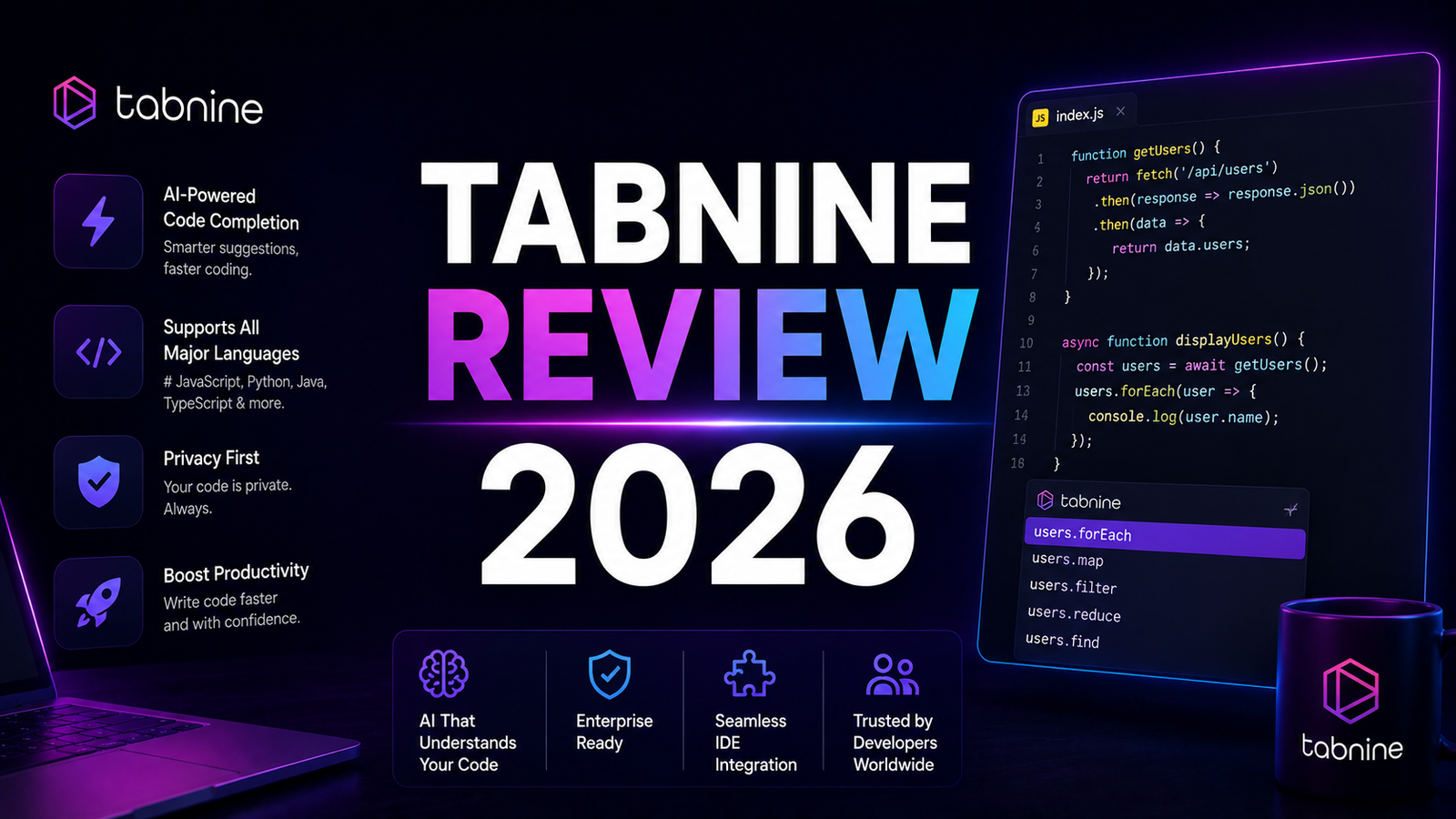
Tabnine in 2026 has evolved from an autocomplete tool into a platform covering completions, chat, agentic workflows, and a Context Engine that learns your entire codebase. The privacy architecture has always been its defining characteristic: zero code retention after inference, air-gapped deployment, SOC 2 Type II, GDPR, and ISO 27001 certifications, and a licensing model that guarantees IP indemnification because every training dataset used permissively licensed code. Those are not marketing claims. They are auditable certifications that enterprise legal and security teams can rely on in procurement decisions.
The honest trade-off: Tabnine’s completion quality is measurably behind Cursor and GitHub Copilot on general coding tasks. Multiple engineering teams who have deployed Tabnine in production describe this gap as persistent and noticeable across every day of coding. You are choosing Tabnine for compliance and privacy. You are not choosing it because it produces the most impressive autocomplete suggestions.
Plan Comparison Table
| Plan | Best For | Starting Price | Free Trial |
|---|---|---|---|
| Dev | Individual developers who want full AI coding features with privacy controls | $12/user/month (annual) | No (14-day trial) |
| Code Assistant | Teams requiring enterprise compliance, SOC 2, and codebase-aware suggestions | $39/user/month (annual) | 14-day trial |
| Agentic Platform | Teams needing autonomous agent workflows, MCP tool integration, and multi-step tasks | $59/user/month (annual) | 14-day trial |
| Enterprise | Organizations requiring on-premises, air-gapped, or BYO LLM deployments | Custom pricing | Sales demo |
“Pricing is subject to change. Always verify current pricing on the tool’s official website before purchasing.”
What Tabnine Is
Tabnine is an AI-powered software development platform built on a privacy-first architecture. Founded in 2018 and currently deployed across thousands of enterprise teams, it integrates as a plugin into VS Code, all JetBrains IDEs, Eclipse, Visual Studio, and provides a CLI for terminal workflows. Unlike Cursor, which replaces the IDE, Tabnine meets developers where they already work.
The free Basic plan was retired in 2024. Every plan from Dev upward requires payment, with a 14-day free trial covering the full feature set. The median enterprise contract is approximately $23,400 per year based on verified purchase data, reflecting the team-size reality of enterprise deployments rather than individual subscriptions.
The platform has three core product areas in 2026. AI completions deliver inline suggestions as you type. AI chat and agents handle larger-scope tasks including code review, test generation, and automated PR analysis. The Enterprise Context Engine learns the organization’s codebase, architecture patterns, and internal libraries to produce suggestions that reflect company-specific standards rather than generic training data.
Key Features
Zero data retention and air-gapped deployment. No code sent to Tabnine is retained after inference. The model processes the request and the data is gone. Air-gapped deployment goes further: the entire AI stack runs on infrastructure with no internet connection required, making it viable for defense contractors, intelligence organizations, and any environment where even outbound connections are prohibited. This is genuinely unique. No other mainstream AI coding assistant offers an equivalent air-gapped deployment option in 2026.
Enterprise Context Engine. Unlike generic models that apply broad training data to any codebase, Tabnine’s Context Engine indexes the organization’s entire private codebase and learns its specific patterns. Completions reference internal libraries, proprietary APIs, and company-specific architecture decisions rather than suggesting patterns that would require significant modification to fit the codebase. For large engineering organizations with extensive internal tooling, this contextual specificity reduces editing time per suggestion compared to suggestions from generic models.
Code Review Agent. The AI-powered code review agent analyzes pull requests for defects, policy violations, and deviations from internal coding standards before human reviewers see the PR. For engineering teams with documented rework rates from code review issues that pass initial human review, this automated pre-screening reduces the cycle time between PR submission and merge. The Code Review Agent was recognized with industry awards in 2025 and carries into 2026 as one of Tabnine’s most consistently praised enterprise features.
BYO LLM support. Enterprise tier customers can bring their own language model rather than relying on Tabnine’s hosted models. This enables organizations that have already invested in fine-tuning proprietary models, or that have compliance requirements around which specific AI systems can process their code, to use Tabnine’s interface and privacy infrastructure with their own underlying model. Claude, GPT, Llama, and custom proprietary models are all supported.
IP indemnification. Tabnine trains only on permissively licensed open-source code. This means the company can offer IP indemnification: if a client faces a copyright claim over Tabnine-generated code, Tabnine provides legal protection. For enterprises whose legal teams flag AI-generated code as an IP risk, this indemnification directly addresses that concern. Neither GitHub Copilot nor Cursor provides equivalent formal indemnification guarantees.
Agentic Platform capabilities. The $59 per user per month Agentic tier adds autonomous multi-step agent workflows, MCP (Model Context Protocol) tool integration for connecting to external services, a command-line interface, and unlimited codebase connections. For teams that want automated task execution alongside privacy-first completions, this tier covers both without requiring a separate agentic tool.
Pros and Cons
Pros:
- The only AI coding assistant offering genuine air-gapped deployment with no internet connectivity requirement
- Zero code retention policy backed by auditable SOC 2 Type II, GDPR, and ISO 27001 certifications
- IP indemnification from permissively licensed training data addresses legal risk that other tools leave open
- BYO LLM support enables enterprises with proprietary or fine-tuned models to use Tabnine’s privacy infrastructure
- Context Engine learns organization-specific patterns, libraries, and architecture for more relevant suggestions in large codebases
- IDE-agnostic plugin approach; works in VS Code, all JetBrains IDEs, Eclipse, Visual Studio without replacing the development environment
- Code Review Agent reduces PR review cycle time and catches policy violations before human reviewers
Cons:
- Completion quality gap is real and persistent; measurably behind Cursor and GitHub Copilot on general coding tasks in independent practitioner testing
- Chat experience is a generation behind Cursor’s chat and Claude Code; shallower context awareness and less capable responses on equivalent queries
- No free tier; Basic plan retired in 2024, requiring payment from day one
- Code Assistant at $39 per user per month is significantly more expensive than Cursor Pro at $20 and GitHub Copilot Pro at $10, for lower suggestion quality on general tasks
- Does not support Neovim or Xcode, narrowing IDE compatibility for developers on those environments
- Agentic capabilities at $59 per user per month are less mature than Cursor’s Composer and Claude Code for autonomous multi-step tasks
Pricing Breakdown
Tabnine’s pricing structure as of May 2026 is notable for the absence of a free tier and for per-seat costs that are higher than most direct competitors.
Dev: $12/user/month (annual). Unlimited AI completions and chat, core privacy controls, and standard IDE integrations. The entry-level paid plan for individual developers who want Tabnine’s privacy approach without the full enterprise feature set.
Code Assistant: $39/user/month (annual). Full AI code completions powered by major LLMs, full SDLC AI chat, Enterprise Context Engine, SOC 2 and GDPR compliance documentation, and SSO. This is the minimum tier for enterprise teams requiring documented compliance credentials for procurement approval. IP indemnification is included.
Agentic Platform: $59/user/month (annual). Everything in Code Assistant plus autonomous agent workflows, MCP tool integration for external service connections, CLI access, and unlimited codebase connections. For teams that want agentic capability alongside privacy-first infrastructure.
Enterprise: Custom pricing. Full Agentic features plus on-premises deployment, air-gapped support with no internet connectivity required, BYO LLM integration, dedicated security compliance support, and advanced governance including audit logs and role-based access controls.
The median verified enterprise contract runs approximately $23,400 per year, reflecting typical team sizes at the Code Assistant tier. For a 10-person team on Code Assistant, the annual cost is $46,800 versus $1,200 for GitHub Copilot Pro and $2,400 for Cursor Pro. The premium is the price of the compliance and privacy infrastructure, and it is only justified when those features are actual requirements rather than preferences.
How It Compares to Cursor and GitHub Copilot
Tabnine vs Cursor
The comparison starts with a fundamental architectural difference. Cursor replaces the IDE entirely; Tabnine integrates as a plugin into your existing IDE. For developers on JetBrains products like IntelliJ, PyCharm, or WebStorm, Cursor’s VS Code dependency is a meaningful barrier that Tabnine does not create. For developers already on VS Code, Cursor’s agentic Composer capability for multi-file editing and autonomous task execution substantially outperforms anything Tabnine offers at any price tier. The code suggestion quality gap is documented by practitioners who have used both: Cursor’s completions are sharper and more context-aware on general coding tasks. Tabnine’s completions are more relevant to organization-specific codebase patterns when the Context Engine is properly configured.
The privacy comparison is the decisive factor. Cursor sends code to AI providers for processing. For organizations where that is a compliance violation, Cursor is not an option regardless of its capability advantage. For developers at those organizations, Tabnine is not a quality trade-off. It is the only tool that meets the requirement.
For a direct feature-by-feature comparison between the two alternatives that most developers evaluate before Tabnine, see our Cursor vs GitHub Copilot 2026 analysis.
Tabnine vs GitHub Copilot
GitHub Copilot at $10 per month is the closest competitor for developers who do not have compliance requirements but want to evaluate whether Tabnine’s additional features justify the 4x price premium. The completion quality comparison consistently favors GitHub Copilot in independent testing, though Tabnine edges closer when the Context Engine is fully configured on a large proprietary codebase. GitHub Copilot Business at $19 per user per month provides enterprise-grade data handling that most technology companies consider adequate, though it does not offer the formal zero-retention guarantee, air-gapped deployment, or BYO LLM support that Tabnine provides.
For IP indemnification specifically, Tabnine has a more explicit guarantee than GitHub Copilot’s current terms. Enterprise legal teams that have flagged Copilot’s training data composition as an IP risk will find Tabnine’s permissive-only training data a more defensible position.
Frequently Asked Questions
Is Tabnine’s completion quality genuinely worse than Copilot and Cursor, and how significant is the gap in practice?
Yes, the gap is real and confirmed by multiple independent practitioner reviews from teams that deployed Tabnine in 2025 and 2026. One engineering team report describes the experience directly: “The quality of Tabnine’s suggestions varies greatly but often they are correct and reduce coding time, though they are not as accurate as Copilot.” Another 15-person team operating Tabnine in a regulated environment for six months described the completion quality gap as “persistent and noticeable across every day of coding.” The gap narrows when the Context Engine is properly configured on a large, well-structured codebase with clear internal patterns. For greenfield projects or codebases with inconsistent conventions, the gap is wider because the Context Engine has less organizational signal to learn from. Organizations choosing Tabnine should budget for the quality gap as a known trade-off rather than expecting parity with Copilot or Cursor on general coding tasks.
Can I use Tabnine as a plugin in JetBrains IDEs without switching to VS Code?
Yes, and IDE flexibility is one of Tabnine’s clearest practical advantages over Cursor. Tabnine integrates natively with the full JetBrains suite including IntelliJ IDEA, PyCharm, WebStorm, Rider, GoLand, and DataGrip, as well as VS Code, Eclipse, and Visual Studio. The plugin experience is consistent across all supported IDEs without requiring developers to change their development environment. Cursor’s IDE-replacement approach, while powerful for VS Code users, requires the entire team to adopt the new editor. For organizations running mixed IDE environments or standardized on JetBrains tools, Tabnine’s plugin architecture means deployment does not disrupt existing developer workflows. The two IDEs Tabnine does not support are Neovim and Xcode; developers on those environments need to evaluate alternatives.
What is the honest ROI case for paying Tabnine’s premium over GitHub Copilot?
The ROI case for Tabnine over GitHub Copilot is specific and should not be stretched beyond its actual scope. The legitimate cases are: regulated industries where external API code transmission is a documented compliance violation (healthcare under HIPAA, finance under specific regulations, defense and government contractors); organizations whose legal teams have flagged AI training data IP risk and want formal indemnification documentation; organizations that have invested in proprietary model fine-tuning and need BYO LLM support to use that investment in the coding workflow; and large engineering organizations where the Context Engine’s codebase-specific suggestions meaningfully reduce editing overhead on proprietary library usage. For organizations where none of these apply, the $29 per seat per month premium over GitHub Copilot Pro is difficult to justify on feature grounds alone given the completion quality gap. For the organizations where these cases do apply, the premium is often not discretionary. It is a procurement requirement.
Final Verdict
Tabnine is conditionally recommended in 2026, and the condition is specific: your organization has documented compliance requirements that prohibit sending source code to external servers.
For those organizations, Tabnine is not a premium option. It is the only credible AI coding assistant in the market that provides air-gapped deployment, zero code retention, formal IP indemnification, and the compliance certifications that regulated industry procurement requires. The completion quality gap versus Cursor and GitHub Copilot is a genuine trade-off that teams should account for in productivity modeling, but it is not a disqualifier when the alternative is non-compliance.
For developers and organizations without those requirements, the honest assessment from practitioner experience is less favorable. Cursor Pro at $20 per month provides substantially more capable completions, Composer for agentic multi-file work, and faster generation, at roughly half the entry price of Tabnine Code Assistant. GitHub Copilot Pro at $10 per month provides adequate enterprise data handling for most technology companies at one-quarter the cost.
The choice is not about which tool is better in a general sense. It is about which requirement is harder to compromise: completion quality or code privacy. Tabnine wins decisively when privacy is non-negotiable. It loses on value when privacy is a preference rather than a requirement.
For a comparison of the two alternatives most developers evaluate before reaching the privacy question, read our Cursor vs GitHub Copilot 2026 analysis.
Rating: 3.8 / 5 — Essential for regulated industries. Hard to justify for general use at the price premium.