Best AI Chatbots 2026: Which Ones Are Actually Worth Using?
AI chatbots have moved from novelty to daily infrastructure. Over 100 million people use ChatGPT every week. Google Gemini is now embedded across more than a billion Google product surfaces. Claude has grown its enterprise user base by over 300 percent since launch. The global AI chatbot market is projected to exceed $27 billion in 2026, up from single digits just three years prior.
But the growth in adoption has created a growth in confusion. Most guides rank chatbots as if there is one winner. There is not. ChatGPT is the most versatile. Claude is the strongest for writing and long documents. Perplexity is built for research. Gemini is the best free option for Google Workspace users. Microsoft Copilot is the natural fit for organizations that live in Microsoft 365. Grok owns the real-time social intelligence lane. Meta AI covers the free-for-everything use case. Poe solves for users who want model flexibility from a single subscription.
The right chatbot is the one that matches the specific work you actually do, not the one with the highest benchmark score. This guide cuts through the noise and tells you exactly which tool belongs in which workflow.
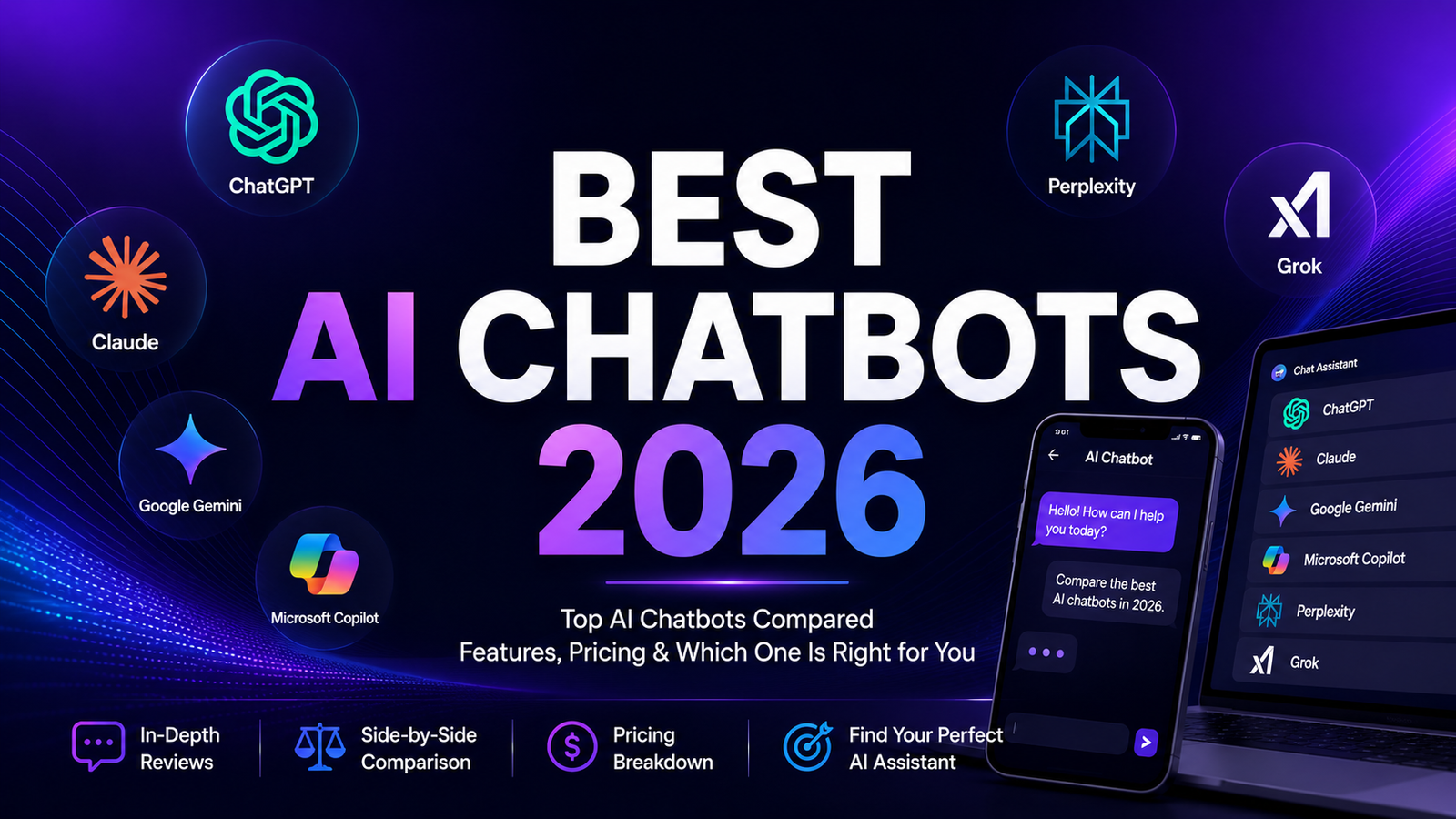
Comparison Table: Best AI Chatbots 2026
| Tool | Best For | Starting Price | Free Plan |
|---|---|---|---|
| ChatGPT | General versatility, creativity, coding, and broad everyday use | Free / $20/month (Plus) | Yes |
| Claude | Writing quality, long documents, and nuanced professional communication | Free / $20/month (Pro) | Yes |
| Gemini | Google Workspace users and the most capable genuinely free experience | Free / $19.99/month (AI Pro) | Yes |
| Perplexity AI | Research, fact-checking, and any query where every claim needs a source | Free / $20/month (Pro) | Yes |
| Microsoft Copilot | Microsoft 365 users who want AI embedded inside Word, Excel, and Teams | Free / $30/user/month (M365 Copilot) | Yes (limited) |
| Meta AI | Completely free AI with no daily limits across social and messaging apps | Free | Yes |
| Grok | Real-time X data, social media intelligence, and current events research | Free (limited) / $10/month (SuperGrok Lite) | Yes (limited) |
| Poe | Power users who want multi-model access from a single subscription | Free / $20/month (Subscriber) | Yes |
“Pricing is subject to change. Always verify current pricing on the tool’s official website before purchasing.”
Detailed Reviews
1. ChatGPT
Best for professionals, creators, developers, and anyone who needs a single AI that handles the widest range of tasks without specializing in any one of them.
ChatGPT remains the most widely used AI chatbot in 2026 with over 100 million weekly active users. That adoption is not inertia. ChatGPT continues to earn it by being the most versatile AI assistant available, covering writing, coding, data analysis, image generation, voice conversation, research, and file analysis from a single interface.
The Plus plan’s Advanced Data Analysis executes Python against uploaded files, generating charts and analysis without a data analyst. Custom GPTs pre-loaded with brand voice and business context replace repeated prompt setup. Web browsing incorporates current information. GPT Image 1.5 generates images within the conversation. Memory builds context about your preferences and projects over time.
Key Features: GPT-5.4 with web browsing and real-time research, Advanced Data Analysis for uploaded file processing, Custom GPTs for workflow-specific assistants, image generation via GPT Image 1.5, Advanced Voice Mode for natural spoken conversation, and memory that builds persistent context across sessions.
Pros:
- Most versatile chatbot on this list; handles every task type from one interface
- Custom GPTs eliminate repeated context setup for recurring workflows
- ChatGPT’s free tier provides access to GPT-4o with daily usage limits, making it the best free option for capable general-purpose AI.
- Advanced Data Analysis is uniquely powerful for non-technical users processing spreadsheets and documents
Cons:
- GPT-5 hallucinates on roughly 5 to 10 percent of factual questions and sometimes invents citations; verification remains necessary for factual claims.
- Free tier now includes ads as of February 2026
- Not the best choice for any single specialized task; Claude beats it for writing, Perplexity for research
Pricing:
- Free: GPT-5.x with daily limits and ads
- Plus: $20/month, full GPT-5.4, no ads, all features
2. Claude
Best for writing quality, long-document analysis, and any professional task where precision of language and nuance of tone are the primary success criteria.
Claude is widely considered the best AI chatbot for writing tasks in 2026, with outputs that feel more natural, nuanced, and stylistically varied than most competitors. Its Constitutional AI training produces writing that follows complex stylistic instructions more reliably than alternatives and handles sensitive or ambiguous requests with consistent, considered judgment.
The 200,000-token context window on the Pro plan allows processing entire manuscripts, lengthy research documents, and extensive code sets in a single session. Claude Opus 4.6 handles 1 million tokens with 76 percent retrieval accuracy, making it uniquely capable for tasks that require maintaining coherent understanding across very long inputs. The no-training-by-default policy on paid plans provides the strongest data privacy posture among major consumer AI tools.
Key Features: Best-in-class prose quality and stylistic instruction-following, 200,000-token context for long document analysis, Projects for maintaining persistent context across ongoing work, Claude Code included in Pro for agentic coding tasks, extended thinking mode for complex analytical reasoning, and no-training-by-default on paid plans.
Pros:
- Claude hallucinates on 3 to 8 percent of factual questions, a lower rate than ChatGPT’s 5 to 10 percent.
- Best choice for professionals who produce long-form writing where tone, voice, and structure matter
- No-training policy on paid plans protects sensitive and pre-publication material
- Claude Code included in Pro covers agentic coding without a separate subscription
Cons:
- Daily message limits on Pro can frustrate intensive use sessions
- No native image generation
- Smaller ecosystem than ChatGPT; fewer third-party integrations
Pricing:
- Free: Claude Sonnet 4.6 with daily limits
- Pro: $20/month, Opus 4.6, 200K context, Projects, Claude Code
3. Gemini
Best for Google Workspace users who want AI across Gmail, Docs, and Sheets, and for anyone looking for the most capable genuinely free experience.
Google Gemini is now embedded in more than 1 billion Google product surfaces, from Search to Docs to Gmail. For users who spend their workday in Google’s ecosystem, Gemini provides AI that activates inside the tools they already use rather than requiring a separate application. Draft emails in Gmail, summarize documents in Docs, build formulas in Sheets from natural language: all of this happens in the existing interface.
Gemini’s free tier is the most capable genuinely free experience in the category. Unlike ChatGPT’s free tier, which now includes ads and daily rate limits, Gemini’s standard free access provides meaningful AI capability for everyday tasks. For someone who wants to stay free forever, Gemini is probably the best pick in 2026. The Deep Research feature on AI Pro compiles comprehensive research reports from multiple sources, and native video understanding covers a multimodal capability Claude cannot match.
Key Features: AI across Gmail, Docs, Sheets, and Google Meet with Workspace integration, native video and audio understanding, Deep Research for multi-source research synthesis, built-in Grounding with real-time web search on every query, 1M token context window, and 2TB Google Drive storage bundled with Google AI Pro.
Pros:
- Best free tier for everyday AI use; no ads and no daily message cap on the standard free plan
- Google Workspace integration eliminates tool-switching for Google-ecosystem users
- Native video understanding covers a capability no other chatbot on this list matches at the same price
- Built-in real-time web search on every query, not just when explicitly requested
Cons:
- Writing precision and nuanced instruction-following trail Claude for professional content tasks
- Context drift in very long conversations; constraints set early in a session can fade with Gemini in ways Claude handles more reliably
- Full advanced features require the $19.99/month Google AI Pro add-on
Pricing:
- Free: Gemini Flash with no daily message cap
- Google AI Pro: $19.99/month, full Gemini Pro, Workspace AI integration, 2TB Drive
4. Perplexity AI
Best for research, fact-checking, and any query where you need every claim to link back to a verifiable primary source.
Perplexity dominates research and citations. Unlike ChatGPT and Claude, which generate answers from training data and may fabricate confident-sounding claims, Perplexity searches the live web before every response and attaches inline source citations to every factual statement. Clicking through to verify a claim takes seconds rather than a separate search. The safest chatbot for factual queries is Perplexity, which shows sources.
Deep Research on the Pro plan autonomously browses 15 to 40 sources per query and synthesizes a structured report with full citations. For professionals who need current, verifiable information, this compresses research sessions from hours of manual reading to a structured starting point in minutes. Students at verified .edu institutions can access Pro free for one year.
Key Features: Real-time web search with inline citations on every response, Deep Research for autonomous multi-source research synthesis (Pro), Spaces for organizing ongoing research projects, follow-up questions maintaining research context, multi-model access to GPT-5.4, Claude, and Gemini on Pro, and file upload for document-grounded research.
Pros:
- Cited sources on every claim make fact-checking a built-in feature rather than an extra step
- Unlimited Deep Research on Pro at $20/month versus ChatGPT Plus’s limited Deep Research allocation
- Free tier with five Pro searches daily is the most functional free research tool available
- .edu email holders receive Pro free for one year
Cons:
- Not a creative or conversational tool; optimized for retrieval rather than generation
- Occasional citation errors still require verification; sources can be misrepresented even when linked
- Less useful for tasks that do not benefit from live web research
Pricing:
- Free: Unlimited standard searches, five Pro searches daily
- Pro: $20/month ($16.67/month annual), unlimited Deep Research, multi-model access
5. Microsoft Copilot
Best for organizations standardized on Microsoft 365 who want AI working directly inside Word, Excel, Outlook, and Teams at no additional tool adoption cost.
Microsoft Copilot has become the go-to chatbot for enterprises standardized on the Microsoft 365 ecosystem. It is not a standalone chatbot; it is AI woven into the applications that millions of professionals already open every morning. Draft emails inside Outlook. Summarize meeting transcripts inside Teams. Generate charts from natural language inside Excel. Create presentations from a brief inside PowerPoint. All of this happens without leaving the Microsoft interface.
For organizations that have already invested in Microsoft 365 infrastructure, Copilot is often the easiest, most secure path to AI adoption with governance features that align with existing IT and compliance frameworks. The free tier in Windows and Edge is genuinely functional for casual use, making it accessible before any enterprise purchasing decision.
Key Features: AI across Word, Excel, PowerPoint, Outlook, and Teams with native document access, Windows and Edge integration with no additional installation, Microsoft Threat Intelligence grounding for security-sensitive workflows, enterprise compliance and data governance through Microsoft Purview, and Microsoft 365 Chat for unified search and summary across all M365 content.
Pros:
- Zero additional tool adoption for Microsoft 365 users; AI activates inside existing applications
- Microsoft’s enterprise compliance posture satisfies security requirements that standalone AI tools do not
- Free tier in Windows and Edge covers basic tasks without any subscription
- Meeting summarization and action item extraction inside Teams is the most seamless implementation of this feature in the market
Cons:
- Standalone chat quality is a step behind ChatGPT or Claude; enterprise rollouts depend heavily on tenant configuration.
- M365 Copilot at $30/user/month requires a qualifying Microsoft 365 base plan, making the effective cost $50 to $65 per user per month combined
- Limited value outside the Microsoft ecosystem; organizations on Google Workspace get minimal benefit
Pricing:
- Free: Copilot in Windows and Edge with basic AI features
- Copilot Pro: $20/month, Copilot in M365 apps for personal accounts
- Microsoft 365 Copilot: $30/user/month for enterprise deployment
6. Meta AI
Best for completely free AI access with no daily limits, no credit card required, and integration across WhatsApp, Instagram, and Facebook.
Meta AI is also fully free with no limits, making it the best zero-cost option for casual everyday use. Access it inside WhatsApp conversations, Instagram DMs, Facebook Messenger, or the standalone Meta.ai app. No account creation for basic use, no credit card, no daily message cap. For users who want genuine AI capability without spending anything, Meta AI is the most accessible option on this list.
The AI is built on Meta’s Llama models and is capable enough for everyday research questions, writing assistance, and image generation. The social platform integration is the clearest differentiator: asking Meta AI a question directly in a WhatsApp conversation without opening a separate app has a frictionless convenience that no other chatbot provides.
Key Features: Completely free with no daily usage limits, integration across WhatsApp, Instagram, Messenger, and Facebook, image generation from text prompts, real-time web search for current information, voice conversation mode, and a standalone Meta.ai web app.
Pros:
- The only chatbot on this list with no usage limits at zero cost
- Social media integration provides the most frictionless access of any AI chatbot for platform users
- Image generation is included at no cost
- No sign-up required for basic use through social platforms
Cons:
- Meta confirmed it uses chat interactions to personalize ads, which is a documented consideration for businesses operating in privacy-sensitive markets.
- Less capable than ChatGPT or Claude on complex professional tasks
- A premium subscription tier is being tested as of early 2026, so the fully-free positioning may narrow during the year.
Pricing:
- Free: Full access across WhatsApp, Instagram, Messenger, Facebook, and Meta.ai
- Premium tier: Testing phase as of early 2026; pricing not yet confirmed
7. Grok
Best for real-time social intelligence, X platform integration, and anyone who needs to know what is happening on social media right now.
Grok comes from xAI and lives inside X. Thanks to a live stream of X’s data, it handles fresh happenings better than most bots: trending chatter, live reactions, and what is bubbling up right now. No other major AI chatbot can search the live X firehose and synthesize what specific communities or accounts are saying about a topic in real time. For social media professionals, PR teams, financial analysts tracking sentiment, and journalists covering breaking news, this is a capability that general chatbots cannot replicate.
The 2026 model updates have improved Grok’s reasoning and writing quality significantly, and SuperGrok Lite at $10 per month is the most accessible paid AI tier on this list. The SuperGrok Heavy tier at $300 per month serves professional developers and analysts where reasoning quality has direct commercial value.
Key Features: Real-time X data access for current social intelligence, Grok 4.1 and 4.3 models with strong reasoning, Aurora image generation with fewer content restrictions than DALL-E, voice mode across all paid tiers, Big Brain extended thinking mode, and the largest context window among consumer chatbots at 2 million tokens on the API.
Pros:
- Exclusive real-time X data access is unavailable in any competing chatbot
- SuperGrok Lite at $10/month is the lowest-cost paid AI entry in this comparison
- Aurora image generation engages with content categories that other platforms restrict
- xAI developer API at $0.20 per million input tokens is the most cost-efficient frontier model pricing available
Cons:
- For SMBs without X-specific needs, ChatGPT or Claude are stronger all-round choices.
- Platform association with Elon Musk creates reputational considerations for some enterprise deployments
- Enterprise compliance documentation is less mature than OpenAI or Anthropic
Pricing:
- Free: Limited daily queries, basic Grok access
- SuperGrok Lite: $10/month, standard features with image generation
- SuperGrok: $30/month, full model access and DeepSearch
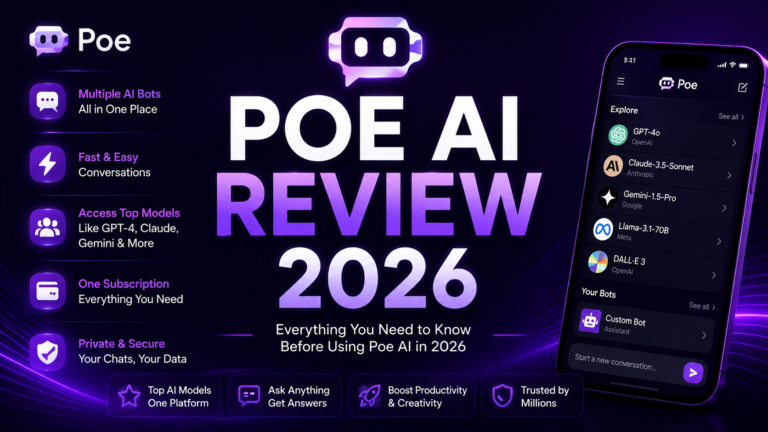
8. Poe
Best for power users who want access to dozens of AI models including Claude, GPT, Gemini, and Llama from a single subscription without managing multiple accounts.
Poe from Quora lets you run the same prompt across Claude, GPT, Gemini, Grok, Llama, and dozens of fine-tuned bots on a single subscription. The compare feature runs three or four models side by side, which is the fastest way to learn which model’s style fits your work. For users who want to evaluate which model handles a specific task best without paying four separate subscriptions, Poe’s unified access is genuinely practical.
Poe also provides access to boutique and experimental models that require individual sign-ups outside Poe, including Mistral variants, Qwen, and community-created custom bots. For researchers, developers, and AI enthusiasts who want the broadest possible model coverage from one interface, Poe is the most efficient way to access the full landscape.
Key Features: Access to Claude, GPT-5, Gemini, Grok, Llama, Mistral, and dozens of additional models from one interface, side-by-side model comparison with the same prompt, community-created custom bots, bot creation tools for building and sharing specialized AI assistants, and mobile apps with sync across devices.
Pros:
- Single subscription covers dozens of AI models that would require multiple separate accounts
- Side-by-side comparison is the fastest practical way to evaluate model differences on real tasks
- Access to boutique and experimental models not available as standalone consumer products
- Community bot ecosystem covers highly specialized use cases
Cons:
- Each model has separate usage limits within the Poe subscription; heavy users of premium models like Claude Opus hit caps faster than expected
- Poe does not replace having a primary Claude or ChatGPT account for deep, context-rich workflows where model memory and Projects matter
- Premium+ at $249.99/month for heavy reasoning-model users is the highest subscription price on this list
Pricing:
- Free: Limited daily messages across models
- Subscriber: $20/month, expanded message limits across all models
- Premium+: $249.99/month for unlimited premium model access
Frequently Asked Questions
Is it worth paying $20 per month for an AI chatbot when so many free options exist?
For casual everyday use, the free tiers of ChatGPT, Claude, Gemini, and Meta AI collectively cover most needs without payment. The paid tiers earn their cost for users who hit specific free-tier limitations daily. ChatGPT Plus pays for itself when Advanced Data Analysis, Custom GPTs, and unlimited GPT-5.4 access are used consistently for professional work. Claude Pro pays for itself when writing quality and long-document analysis are primary daily tasks. Perplexity Pro pays for itself when unlimited Deep Research compresses hours of manual research into minutes. Meta AI is the right answer if budget is a hard constraint and no specialized capability is needed. The clearest test: use the free tier of your most-relevant tool for two weeks. If you hit the limits and workarounds cost you more time than the subscription costs in money, pay for the upgrade. If you do not hit limits, the free tier is sufficient.
Can I use multiple AI chatbots, and what is the most effective multi-tool strategy?
The most important insight from testing: the best AI strategy uses multiple specialized tools rather than forcing one chatbot to do everything. The most commonly recommended two-tool combination is one frontier model for generation and creation (ChatGPT or Claude) plus Perplexity for research and fact-checking. This pairing costs $40 per month and covers the two most common AI workflow needs without redundancy. A third tool is justified only when a specific gap exists: Gemini for Google Workspace integration, Copilot for Microsoft 365 users, Grok for social media intelligence. Poe is a more economical path to multi-model coverage for users who want breadth without four separate subscriptions. The tools to avoid combining are direct substitutes: Claude and ChatGPT both at the paid tier is redundant for most users, since the use cases overlap more than they differ.
Which AI chatbot is safest for privacy, and what should users understand before uploading sensitive information?
Privacy posture varies significantly across tools. Consumer plans often train on your data unless you opt out. Treat anything you upload as retained unless the product docs or your contract states otherwise. Claude Pro and ChatGPT Plus both have no-training-by-default policies on paid plans, providing the strongest consumer-tier privacy among major chatbots. Gemini’s privacy settings are manageable but require active configuration. Meta AI uses chat interactions to personalize ads, which is a documented consideration for privacy-sensitive content. Grok’s data handling is governed by X’s privacy policy. For users handling confidential professional content, sensitive personal information, or proprietary business data, the minimum appropriate standard is a paid plan with an explicit no-training policy and verified privacy documentation. Enterprise plans with formal Data Processing Agreements are required for any content with regulatory sensitivity.
Final Recommendation
The best AI chatbot in 2026 is the one matched to what you actually do. Here is the decision framework.
For most individuals who want one tool that handles everything well, ChatGPT Plus at $20 per month covers the widest range of daily tasks and earns its cost for anyone using AI seriously more than a few times per week.
For professionals whose primary AI use is writing, analysis, and long documents, Claude Pro at $20 per month produces better results on those specific tasks and pays for itself through fewer editing iterations and more precise output.
For anyone who needs reliable, cited research rather than generated answers, Perplexity Pro at $20 per month is the clearest single-tool investment. The inline citations alone prevent the verification overhead that ungrounded AI responses require.
For Google Workspace users, Gemini’s free tier or $19.99 AI Pro covers the same daily tasks inside the apps you already use. The integration eliminates tool-switching that adds up across a full workday.
For Microsoft 365 organizations, Microsoft 365 Copilot at $30 per user per month is the path of least resistance to enterprise AI adoption with compliance documentation that standalone tools cannot match.
For anyone who wants AI capability at zero cost with no daily limits, Meta AI is the only option that delivers genuinely capable AI with no subscription and no message cap.
For social media professionals, analysts, and journalists tracking current events and public sentiment, Grok’s real-time X access justifies $10 per month at the SuperGrok Lite tier for a capability that no other chatbot on this list provides.
For power users who want model diversity and side-by-side comparison from a single subscription, Poe covers the landscape at $20 per month without managing separate accounts across every AI platform.
Start with whichever free tier best matches your primary use case. Upgrade when you hit limits that cost you more time than the subscription would cost you in money.