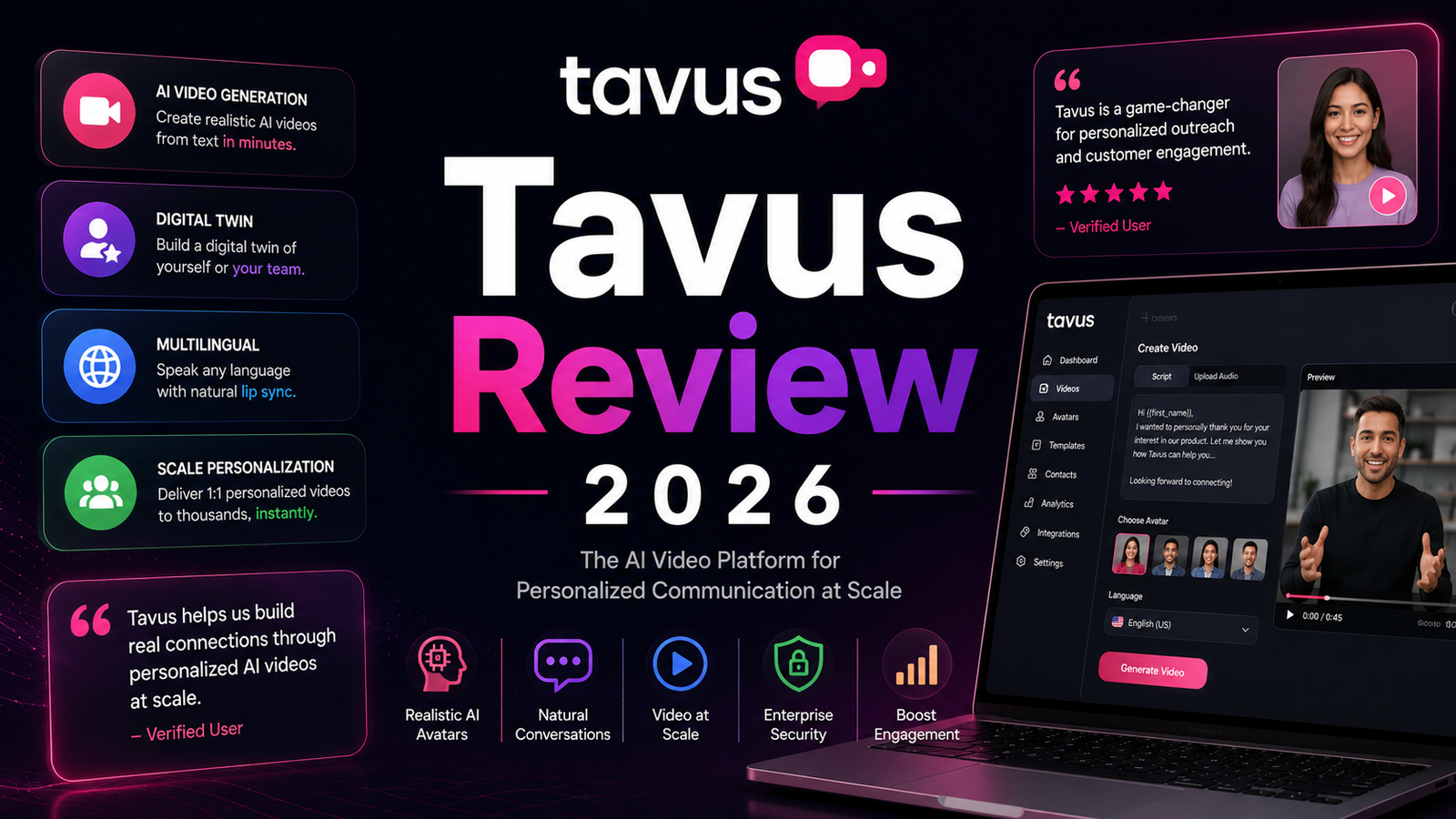
Tavus Review 2026: AI Video at Scale, But Is It Ready for Your Team?
Tavus is doing two genuinely different things under one platform name, and understanding which one applies to your situation is the first thing this review will clarify.
The first thing is personalized video at scale. A salesperson records one outreach video. A developer pushes that recording to the Tavus API with a spreadsheet of 500 prospect names, companies, and pain points. Tavus generates 500 unique versions of that video, each one with the salesperson appearing to address the specific recipient directly. What used to take a recording session per prospect is now a batch job.
The second thing is real-time conversational AI humans. A developer builds a customer support widget using Tavus’s Conversational Video Interface (CVI) API. A website visitor clicks it. A digital avatar that sees, hears, and responds to the visitor in under 600 milliseconds starts having a face-to-face conversation, handling product questions, qualifying leads, or walking through a demo. No human on the other end.
These are genuinely different capabilities. The first is a go-to-market operations tool. The second is a developer platform for building human-layer AI applications. The companies who get the most from Tavus are either running B2B sales outreach at scale that justifies the cost, or developers building applications where the conversation itself is the product.
The companies for whom Tavus is overkill are general content creators, small teams without developer resources, and anyone whose deal economics do not support the pricing structure.
**Not a developer or need something simpler? Synthesia is the easier no-code alternative most teams pick.** Try Synthesia free →
Plan Comparison Table
| Plan | Best For | Starting Price | Free Plan |
|---|---|---|---|
| Free | Testing the CVI pipeline and basic replica generation before any commitment | $0 (25 min conversational video + 5 min generation) | Yes |
| Starter | Small teams doing limited personalized video outreach or initial CVI prototyping | $59/month | No |
| Growth | Active sales or CS teams running ongoing personalized video at higher volume | $375-397/month | No |
| Enterprise | Organizations needing custom SLAs, dedicated infrastructure, white-labeling, and HIPAA compliance | Custom pricing | No |
“Pricing is subject to change. Tavus pricing is usage-based with overages on CVI minutes and replica training beyond plan limits. Always verify current pricing directly at tavus.io before purchasing.”
What Tavus Is
Tavus is an AI video platform and research organization backed by approximately $58 million in funding including Sequoia and Y Combinator (S21). The platform is built around four proprietary AI models:
Phoenix-4 (released February 2026): The visual rendering model. Operates at 40 frames per second with full-duplex capability, meaning it simultaneously listens and speaks while generating visual responses. It supports 10-plus controllable emotion states and generates active listening behaviors such as nodding and micro-expressions per frame rather than as canned animations triggered by keywords.
Raven-1: The multimodal perception model. Operates at sub-100ms latency and reads body language, facial cues, and environmental context during a live conversation. The EU AI Act includes relevant restrictions on AI-based emotion detection in workplace contexts as of February 2025; organizations deploying Raven-1 in EU employment applications should obtain legal review before going live.
Sparrow-1: The turn-taking model. Solves the specific problem of knowing when a human is done speaking, which traditional silence-detection approaches handle poorly. Operates at 40ms frame-level granularity and models floor ownership probabilistically based on prosodic signals rather than pause length.
Hummingbird-0: The overall conversational integration layer connecting the above models into a coherent real-time interaction.
This is not a vendor assembling commodity models from third-party APIs. These are proprietary research systems with published benchmarks. That technical foundation is why Tavus’s CVI competes credibly in the developer API space where other platforms do not.
Key Features
Personal Replica creation. A replica is a digital twin of a real person trained from approximately two minutes of video footage. The Phoenix-4 model learns the person’s face, micro-expressions, and voice. From that training, the platform can generate video of the person appearing to say any scripted content, or can run the persona in real-time CVI conversations.
The image-to-replica feature, launched in 2026, extends replica creation to still photographs. A single image of a real person, an AI-generated portrait, an illustrated character, or a brand mascot can now produce a usable Phoenix-4 AI human without a video recording session. This removes the video recording requirement that previously limited replica creation to individuals willing to film themselves.
Programmatic personalization for outreach. The Replica API allows generating thousands of video variants from one source replica using template variables. An SDR records one discovery call opener: “Hey [first_name], I’ve been looking at what you’re doing at [company] and I think we can help with [pain_point].” The template variables are populated from a CRM export and Tavus renders a unique video for each recipient. This is the use case where Tavus’s cost-per-deal economics make the pricing defensible: for B2B teams where a 20 percent lift in email response rates on a high-ticket deal pipeline produces returns that exceed the subscription cost in the first month.
Conversational Video Interface (CVI). The CVI is Tavus’s primary developer-facing product. It delivers real-time, face-to-face video conversations through a single API endpoint, replacing what was previously a five or six-vendor stack: WebRTC provider for streaming, STT provider for transcription, LLM for generation, TTS for synthesis, lip-sync model for avatar animation, and orchestration logic. Integration paths include React components, iframe embedding, and the Daily SDK. The platform supports 1080p video, 24 kHz audio, and 30-plus languages over WebRTC. End-to-end conversation latency rounds to approximately 600 ms, which is below the threshold where pauses feel unnatural to most users.
White-labeled API and enterprise compliance. The Enterprise plan supports full white-labeling, removing Tavus branding from deployed applications. SOC 2 compliance covers standard enterprise security requirements. HIPAA compliance is available for healthcare deployments. The biometric data disclaimer is worth stating clearly: creating a replica involves uploading face and voice data to Tavus’s servers. Tavus is SOC 2 compliant and states that biometric data is deleted after replica training. Organizations in regulated industries should conduct their own security review before proceeding.
Pros and Cons
Pros:
- CVI delivers genuine real-time conversational video AI at sub-600ms latency with proprietary models that a self-assembled stack cannot easily replicate
- Phoenix-4’s 40fps emotional rendering and active listening behaviors are materially more convincing than static avatar systems at the same use case
- Programmatic personalization through the Replica API enables B2B outreach workflows that are impossible with manual video recording
- Image-to-replica feature removes the video recording requirement, opening replica creation to non-human entities and brand mascots
- SOC 2 and HIPAA compliance coverage for regulated industry deployments
- Free plan with 25 minutes of CVI and 5 minutes of video generation allows genuine API testing before any payment
- Y Combinator and Sequoia backing provides platform stability signals that newer entrants cannot offer
Cons:
- No built-in video editing tools. Tavus exports standard MP4s and terminates its involvement there. Any post-production, branding, captions, or editing happens outside Tavus in a separate tool
- Voice quality from cloned replicas has been described by multiple independent reviewers as robotic, lacking the natural emotional cadence of human speech. The visual rendering is convincing; the voice is where the uncanny valley is most likely to appear
- Public documentation is thin relative to the platform’s complexity. Developers building novel CVI applications frequently encounter underdocumented edge cases
- Usage-based pricing creates cost unpredictability at scale. CVI overage billing runs approximately $0.32 to $0.37 per minute beyond plan limits. An unexpected traffic spike on a CVI deployment can produce significant overage charges
- The Growth plan at $375 to $397 per month and the Enterprise tier make Tavus economically inaccessible for small teams or individuals testing the B2B outreach use case seriously
- User base is smaller and less battle-tested than HeyGen or Synthesia. Production edge cases and reliability incidents are less thoroughly documented in the community
Pricing Breakdown
Free: $0. 25 minutes of conversational video (CVI) and 5 minutes of video generation. Access to stock avatars. Sufficient to test the CVI pipeline end-to-end and evaluate personalized video rendering quality before any financial commitment. This is a genuine technical evaluation tier rather than a feature preview.
Starter: $59/month. Includes a limited number of custom replica slots (reported at approximately 3 replicas), 100 minutes of conversational video, and basic API access. The entry point for small teams beginning to pilot personalized video outreach or initial CVI integration. Overage on replica training beyond the included quota is charged at $65 per additional replica.
Growth: $375 to $397/month. Higher volume of CVI minutes, more custom replica slots, conversation recording, advanced API features, and usage-based scaling. The plan where active sales or customer success teams running ongoing personalized outreach campaigns operate. Replica overage at $40 per additional replica reflects the volume discount over Starter.
Enterprise: Custom pricing. Privately hosted infrastructure, custom SLAs, dedicated support, full white-labeling, HIPAA compliance, and volume discounts. Contact Tavus directly for current enterprise rates.
CVI overage billing applies when usage exceeds plan limits at approximately $0.32 to $0.37 per minute of additional conversational video, rounded to the nearest 6 seconds. For CVI deployments with high traffic variability, the cost exposure from overages should be modeled conservatively before going live.
How It Compares to Synthesia and HeyGen
Tavus vs Synthesia
The comparison between Tavus and Synthesia resolves cleanly: Synthesia is a studio-first platform for high-quality pre-rendered training and corporate communications videos; Tavus is a developer-first platform for real-time conversational AI and programmatic personalization. The use cases do not significantly overlap.
Synthesia at $18 per month provides 230-plus professional avatars, SCORM export for LMS integration, and a polished no-code interface that non-technical users can operate within their first session. It is the appropriate tool for L&D teams producing corporate training videos where quality, consistency, and accessibility matter more than real-time interaction or personalization at scale.
Tavus requires developer integration, handles real-time video conversations that Synthesia cannot support at all, and enables programmatic batch generation that Synthesia’s no-code interface does not cover. If you are evaluating tools for training content, Synthesia wins without contest. If you are evaluating tools for conversational AI applications or B2B personalized outreach APIs, Synthesia is not in the comparison.
Tavus vs HeyGen
HeyGen is the most direct competitor to Tavus on personalized video generation and digital twin creation. The practical differentiation in 2026 is developer depth versus accessibility. HeyGen is significantly more practical for non-developers: the Studio interface allows producing personalized video and multilingual content without writing code. The Streaming Avatar API for real-time interactive deployments is HeyGen’s CVI equivalent, and its multilingual lip-sync capability across 300-plus languages exceeds Tavus’s 30-plus.
Tavus’s CVI with Phoenix-4, Raven-1, and Sparrow-1 is more technically sophisticated as a real-time conversational experience: the emotional rendering, turn-taking precision, and multimodal perception capabilities are ahead of HeyGen’s streaming avatar for applications where the conversation quality is the primary product requirement.
The practical decision: if your team has developers building CVI applications where conversation depth and latency matter, Tavus is the appropriate platform. If your team needs personalized video for sales outreach without developer involvement, or multilingual content translation, HeyGen’s $24 per month Creator plan provides accessible implementation that Tavus requires engineering resources to achieve.
Frequently Asked Questions
Is Tavus suitable for a small sales team of 3 to 5 people without a developer, or does it require engineering resources?
It depends heavily on which Tavus capability the team needs. The no-code interface for creating replicas and generating personalized outreach videos is accessible without developer involvement for basic use cases. Uploading a recording, connecting variable fields from a CSV, and generating a batch of personalized videos can be done through the Tavus interface without API integration. The CVI for building conversational video interfaces into products or websites does require developer resources. The API-based workflows that enable CRM-triggered video generation, automated outreach sequences, or embedded conversational experiences all require engineering work that a non-technical sales team cannot do without a developer. The Starter plan at $59 per month is the accessible entry point for a small team testing no-code personalized video. The CVI and programmatic API capabilities require technical investment to unlock.
What are the actual risks of using a Tavus digital replica for customer-facing sales and marketing?
Three documented risk categories are worth addressing before deployment. First, voice quality: cloned voices have been described by multiple independent reviewers as robotic and lacking emotional nuance. In outreach videos where the first five seconds determine whether the recipient continues watching, a voice that sounds synthetic can undermine the personalization value the replica is meant to create. Testing voice quality on a sample batch before scaling is strongly recommended. Second, the “95 percent human” threshold: Phoenix-4’s visual rendering is convincing, but occasional rendering artifacts, a blink that looks slightly wrong or a tonal shift, can cross into the uncanny valley in ways that undermine brand trust. Third, biometric data: replica creation requires uploading face and voice data. Tavus is SOC 2 compliant and states biometric data is deleted after training, but organizations in financial services, healthcare, or legal should conduct their own security review before uploading employee likeness data.
How unpredictable is Tavus’s usage-based pricing, and how should teams budget for it?
The usage-based model creates genuine cost variability that flat-subscription tools do not. CVI overages bill at approximately $0.32 to $0.37 per minute beyond plan limits. A CVI deployment that handles 10 concurrent users for 30 minutes each consumes 300 CVI minutes in a single session. On the Starter plan with 100 included CVI minutes, that single session would generate approximately $65 to $74 in overage charges. For deployments with predictable traffic, the Growth plan’s higher included volume reduces this risk. For deployments with variable traffic, such as a CVI embedded in a marketing campaign that drives significant temporary traffic, the overage exposure requires active monitoring and a ceiling configuration to prevent runaway billing. The free plan’s 25 CVI minutes are specifically sufficient to test the cost model on a small representative traffic pattern before committing to a paid plan.
Final Verdict
Tavus in 2026 is the most technically capable platform for real-time conversational video AI and developer-first personalized video generation. The proprietary Phoenix-4, Raven-1, and Sparrow-1 models represent genuine research differentiation that commodity API stacks cannot replicate on the CVI use case. The programmatic personalization workflow for B2B sales outreach addresses a legitimate at-scale problem with a capability that recording-based tools cannot match.
The platform is not ready for every team. Voice quality from cloned replicas is the most consistent documented limitation and represents a meaningful risk for outreach-focused deployments where voice naturalness determines response rates. The lack of built-in editing tools means every Tavus output requires post-production work in another application. Thin public documentation creates friction for developer teams building novel CVI applications. And the pricing structure, requiring $59 per month minimum for serious use and $375 to $397 per month for volume operations, makes the ROI case dependent on deal economics that not every team can demonstrate.
For sales and marketing teams with high-ticket B2B deal pipelines where personalization economics are demonstrable: evaluate the Starter plan for a single campaign cycle. One additional closed deal typically covers the cost. For developers building applications where real-time conversational video AI is the differentiating capability: Tavus’s CVI API is the most technically complete option available and the free plan provides a genuine end-to-end technical evaluation.
For non-technical teams who need personalized video for outreach without developer involvement, read our HeyGen Review 2026. For teams building corporate training content and educational video, read our Synthesia Review 2026.
If you want a more accessible, non-developer AI video tool with ready-made avatars and no API setup, Synthesia is the stronger choice for most teams.
Rating: 4.2 / 5 — Most technically capable conversational video AI for developer use cases. Pricing and voice quality limitations narrow the practical audience.
Disclosure: This article may contain affiliate links. OnyxRanked may earn a commission on qualifying purchases or subscriptions made through links on this page. This does not affect our editorial recommendations or ratings.