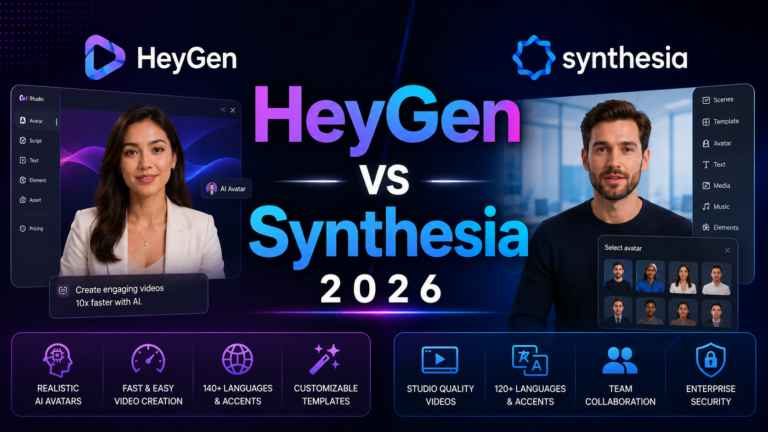
HeyGen vs D-ID 2026: Realistic Avatars or Cheap Talking Photos?
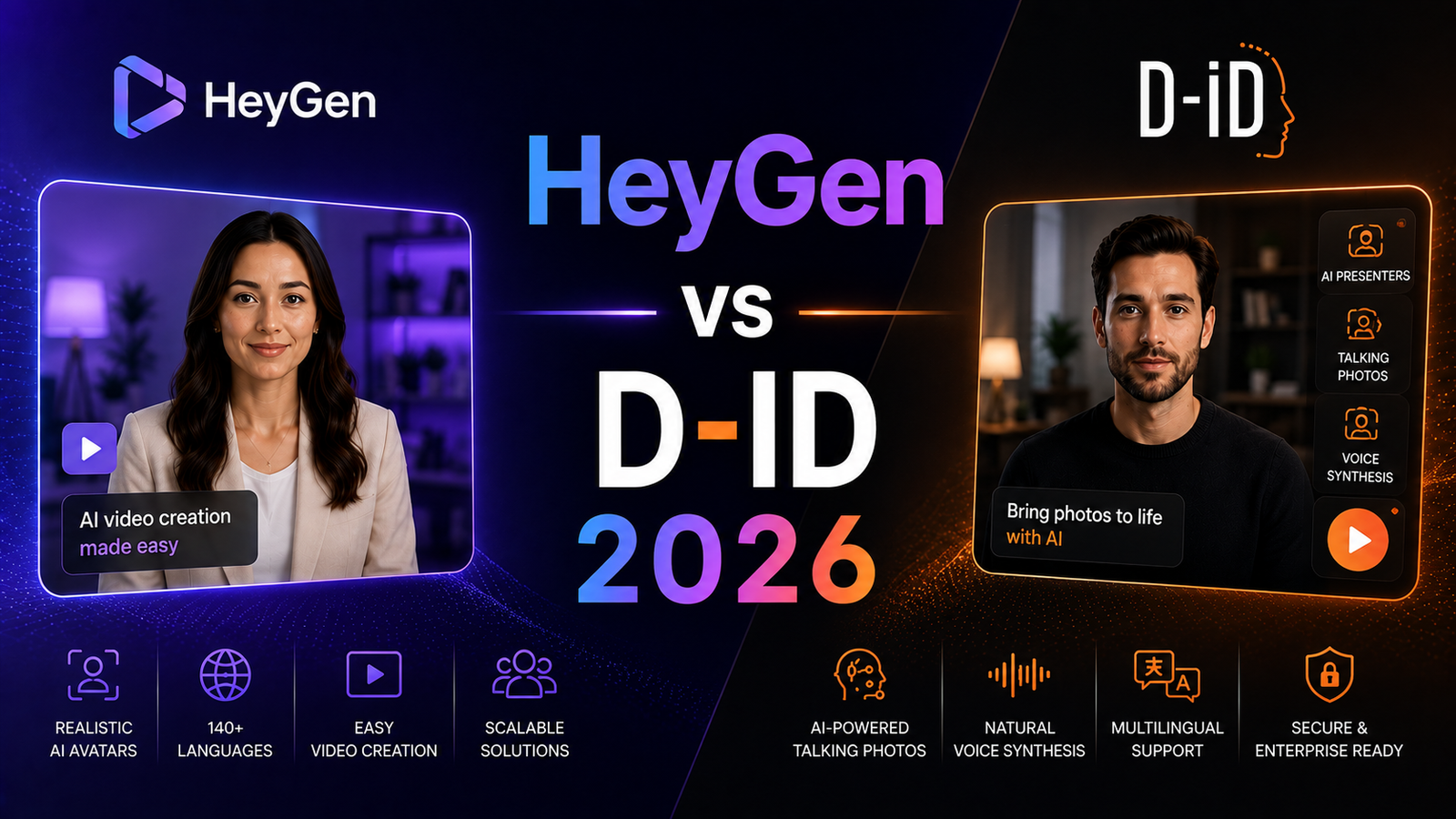
HeyGen and D-ID both turn text into talking-avatar video, and both get filed under the same category, but they sit at genuinely opposite ends of the market. One is built to produce realistic, professional presenter video that can carry a brand. The other is built to animate a photo into a talking clip as cheaply and quickly as possible. Comparing them is less about which is better in the abstract and more about deciding whether you are paying for quality or paying for the lowest possible entry price.
Here is the honest framing. HeyGen delivers realistic, expressive avatars, sometimes full-body with gestures, a full built-in editor, and enormous language coverage. It is a production platform for real video. D-ID delivers cheap, fast talking-photo clips and an API-first approach, with visibly lower realism, portrait-only output, and a starting price that undercuts almost everything else. It is a budget and developer tool for simple talking-head video.
If your work involves professional, marketing, or multilingual video, this comparison will not be close. If your need is genuinely just a cheap talking photo or an API integration on a tight budget, D-ID has a real place. This piece walks through exactly where the line falls, so you do not overpay for polish you will not use or underpay for quality your project actually needs.
Comparison Table
| Feature | HeyGen | D-ID |
|---|---|---|
| Avatar realism | High, expressive | Lower, visibly AI |
| Full-body vs portrait | Full-body avatars available | Portrait-only |
| Editing tools | Full built-in editor | Minimal, needs external editing |
| Languages | 175+ | 30+ |
| API | Yes | Yes, API-first |
| Starting price | ~$29/mo (Creator) | ~$5.90/mo (Lite) |
| Free tier | Yes, 3 videos | Yes, watermarked trial |
Pricing is subject to change. Always verify current pricing on the tool’s official website before purchasing.
Avatar Quality and Realism
This is the category that matters most, and it is where the two tools separate most sharply.
HeyGen’s avatars are among the most realistic and expressive in the category. Its latest Avatar technology produces presenters with natural facial expressions, convincing lip-sync, and in many cases full-body avatars that gesture and move rather than just talking heads locked in place. The result reads as a professional presenter delivering a message, which is exactly what marketing, sales, and training video need. Across longer scripts, HeyGen holds its quality, keeping lip-sync and delivery consistent from start to finish.
D-ID takes a fundamentally different approach. It animates a single still photo into a talking portrait, and its strength is that it can bring almost any image to life, including illustrations and historical portraits. But the realism is visibly lower. The output is portrait-only, the head movement can feel mechanical, and the surrounding facial animation is less refined than HeyGen’s. On longer clips, lip-sync can drift, which becomes noticeable in anything beyond a short segment. For simple talking-head use this is acceptable, but the avatars are recognizably AI in a way HeyGen’s increasingly are not.
The verdict here is clear: for avatar realism, HeyGen is well ahead. D-ID’s photo animation is clever and flexible, but it is not competing on quality, and it does not claim to.
Editing and Workflow
Production quality is not just the avatar. It is everything around it, and here the tools diverge again.
HeyGen includes a full built-in editor. You can build multi-scene videos, add text, images, backgrounds, music, and transitions, and assemble a complete, polished video inside the platform without leaving it. For a team producing finished content, this end-to-end workflow is a major time-saver, because the video is essentially done when the render completes.
D-ID offers a much more minimal editing environment. It is built to generate a talking clip, not to assemble a produced video. Anything beyond the basic talking-photo, such as multi-scene structure, overlays, or polished transitions, generally means taking D-ID’s output into a separate editing tool to finish the job. That extra step adds time and complexity, and it reinforces D-ID’s real identity as a component in a larger workflow rather than a complete production studio.
For teams that want to produce finished video in one place, HeyGen’s full editor is a significant advantage. D-ID fits better as a talking-head generator that feeds into another tool.
Language Coverage
This is not close, and for many teams it is decisive.
HeyGen supports a very broad language range, reported at 175 or more languages, with lip-synced translation extending across an even wider set. For any team producing multilingual marketing, global training, or localized customer content, that breadth is a major advantage. You can take one video and ship it convincingly in dozens of languages with matched lip movement, which is exactly what global content operations need.
D-ID supports a more modest range, reported around 30 or so languages through its text-to-speech, though its Video Translate feature does add dubbing capability. For simple, single-market talking-head use that is often enough. But if localization is any part of your strategy, HeyGen’s coverage is far ahead and hard to ignore.
For multilingual work of any kind, HeyGen wins this category outright.
API and Developer Use
This is the one category where D-ID genuinely leads, and it is the core of its appeal to a specific audience.
D-ID is API-first. As one of the pioneers in the talking-avatar space, it has a mature, stable, well-documented API that has powered production applications for years. For developers who want to embed talking-head video into their own software, generate clips programmatically, or build real-time conversational agents, D-ID’s API is a genuine strength, and its low entry price makes it especially attractive for startups and budget-constrained teams building on top of it. Webhook support enables fully automated video pipelines, which suits use cases like personalized email campaigns where every recipient gets a custom clip.
HeyGen also offers an API, including a Streaming Avatar API for interactive use, and it is capable. But HeyGen’s center of gravity is its no-code Studio and produced video, whereas D-ID’s whole identity is developer-first, low-cost programmatic video. For a developer whose priority is cheap, reliable, API-driven talking-head generation, D-ID is purpose-built for exactly that.
So the split is honest: D-ID wins on being an affordable, API-first developer tool. HeyGen wins on being a production platform that also happens to offer an API.
Pricing and Total Cost
On raw entry price, D-ID is the cheapest option in the category. Its Lite plan around $5.90 per month is lower than any comparable avatar tool’s starting tier. But the caveats matter. The Lite plan carries a watermark and caps resolution at 512px, which is too low for professional output, so serious use starts at the Pro plan around $29 per month. And D-ID’s separate credit structures for Studio and API mean heavy users of both need to budget carefully.
HeyGen starts at around $29 per month on its Creator plan, with a Business plan adding per-seat pricing for teams. It is more expensive at the entry level than D-ID’s Lite tier, but the comparison is not really like for like. HeyGen’s entry price buys realistic avatars, a full editor, and broad language support out of the box, whereas D-ID’s cheapest tier buys watermarked, low-resolution talking-photo clips.
The honest read on cost: D-ID wins if your only goal is the lowest possible price for simple clips or API access. HeyGen wins on value, because what you get at its entry price is a genuinely more capable production tool. Cheapest and best value are not the same thing here, and which one matters depends on your use case.
Frequently Asked Questions
Is D-ID’s lower price worth the quality drop?
It depends entirely on your use case. If you genuinely only need simple, short talking-photo clips or an affordable API for a developer project, D-ID’s low price is worth it and its quality is acceptable for that narrow purpose. But if you are producing professional, marketing, or multilingual video where the avatar’s realism reflects on your brand, the quality gap is significant and HeyGen’s higher price buys output that actually does the job. Cheap is only a bargain if the quality clears your bar.
Can HeyGen animate a photo like D-ID does?
HeyGen’s core approach centers on its avatar library and highly realistic presenters rather than animating arbitrary uploaded photos, which is D-ID’s signature trick. If your specific need is bringing a particular still image, illustration, or historical portrait to life, D-ID is built for that flexibility. If you want a realistic professional presenter, HeyGen’s avatars are the stronger and more polished route.
Which is better for multilingual video?
HeyGen, clearly. It supports 175 or more languages with lip-synced translation extending even wider, making it the strong choice for global marketing, localized training, and multilingual customer content. D-ID supports around 30 languages with some dubbing capability, which suits single-market talking-head use but falls well short of HeyGen for any localization-heavy strategy.
Final Verdict
HeyGen and D-ID answer two different questions. HeyGen answers “how do I produce realistic, professional, multilingual video?” D-ID answers “how do I make a cheap talking clip or build one into my app on a tight budget?”
For anyone producing real, professional, or multilingual video, HeyGen is the clear winner. Its avatars are realistic and expressive, often full-body with natural gestures, its built-in editor lets you produce finished video in one place, and its language coverage is far broader. For marketing, sales, training, and any content where the avatar needs to look genuinely professional, HeyGen delivers output that D-ID cannot match, and its entry price buys real capability rather than watermarked clips.
D-ID earns its place only in a narrow lane: cheap, simple talking-photo clips, or API-first developer integrations where the lowest possible price and programmatic access matter more than realism. If that is genuinely your use case, D-ID is a reasonable and affordable pick. For essentially everything else, the quality, editing, and language advantages make HeyGen the better tool.
Choose HeyGen if you care about how the video looks. Choose D-ID only if you care mainly about how little it costs. For most teams, that distinction points firmly toward HeyGen.
Pricing is subject to change. Always verify current pricing on the tool’s official website before purchasing.
Disclosure: This article contains affiliate links.