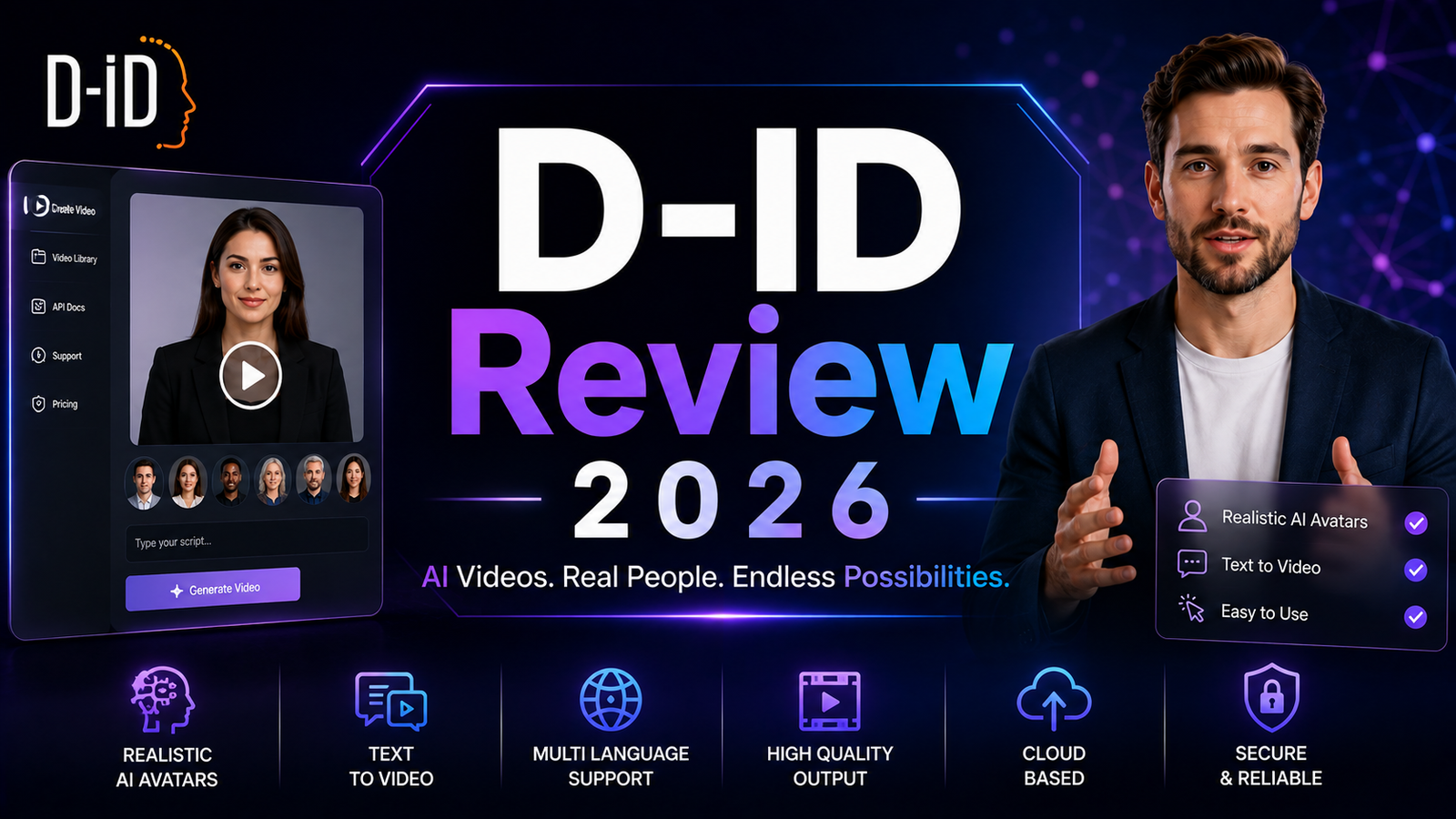
D-ID Review 2026: The Cheapest Way to Turn a Photo Into a Talking Avatar?
Most AI avatar tools start with a library of pre-built presenters. D-ID starts with a different premise: give it any single still image, a headshot, a sketch, even a painting, and it will animate that face into a lip-synced talking avatar. That photo-to-video approach is what D-ID has been known for since it helped pioneer the category, and in 2026 it is still the platform’s defining trick.
The question this review answers is narrower than “is D-ID good.” It is “is D-ID the cheapest sensible way to turn a photo into a talking avatar, and where does that low price start to cost you?” Because the honest answer is that D-ID competes almost entirely on two things: entry price and developer-friendly API access. On raw avatar realism, it sits a visible step behind the category leaders. Whether that tradeoff makes sense depends entirely on what you are building.
D-ID is built for three groups. Developers who want to embed talking-head video into their own apps through a clean REST API. Low-budget teams and solo creators who need occasional avatar clips without paying enterprise prices. And anyone whose use case is genuinely just a talking photo, such as personalized video emails, simple explainers, or a conversational agent on a website, rather than polished marketing or training production.
Our Take: D-ID wins on price and API maturity, not realism. If you are a developer building personalized video into a product, or you just need cheap talking-photo clips, it is a strong pick. If avatar quality is the point, HeyGen and Synthesia are worth the extra money.
Plan Comparison Table
| Plan | Best For | Starting Price | Free Plan |
|---|---|---|---|
| Free Trial | Evaluating quality before committing | $0 (14 days) | Yes, watermarked, ~5 min, 512px |
| Lite | Personal projects, social clips, testing | ~$5.90/mo | No |
| Pro | Professional use, watermark-free, commercial rights | ~$29/mo (or ~$16/mo annual) | No |
| Advanced | Higher volume, voice cloning, interactive agents | ~$149-196/mo | No |
| Enterprise | API at scale, SLAs, custom avatars | Custom | No |
Pricing is subject to change. Always verify current pricing on the tool’s official website before purchasing.
What D-ID Is and Who It Is For
D-ID is a generative AI platform that turns text, images, and audio into talking-avatar videos using deep-learning face animation and text-to-speech. Its core product is Creative Reality Studio, the web app where you upload a photo, type or paste a script, choose a voice, and get back an animated speaking video. Around that sit several other products: a developer API, real-time streaming avatars, Visual AI Agents for two-way website conversations, and a Video Translate feature that dubs existing videos into other languages while re-syncing the speaker’s lips.
The platform serves a specific kind of user well. Developers get a mature, well-documented REST API that has powered production applications for years, which matters when API stability is the difference between a feature that ships and one that breaks. Budget-conscious creators get the lowest entry price in the avatar category. And teams building conversational experiences get the Interactive Avatar and Agents features, which are more distinctive than D-ID’s standard video output.
Where D-ID is a poor fit is high-end marketing and training video. If your goal is a polished presenter delivering a brand video that looks close to a real person on camera, D-ID’s output will feel a step behind what you would get from HeyGen or Synthesia. D-ID is a talking-photo and API tool first, and a general avatar video studio second.
Key Features
Photo-to-video talking avatars are the headline. Upload a still image and D-ID animates the face with lip-synced speech generated from your script. This works on real headshots, illustrations, and historical portraits alike, which is genuinely useful for use cases where a stock avatar would feel wrong. The V4 engine in 2026 improved micro-expressions and mouth-sync noticeably over earlier versions.
Text-to-speech spans a large language range, with support reported at over 120 languages and a wide selection of voices. Voice cloning is available from the Pro plan upward, with a single clone on Pro and more on higher tiers, letting you put a consistent branded voice on your avatars.
The developer API is D-ID’s real competitive moat. It is an API-first platform in a market where the majority of enterprise avatar video usage is now programmatic. You send a REST call with a photo URL, script, and voice selection, and receive a rendered video back. Webhook support lets you build fully automated video pipelines, which powers use cases like personalized email campaigns where every recipient gets a video with their own name and details, automated course generation, and dynamic product demos.
Real-time streaming avatars and Visual AI Agents extend D-ID beyond pre-rendered clips into live, conversational experiences. An agent can hold a two-way conversation with a website visitor, handling support questions or product demos as an avatar rather than a text chatbot. This is one of D-ID’s more differentiated capabilities, though it requires real development effort to implement.
Integrations round out the platform, with plugins for PowerPoint, Canva, and Google Slides that drop talking-avatar clips into presentations, plus CRM connections for personalized outreach.
Pros
The entry price is the lowest in the category. A Lite plan around $5.90 per month is cheaper than any comparable avatar tool’s starting tier, making D-ID the most affordable on-ramp to talking-avatar video.
The photo-to-video capability is genuinely strong and distinctive. Animating any arbitrary still image, rather than choosing from a fixed avatar library, is something D-ID does better than most competitors.
The API is mature, stable, and well-documented. As one of the pioneers in the space, D-ID has the most battle-tested developer platform, which matters for anyone integrating avatar video into production software.
Interactive Avatars and Agents offer real-time conversational experiences that go beyond what standard avatar video tools provide.
Language coverage is broad, with 120+ languages and a Video Translate feature that re-syncs lips to dubbed audio.
Cons
Avatar realism is a visible step below HeyGen and Synthesia. Independent testing consistently places D-ID’s avatars a tier lower: lip movements are accurate, but the surrounding facial animation is less refined and head movement can feel mechanical. The avatars are more recognizably AI.
It is best for simple talking-head use, not polished production. For brand marketing or professional training video where realism carries the message, D-ID’s output can undercut the impression you are trying to make.
Pricing is credit-based and can be confusing. Studio pricing and API pricing use separate structures that do not always share a credit pool, so heavy users of both need to calculate costs carefully to avoid surprises.
Lower tiers carry real limitations. The free trial and Lite plan include a watermark and cap resolution at 512px, which is too low for professional output, so serious use effectively starts at Pro.
Interactive Agents require significant technical expertise. The most differentiated feature is also the one most teams cannot deploy without developer resources.
Pricing Breakdown
D-ID’s pricing ladder starts with a 14-day free trial that gives a few minutes of watermarked, 512px video plus API trial credits, which is genuinely useful for evaluating quality before paying. The Lite plan at roughly $5.90 per month is the cheapest entry to avatar video anywhere, suited to personal projects and social clips where a watermark is acceptable. Pro, around $29 per month monthly or closer to $16 per month billed annually, removes the watermark and adds commercial rights, and is the real starting point for professional use. Advanced, in the $149 to $196 per month range, unlocks higher volume, more voice clones, and interactive agent features. Enterprise is custom-priced for API at scale, SLAs, and custom avatars.
The important caveat is the credit-based model. Studio and API pricing are separate, and if you plan to use both, you need to budget for each independently. This flexibility suits developers who only touch the API, but it makes total cost harder to predict for teams using the full platform daily.
How D-ID Compares to HeyGen and Synthesia
D-ID, HeyGen, and Synthesia all generate talking-avatar video from text, but they win on different axes.
Against HeyGen, D-ID’s photo animation is arguably stronger, since HeyGen leans on its pre-built avatar library. But HeyGen’s Avatar technology produces more expressive, natural-looking presenters, and for business headshot scenarios and social content HeyGen’s realism clearly leads. If you want the avatar to look as close to real as possible, HeyGen is the better spend.
Against Synthesia, D-ID is cheaper to start but offers fewer templates, fewer stock avatars, and a less polished editor. Synthesia is built for enterprise training and internal comms at scale, with the consistency, compliance features, and editing polish that large organizations need. D-ID cannot match that production environment, but it undercuts Synthesia significantly on entry price.
The clean way to frame it: D-ID is the budget and API pick, HeyGen wins on avatar realism, and Synthesia wins on enterprise training and polish. Your use case decides which tradeoff is right.
Frequently Asked Questions
Is D-ID actually the cheapest avatar video tool?
At the entry level, yes. The Lite plan around $5.90 per month is the lowest starting price in the talking-avatar category. But “cheapest to start” and “cheapest for your actual workload” are different questions. The Lite plan’s watermark and 512px resolution make it unsuitable for professional output, so real use starts at Pro. And the separate credit structures for Studio and API mean heavy users should model their true monthly cost rather than assume the headline price.
Can D-ID really animate any photo?
Largely yes. That is its signature feature. You can upload a real headshot, an illustration, a sketch, or a portrait, and D-ID will animate the face with lip-synced speech. Results are best on clear, front-facing images with a visible face. It is one of the few tools where you are not limited to a fixed library of stock avatars, which is the main reason to choose it over more realistic but less flexible competitors.
Is D-ID good enough for professional marketing videos?
For polished brand marketing, usually not on its own. D-ID’s avatar realism sits a step below HeyGen and Synthesia, and for high-end marketing where the avatar needs to look nearly human, that gap is noticeable. D-ID shines for simple talking-head content, personalized video at scale via API, and conversational agents. For flagship marketing video, the higher-realism tools are the safer choice.
Final Verdict
D-ID earns its place in 2026 by being the most affordable and most developer-friendly talking-avatar platform, not the most realistic one. Its photo-to-video animation is distinctive, its API is the most mature in the category, and its entry price is unmatched. For developers building personalized or conversational video into their own products, and for budget-conscious creators who need simple talking-photo clips, D-ID is a genuinely strong pick that does something its competitors do not.
The tradeoff is realism. D-ID’s avatars are a visible tier below the leaders, facial animation is less refined, and the platform is best kept to simple talking-head use rather than polished marketing or training production. The credit-based pricing also demands attention if you use both the Studio and the API.
If avatar quality is the point of your project, the extra money is worth it. HeyGen produces more expressive, natural-looking avatars and is the better choice for marketing, sales, and creator content where realism sells. Synthesia is the stronger option for enterprise training and internal communications, with the polish, consistency, and compliance features large teams need. D-ID is the budget and API specialist. HeyGen and Synthesia are the quality plays. Choose based on which one your use case actually rewards.
Pricing is subject to change. Always verify current pricing on the tool’s official website before purchasing.
Disclosure: This article contains affiliate links.