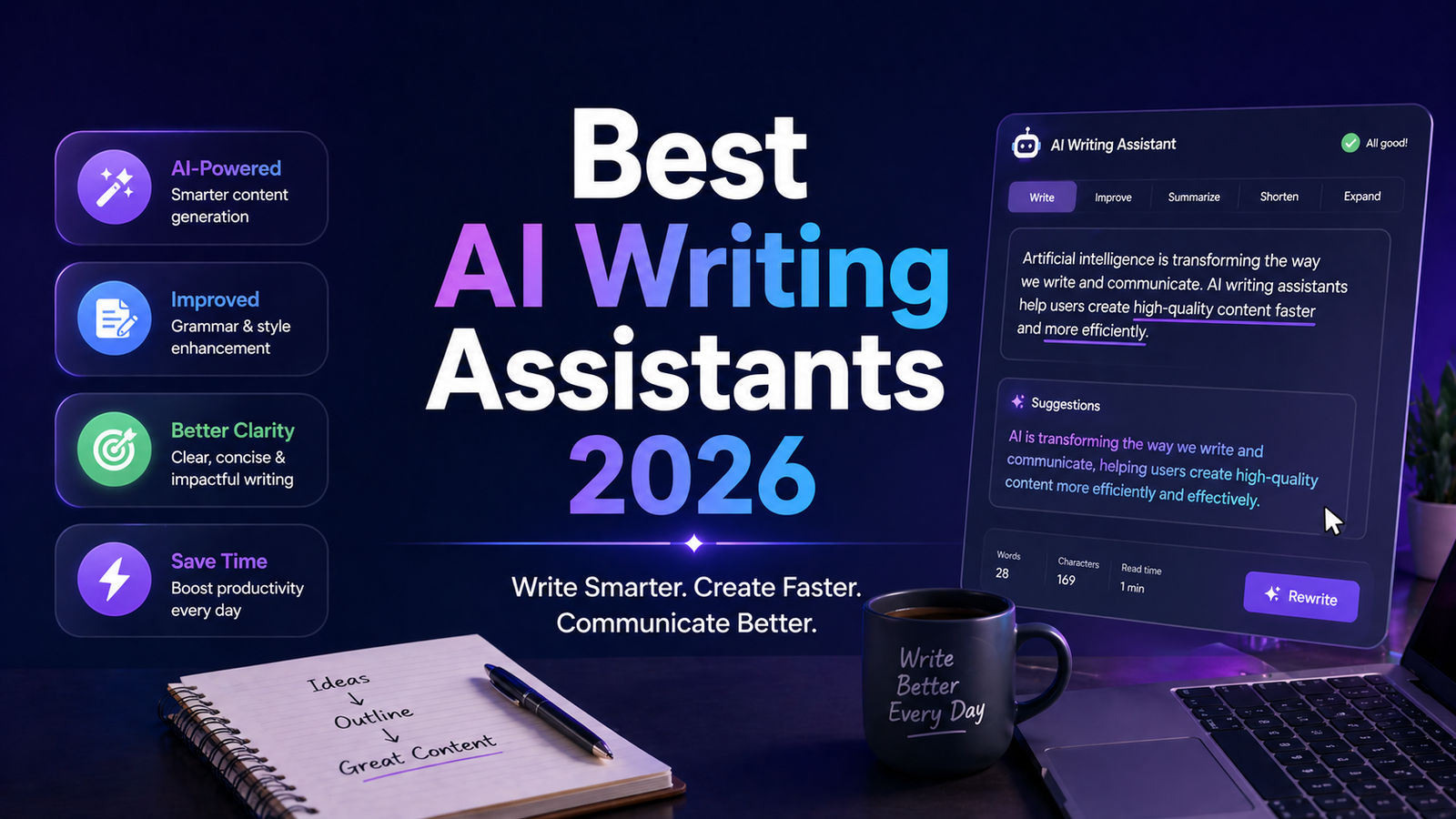
Best AI Writing Assistants 2026: Ranked, Reviewed and Compared
Writing is one of the most time-consuming tasks in professional and creative work. A marketing manager producing blog posts, email campaigns, and social captions. A novelist pushing through chapter 14. A founder drafting investor updates, job descriptions, and product documentation. A journalist fact-checking and filing under deadline. All of them face the same fundamental bottleneck: the gap between how fast they can think and how fast they can write.
AI writing assistants have narrowed that gap substantially. According to consistent reports across content teams, skilled writers using AI assistants produce three to four times more content without a measurable decline in quality. The qualifier matters: skilled writers using AI, not AI replacing writers. The tools that produce the best results are the ones where a human brings judgment, expertise, and voice and the AI handles first-draft velocity, structural suggestions, and editing overhead.
The category has also matured significantly. In 2026, the AI writing market has split into two distinct camps. General-purpose AI assistants like Claude and ChatGPT now produce prose capable of fooling experienced readers, making the case for specialized tools less obvious than it was two years ago. But specialized tools still earn their place: Sudowrite for fiction writers, Jasper for marketing teams with brand consistency requirements, Grammarly and ProWritingAid for editing depth, and Writesonic for SEO-focused content at accessible pricing.
This guide covers eight tools across both categories, with clear guidance on who each serves and where general-purpose assistants are sufficient.
Comparison Table: Best AI Writing Assistants 2026
| Tool | Best For | Starting Price | Free Plan |
|---|---|---|---|
| ChatGPT | Versatile writing, ideation, and flexible first drafts | Free / $20/month (Plus) | Yes |
| Claude | Long-form writing, nuanced prose, and document analysis | Free / $20/month (Pro) | Yes |
| Jasper | High-volume brand-consistent marketing copy for teams | $59/month (Pro) | 7-day trial |
| Copy.ai | Fast short-form copy and GTM workflows for sales and marketing | Free / $29/month (Chat, 5 seats) | Yes |
| Writesonic | SEO-focused blog content at accessible pricing | Free / $16/month (Individual) | Yes |
| Grammarly | Writing quality, tone correction, and editing across all platforms | Free / $12/month (Pro, annual) | Yes |
| ProWritingAid | Deep manuscript editing and structural analysis for serious writers | Free / $20/month (Premium) | Yes |
| Sudowrite | Fiction writing, creative prose, and novel drafting | $10/month (Hobby) | No (free trial on signup) |
“Pricing is subject to change. Always verify current pricing on the tool’s official website before purchasing.”
Detailed Reviews
1. ChatGPT
Best for writers who need a flexible AI writing partner across every content type, from marketing copy to personal essays.
ChatGPT is where most professional writers start with AI and where a significant number stay. At $20 per month for Plus, GPT-5.4 handles blog drafts, email sequences, social captions, product descriptions, pitch decks, landing page copy, and virtually every other content format with reasonable first-draft quality. The conversational interface makes iteration natural: request a draft, respond with feedback, and refine in dialogue rather than through repeated prompting.
The Custom GPTs feature allows building brand-specific writing assistants pre-loaded with tone guidelines, vocabulary preferences, and style requirements, which means teams can maintain consistent output without repeating context in every session. Memory builds an understanding of your writing preferences and recurring projects over time, gradually reducing the setup overhead for each session.
Key Features: GPT-5.4 with web browsing for research-integrated writing, Custom GPTs for brand-specific writing assistants, memory for persistent writing style and project context, Advanced Data Analysis for processing and writing about uploaded data, and Canvas for collaborative long-form document editing.
Pros:
- Most versatile writing tool on this list; handles every content type without switching platforms
- Web browsing integrates current research directly into writing sessions
- Custom GPTs eliminate repeated brand context setup for recurring writing tasks
- Free tier with GPT-5.x is genuinely capable for occasional professional writing
Cons:
- Output can feel slightly formulaic for high-stakes brand writing without careful prompting
- No native grammar or style checking layer; pairs with Grammarly for quality oversight
- Daily rate limits on the free tier interrupt intensive writing sessions
Pricing:
- Free: GPT-5.x with daily limits, no credit card required
- Plus: $20/month, full GPT-5.4, web browsing, Custom GPTs, memory, Canvas
- Team: $25 to $30/user/month, shared workspace, data privacy
2. Claude
Best for long-form writing, nuanced prose, and any project where writing quality and instruction-following precision are the primary metrics.
Claude consistently earns the highest marks in independent blind evaluations for prose quality. Its outputs have a more natural sentence rhythm, follow stylistic instructions more precisely, and produce less of the slightly generic polish that experienced readers associate with AI-generated text. For high-stakes writing, investor narratives, editorial pieces, detailed product documentation, or any project where the writing itself is the deliverable, Claude is the strongest tool available.
The 200,000-token context window on the Pro plan allows processing entire manuscripts, comprehensive research sets, or long conversation histories in a single session. For non-fiction writers synthesizing research, novelists needing consistency across a full draft, or technical writers working with extensive documentation, this capacity is practically significant. Anthropic’s no-training-by-default policy on paid plans is relevant for writers working on unpublished material they need to protect.
Key Features: Best-in-class prose quality verified in consistent blind evaluations, 200,000-token context window for long manuscripts and research synthesis, Projects for maintaining persistent writing project context across sessions, extended thinking mode for complex analytical and creative reasoning, and no-training-by-default on paid plans for pre-publication content protection.
Pros:
- Best writing quality in the AI assistant category; produces more natural, tonally precise prose
- 200,000-token context handles full manuscripts without chunking
- Strong at following complex stylistic instructions across long documents
- No-training policy protects pre-publication intellectual property
Cons:
- No native image generation or visual content support
- Daily message limits on free and Pro tiers can frustrate intensive writing sessions
- Smaller template library than dedicated marketing writing tools
Pricing:
- Free: Claude Sonnet 4.6 with daily limits, no credit card required
- Pro: $20/month, Opus 4.6 access, 200K context, Projects, Research feature
3. Jasper
Best for marketing teams producing high-volume, brand-consistent content across multiple channels who cannot afford voice drift.
Jasper’s defining feature is not raw output quality but structural brand consistency. The Brand Voice system analyzes existing content to extract a tonal and stylistic fingerprint, then applies that profile to every generated piece. For a team where multiple writers contribute to the same brand’s content calendar, this automated consistency is worth the premium over general-purpose tools where maintaining voice requires careful manual prompting on every session.
The campaign workflow generates aligned assets from a single brief: a blog post, email sequence, social copy, and ad variants all emerge from the same inputs maintaining consistent positioning. The Surfer SEO integration enables real-time content optimization scoring within the Jasper editor, combining generation and SEO guidance in one workflow.
Key Features: Brand Voice trained on existing content for team-wide consistency across all writers, campaign workflow generating multi-channel assets from a single brief, 50-plus marketing content templates, Surfer SEO real-time optimization integration, and API access on Business plans for custom automation.
Pros:
- Best brand voice consistency for teams managing multiple content contributors
- Campaign workflow compresses multi-channel content production significantly
- 7-day free trial with full feature access
- Surfer SEO integration eliminates a tool-switching step for SEO content teams
Cons:
- $59/month Pro starting price is harder to justify for individual writers or low-volume teams
- Per-seat pricing scales uncomfortably for larger teams
- Output quality on general writing tasks is comparable to ChatGPT Plus at $20 per month less per seat
Pricing:
- Pro: $59/month (annual) / $69/month (monthly), 1 seat, 2 Brand Voices
- Business: Custom pricing, unlimited Brand Voices, API access
4. Copy.ai
Best for sales and marketing professionals who need high-volume short-form copy across multiple channels at the most accessible per-seat price point.
Copy.ai repositioned itself in 2025 and 2026 as a GTM (go-to-market) AI platform rather than a pure writing tool. For marketing and sales teams, the practical value is in speed and volume: email sequences, LinkedIn outreach, ad copy variants, landing page sections, and product descriptions generate quickly with minimal prompting. The Chat plan at $29 per month covers five seats with unlimited word generation, the strongest per-seat economics in the AI writing category.
The free plan with unlimited chat-based writing is the most generous in the category and genuinely usable for evaluating whether Copy.ai’s templates and output style match your workflow before committing.
Key Features: 90-plus marketing and sales content templates, Brand Voice for training on existing content (paid plans), multi-model access routing tasks to GPT-4o, Claude, or Gemini, unlimited word generation on Chat plan, and five seats included at the Chat tier.
Pros:
- Five seats at $29/month is the best per-seat value in AI copywriting
- Free plan with unlimited words is the most generous evaluation tier in the category
- Low learning curve; accessible to non-technical marketing team members
- Multi-model access allows routing to the strongest model for each task
Cons:
- Best for short-form and medium-form copy; long-form articles require more editing investment
- Brand Voice locked behind paid tiers
- Not the strongest tool for literary or editorial writing
Pricing:
- Free: Unlimited chat words, 1 seat
- Chat: $29/month ($24/month annual), unlimited words, 5 seats, multi-model access
- Pro: $49/month ($36/month annual), Brand Voice, Infobase, integrations
5. Writesonic
Best for bloggers and content marketers who need SEO-focused articles at the most accessible paid price point in the category.
Writesonic occupies the budget-friendly end of the dedicated marketing writing tools. Powered by GPT-4 Turbo, it offers 100-plus content templates, a built-in keyword optimization tool, and a long-form article writer that produces decent first drafts at $16 per month for the Individual plan. The SEO integration guides content to include target keywords and hit recommended content length, providing optimization guidance without requiring a separate Surfer SEO subscription for teams publishing at lower volumes.
For bloggers and content marketers who need respectable SEO content without the enterprise budgets that Jasper and dedicated SEO tools require, Writesonic offers a functional middle path.
Key Features: 100-plus content templates across all standard marketing formats, AI Article Writer 6.0 for long-form blog post generation, built-in SEO keyword integration for optimization guidance, Chatsonic conversational AI with web search for research-backed writing, and WordPress and Webflow direct integration for faster publishing.
Pros:
- Most accessible paid entry point for dedicated marketing writing: $16 per month
- Built-in SEO optimization reduces the need for a separate tool at lower content volumes
- Trustpilot rating of 4.7 out of 5 based on verified user reviews
- 100-plus templates cover every standard marketing content format
Cons:
- Output requires more editing than Claude or Jasper for publication-quality content
- Brand voice consistency is weaker than Jasper at scale
- Less suitable for literary, editorial, or highly nuanced writing tasks
Pricing:
- Free: Limited monthly credits
- Individual: $16/month (annual), expanded generation
- Teams: Custom pricing, team features and collaboration
6. Grammarly
Best for every writer as the quality layer that works silently across every platform they already use.
Grammarly is not a writing generation tool. It is the writing quality infrastructure that makes everything else better. Install the browser extension once and it activates across Gmail, Google Docs, Microsoft Word, Notion, LinkedIn, Slack, and essentially every web text field, providing real-time grammar, clarity, and tone feedback without any workflow change.
For writers specifically, the Pro plan’s GrammarlyGO with 2,000 monthly rewrite prompts is a meaningful content editing layer: highlight a sentence and ask for a more formal version, a shorter version, or a version with stronger impact. The plagiarism checker on Pro is relevant for any writer using AI assistance before publishing. The tone detection feature catches when professional writing sounds unintentionally passive-aggressive or over-casual before it reaches an audience.
Key Features: Real-time grammar, clarity, and tone correction across every integrated platform, GrammarlyGO for AI-assisted rewriting and paraphrasing (100 prompts free, 2,000 on Pro), plagiarism detection for content integrity verification, tone detection for professional communications, and style consistency suggestions calibrated to business writing standards.
Pros:
- Works everywhere writers work without any additional workflow steps after installation
- Pro at $12 per month annually is among the highest-ROI writing subscriptions available
- Plagiarism checker is essential for writers publishing AI-assisted content
- Tone detection catches subtle communication issues before they reach readers
Cons:
- Not a content generation tool; improves existing writing rather than creating from scratch
- 100 monthly AI prompts on the free plan depletes quickly for heavy rewriting use
- Full style suite and tone controls require Pro; free tier is correction-focused
Pricing:
- Free: Grammar, spelling, punctuation, 100 AI prompts/month, no credit card required
- Pro: $30/month ($12/month annual, $144 upfront)
- Business: Custom pricing for teams with centralized style guide management
7. ProWritingAid
Best for serious writers, authors, and editors who need the deepest manuscript analysis and structural writing feedback available.
ProWritingAid is the editing tool built for writers who want to improve rather than just correct. Where Grammarly focuses on real-time correction across professional communications, ProWritingAid provides 20-plus in-depth analysis reports covering pacing, sentence structure variation, dialogue authenticity, consistency, passive voice patterns, cliche density, and readability across different audiences. The Virtual Beta Reader feature gives fiction writers story-level feedback on plot pacing and character development that no grammar checker comes near.
For self-publishing authors and novelists who otherwise pay professional editors $0.02 to $0.05 per word for developmental feedback, ProWritingAid compresses significant editing costs. The Premium plan at $20 per month, or the lifetime plan at $399, puts this depth of analysis within reach of any serious writer. ProWritingAid integrates directly with Scrivener, Word, Google Docs, and Open Office, and holds a 4.3 out of 5 Trustpilot rating from verified users.
Key Features: 20-plus in-depth writing reports including pacing, consistency, dialogue, and readability, Virtual Beta Reader for fiction-level story structure feedback, real-time grammar and style correction across Scrivener, Word, and Google Docs, plagiarism checker with 16-billion-word comparison database, and a lifetime license option that eliminates subscription costs for long-term users.
Pros:
- Deepest manuscript analysis available in the AI writing category; unmatched for self-editing serious writers
- Virtual Beta Reader provides story-level structural feedback unavailable elsewhere
- Lifetime plan at $399 eliminates subscription overhead for committed writers
- Scrivener integration is particularly valuable for fiction writers using that workflow
Cons:
- Steeper learning curve than Grammarly for users who want simple real-time correction
- Less useful for short-form marketing copy and business writing than Grammarly
- Interface is denser than newer tools; not the most accessible entry point for casual writers
Pricing:
- Free: Limited monthly usage, basic suggestions
- Premium: $20/month ($10/month annual), full 20-plus reports, unlimited usage
- Lifetime: $399 one-time, all current and future Premium features
8. Sudowrite
Best for fiction writers who need a specialized AI writing partner built for the specific challenges of creative prose, narrative structure, and novel drafting.
Sudowrite is the one tool on this list that does not try to serve everyone. It was built for fiction writers and serves them better than any general-purpose AI assistant for the specific tasks of creative prose drafting. The Muse model, proprietary to Sudowrite and fine-tuned on published fiction, produces dialogue, pacing, and sensory detail that reads distinctly more like human-written fiction than output from GPT-5.4 or Claude using generic prompting.
The Story Bible feature maintains character details, world-building elements, and plot threads across a full manuscript, ensuring consistency over 90,000 words in a way that context window management alone cannot. The Rewrite, Describe, Expand, and Write Ahead tools are purpose-built editing functions that address the specific places fiction writers get stuck: elaborating a thin scene, finding stronger sensory language, or continuing from a specific beat.
December 2025 brought project-wide find and replace, a frequently requested feature that makes the platform more practical for full manuscript management. Sudowrite is also uncensored, making it the practical choice for fiction genres requiring mature content that content-filtered general tools refuse.
Key Features: Muse 1.5 model fine-tuned on published fiction for natural creative prose, Story Bible for maintaining character and world consistency across full manuscripts, purpose-built fiction editing tools (Rewrite, Describe, Expand, Write Ahead), Canvas mode for project-level manuscript management, and uncensored generation for mature fiction genres.
Pros:
- Muse model produces the most natural fiction prose of any AI tool at this price point
- Story Bible solves the consistency problem that plagues AI-assisted long-form writing
- Purpose-built editing tools address the exact places fiction writers get stuck
- Uncensored generation covers genres other tools refuse
- Most affordable specialized fiction writing tool at $10 per month for the Hobby tier
Cons:
- Only useful for creative fiction; not designed for marketing, business, or non-fiction writing
- No model flexibility; users work with Sudowrite’s selected models rather than choosing their own
- No publishing, formatting, or distribution features; manuscript must be exported for everything else
Pricing:
- Hobby: $10/month, 225,000 AI credits per month (~90,000 words of generation)
- Professional: $22/month, 1,000,000 credits per month
- Max: $44/month, 4,000,000 credits per month
Frequently Asked Questions
Do I need a specialized writing tool or can I just use ChatGPT or Claude for everything?
For most individual writers and small teams, Claude or ChatGPT handles the majority of writing tasks well enough that specialized tools are optional. The cases where specialized tools clearly add value beyond what a general-purpose assistant provides are: brand-consistent marketing copy at volume across a team (Jasper), deep manuscript editing and structural analysis (ProWritingAid), fiction-specific prose generation with story context management (Sudowrite), and ubiquitous real-time writing correction across every platform you use (Grammarly). If none of those specific needs apply to your workflow, Claude Pro or ChatGPT Plus at $20 per month covers most professional writing requirements. The honest framing from practitioners in 2026 is to start with Claude or ChatGPT and add specialized tools only when you encounter a specific, documented limitation that the general tool cannot address.
Is AI writing assistance ethical and what are the disclosure requirements in 2026?
Using AI for writing assistance is widely accepted and ethical when used appropriately. The key distinction is between AI as a writing partner (drafting, editing, brainstorming, restructuring) and AI generating content misrepresented as entirely human-created original work. For professional and commercial writing, the FTC requires disclosure of AI-generated content as of 2026. For academic writing, institution-specific policies vary widely and should be verified before using any AI assistance on assessed work. For journalism, most major publications have AI use guidelines covering what is permitted. For book publishing, consult your publisher’s current AI policy before submitting AI-assisted manuscripts. For personal creative work and self-publishing, AI assistance is standard practice with no legal disclosure requirements, though some authors choose to disclose for reader transparency.
How should writers protect their unpublished work when using AI tools?
This is the most important data privacy question for writers, particularly those working on pre-publication material. The key variables are whether the AI tool uses your content for model training and whether your data is processed by third parties. Claude Pro, Claude Team, and ChatGPT Plus and Team all explicitly do not train on user data by default on paid plans. Sudowrite does not train on user data according to their privacy policy. ProWritingAid does not use your writing to train AI models. Grammarly Pro does not use your documents for model training. The riskier scenario is free tiers of general-purpose tools, which may use conversations for improvement. For unpublished manuscripts, proprietary business content, or any material where IP protection is critical, verify the specific plan tier’s data handling policy before uploading, and consider whether local tools or API-based solutions provide stronger privacy guarantees for your threat model.
Final Recommendation
The right AI writing stack depends on what type of writing you do most and where your biggest productivity bottleneck sits.
For most professional writers, a two-tool combination covers everything at reasonable cost. Claude Pro at $20 per month handles all generation, analysis, and long-form writing with the best prose quality available. Grammarly Pro at $12 per month (annual) handles quality, tone, and editing across every surface the writer uses. Combined at $32 per month, this stack addresses generation and editing without platform switching or specialized tool overhead.
For marketing teams producing high-volume branded content, add Jasper at $59 per month when brand voice consistency across multiple writers becomes a documented problem that ChatGPT and Claude free-form prompting cannot maintain reliably.
For fiction writers, Sudowrite at $10 to $22 per month is the most purpose-built and highest-value specialized writing tool in the category. The Muse model’s prose quality for fiction genuinely cannot be replicated through general-purpose prompting. Add ProWritingAid Premium at $10 per month (annual) for the manuscript editing depth that Grammarly does not reach.
For bloggers and content marketers at budget-conscious stages, Writesonic at $16 per month with its built-in SEO guidance and Copy.ai’s free plan for short-form copy provide meaningful AI writing support before investing in the higher-tier tools.
Every writer regardless of category benefits from Grammarly free as the baseline quality layer across all their communications. Install it once, let it run in the background, and layer paid tools on top only when specific documented needs justify the investment.