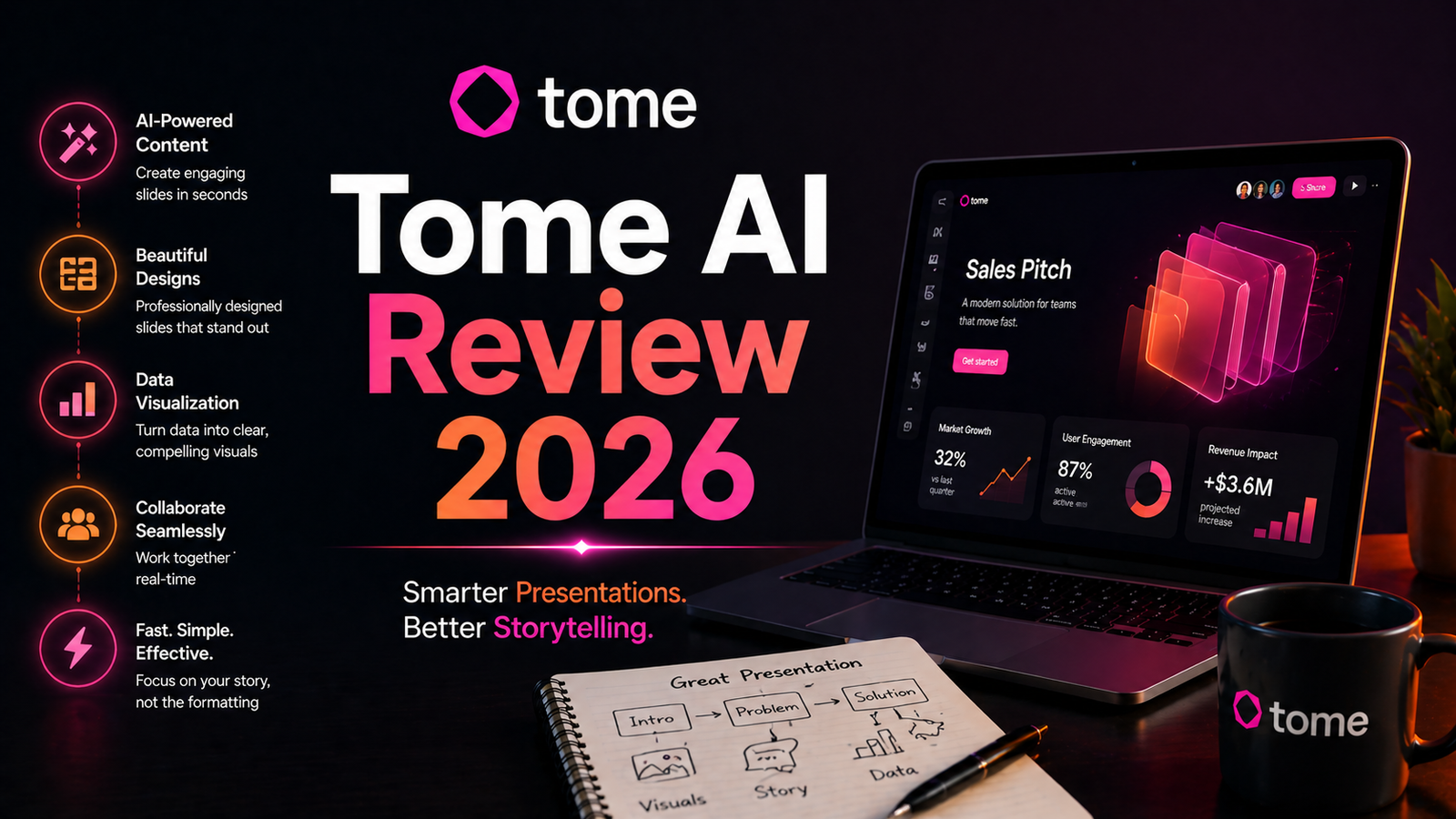
Tome AI Review 2026: Is the AI Presentation Hype Actually Real?
Tome AI is no longer the broad AI presentation platform it once was. In 2026, the company shifted heavily toward sales and marketing workflows, fundamentally changing who the platform is actually built for.
Gamma treats presentations as web native documents built for sharing and interactivity. Beautiful.ai treats them as enforced design slide outputs where bad formatting is impossible by default. Tome treats them as narrative arguments, visual stories with emotional arc and momentum, and the AI is specifically trained to build structure that moves a viewer through an idea rather than stacking information on slides.
That philosophy has always been Tome’s most interesting differentiator. In 2026, the company has made a significant strategic pivot that buyers need to understand before evaluating the product: Tome has refocused exclusively on sales and marketing use cases and removed AI generation features from its free plan. If you signed up in 2024 expecting a generous free AI tier for general use, that product no longer exists in its previous form. What Tome offers now is a purpose-built sales and marketing presentation platform with strong narrative AI generation and a professional entry point that has moved from free to paid for meaningful AI access.
Whether that focus makes it the right choice for you depends on how closely your use case matches the workflows Tome AI has specifically built toward.
Our Take: The best AI presentation tool for people who hate making presentations. If you need pixel perfect control over every slide, stick with PowerPoint. If you just need something that looks good fast, Tome delivers.
Building presentations with video? Our Synthesia review covers the AI avatar tool most teams use for training and presentation video.
What Tome AI Is and Who It Is For
Tome is an AI-powered presentation creation platform that generates story-driven presentations from text prompts, outlines, and uploaded documents. Founded in 2020 by Keith Peiris and Henri Liriani with backing from Andreessen Horowitz, Lightspeed, and Coatue, the platform operates at the intersection of presentation design and narrative communication. The AI generates not just slide content but the structural argument connecting slides, treating each presentation as a persuasive story with beginning, middle, and end rather than a collection of independent pages.
The 2026 pivot toward sales and marketing personas reflects a deliberate choice to compete on depth rather than breadth in a specific use case rather than being a general-purpose tool competing with Gamma across every workflow. For the users Tome now specifically serves, that focus delivers a more tailored experience than general competitors.
Tome is built for:
Sales teams creating account-specific pitch decks who need to customize presentations for individual prospects quickly without rebuilding from scratch. Tome’s AI can generate a complete pitch tailored to a specific company’s industry, size, and stated pain points from minimal input.
Startup founders building investor presentations where the quality of the narrative arc and the persuasiveness of the story determine whether the deck gets a second meeting. Tome’s narrative generation AI produces content with intentional story structure that addresses what investors want to see without requiring founders to learn pitch deck conventions manually.
Marketing teams producing thought leadership, campaign decks, and strategy presentations for stakeholders who need to be moved to a position rather than just informed. The visual storytelling approach serves external communications better than data-heavy internal reporting.
Educators and trainers who build presentations around conceptual understanding and want the flow of ideas to feel intentional rather than listed. Tome’s template approach for educational content produces strong learning arc structure from minimal input.
Tome is less suited for data-heavy presentations where charts, financial tables, and quantitative precision are the primary content, users who need reliable PowerPoint export for clients or enterprise sharing, teams whose primary priority is generation speed over narrative depth, or general business users who need a multi-purpose tool.
Key Features
AI narrative generation from prompts. Describe your presentation goal in plain language and Tome generates a complete multi-page presentation with structured narrative flow. Independent testing confirms the output quality at 70 to 80 percent of professional polish from a single prompt, requiring customization for brand specificity and real data replacement but providing a starting point significantly stronger than a blank slide. A 100-word prompt about a digital marketing strategy, for example, produces a 15-slide presentation with title slide, table of contents, strategy sections with placeholder charts, recommendations, and conclusion within approximately 5 minutes.
Document-to-presentation conversion. Upload a Google Doc, PDF, or written outline and Tome converts it into a structured presentation, mapping the document’s sections into a visual narrative without requiring manual slide-building. For founders and marketers who write their arguments in prose first, this conversion removes the reformatting step that previously consumed hours.
Layout intelligence and composition awareness. Tome’s AI understands visual composition including image placement, text hierarchy, and color balance at a level that produces layouts that look intentionally designed rather than template-assembled. Users in independent reviews consistently describe the output as looking professional even before significant manual customization, which differentiates it from tools where the AI generates text onto generic template backgrounds.
Real-time collaboration with changelog. Multiple team members can edit simultaneously with changes appearing instantly, similar to Google Docs. The changelog tracks all modifications with attribution, enabling version control across collaborative presentations without confusion about who changed what. This feature is particularly valuable for sales teams building and iterating decks across account executives and managers.
Interactive embeds. Live data from Figma designs, Airtable bases, Loom videos, Miro boards, and Looker dashboards can be embedded directly into Tome presentations, keeping data sources live rather than presenting static screenshots that become outdated between review cycles.
Brand kit for consistent output. Paid plans include brand kit functionality that stores organization colors, fonts, and logo for automatic application across all presentations, ensuring visual consistency without manual style application on each new deck.
Pros and Cons
Pros:
- Strongest narrative structure AI in the presentation category; generates story-driven content rather than information-stacked slides
- Document-to-presentation conversion eliminates the reformatting step for users who draft in prose
- Layout intelligence consistently produces compositions that look professionally designed from initial generation
- Real-time collaboration with changelog provides clean version control for team-edited presentations
- Live data embeds from Figma, Airtable, Loom, and Miro keep presentations current without manual screenshot replacement
- Professional plan at $16 per month (annual) is the lowest-priced paid entry in the dedicated AI presentation category
- Intuitive interface accessible to users without design experience; no PowerPoint or Keynote knowledge required
Cons:
- AI features removed from the free plan in the 2026 pivot; free tier now offers only manual editing and basic templates
- No PowerPoint export; Tome outputs as a web-based document only, which creates friction for clients and stakeholders who expect a PPTX file
- Limited customization beyond AI-generated layouts; precise design control for exacting brand requirements requires working around Tome’s composition system
- Pivoted focus on sales and marketing means general-purpose use cases feel less tailored than they did in earlier versions
- Chart data is placeholder on generation; real data must be manually input after the initial AI draft
- Less suitable for data-heavy presentations than for narrative and persuasion-focused content
Pricing Breakdown
Tome’s pricing as of April 2026, reflecting the product pivot that removed AI features from the free plan:
Free (Basic): $0. Manual editing only, template browsing, and unlimited sharing. No AI generation, no AI image creation. Access to the editing interface for evaluating Tome’s layout system and templates before committing to a paid plan. This tier is now primarily a platform preview rather than a functional tool for AI-assisted work.
Professional: $16/month (annual billing), approximately $20/month (monthly billing). Full AI presentation generation from prompts and documents, unlimited presentations, AI image generation, brand kit, real-time collaboration, and advanced templates. This is the meaningful entry point for anyone using Tome for AI-assisted work. At $16 per month on annual billing, it is priced below both Gamma Pro ($15 per month on annual), though Gamma’s lower-end Plus plan at $8 per month undercuts Tome significantly for budget-conscious individual users.
Enterprise: Custom pricing. Advanced security features, SSO, admin controls, custom AI models for specific sales and marketing workflows, priority support, and organizational management. Contact Tome directly for enterprise quotes.
“Pricing is subject to change. Always verify current pricing on the tool’s official website before purchasing.”
How It Compares to Gamma AI and Beautiful.ai
Tome vs Gamma
Gamma and Tome are the most directly comparable AI presentation tools in 2026, and the differences reflect genuinely different product philosophies rather than feature gaps in either direction.
Gamma is built for speed and breadth. Its under-90-second generation pipeline, multi-format output covering presentations, documents, and websites, Generate API for programmatic creation, and viewer analytics are optimized for volume content production and maximum versatility. Gamma’s 70 million users and $100 million ARR reflect adoption driven by that accessibility and speed. The Gamma Agent handles bulk content changes and the platform includes the widest feature set in the category.
Tome is built for narrative depth and persuasive quality. Its AI generates story-driven content with intentional emotional arc and composition-aware layouts that consistently produce higher perceived design quality in controlled user reviews. For startup pitch decks and sales presentations where the quality of the argument and the visual professionalism of the output affect the outcome of high-stakes conversations, Tome’s output quality at the Professional plan level is consistently rated above Gamma’s.
The practical split: Gamma for teams that need to produce many different types of content quickly across multiple formats with the lowest friction. Tome for founders, sales teams, and marketers whose primary use is persuasive presentation where narrative quality justifies a more focused tool with a higher starting paid price.
Tome vs Beautiful.ai
Beautiful.ai and Tome are optimized for different problems within the presentation category, making direct comparison somewhat misleading.
Beautiful.ai’s Smart Slide engine enforces professional design rules automatically as content is added, preventing bad layout outcomes by constraining what the editor allows. This makes it the safest choice for organizations where design consistency across a non-designer team is the primary concern. Beautiful.ai also exports clean PowerPoint files, which is the feature most critical for enterprise workflows where PPTX delivery is a hard requirement.
Tome’s AI generates story-driven content that Beautiful.ai’s more structural approach does not replicate. Beautiful.ai adds design intelligence to whatever content you bring; Tome generates the content structure as part of the AI process. For users who know what they want to say but need help making it look professional, Beautiful.ai is more appropriate. For users who need the AI to help them figure out how to structure the argument in the first place, Tome is the stronger tool.
The PowerPoint export gap is the most significant practical difference for many buyers. Tome shares presentations as web-based documents only. Beautiful.ai exports clean PPTX. For any workflow where delivering a PPTX to a client or investor is expected, Beautiful.ai covers that requirement and Tome does not.
Frequently Asked Questions
Can Tome AI export to PowerPoint?
No. This is the most important limitation to understand before committing to Tome. Presentations are created and shared as web-based documents, accessible via a shared link that viewers open in a browser. There is no native export to PPTX, PDF, or any other traditional file format. For use cases where the output is shared internally via link, embedded on a website, or viewed asynchronously, this is a non-issue and the web-native format is actually an advantage for live data embeds and interactive elements. For any workflow where a client, investor, or stakeholder expects to receive an editable or even a static PPTX or PDF file, Tome is not the appropriate tool. Gamma, Beautiful.ai, Canva, and Microsoft Copilot for PowerPoint all provide more reliable export options for traditional file delivery requirements.
Is the Tome free plan still useful after the 2026 changes?
The free plan now offers manual editing, template browsing, and unlimited sharing without any AI generation capability. This makes it useful as a platform preview to evaluate Tome’s interface, layout system, and collaborative features before committing to the Professional plan. It is not a useful ongoing working tool for anyone who needs AI-assisted content generation, which is the primary reason most users come to Tome. If you are evaluating whether Tome’s narrative quality and design approach justify the $16 per month (annual) Professional plan, the free tier allows you to understand the interface and template quality before the subscription starts. The free tier does not provide enough AI capability to make a meaningful quality comparison against Gamma or Beautiful.ai from within Tome’s free plan alone.
Who gets the most value from Tome in 2026?
The users who get disproportionate value from Tome in 2026 are those whose presentation use cases align directly with the product’s narrowed focus. Startup founders preparing investor pitch decks benefit most from the narrative structure AI that produces persuasive story arcs aligned to what investors expect. Sales teams creating account-specific prospect presentations benefit from quick customization of a structured template to a specific company’s context. Marketing teams producing thought leadership and campaign strategy presentations for external audiences benefit from the visual design quality that produces polished-looking output without design resources. Users who primarily need internal data-heavy reporting, multi-format content production, or reliable PPTX export are better served by Gamma, Beautiful.ai, or Microsoft Copilot for PowerPoint depending on their specific workflow.
Final Verdict
Tome AI in 2026 is a more focused product than it was in 2024, deliberately so. The pivot toward sales and marketing use cases and the removal of AI generation from the free plan are signals that the company has chosen depth in a specific workflow over breadth across all presentation use cases.
For the users it now specifically serves, founders preparing investor pitches, sales teams building prospect decks, and marketers producing external communications, the narrative generation quality and visual composition intelligence are the strongest in the presentation AI category. The Professional plan at $16 per month on annual billing is priced accessibly for the value it delivers in those specific contexts.
The limitations are real and require explicit acknowledgment: no PowerPoint export, AI removed from the free plan, limited customization for exacting design requirements, and a narrowed value proposition that leaves general-purpose users better served elsewhere.
Start with the free tier to evaluate the interface and template quality. If the narrative-driven output approach matches your primary use case, the Professional plan is worth the investment for the specific workflows where Tome’s philosophy produces meaningfully better presentations than faster, broader alternatives.
Rating: 4.0 / 5