Synthesia vs Colossyan 2026: Which AI Tool Is Better for Training?
If you are an L&D team shopping for AI avatar video, Synthesia and Colossyan will both land on your shortlist, and they will both look like they do the same thing. Both turn a script into a polished, avatar-led training video with no camera and no on-screen talent. Both support many languages, both export to your LMS, and both are aimed squarely at corporate learning. On the surface, choosing between them can feel like splitting hairs.
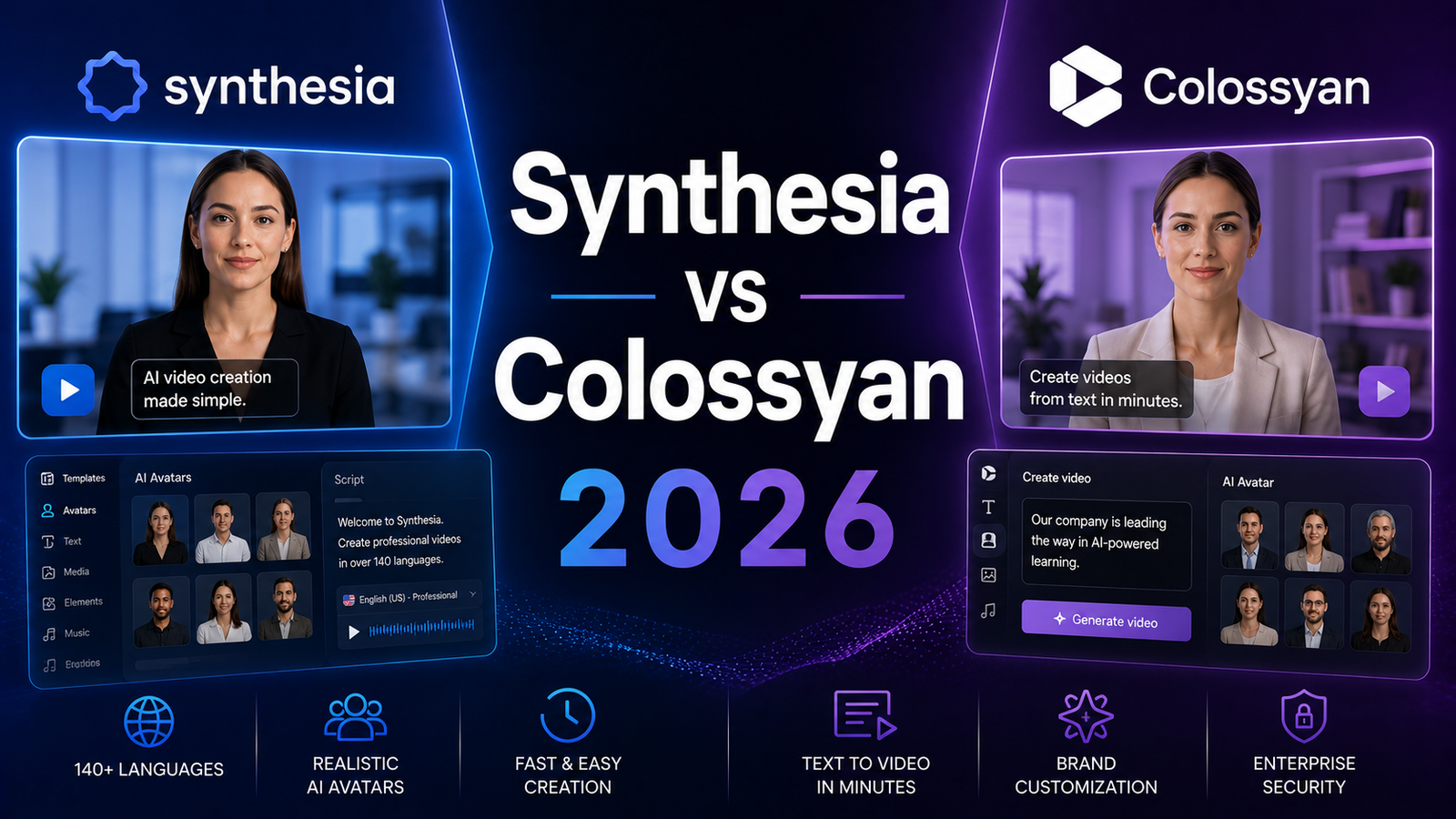
It is not. The two tools optimize for genuinely different things, and picking the wrong one has a real cost. Synthesia optimizes for polished, localized video at enterprise scale: the consistent, professional, on-brand look you want when you are producing a large library of training content across many languages. Colossyan optimizes for native interactivity: quizzes, branching scenarios, and multi-avatar role-play built directly into the video, so learners do more than passively watch.
Get this wrong in one direction and you pay for enterprise polish and localization you do not need. Get it wrong in the other and you discover, halfway through building your program, that your tool cannot deliver the interactive assessments your training actually requires. This comparison exists to prevent both mistakes. The short version: Synthesia wins for polished localized video at scale, and Colossyan wins for interactive, assessment-driven learning.
Comparison Table
| Feature | Synthesia | Colossyan |
|---|---|---|
| Core strength | Polished, localized video at scale | Native interactivity and assessments |
| Avatars | Large professional library | Solid library, growing |
| Languages | 140+ | 120+ |
| Interactivity (quizzes, branching) | Limited, add-on | Native, built-in |
| Multi-avatar conversation | Limited | Yes, Conversation Mode |
| SCORM / LMS export | Yes | Yes |
| Free tier | Yes, limited | Yes, Starter |
| Starting price | ~$18/mo (annual) | ~$35/mo |
Pricing is subject to change. Always verify current pricing on the tool’s official website before purchasing.
Who Each Tool Is For
Synthesia is for teams whose priority is producing a high volume of polished, professional training video, often across many languages, with the consistency and control that large organizations demand. It has become the enterprise standard for AI training video precisely because it scales gracefully: a global company can produce hundreds of on-brand videos, localize them into dozens of languages, and package them for an LMS without the output ever looking inconsistent. If your L&D challenge is volume, polish, and localization, Synthesia is built for exactly that.
Colossyan is for teams whose training depends on learners actually doing something, not just watching. It was built for corporate learning with interactivity as the core design principle rather than an afterthought. If your programs need knowledge checks, branching scenarios that adapt to learner choices, or role-play conversations between avatars, Colossyan delivers those natively. It is the specialist choice for interactive, assessment-driven learning where engagement and retention matter more than sheer production volume.
So the audience split comes down to what your training is really for. If it is delivering polished information at scale, Synthesia fits. If it is driving interaction and measuring understanding, Colossyan fits.
Video Polish and Avatar Realism
This is Synthesia’s strongest category, and the gap is real if not enormous.
Synthesia’s avatars are polished, consistent, and highly professional, which is exactly what enterprise training needs. When you are producing dozens or hundreds of videos that all have to look on-brand and reliable, Synthesia’s predictability becomes a genuine feature rather than a nicety. Its large avatar library, refined rendering, and strong brand controls make it easy to keep an entire training catalog looking cohesive. For flagship courses, onboarding sequences, and compliance training where the production quality reflects on the organization, Synthesia’s polish is easy to rely on.
Colossyan’s video quality is solid and steadily improving, and for most training scenarios it looks perfectly professional. But its avatar library and rendering polish are a step behind Synthesia’s, and its focus has always been on what learners can do with the video rather than squeezing out the last increment of visual fidelity. For a team whose priority is the most polished possible presenter video, Synthesia holds the edge.
The honest read: both look professional, but Synthesia leads on consistent, controllable polish across a large library, which is what enterprise production values most.
Interactivity and Assessments
This is Colossyan’s category, and here the gap runs the other way, decisively.
Colossyan builds interactivity in as a native capability. In-video quizzes and knowledge checks let you verify understanding at the moment of learning. Branching scenarios pause the video and route learners down different paths based on their answers, which turns passive watching into genuine decision-making practice. And Conversation Mode, where multiple avatars talk to each other, enables realistic role-play and comparison scenarios that are especially valuable for sales training, customer-service coaching, and soft-skills development. Crucially, all of this reports back through SCORM to your LMS, so you can actually measure how learners performed, not just whether they finished.
Synthesia, by contrast, is fundamentally a video production platform. It produces excellent linear video, but native interactivity, branching, and in-video assessment are not its core strength. Teams that need those elements with Synthesia typically bolt them on through a separate authoring tool, which adds cost and complexity. If interactivity is central to your training, that gap is significant.
The verdict here is clean: for interactive, assessment-driven learning, Colossyan is purpose-built and Synthesia is not. This single difference decides the tool choice for many L&D teams.
Localization and Scale
Localization is where Synthesia pulls ahead again, and for global organizations it can be the deciding factor.
Synthesia supports 140 or more languages with a mature localization pipeline that keeps lip-sync and delivery clean across translations. For a company rolling out the same training to a global workforce, the ability to produce one video and ship it convincingly in dozens of languages, at scale and on-brand, is a major operational advantage. Synthesia was built with enterprise localization in mind, and it shows in the reliability of the output across languages.
Colossyan supports a strong range as well, around 120 or more languages with auto-translation, which is more than enough for most teams. But for the largest global rollouts, where breadth, consistency, and localization tooling at scale are the priority, Synthesia’s pipeline is the more battle-tested option.
For teams whose training must reach many markets in many languages, Synthesia wins this category. For teams operating in a handful of languages, both are more than capable and the difference matters less.
Ease of Use and Pricing
Both tools are no-code and approachable, designed so an L&D professional can build training video without technical help. Synthesia’s editor is clean and scene-based, optimized for producing polished linear video quickly. Colossyan’s editor is similarly accessible but includes the interactive-authoring controls that its quizzes and branching require, which adds a little more to learn in exchange for the interactivity payoff. Neither has a steep curve, and a capable L&D person will be productive on either within a day or two.
On price, Synthesia starts lower, around $18 per month billed annually on its accessible plans, scaling to enterprise tiers for larger teams and heavier localization. Colossyan starts around $35 per month on Starter and climbs to roughly $120 per month on Pro for the full interactive feature set. The pricing difference reflects the products: Synthesia’s entry tiers get you into polished video production affordably, while Colossyan’s pricing bundles in the interactive capabilities that are its whole reason for existing. Neither is expensive relative to the cost of traditional course production, so the decision should hinge on capability fit rather than a modest price gap.
Frequently Asked Questions
Can Synthesia do interactive quizzes and branching like Colossyan?
Not natively to the same degree. Synthesia is primarily a video production platform that excels at polished linear video. Native in-video quizzes, branching scenarios, and multi-avatar role-play are Colossyan’s core strengths, built directly into the tool. Teams using Synthesia who need interactivity typically add a separate authoring tool, whereas Colossyan includes it. If interactivity is central to your training, Colossyan is the better fit.
Which one is better for a global company training in many languages?
Synthesia, for most large global rollouts. It supports 140 or more languages with a mature, reliable localization pipeline that keeps lip-sync clean at scale, which is exactly what a global training program needs. Colossyan supports around 120 or more languages and handles multilingual training well, but for the largest and most localization-heavy programs, Synthesia’s pipeline is the more proven option.
Is Colossyan worth the higher starting price?
If your training relies on interactivity, yes. Colossyan’s higher entry price reflects the native quizzes, branching, and Conversation Mode that no general video tool matches. If you need those features, paying for Colossyan is cheaper than buying a separate video tool plus a separate interactivity layer. If you only need polished linear video, Synthesia’s lower starting price makes it the more economical choice.
Final Verdict
Synthesia and Colossyan are both excellent AI training tools, and the right choice comes down to a single honest question: is your training about delivering polished information at scale, or about driving interaction and measuring understanding?
For polished, localized training video at scale, Synthesia is the winner. It offers the professional consistency, large avatar library, extensive language support, and enterprise localization that make it the standard for organizations producing a high volume of on-brand training content. If your L&D challenge is volume, polish, and reaching a global workforce in many languages, Synthesia is the tool built for that job, and its lower entry price is a bonus.
For interactive, assessment-driven learning, Colossyan is the winner. Its native quizzes, branching scenarios, and multi-avatar Conversation Mode turn passive video into genuine practice and measurable learning, and nothing in Synthesia’s toolkit replaces that interactivity without bolting on another platform. If engagement, decision-making practice, and LMS-reported assessment results are central to your training, Colossyan is purpose-built for it.
Choose Synthesia for polished localized video at scale. Choose Colossyan for interactive learning that measures understanding. Match the tool to what your training is actually for, and you will neither overpay for polish nor come up short on interactivity.
Pricing is subject to change. Always verify current pricing on the tool’s official website before purchasing.
Disclosure: This article contains affiliate links.