Best AI Tools for Marketing Teams 2026: Ranked, Reviewed and Compared
Marketing has always been part science and part creativity. In 2026, AI has made the science dramatically faster and the creativity significantly more scalable. Teams that previously spent hours on keyword research, content drafts, design iterations, and performance analysis can now compress that work into minutes, freeing attention for strategy, relationship-building, and the judgment calls that actually differentiate great marketing from average marketing.
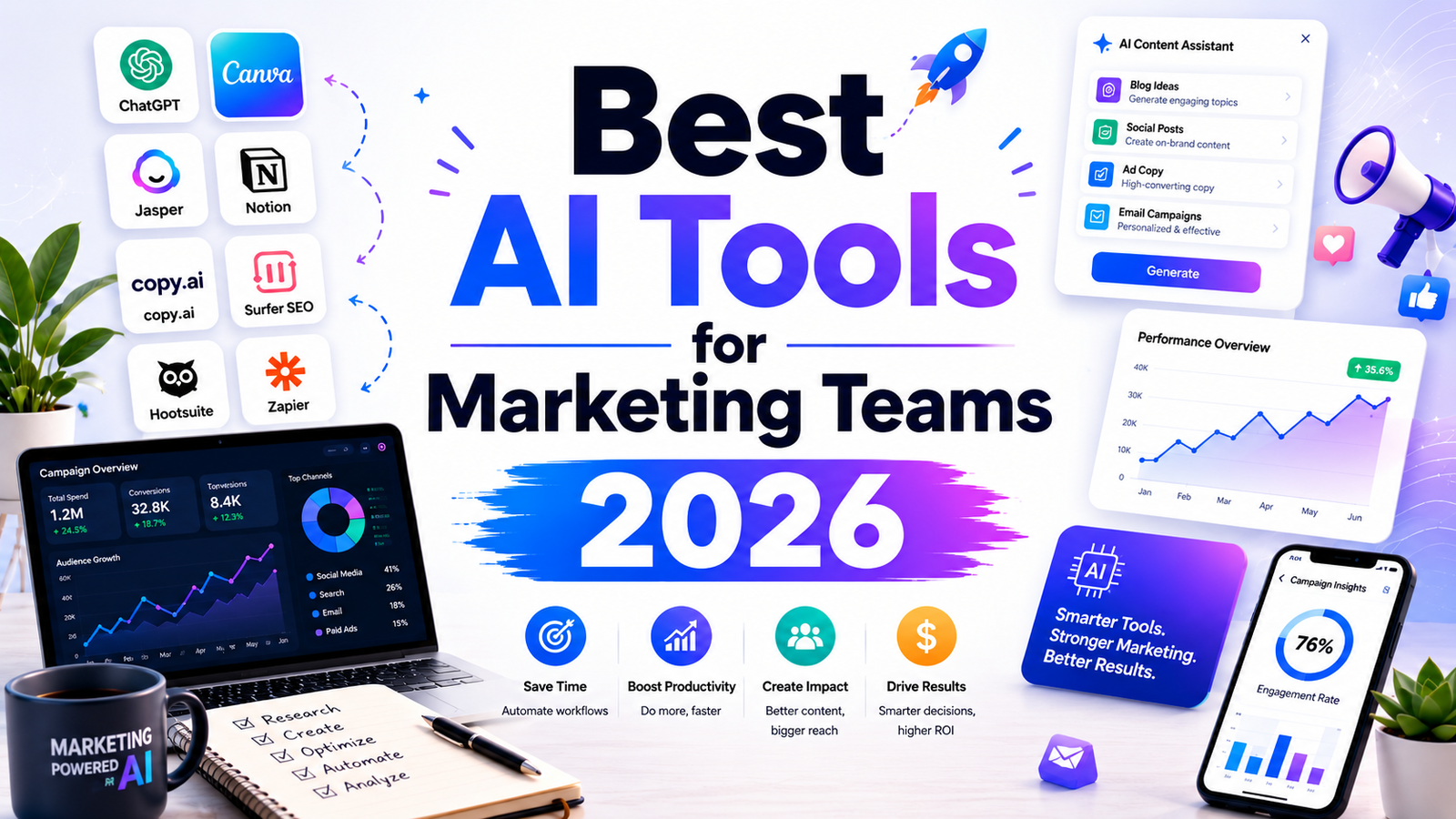
According to HubSpot’s State of Marketing Report, teams using AI-integrated CRMs see 35 percent higher conversion rates than those using disconnected tools. Marketing professionals who report using AI consistently estimate saving between four and ten hours per week compared to fully manual workflows. That is not marginal productivity improvement. At a $50 per hour blended rate, four hours per week recovered per team member represents over $10,000 per person annually in recaptured capacity.
The practical challenge in 2026 is not whether to use AI in your marketing stack. It is knowing which tools address which problems, and how to build a stack that covers content, SEO, design, CRM, writing quality, and market intelligence without subscriptions that overlap or go unused.
This guide reviews eight AI tools that together cover the full marketing workflow, with clear guidance on who each tool is for and where it fits in a team’s broader stack.
Our Take: AI is quickly becoming the operating system behind modern marketing. The most successful teams aren’t replacing marketers with AI. They’re using AI to eliminate bottlenecks, shorten execution cycles, and scale output without scaling headcount.
Comparison Table: 8 Best AI Tools for Marketing Teams 2026
| Tool | Best For | Starting Price | Free Trial |
|---|---|---|---|
| Jasper | High-volume on-brand content and campaign copy | $59/month (Pro, annual) | 7 days |
| Copy.ai | Fast short-form marketing copy and GTM workflows | Free / $29/month (Chat) | Yes (free plan) |
| Surfer SEO | Content optimization and SEO scoring | $99/month (Essential) | No (7-day money-back) |
| Canva AI | Social graphics, presentations, visual marketing assets | Free / $15/month (Pro) | Yes (free plan) |
| HubSpot AI | Full-funnel marketing automation with CRM context | Free CRM / $20/month (Starter) | Yes (free CRM) |
| ChatGPT | Flexible AI assistant for writing, strategy, and analysis | Free / $20/month (Plus) | Yes (free tier) |
| Grammarly | Writing quality, tone consistency, and communication polish | Free / $12/month (Pro, annual) | Yes (free tier) |
| Semrush | SEO, competitive intelligence, and content strategy | $139.95/month (Pro) | 14 days |
“Pricing is subject to change. Always verify current pricing on the tool’s official website before purchasing.”
Detailed Reviews
1. Jasper
The standard for on-brand content production at scale.
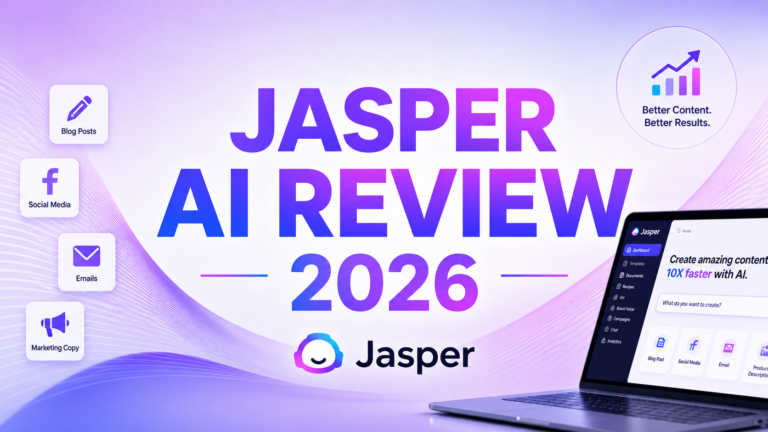
Jasper is purpose-built for marketing teams that produce high volumes of content and cannot afford inconsistent brand voice across campaigns, channels, and team members. Its Brand Voice feature analyzes existing marketing content and establishes a tone, style, and vocabulary profile that every subsequent piece of generated content follows. A blog post drafted by one team member sounds like the same brand as an email sequence drafted by another, without manual style guide enforcement.
Where Jasper earns its premium price is in campaign workflow integration. Rather than starting with a blank prompt for every asset, teams build structured campaigns where a single brief populates blog posts, email sequences, social variations, and ad copy that all stay aligned to the original positioning. The Surfer SEO integration enables real-time content optimization scoring within the Jasper editor, combining generation and optimization in one workflow.
Key Features:
- Brand Voice with Jasper IQ: Trains on existing content to maintain consistent tone, style, and vocabulary across all generated outputs without repeated manual prompting
- Campaign workflow: Generate multiple content assets from a single brief, ensuring alignment across blog posts, emails, social copy, and ads
- Surfer SEO integration: Real-time content optimization scoring within the Jasper editor, enabling generation and optimization in one pass
Pros:
- Best brand voice consistency of any AI writing tool for teams managing multiple writers or high content volume
- 7-day free trial gives full access to evaluate whether output quality justifies the price
- 50-plus templates covering every standard marketing content type
- API access on Business plan enables custom content automation pipelines
Cons:
- $59/month starting price is among the highest for AI writing tools; ChatGPT and Copy.ai cover similar tasks at lower cost for lower-volume use
- Per-seat pricing means team costs scale quickly with headcount
- Business plan features including unlimited Brand Voices and AI Agents require contacting sales
- Not the strongest tool for conversational AI tasks or complex reasoning
Pricing:
- Pro: $59/month (annual) / $69/month (monthly), 1 seat, 2 Brand Voices, 5 Knowledge Assets
- Business: Custom pricing, unlimited Brand Voices, AI Agents, API access
Best For: Marketing teams producing 20-plus pieces of content per month across multiple channels who need consistent brand voice without constant editorial oversight.
2. Copy.ai
Fast, unlimited marketing copy with the most accessible free tier in the category.
Copy.ai has repositioned itself significantly in 2026, moving beyond simple copywriting toward a broader GTM (go-to-market) platform supporting marketing, sales, and content workflows. For marketing teams, its practical value is in the volume and speed of short-form copy production: email subject lines, social captions, ad headlines, product descriptions, and landing page copy generate in seconds with minimal prompting.
The Chat plan at $29/month covers five seats with unlimited word generation, making it the most cost-efficient team option in AI copywriting. The free plan with unlimited chat-based writing is the most genuinely usable free tier in the category, functional for light professional use without a subscription. Multi-model access on paid plans allows routing requests to OpenAI, Anthropic, and Gemini models depending on the task.
Key Features:
- Chat by Copy.ai: Conversational AI interface generating marketing copy across all standard formats with guided prompts for specific output types
- Brand Voice: Train Copy.ai on existing brand content so outputs match tone automatically (available on paid plans)
- 90-plus templates: Pre-built formats for every standard marketing content type, accessible without detailed prompt engineering
Pros:
- Free plan with unlimited word generation is the most generous in the category
- Five seats included on the $29/month Chat plan delivers exceptional per-seat value
- Low learning curve accessible to non-technical marketing team members
- Multi-model access on paid plans provides flexibility across task types
Cons:
- Best suited for short-form copy production; long-form blog content requires significant editing
- Brand Voice locked behind paid tiers
- Workflow automation features that distinguish it from pure writing tools start at $1,000/month, limiting enterprise GTM capabilities to larger budgets
Pricing:
- Free: Unlimited chat words, 1 seat
- Chat: $29/month ($24/month annual), unlimited words, 5 seats, multi-model access
- Pro: $49/month ($36/month annual), Brand Voice, Infobase, integrations
Best For: Marketing teams and agencies producing high volumes of short-form copy across multiple clients or campaigns who want the best per-seat economics in AI copywriting.
3. Surfer SEO
The benchmark for data-driven content optimization.
Content marketing that does not rank does not drive results. Surfer SEO sits between content strategy and content creation, analyzing what is currently ranking for any target keyword and translating that competitive intelligence into actionable guidance for writers. The Content Editor provides a real-time optimization score calibrated against the top-ranking pages for a keyword, showing which NLP terms to include, what heading structure works best, and how long the content should run.
For marketing teams investing in organic traffic, Surfer SEO compresses the research and optimization process that previously required hours of manual SERP analysis into a structured workflow that writers can execute in a single session. In 2026, Surfer has also added Topical Maps for planning content cluster strategies and AI Tracker for monitoring brand visibility in AI-generated search results.
Key Features:
- Real-time Content Editor with live NLP scoring against current top-ranking competitors for the target keyword
- Topical Map for building content cluster strategies that establish topical authority across a subject area
- AI Tracker add-on monitoring brand visibility in AI-generated search results from ChatGPT and other platforms (available as an add-on at $95/month)
Pros:
- Industry-standard for content optimization; used by major enterprise brands including FedEx and Shopify
- Integrates directly with Google Docs, WordPress, and Jasper for smooth content workflows
- 7-day money-back guarantee allows thorough evaluation
- GEO tracking add-on addresses the growing importance of visibility in AI-generated search answers
Cons:
- No free trial; requires commitment before evaluation
- Credits on monthly plans expire with no rollover, penalizing irregular publishers
- AI Tracker costs $95/month on top of the base subscription, adding to total cost
- Essential plan at 30 credits per month constrains high-volume content teams
Pricing:
- Essential: $99/month ($79/month annual), 30 Content Editor credits
- Scale: $219/month ($175/month annual), 100 Content Editor credits, team access
- AI Tracker add-on: $95/month
Best For: Content marketing teams and SEO professionals who publish eight or more optimized articles per month and need data-driven guidance on what each piece of content must contain to rank.
4. Canva AI
Professional visual content for marketing teams without a design budget.
Every marketing team needs visuals: social media graphics, presentation decks, email headers, ad creatives, and event materials. Canva AI’s Magic Studio suite packages text-to-image generation, background removal, image expansion, AI-powered design automation, and a library of 140 million-plus premium assets into a single platform that non-designers can operate professionally. The Brand Kit feature stores each client’s or brand’s visual identity separately, enabling rapid context-switching across accounts without losing consistency.
For marketing teams managing social media and content marketing simultaneously, Canva’s Magic Resize adapts any design to every platform dimension in one click, and Magic Write generates caption and copy variations directly within the design workspace. In 2026, Canva Pro at $15/month remains one of the highest-value subscriptions in any marketing stack.
Key Features:
- Magic Studio suite: Text-to-image generation, background removal, Magic Eraser, Magic Expand, and AI video generation built into the design workflow
- Brand Kit: Store brand colors, fonts, and logos for instant application across any design; up to 1,000 kits on Pro
- Magic Resize and Magic Switch: Adapt any design to every platform format and convert content between types (blog to social, presentation to video) in one click
Pros:
- Most accessible professional design tool available; no design experience required
- Brand Kit manages multiple brand identities for agencies and multi-brand teams efficiently
- Pro at $15/month delivers exceptional value against what it would cost to produce equivalent designs professionally
- Teams plan at $10/user/month makes team-wide brand consistency affordable
Cons:
- Image generation quality does not match dedicated generators like Midjourney for premium artistic output
- 500 AI credits per month shared across all Magic Studio features can deplete mid-month for heavy users
- Video generation capped at 8 seconds per clip, unsuitable for longer video content
Pricing:
- Free: Limited Magic Studio credits, core templates
- Pro: $15/month, full Magic Studio, Brand Kit, 1TB storage
- Teams: $10/user/month (minimum 3 users), team collaboration, shared brand controls
Best For: Marketing teams, social media managers, and content creators who produce high volumes of branded visual content and need to maintain consistency across channels without a dedicated design team.
5. HubSpot AI (Breeze)
The only AI tool with full-funnel context from a unified CRM.
HubSpot’s Breeze AI suite is not a standalone tool. It is an AI layer embedded throughout HubSpot’s CRM, Marketing Hub, Sales Hub, and Service Hub, giving it access to contact records, campaign history, website analytics, email engagement data, and social performance that no standalone AI tool can match. When HubSpot’s AI drafts a follow-up email, it draws on the contact’s entire history with the company. When it suggests content topics, it draws on what has performed with specific audience segments.
Breeze includes three distinct components. Breeze Assistant is the everyday AI companion for content generation, report creation, and task automation. Breeze Agents are specialized AI teammates that handle entire workflows autonomously, including a Social Media Agent that schedules posts, a Prospecting Agent that researches leads and writes outreach, and a Customer Agent that manages support conversations. Breeze Intelligence provides predictive lead scoring, contact enrichment, and buying intent detection.
Key Features:
- Breeze Assistant: Embedded AI content writer and workflow assistant with full access to CRM data for context-aware drafting across emails, social posts, and landing pages
- Breeze Agents: Specialized autonomous AI teammates for social media management, prospect research, outreach writing, and customer service
- Predictive lead scoring: AI-driven contact ranking by conversion likelihood, using behavioral signals, email engagement, and website activity
Pros:
- Unique access to full CRM context produces more relevant, personalized output than any standalone AI writing tool
- Marketing teams already using HubSpot get AI capabilities without adding a new subscription
- Breeze Agents automate entire workflow categories rather than just individual tasks
- Free CRM provides basic AI features to teams not yet on paid HubSpot plans
Cons:
- Full Breeze AI capabilities require Marketing Hub Professional at $890/month or above, creating a high entry barrier
- Breeze Agents use outcome-based pricing ($0.50 per resolution or $1 per lead) which can add unpredictable costs at scale
- Teams using multiple platforms outside HubSpot miss the context-richness that makes Breeze most valuable
- Mandatory professional onboarding costs ($3,000 for Professional, $7,000 for Enterprise) add to total investment
Pricing:
- Free CRM: Basic AI features included
- Starter: $20/month, limited AI capabilities
- Marketing Hub Professional: $890/month, full Breeze AI access
- Enterprise: $4,700/month, advanced AI and custom permissions
- Breeze credits: $45 to $1,000/month for usage-based AI features
Best For: Mid-market and enterprise marketing teams that manage their full funnel inside HubSpot and want AI that operates with complete customer context rather than generating generic content from prompts.
6. ChatGPT
The Swiss Army knife of marketing AI for teams that need flexibility.
ChatGPT is the most versatile AI tool in any marketing stack and the highest-return entry point for teams exploring AI for the first time. At $20/month for the Plus tier, it handles content drafting, campaign strategy brainstorming, competitor research, email sequence writing, data analysis from uploaded documents, image generation, and real-time research across more use cases than any specialized tool. The Custom GPTs feature allows creating pre-configured marketing assistants with specific brand context and instructions, reducing the prompt engineering required for recurring tasks.
For marketing teams that want one tool before investing in specialists, ChatGPT Plus provides the broadest exploration at the lowest committed cost. For teams already using specialized tools, ChatGPT remains valuable as the flexible layer that handles the irregular tasks that do not fit neatly into any specialist’s workflow.
Key Features:
- GPT-4o with real-time web browsing: Research current competitor campaigns, trending topics, and live market data within a single conversation
- Advanced Data Analysis: Upload campaign reports, spreadsheets, and performance data for AI-generated insights and visualization without separate analytics tools
- Custom GPTs: Build pre-configured marketing assistants for recurring workflows, brand voice maintenance, or specific campaign types
Pros:
- Broadest versatility of any tool on this list across content types, channels, and marketing functions
- Memory feature adapts to brand voice and preferences over time, improving output quality with continued use
- Free tier is genuinely capable for occasional professional use
- Best ecosystem of community resources, shared GPTs, and third-party integrations
Cons:
- No native CRM or marketing platform integration; requires copy-pasting into publishing workflows
- Can produce plausible-sounding but factually incorrect content; verify outputs before publishing
- Less effective than Jasper for brand-consistent long-form content at scale
Pricing:
- Free: Limited GPT-4o access with rate limits
- Plus: $20/month, full GPT-4o access, web browsing, image generation, file analysis, Custom GPTs
- Team: $25 to $30/user/month, shared workspace, admin controls, data privacy
Best For: Every marketing team as an entry point or supplementary flexible tool; particularly valuable for strategy work, campaign ideation, and tasks that do not fit specialized tools.
7. Grammarly
The quality layer every marketing team’s communications need.
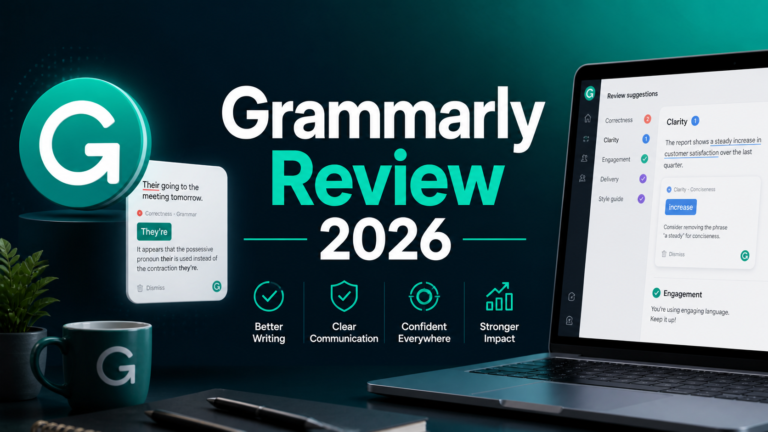
Marketing teams write more than they realize: dozens of client emails, social media captions, campaign briefs, landing page copy drafts, Slack messages, and meeting follow-ups every day. Grammarly operates across all of those surfaces simultaneously, catching grammar errors, tone inconsistencies, and clarity issues in real time across Gmail, Slack, Google Docs, Microsoft Word, and any web browser. It does not replace content generation tools; it ensures that everything produced through those tools, and everything written manually, meets a consistent quality standard before it reaches a client or customer.
The Pro plan at $12/month (annual) adds 2,000 monthly AI prompts through GrammarlyGO for rewriting sentences, adjusting tone, and paraphrasing, plus plagiarism checking that is essential for teams publishing AI-assisted content. For the price of one hour of human editing per month, Grammarly Pro provides continuous quality oversight across an entire team’s written output.
Key Features:
- Real-time correction across all platforms: Works in Gmail, Slack, Google Docs, Word, Chrome, and mobile with no workflow change required
- Tone detection: Identifies how written communication reads emotionally and flags issues before sending, particularly valuable for client-facing messages
- GrammarlyGO on Pro: 2,000 monthly AI prompts for rewriting, paraphrasing, and adjusting tone within documents
Pros:
- Works everywhere a marketing team writes, with zero workflow change required
- Plagiarism checker on Pro is essential for teams producing AI-assisted content at scale
- $12/month (annual) is among the lowest-cost, highest-impact subscriptions in a marketing stack
- Catches subtle tone and clarity issues that content generation AI regularly produces
Cons:
- Free plan limits to 100 AI prompts per month, depleting quickly for active users
- Not a content generation tool; complements rather than replaces Jasper or ChatGPT
- No team performance analytics for identifying common writing quality issues across the organization
Pricing:
- Free: Basic grammar, spelling, punctuation, 100 AI prompts/month
- Pro: $30/month (monthly), $12/month (annual, $144 upfront)
- Enterprise: Custom pricing for teams with centralized management
Best For: Every marketing team. Grammarly is the quality baseline that makes everything else better, and the Pro plan pays for itself the first time it prevents a client-facing error.
8. Semrush
The intelligence layer for competitive marketing strategy.
Semrush is the most comprehensive competitive intelligence and SEO platform available, covering keyword research across 27 billion keywords, backlink analysis across 43 trillion links, site auditing, PPC research, social media analytics, and content marketing tools from a single interface. For marketing teams whose performance depends on organic search, Semrush provides the data infrastructure that makes every other content investment more effective.
In 2026, Semrush One has expanded its offering to include AI Visibility tracking, monitoring how a brand appears in ChatGPT, Google AI Overviews, Gemini, and Perplexity. For marketing teams concerned about traffic diversion from AI-generated search answers, this feature provides the measurement layer needed to understand and respond to AI search visibility. The SEO Writing Assistant provides real-time optimization guidance directly in Google Docs or WordPress, functioning similarly to Surfer SEO’s Content Editor as a complement to content creation workflows.
Key Features:
- Keyword Magic Tool: 27 billion keywords across 142 geographic databases with intent classification and content clustering
- AI Visibility Toolkit: Monitors brand presence across ChatGPT, Google AI Overviews, Gemini, and Perplexity to track GEO performance alongside traditional SEO metrics
- Site Audit and competitive analysis: 140-plus technical SEO checks, competitor gap analysis, and backlink monitoring in a single dashboard
Pros:
- Most comprehensive marketing intelligence platform available; often replaces multiple separate subscriptions
- AI Visibility tracking at $99/month is meaningfully cheaper than Ahrefs’ equivalent ($199/month)
- SEO Writing Assistant provides optimization guidance without a separate Surfer SEO subscription for teams with lower content volume
- 14-day free trial on Semrush One plans allows thorough evaluation including AI Visibility features
Cons:
- $139.95/month Pro plan is the highest starting price on this list
- Content marketing tools including Topic Research and ContentShake AI require the Guru plan at $249.95/month
- Steep learning curve; new users often feel overwhelmed by the breadth of features
- For pure backlink analysis, Ahrefs remains the stronger tool
Pricing:
- Pro: $139.95/month ($117/month annual), 5 projects, 500 keywords tracked
- Guru: $249.95/month ($208/month annual), 15 projects, full content marketing platform
- Business: $499.95/month, API access, 40 projects
Best For: Marketing teams that need a complete competitive intelligence layer covering SEO, content strategy, PPC research, and GEO visibility tracking from a single platform.
Frequently Asked Questions
What is the most cost-effective AI marketing stack for a small team?
For a team of two to five people with a limited budget, a three-tool stack covers most marketing needs. Start with ChatGPT Plus at $20/month per user for versatile content generation and strategy. Add Grammarly Pro at $12/month per user for communication quality across every surface. Add Canva Pro at $15/month for visual content. That combination at $47 per user per month covers writing, quality assurance, and design without overlapping capabilities. When organic traffic becomes a priority, add Surfer SEO Essential at $79/month (annual). When content volume justifies brand voice consistency at scale, add Copy.ai Chat at $29/month for five seats.
Do AI marketing tools actually save time, or do they just shift the work?
They save time on specific, measurable tasks and shift other work. The time savings are most reliable for: first draft generation (reducing a two-hour blog post to 45 minutes of editing), visual asset resizing and adaptation (reducing hours in Photoshop to minutes in Canva), keyword research and competitive analysis (reducing days of manual research to hours in Semrush), and email subject line testing (reducing A/B test planning from hours to minutes). The shifted work is quality review and judgment: AI produces faster, but human review remains essential before anything reaches a customer or client. The honest benchmark is to track time on a specific task before and after introducing an AI tool, and measure the actual reduction rather than accepting vendor claims.
How should marketing teams handle brand voice when multiple people use AI tools?
The most practical approach combines tool-level configuration with a shared reference document. In Jasper, Brand Voice trained on existing content reduces inconsistency structurally. In ChatGPT, Custom GPTs pre-loaded with brand guidelines and writing style notes give every team member a consistent starting point. In Grammarly, style guides and tone settings can be shared across team accounts at the Enterprise level. The supporting practice is maintaining a short brand voice reference document (two to four pages covering tone descriptors, vocabulary to use and avoid, and example sentences) that team members paste into any AI tool when the tool does not have built-in brand training. This takes ten minutes to create and prevents most of the generic-sounding AI output that makes branded content feel off.
Final Recommendation
No single AI tool covers every marketing need. The question is which combination of tools addresses your team’s specific bottlenecks at a sustainable cost.
For content marketing and SEO teams: Jasper for on-brand long-form content, Surfer SEO for optimization, and Semrush for keyword research and competitive intelligence form the strongest content marketing stack available. Budget for all three if organic traffic is your primary acquisition channel.
For social media and visual content teams: Canva Pro covers design comprehensively at $15/month. Copy.ai handles short-form copy across platforms. ChatGPT Plus fills any remaining content gaps. Total cost for three tools: under $70/month.
For teams already on HubSpot: Maximize what you already pay for before adding external tools. Breeze AI on the Professional plan provides content assistance, lead scoring, and agent automation that standalone tools cannot replicate with the same CRM context.
For every marketing team regardless of size: Grammarly Pro at $12/month (annual) is the single highest-ROI marketing AI tool available. It improves the output quality of every other tool in your stack and every human-written communication simultaneously. It belongs in every team’s budget before any other subscription.
Build your stack from the bottom up: Grammarly first, ChatGPT second, then specialize as specific workflows prove they justify dedicated tools.
“Pricing is subject to change. Always verify current pricing on the tool’s official website before purchasing.”