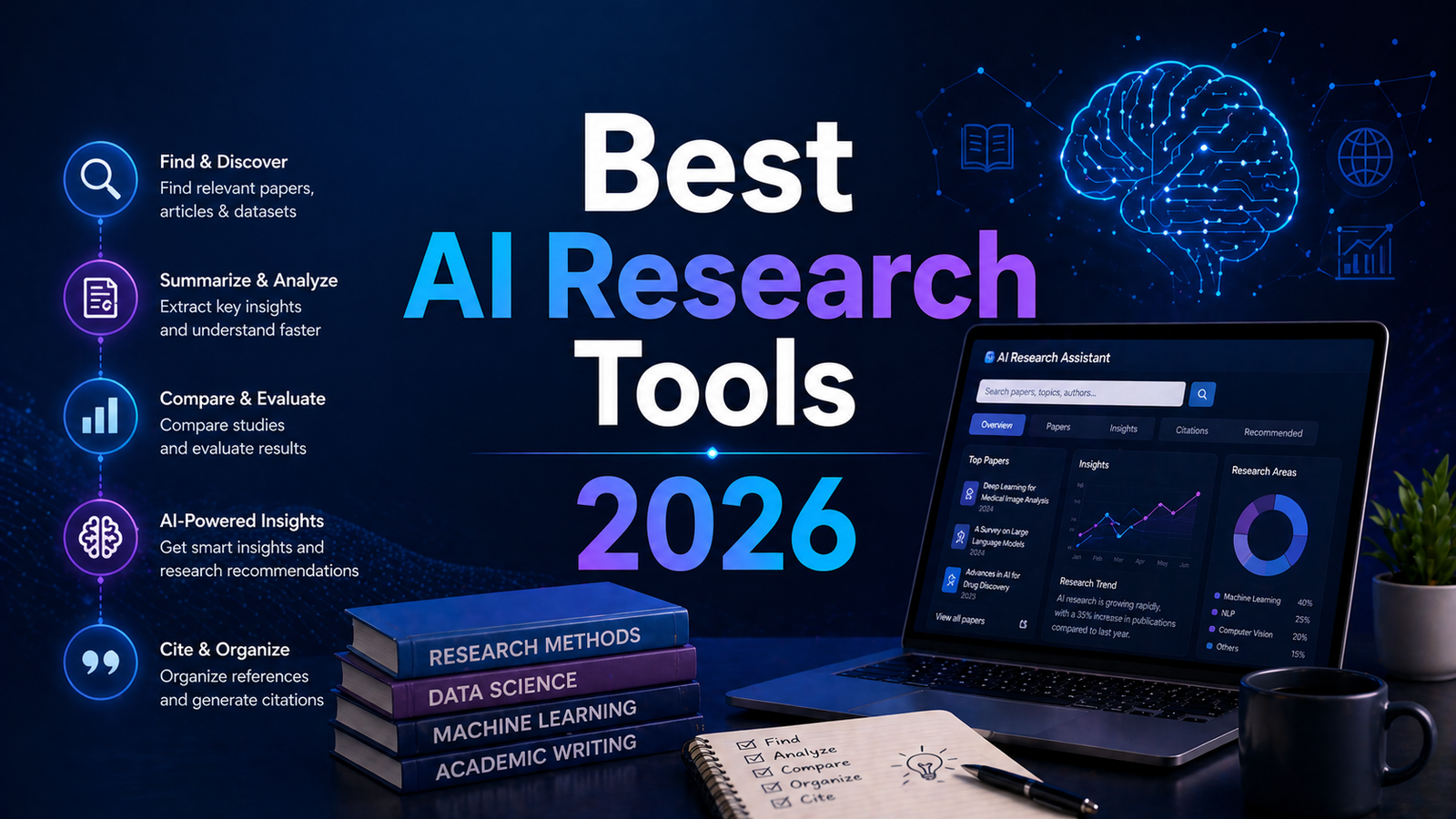
Best AI Research Tools 2026: Ranked, Reviewed and Compared
Research has always been expensive in the currency that matters most to the people doing it: time. A graduate student building a literature review for a systematic review might spend weeks searching databases, screening abstracts, reading full-text papers, and extracting data into comparison tables. A journalist fact-checking a complex claim might spend hours tracing citations through primary sources. An analyst monitoring emerging research across a field might read hundreds of abstracts weekly just to stay current.
AI research tools in 2026 have changed the mechanics of all of those workflows without changing what matters most about them: that human judgment, critical evaluation, and domain expertise still determine the quality of research conclusions. What has changed is the time cost of the mechanical work. Elicit users report up to 80 percent time savings on systematic reviews. Consensus synthesizes findings from 220 million papers in seconds. Semantic Scholar’s AI-generated TLDRs surface the key finding of any paper without reading the full text. Perplexity retrieves cited web and academic sources in real time for any research question.
The category in 2026 is also more differentiated than it was two years ago. General-purpose AI assistants like ChatGPT and Claude are powerful for synthesis and analysis but do not verify citations against real databases. Purpose-built academic tools like Elicit, Consensus, and Scite are grounded in peer-reviewed literature databases but require more specific workflows to use well. Document-grounded tools like NotebookLM shine when you supply the sources. The right stack for any researcher combines tools from multiple categories rather than choosing one and treating it as a complete solution.
Comparison Table: Best AI Research Tools 2026
| Tool | Best For | Starting Price | Free Plan |
|---|---|---|---|
| Perplexity AI | Fast web and academic research with real-time citations | Free / $20/month (Pro) | Yes |
| ChatGPT | Flexible research synthesis, brainstorming, and writing assistance | Free / $20/month (Plus) | Yes |
| Claude | Long-document analysis, paper reading, and high-quality synthesis | Free / $20/month (Pro) | Yes |
| Google NotebookLM | Source-grounded Q&A across uploaded research documents | Free / $19.99/month (AI Pro) | Yes |
| Elicit | Systematic literature reviews and structured data extraction from papers | Free / $10/month (Plus) | Yes |
| Consensus | Evidence-based answers with yes/no/mixed synthesis from 220M papers | Free / $9.99/month (Premium) | Yes |
| Semantic Scholar | Free academic paper discovery with AI-generated TLDRs and citation graphs | Free | Yes (fully free) |
| Scite | Citation context analysis: whether papers support or contradict each other | $20/month (Premium) | Limited |
“Pricing is subject to change. Always verify current pricing on the tool’s official website before purchasing.”
Detailed Reviews
1. Perplexity AI
Best for researchers who need fast, cited answers spanning both web and academic literature.
Perplexity functions as an AI search engine rather than a document analysis tool: it searches the web and academic literature in real time, synthesizes what it finds, and presents the result with inline citations to the specific sources used. Every claim is attributed to a verifiable source, which distinguishes it from ChatGPT and Claude for factual research queries where citation traceability matters.
The free plan includes unlimited standard searches and approximately five Pro searches per day. Pro searches access more powerful models including GPT-4o, Claude, and Gemini for more nuanced synthesis. For researchers who use Perplexity to orient themselves in a new topic, track current developments, or rapidly verify factual claims before deeper investigation, the free tier covers most daily research habits. The Deep Research feature on Pro conducts multi-step autonomous research, browsing dozens of sources and producing structured, fully cited reports.
Key Features: Real-time web and academic search with inline source citations, academic paper search via Perplexity’s scholarly search mode, Deep Research for autonomous multi-step research reports on Pro, follow-up question capability that maintains research context, and Spaces for organizing research projects.
Pros:
- Inline citations on every claim make source verification faster than any general AI assistant
- Real-time search means current events, recent papers, and live regulatory updates are all accessible
- Free tier is the most functional in the research tool category for general research use
- Students get Perplexity Pro free for one year with a verified .edu email
Cons:
- Draws from the open web alongside academic sources; less rigorously constrained to peer-reviewed literature than Elicit or Consensus
- Standard tier model is less capable than Claude or ChatGPT for complex multi-step synthesis
- Not appropriate as the primary tool for formal systematic reviews requiring PRISMA compliance
Pricing:
- Free: Unlimited standard searches, approximately 5 Pro searches per day
- Pro: $20/month ($10/month with .edu email), unlimited Pro searches, Deep Research, file uploads
2. ChatGPT
Best for flexible research assistance including brainstorming, synthesis, and writing support across any topic.
ChatGPT is not an academic search engine and should not be used to generate citations for formal research. It can and does hallucinate references, a limitation that has been independently documented at rates that make it unsuitable for any application where citation accuracy is a hard requirement. What it excels at is everything around that constraint: developing research questions, understanding unfamiliar concepts, synthesizing analysis across uploaded papers, drafting literature review sections, identifying gaps in an argument, and explaining statistical methods in plain language.
The Advanced Data Analysis feature on Plus allows uploading research datasets, papers, and reports for AI-assisted analysis without specialized software. The Web browsing feature retrieves current research developments. For researchers who already have their citations from Elicit or Consensus, ChatGPT is a powerful synthesis and writing layer on top of verified sources.
Key Features: Flexible research synthesis from uploaded documents, Advanced Data Analysis for spreadsheet and dataset queries, web browsing for current research developments, Custom GPTs for building domain-specific research assistants, and memory for persistent research project context.
Pros:
- Most versatile research assistant for tasks beyond literature search: analysis, writing, methodology discussion
- Advanced Data Analysis handles uploaded research datasets without coding knowledge
- Free tier is genuinely capable for research brainstorming and synthesis support
- Custom GPTs allow building field-specific research assistants with pre-loaded context
Cons:
- Known hallucination rate on citations; never use for generating reference lists without verification
- No academic database integration; cannot search Semantic Scholar, PubMed, or arXiv natively
- Not appropriate as a primary tool for systematic reviews or evidence-based clinical decisions
Pricing:
- Free: GPT-5.x with daily limits, no credit card required
- Plus: $20/month, full GPT-5.4, web browsing, file analysis, Advanced Data Analysis
3. Claude
Best for reading and analyzing long academic papers, synthesizing across large document sets, and producing high-quality research prose.
Claude’s core research advantage is its 200,000-token context window at the Pro tier and its consistently strong instruction-following for complex analytical tasks. Uploading a complete dissertation, a set of systematic review papers, or an entire research corpus and asking Claude to synthesize, critique, and compare across them is a practical workflow on the Pro plan that no other tool in this list handles as cleanly.
Independent evaluations consistently rate Claude’s synthesis prose above ChatGPT for nuance, tonal precision, and adherence to structured analytical instructions. For researchers producing literature review sections, grant application narratives, or research reports, Claude is the most reliable AI writing layer available. Anthropic’s explicit no-training-by-default policy on paid plans addresses the data privacy concern that matters to researchers handling sensitive or pre-publication material.
Key Features: 200,000-token context window for full corpus analysis, Projects for persistent research project context across sessions, extended thinking mode for complex multi-step analytical reasoning, Research feature for autonomous multi-step literature synthesis, and no-training-by-default on paid plans for data privacy.
Pros:
- Best synthesis prose quality of any AI assistant for formal academic writing
- 200,000-token context window handles entire papers or small corpora in a single session
- No-training policy on paid plans is important for researchers working with pre-publication data
- Extended thinking mode produces more reliable multi-step reasoning for complex methodological questions
Cons:
- Does not search academic databases natively; source verification requires a separate tool
- Independent hallucination rate on citations (14% in January 2026 testing) still requires verification
- Daily message limits on free and Pro tiers can frustrate heavy daily research use
Pricing:
- Free: Claude Sonnet 4.6 with daily limits, no credit card required
- Pro: $20/month, Opus 4.6 access, 200K context, Projects, Research feature, extended thinking
4. Google NotebookLM
Best for source-grounded Q&A across your own uploaded research documents with zero risk of the AI inventing external sources.
NotebookLM occupies a unique position in the research tool stack: it only knows what you tell it. Every answer it produces is drawn exclusively from documents you have uploaded, with inline citations pointing to the exact passage supporting each claim. There are no external database searches, no web browsing, and no training data responses. If the answer is not in your uploaded sources, NotebookLM will say so rather than inventing one.
This source-grounded architecture eliminates citation hallucination entirely for document-specific queries, making it the safest AI tool for working with your own research materials. Upload your set of included systematic review papers, your primary sources for a historical analysis, or your reference library for a literature chapter, and NotebookLM becomes an expert on exactly those materials. The Audio Overview feature generates a podcast-style discussion of the key themes across all uploaded sources, which many researchers find genuinely useful for absorbing material during commutes or exercise.
Key Features: Source-grounded Q&A where every answer cites the specific passage from uploaded documents, Audio Overviews generating podcast-style discussions of uploaded source themes, support for PDF, Google Docs, YouTube links, web pages, and audio files up to 50 sources per notebook, no hallucination on document-specific queries by design, and Google Classroom integration for institutional users.
Pros:
- Zero citation hallucination risk on document-specific queries; most reliable AI tool for your own uploaded sources
- Audio Overviews genuinely useful for processing large reading lists through listening
- Completely free with generous limits: 100 notebooks, 50 sources per notebook, 50 chat queries per day
- March 2026 Classroom integration makes it practical for academic institutional workflows
Cons:
- Cannot answer questions beyond your uploaded sources; not useful for discovery or finding new literature
- 3 Audio Overviews per day on the free plan is a real constraint during heavy reading periods
- No built-in citation management or export to reference managers
- Works as a reading and synthesis layer, not a research discovery tool
Pricing:
- Free: 100 notebooks, 50 sources per notebook, 50 daily chat queries, 3 Audio Overviews per day
- Google AI Pro: $19.99/month (includes NotebookLM Plus with higher limits across all features)
5. Elicit
Best for systematic literature reviews, structured data extraction, and automating the most time-consuming parts of evidence synthesis.
Elicit is the most powerful tool for academic research workflows that require structured, replicable processes. It searches across 200 million-plus papers from Semantic Scholar and OpenAlex using semantic search that does not require knowing the exact right keywords. It extracts structured data from papers into comparison tables: sample sizes, methodologies, outcome measures, results, and limitations all pulled into organized rows without manual transcription. Researchers report up to 80 percent time savings on systematic reviews using Elicit for the screening and data extraction phases.
The Research Report feature generates structured literature review reports from up to 50 sources, with the ability to customize which papers are included and which data fields are extracted. Elicit Alerts notify researchers when new papers matching their search criteria are published, removing the need for periodic manual database checks to stay current.
Key Features: Semantic search across 200M-plus papers from Semantic Scholar and OpenAlex, automated data extraction into customizable structured tables (sample size, methods, results), Research Reports generating structured literature reviews from up to 50 sources, Elicit Alerts for new paper notifications, clinical trials search alongside standard literature search, and explicit no-training-on-user-data policy.
Pros:
- Most purpose-built systematic review tool; data extraction table is uniquely powerful for evidence synthesis
- 80% time savings on systematic reviews reported consistently by users
- Explicit data privacy policy: Elicit does not train on user data
- Semantic search finds relevant papers without requiring exact keyword knowledge
- Free tier is functional for evaluating core capabilities before upgrading
Cons:
- Free tier limits table columns and report paper count; substantive systematic work requires Plus
- Database coverage weighted toward English-language literature; non-English research may surface incompletely
- Does not assess citation quality or whether findings have been subsequently supported or contradicted (use Scite alongside for this)
- Clinical and humanities coverage less comprehensive than biomedical and social science fields
Pricing:
- Free: Basic search, limited extraction table columns, smaller report paper counts
- Plus: $10/month, expanded extraction features and report capabilities
- Professional: Custom pricing for institutional and high-volume use
6. Consensus
Best for researchers who need a fast, evidence-grounded yes/no/mixed answer to a research question backed by peer-reviewed literature.
Consensus is built around a single compelling use case: you have a research question and you want to know what the scientific literature says about it, quickly and with cited evidence. The Consensus Meter synthesizes findings from the 10 most relevant papers on any question and returns a structured verdict: Yes, Probably Yes, Inconclusive, Probably No, or No, with the papers supporting each position clearly cited. Eight million researchers use the platform, which reached eight times revenue growth in 2025.
The GPT-5 integration through the Scholar Agent provides deeper conversational research capability within the Consensus interface. The Study Snapshot feature extracts key metadata from individual papers including population, sample size, methods, and findings in a structured format, making it useful for rapid paper assessment without full-text reading.
Key Features: Consensus Meter providing yes/no/mixed synthesis from 10 most relevant papers, Scholar Agent powered by GPT-5 for conversational research on 220M-plus papers, Study Snapshot for structured paper metadata extraction, citation export to Zotero, Mendeley, EndNote, and RefWorks, and subject filter for domain-specific searches across health, psychology, and social sciences.
Pros:
- Fastest evidence synthesis for binary research questions of any tool reviewed
- 220M-plus paper database with 8x revenue growth reflecting genuine research community adoption
- Citation export to major reference managers reduces manual bibliography work
- Free tier with 10 Pro Analyses per month allows meaningful evaluation
Cons:
- AI synthesis can oversimplify complex methodological debates; use as a starting point, not a conclusion
- No automatic mechanism to exclude retracted papers from search results; verify critical papers against Retraction Watch
- Preprints from OpenAlex and Semantic Scholar may be included alongside peer-reviewed literature; always check publication status
- Primarily optimized for English-language research; non-English papers present but interface and synthesis are English-only
Pricing:
- Free: 10 Pro Analyses per month, basic search
- Premium: $9.99/month, unlimited searches, Study Snapshots, full features
- Teams: Custom pricing for institutional and group access
7. Semantic Scholar
Best free academic paper discovery engine available, with AI-generated TLDRs and citation graph visualization at no cost.
Semantic Scholar is the database underlying several other tools on this list, including Elicit and Consensus. As a standalone research tool, it is the strongest free academic discovery engine available, indexing over 220 million papers with AI-generated TLDRs that surface the key finding of any paper in one to two sentences without requiring full-text access. The citation graph visualization shows how papers are connected through citations, revealing influential works, research clusters, and unexplored connections in a field.
For researchers who need comprehensive paper discovery at no cost, Semantic Scholar is the starting point. The Saved Papers and Research Alerts features allow building a monitored library that notifies users when new papers matching their interests are published. The API access for developers enables building custom research tools on top of Semantic Scholar’s database.
Key Features: 220M-plus paper index with AI-generated TLDRs, citation graph visualization for understanding field connections, Research Alerts for new paper notifications, Saved Papers library for personal reference management, API access for custom workflow development, and author disambiguation for tracking specific researchers’ work.
Pros:
- Fully free with no credit card required and no usage limits for standard search and discovery
- AI-generated TLDRs compress abstract reading time significantly across large paper sets
- Foundation database for Elicit, Consensus, and Research Rabbit; same coverage as premium tools at no cost
- API access enables custom workflow development for technically capable researchers
Cons:
- No AI synthesis of findings across multiple papers; discovery only, not evidence aggregation
- Does not extract structured data from papers; combine with Elicit for systematic review workflows
- Less specialized interface than purpose-built systematic review tools for formal evidence synthesis
- Primarily English-language indexing for AI features; multilingual coverage in the database itself
Pricing:
- Fully free for all users, no paid tier for consumer use
- API access available for developers
8. Scite
Best for verifying whether a paper’s findings have held up in subsequent research before citing it.
Scite addresses a specific and critical problem that no other tool in this list handles: citation context. Most research tools tell you how many times a paper has been cited. Scite tells you how it has been cited, parsing over 1.2 billion citation statements across 200 million-plus sources to classify each citation as supporting, contrasting, or mentioning the original finding.
A paper cited 500 times with 50 contradicting citations is a fundamentally different body of evidence than a paper cited 500 times with 490 supporting citations. This distinction matters for meta-analysis, systematic reviews, grant applications, and any research where the reliability of cited findings directly affects the conclusions drawn. The Smart Citations system surfaces this evidence quality layer that traditional citation count metrics obscure.
Key Features: Smart Citations classifying 1.2B-plus citation statements as supporting, contrasting, or mentioning, citation count dashboards showing the balance of evidence across a paper’s citation history, Journal and Author pages summarizing citation patterns for outlets and researchers, reference management integration, and research report generation using Smart Citation context.
Pros:
- Unique capability with no direct equivalent: citation context analysis at scale
- Identifies papers with significant contradicting evidence that raw citation counts would hide
- Essential quality check before citing any paper in formal academic or clinical work
- 1.2B-plus citation statements analyzed; the most comprehensive citation context database available
Cons:
- No meaningful free tier; Premium at $20/month is required for substantive use
- Does not discover new papers; use Semantic Scholar or Elicit for discovery, Scite for verification
- Coverage and context quality vary by field; biomedical literature is best covered
- Interface is less intuitive than Elicit or Consensus for users new to academic research tools
Pricing:
- Limited free access for basic searches
- Premium: $20/month, full Smart Citations access, unlimited searches
- Institutional: Custom pricing for university and organization-wide access
Frequently Asked Questions
Can AI research tools replace traditional database searches like PubMed or Web of Science?
Not completely, and treating them as direct replacements creates real methodological risk for formal research. Elicit, Consensus, and Semantic Scholar draw primarily from Semantic Scholar and OpenAlex, which are extensive but not equivalent to the comprehensively curated MeSH-indexed coverage of PubMed for biomedical literature or the citation network completeness of Web of Science for formal systematic reviews. For informal literature surveys, rapid evidence checks, and exploratory research in most fields, the AI tools are sufficient and significantly faster. For PRISMA-compliant systematic reviews, Cochrane-standard evidence syntheses, or any formal research requiring documented search reproducibility, AI tools should complement rather than replace searches in established databases. The practical workflow recommended by most research librarians in 2026 is to use AI tools for initial exploration and efficiency gains while maintaining traditional database searches for the formal search documentation that peer reviewers expect.
Are AI-generated research summaries reliable enough to cite?
Never cite an AI summary directly. Cite the primary source the summary describes. The practical workflow is to use AI synthesis to identify which papers are most relevant to your question, then read those papers and cite them directly based on your own reading. This is not only the academically appropriate approach; it is also the risk-management approach given documented hallucination rates in AI research tools. Consensus’s evidence meter and Elicit’s data extraction reduce the time cost of reaching the original papers; they do not replace reading them. For formal academic work, the citation should always be to the paper itself, verified by you, with the AI tool credited appropriately in methodology sections if your field’s style guide requires disclosure of AI use in research processes.
What is the most cost-effective research tool stack for a graduate student on a tight budget?
An effective research stack is achievable at zero cost for most graduate students. Semantic Scholar covers paper discovery for free. Google NotebookLM covers document-grounded Q&A and synthesis across uploaded papers for free. Consensus’s free tier provides 10 Pro Analyses per month for evidence-based question answering. Elicit’s free tier allows evaluating systematic review workflows. Claude’s free tier provides synthesis and writing assistance. Perplexity’s free tier covers web and academic search with citations. Combined, these free tools address paper discovery, evidence synthesis, source-grounded Q&A, and writing assistance without spending anything. The case for paying arises at specific points: Perplexity Pro at $10/month with an .edu email for unlimited Deep Research sessions, Elicit Plus at $10/month when systematic review extraction volume exceeds the free tier, and Scite Premium at $20/month when citation reliability verification becomes critical to your field’s research standards. Most graduate students can build a complete research workflow for $0 to $30 per month by combining free tiers strategically.
Final Recommendation
No single tool covers the full research workflow. The most effective researchers in 2026 use two to four complementary tools rather than searching for a complete solution in one platform.
For discovery: Start with Semantic Scholar for free, comprehensive academic paper discovery. Add Elicit when you need semantic search that finds relevant papers without knowing exact keywords.
For evidence synthesis: Consensus provides the fastest evidence-grounded answers to binary research questions. Elicit handles structured data extraction for systematic review workflows. Both are more reliable for academic research than ChatGPT or Claude for citation-dependent synthesis.
For source-grounded document analysis: NotebookLM is the most reliable tool for Q&A across your own uploaded research materials, with zero citation hallucination risk for document-specific queries.
For citation quality verification: Scite is the only tool that answers the question that matters most before you cite something: has this finding held up, or has it been contradicted?
For writing and synthesis: Claude produces the highest-quality research prose for literature review sections, grant narratives, and analytical summaries. Use it after verified sources are in hand.
For fast, cited general research: Perplexity is the most useful free-tier research tool for orienting in a new topic, verifying current facts, and tracking developments across web and academic sources simultaneously.
The combination that serves most researchers well at minimal cost: Semantic Scholar (free) for discovery, NotebookLM (free) for document analysis, Consensus (free tier) for evidence questions, and Claude (free tier) for writing. Add Elicit Plus at $10/month when systematic review volume justifies it. Add Scite Premium at $20/month when citation verification becomes critical to your field’s standards.