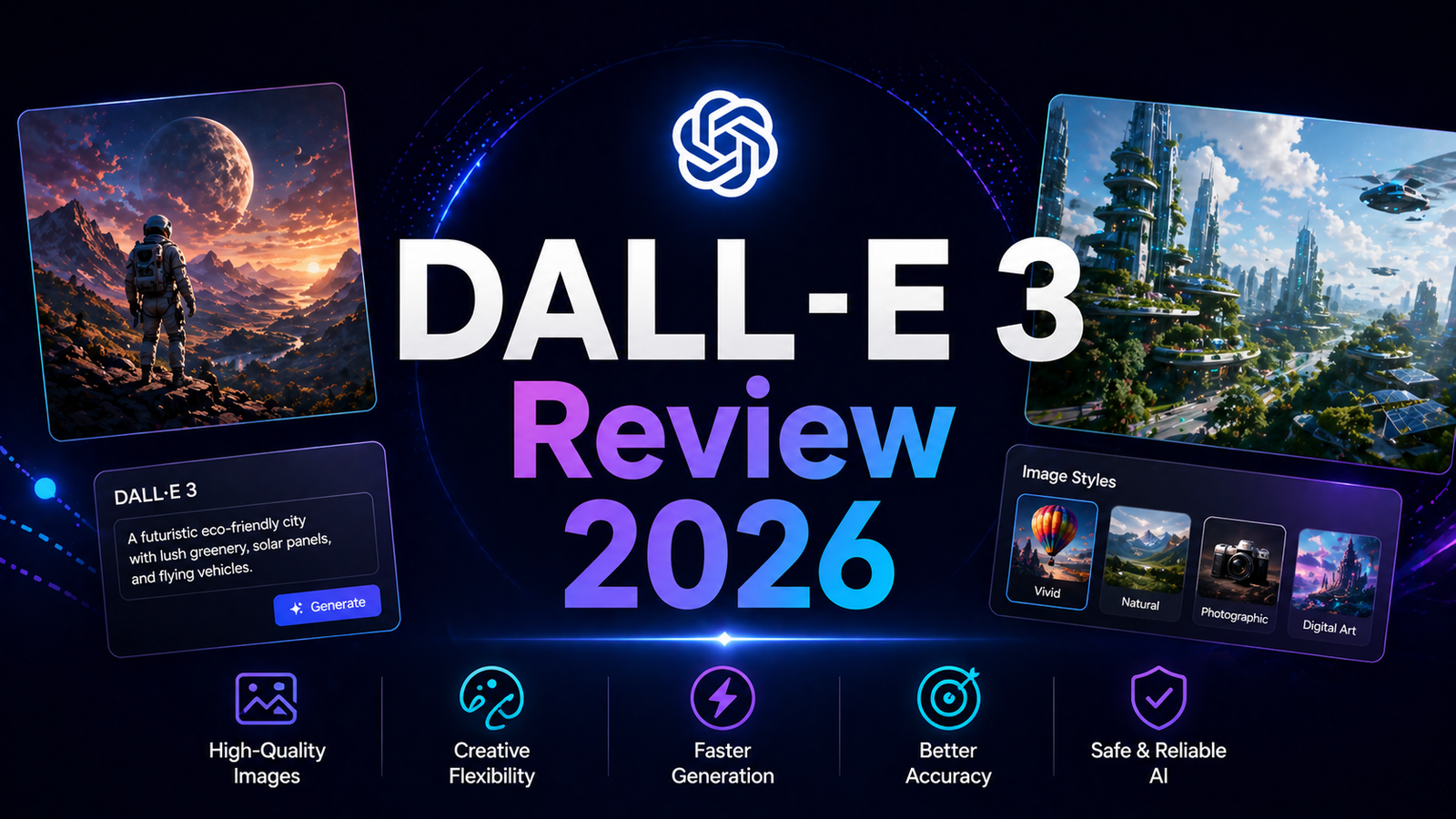
DALL-E 3 Review 2026: Still the Best AI Image Generator?
DALL-E 3 changed the AI image generation market by making prompt interpretation dramatically more accessible, but in 2026 the competitive landscape looks very different than it did at launch. Midjourney still dominates stylistic quality, Stable Diffusion dominates customization, and Adobe Firefly dominates workflow integration, leaving DALL·E 3 positioned somewhere between all three approaches.
DALL-E 3, launched in 2023, was a genuine leap forward in AI image generation. Its tight integration with ChatGPT, its natural language prompt interpretation, and its text rendering accuracy within images set standards that competitors spent the following two years trying to match. By 2024 it was the dominant consumer AI image tool. By 2026, the competitive landscape has caught up significantly and OpenAI has responded by developing a better replacement rather than iterating further on the existing model.
Understanding what DALL-E 3 did well, where it fell short, and what GPT Image 1.5 means for continuity is the useful information for any buyer making a decision about OpenAI’s image generation today.
What DALL-E 3 Is and Who It Is For
DALL-E 3 is OpenAI’s text-to-image generation model, accessible primarily through ChatGPT and the OpenAI API. Unlike Midjourney, which requires Discord and a learned prompt syntax, or Leonardo AI, which operates through a dedicated web platform, DALL-E 3 functions through the same conversational interface users already use for ChatGPT tasks. You describe what you want in plain English, and the model generates it inline within the conversation.
This integration-first design defines DALL-E 3’s user base more precisely than any other characteristic. The tool is strongest for:
ChatGPT Plus subscribers who already pay $20 per month and want image generation without an additional subscription. For this group, DALL-E 3 costs nothing beyond what they already pay, making its value proposition essentially unbeatable on a per-dollar basis for casual to moderate use.
Marketers and content creators who need text rendered accurately within images. Social media graphics with readable captions, product labels, signage, infographics, and any image where the text must be legible are categories where DALL-E 3 has historically outperformed every major competitor. In direct testing, DALL-E 3 rendered accurate text in images 4 out of 5 attempts where Midjourney succeeded 0 out of 5 on the same prompts.
Developers building image generation into applications through the OpenAI API. The predictable per-image pricing, reliable generation behavior, and the ability to chain DALL-E 3 into GPT-4 workflows for automated content pipelines has made it the most widely integrated AI image API in enterprise applications.
Non-technical users who want to generate images without learning prompt engineering. DALL-E 3’s ChatGPT integration rewrites user prompts automatically to optimize generation results, meaning users do not need to learn parameter syntax or prompt engineering techniques to produce usable outputs.
DALL-E 3 is less suited for artists who need fine-grained compositional control, users who require outputs above 1024 pixels (Midjourney V8 Alpha generates native 2K), or workflows requiring real-time generation under 10 seconds consistently.
Key Features
ChatGPT conversational integration. The defining feature of DALL-E 3 is not image quality but workflow integration. Within any ChatGPT conversation, image generation is a natural extension of the text interaction. Describe a scene, get the image, then say “make the background darker” or “move the subject to the right” and the model interprets the iterative instruction contextually rather than requiring a rebuilt prompt from scratch. This conversational refinement loop is faster and more intuitive for most users than the parameter-based iteration of competing tools.
Automatic prompt enhancement. When a user submits a generation request through ChatGPT, GPT-4 rewrites the prompt before passing it to DALL-E 3. This optimization step interprets user intent, adds descriptive detail that improves generation quality, and resolves ambiguity in the original request. The result is that DALL-E 3 consistently produces outputs closer to what users intended than a raw prompt submission to the same model would produce.
Text rendering within images. Rendering legible typography inside generated images has been a persistent weakness of AI image generators since the category emerged. DALL-E 3 addressed this more successfully than contemporaries, producing accurate text on signs, labels, infographics, and social media graphics at a reliability level that made it the standard recommendation for any marketing application requiring readable in-image text.
Microsoft ecosystem integration. Beyond ChatGPT, DALL-E 3 powers Bing Image Creator, Microsoft Copilot’s image features, and Microsoft Designer (formerly Microsoft Designer). For organizations already in the Microsoft 365 ecosystem, DALL-E 3 access comes through multiple touchpoints without additional subscription cost.
API with inpainting and variations. The OpenAI API exposes DALL-E 3 generation, inpainting for replacing regions of existing images, and variations for generating alternatives from a source image. Developers can build fully automated content pipelines including analyzing competitor creative assets, generating multiple alternatives, and delivering them programmatically.
Pros and Cons
Pros:
- Included in ChatGPT Plus at $20 per month with no additional cost; best value for existing Plus subscribers
- Conversational refinement through ChatGPT is more intuitive than parameter-based tools for non-technical users
- Best text rendering within images of any consumer AI generator in independent testing; 4 out of 5 text prompts rendered accurately versus 0 out of 5 for Midjourney
- Microsoft ecosystem integration through Bing Image Creator, Copilot, and Designer provides access through multiple platforms
- API inpainting and variation generation support automated developer workflows
- No watermarks on any generated images; all outputs are clean and watermark-free at every access tier
- Automatic prompt enhancement through GPT-4 reduces the expertise required to produce good outputs
Cons:
- Being retired May 12, 2026; building new workflows on DALL-E 3 directly is inadvisable at this point
- Maximum resolution of 1024×1024 square or 1024×1792 portrait trails competitors; Midjourney V8 Alpha generates native 2K
- Artistic quality and compositional sophistication trail Midjourney for creative and stylized work in blind comparisons
- Limited parameter control compared to Midjourney or Leonardo; outputs reflect the model’s aesthetic choices more than the user’s specific stylistic direction
- API rate limit of 7 images per minute on standard tier constrains high-volume generation pipelines
- Generation speed of 10 to 15 seconds per image is competitive but not the fastest available
Pricing Breakdown
Via ChatGPT (consumer):
- Free: Limited generations included in the free ChatGPT tier; specific daily limits not publicly disclosed but constrained
- Plus: $20/month, full DALL-E 3 access included alongside GPT-5.4, no additional cost per image
- Pro: $200/month, highest generation limits and priority access
Via OpenAI API (developer):
- Standard quality, 1024×1024: $0.040 per image
- HD quality, 1024×1024: $0.080 per image
- HD quality, 1024×1792 (portrait) or 1792×1024 (landscape): $0.120 per image
- New API accounts receive $5 in free credits, covering approximately 125 standard-quality images
GPT Image 1.5 (replacing DALL-E 3 from May 12, 2026):
- Access tiers identical to DALL-E 3: available to ChatGPT Plus, Pro, and Team subscribers
- API pricing remains similar: approximately $0.04 to $0.12 per image depending on resolution and quality
- Capability improvements expected across photorealism, prompt adherence, and text rendering
“Pricing is subject to change. Always verify current pricing on the tool’s official website before purchasing.”
How It Compares to Midjourney and Adobe Firefly
DALL-E 3 vs Midjourney
The comparison between DALL-E 3 and Midjourney reflects two tools optimized for genuinely different outcomes. Midjourney V7 and V8 Alpha produce the most artistically striking AI images available in 2026, with a cinematic, painterly aesthetic that independent comparisons consistently rate above DALL-E 3 for creative and conceptual work. Midjourney’s parameter system gives experienced users precise control over stylization, chaos, aspect ratio, and character consistency that DALL-E 3 simply does not expose.
DALL-E 3 wins on accessibility, text rendering, and integration. The ChatGPT conversational workflow requires no Discord account, no syntax learning, and no separate platform. Text rendering at 4 out of 5 accuracy in direct testing versus 0 out of 5 for Midjourney on the same prompts is a decisive advantage for any marketing or design workflow requiring legible in-image typography. And for ChatGPT Plus subscribers, DALL-E 3 costs nothing additional while Midjourney starts at $10 per month separately.
The practical decision: Midjourney for users who prioritize artistic quality and are willing to learn its parameter system. DALL-E 3 (or GPT Image 1.5 from May) for users who want natural language generation, reliable text rendering, and ChatGPT workflow integration.
DALL-E 3 vs Adobe Firefly
Adobe Firefly and DALL-E 3 compete most directly for the commercial-use buyer who needs legally defensible AI-generated imagery. Firefly’s exclusive training on Adobe Stock and licensed content provides commercial indemnification that DALL-E 3 does not match on equivalent legal terms; Adobe accepts legal responsibility for copyright claims on Firefly outputs in a way OpenAI does not explicitly guarantee.
DALL-E 3 wins on accessibility and integration for buyers outside the Adobe ecosystem. Firefly Pro at $19.99 per month requires a separate subscription without adding the conversational ChatGPT workflow, Custom GPTs, or the broader GPT capabilities. For users who already pay $20 per month for ChatGPT Plus, DALL-E 3 is effectively free by comparison. For enterprise or agency buyers where copyright indemnification is a contractual requirement, Firefly’s commercial protection justifies the additional subscription.
Frequently Asked Questions
Should I start using DALL-E 3 now given that it is being retired in May 2026?
For consumer use through ChatGPT, yes, with the understanding that GPT Image 1.5 is replacing it on the same access tiers at a similar price point. ChatGPT Plus subscribers will continue generating images after May 12; the underlying model will simply be GPT Image 1.5 instead of DALL-E 3, and early indications suggest quality improvements rather than regressions. For developer workflows using the DALL-E 3 API directly, the retirement requires a migration to GPT Image 1.5’s API endpoint. OpenAI has indicated that pricing and commercial rights will carry over at similar rates, but verifying current API migration documentation on OpenAI’s developer portal before building new integrations is advisable. For new users evaluating OpenAI’s image generation in April or May 2026, the practical advice is to start a ChatGPT Plus trial and generate images through ChatGPT without worrying about which underlying model is handling the requests.
How does the text rendering advantage actually work in practice?
DALL-E 3’s text rendering accuracy comes from the GPT-4 prompt enhancement step, which explicitly instructs the model on letter placement, spacing, and typographic requirements before generation begins. In practical testing, generating a social media graphic containing a headline and subhead produces readable output consistently, while Midjourney and earlier AI image generators frequently produce garbled or decorative approximations of text. This advantage is meaningful for social media managers who need captions, labels, or headlines incorporated into images, marketers creating product photography with readable text overlays, and content creators generating infographics where data labels must be accurate. The limitation is that complex multilingual text, very small font sizes, and highly stylized typefaces still produce occasional errors. The practical standard is that DALL-E 3 gets text right often enough to be productively useful; other tools get it right rarely enough that text should be added in post-production using graphic design tools.
Will commercial rights transfer to GPT Image 1.5?
Yes, according to OpenAI’s published terms and communications around the transition. Commercial use rights apply to content generated through paid ChatGPT plans and API access under existing commercial terms, and those terms carry forward to GPT Image 1.5. OpenAI’s current terms grant users usage rights to outputs generated through paid plans, though OpenAI does not guarantee exclusivity since identical or similar prompts from different users can produce similar images. For professional applications where intellectual property documentation is important, OpenAI’s commercial use terms should be reviewed directly on their website before the transition date. The copyright landscape around AI-generated imagery more broadly remains an evolving legal area; Adobe Firefly continues to be the only major consumer AI image generator offering explicit enterprise indemnification that covers copyright claims.
Final Verdict
DALL-E 3 is a capable, well-integrated AI image generator that democratized image generation for non-technical users and set the standard for in-image text rendering. Its integration into ChatGPT remains its strongest differentiating feature, and the conversational refinement workflow is still more accessible than any competing tool for users who want to generate images without learning dedicated platforms or prompt syntax.
The honest assessment in April 2026 is that DALL-E 3 itself is not a tool to build new workflows around. It is being retired in weeks. The relevant question is whether OpenAI’s image generation capability, continuing through GPT Image 1.5, belongs in your creative stack. For ChatGPT Plus subscribers at $20 per month who want image generation included at no additional cost, with natural language workflow and reliable text rendering, the answer is yes. For users who prioritize artistic quality above all else, Midjourney remains the leader. For users who need commercial copyright indemnification, Adobe Firefly remains the most legally defensible choice.
GPT Image 1.5, arriving May 12, 2026, is expected to improve on DALL-E 3’s photorealism, prompt adherence, and output resolution. If the trajectory holds, OpenAI’s image generation will be meaningfully more competitive with Midjourney and Firefly after the transition than it is today.
Rating: 4.0 / 5 (as of its final weeks; GPT Image 1.5 will be reviewed separately upon launch)