Kaedim Review 2026: Studio-Grade 2D to 3D, or Overpromised?
The marketing claim is bold: upload a 2D concept art image and receive a production-ready 3D model in minutes, generated by AI. The reality, documented across Product Hunt reviews, independent analysis, and practitioner feedback, is more nuanced. The output is genuinely usable for professional game studios when inputs are clean and expectations are calibrated. The “minutes” timeline and the “AI generation” framing are disputed enough by enough reviewers to merit serious scrutiny before any enterprise team commits a pipeline budget.
Kaedim is a London-based platform founded with the goal of automating the concept-art-to-3D-asset conversion that costs studios weeks of artist time. Kaedim earns praise for speeding up 3D asset workflows and fitting neatly into professional pipelines, with several users calling results strong and production-friendly. Reviewers highlight steady product improvements and straightforward usability, and one detailed report notes high fidelity from multi-view character uploads.
Criticism centers on expectations versus delivery: some argue turnaround times exceed “minutes,” question the AI claims, and cite occasional instability or uneven quality on simpler inputs.
Both things are true. This review covers both.
Plan Comparison Table
| Plan | Best For | Starting Price | Free Plan |
|---|---|---|---|
| Demo Access | Enterprise teams evaluating before commitment | No cost but requires sales contact | No (demo only) |
| Credit-based plans | Game studios and production teams with defined asset volume | Custom pricing; contact Kaedim | No |
| Enterprise | Larger studios needing API access, volume pricing, and pipeline integration | Custom pricing; contact Kaedim | No |
“Pricing is subject to change. Kaedim does not publicly list standard pricing. Pricing is custom-quoted based on team size, asset volume, and plan structure. Independent sources describe pricing as higher than average and positioned for professional and studio-level budgets rather than indie or hobbyist use. Contact Kaedim directly for current pricing at kaedim.com. Always verify current pricing and trial access terms directly with the vendor before any budget commitment.”
What Kaedim Is
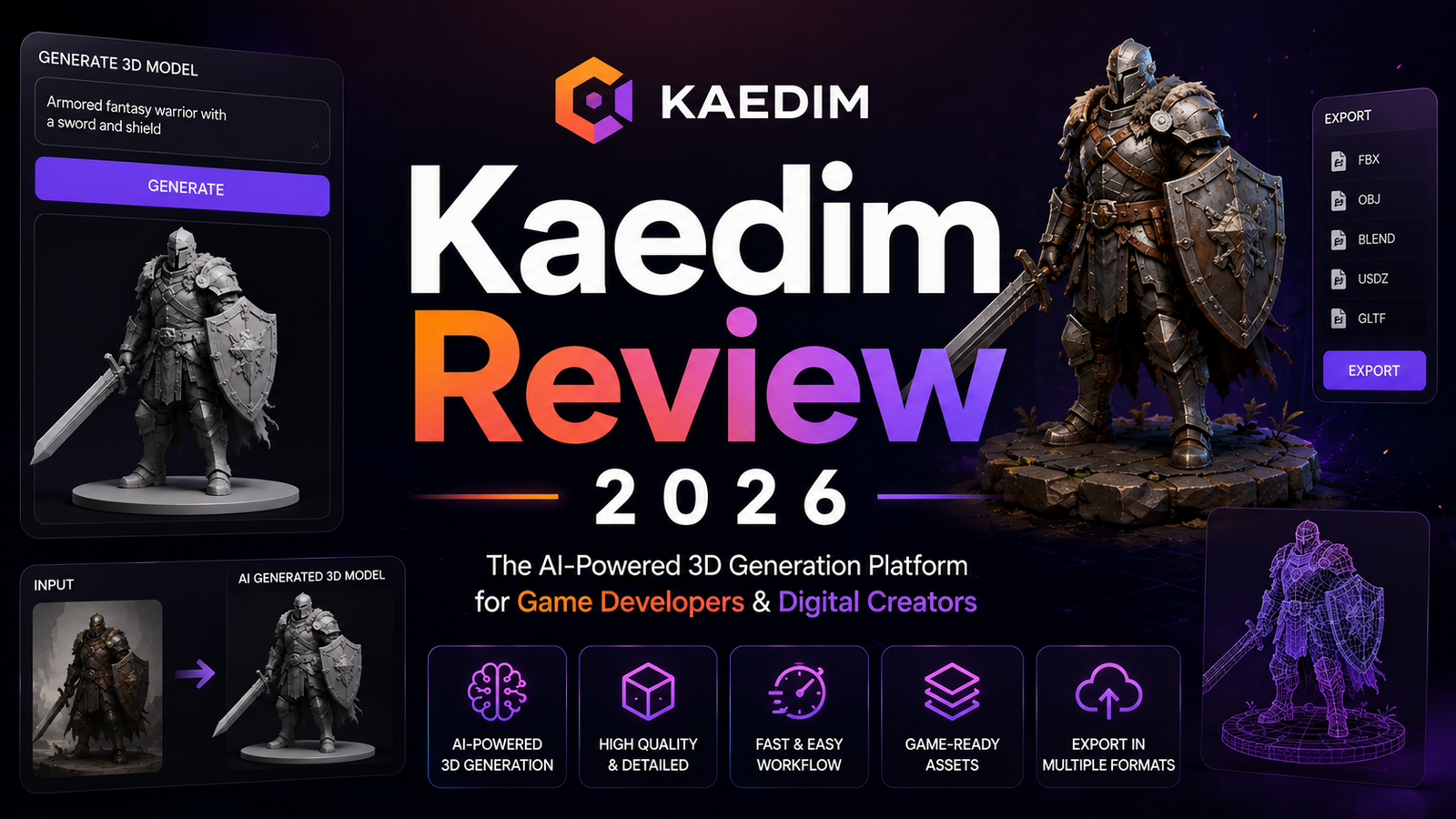
Kaedim is a platform that converts 2D concept art, sketches, and product photographs into 3D models for game development, VFX, AR/VR, and product visualization. It combines AI mesh generation with a quality assurance step that involves human review before delivering the final model. The platform was built specifically to address the bottleneck in game studio pipelines where concept art approval moves faster than 3D modeling capacity, leaving games in production backlogs.
The service accepts image inputs and supports multi-view uploads (up to six angles) for more complex assets, delivering output in FBX, OBJ, and GLTF formats with UV mapping, PBR textures, and level-of-detail variants. Integration is available with Unity, Unreal Engine, Blender, Maya, and Cinema 4D. An API and SDK enable programmatic integration into automated studio pipelines.
Kaedim is particularly well-suited for game studios scaling asset production, e-commerce brands needing 3D product models, and enterprise AR/VR development teams generating production-grade 3D assets for corporate training simulations, virtual showrooms, or AR applications. The recommendation is to choose Kaedim when quality matters more than speed and you need assets that work in Unity and Unreal without cleanup.
The human QA layer distinguishes Kaedim from fully automated AI generators. Where platforms like Tripo AI and Meshy AI return AI-generated output automatically without human review, Kaedim incorporates quality assurance before delivery. The practical effect is that assets arrive reviewed rather than raw, which explains the quality consistency that positive reviewers describe and the turnaround times that exceed the “minutes” claim.
Key Features
Multi-view image-to-3D with UV mapping and PBR textures. The primary workflow: upload concept art from one to six angles, and Kaedim converts the input to a 3D mesh with UV unwrapping and base textures applied. It does not just create shapes; it infers textures and lighting, crucial for production-ready assets. The multi-view support significantly improves output accuracy on complex assets: a single front-view input provides limited depth information, while a full character turnaround sheet with front, three-quarter, side, and back views allows the system to construct more geometrically accurate models.
Clean, detailed 2D images yield the best results, while messy or low-res inputs can lead to less accurate models. The quality of the input concept art is the most significant variable in output quality. Studios that produce clean, professionally rendered concept art with clear silhouettes, consistent line weights, and unambiguous proportions report the strongest results. Teams that input rough sketches, low-resolution images, or concept art with ambiguous forms report more inconsistency.
Level-of-detail support. The LoD feature, added in 2023 and refined since, generates multiple polygon-count variants of the same asset for different rendering contexts. High-poly for hero assets and close-up rendering, reduced-poly for mid-distance rendering, and low-poly for distant and background use. For studios that would otherwise manually create LoD variants in Blender or Maya, the automated LoD generation compresses a multi-step manual process into the initial delivery.
Automatic UV unwrapping. Kaedim’s automation of UV unwrapping and base texture generation can save users hours of work, letting them focus on creativity rather than technical tasks. UV unwrapping is one of the most time-consuming manual steps in 3D production; automating it from the concept art input removes the most technically demanding post-generation step from the studio workflow.
Scene generation from environment images. In 2024, a new feature for scene generation was added: uploading entire scene images produces editable 3D versions with multiple assets positioned within a scene layout. For pre-visualization and level prototyping where the goal is a rough 3D version of a concept scene rather than individual polished assets, this extends Kaedim’s applicability from individual asset production into environment prototyping.
API and SDK for pipeline integration. The API enables studios to integrate Kaedim’s conversion workflow into automated production pipelines rather than requiring web interface uploads for each asset. For studios producing dozens to hundreds of assets per month, the API allows triggering conversions programmatically from an asset management system and receiving deliverables to a defined output location.
Pros and Cons
Pros:
- Human quality assurance before delivery produces more consistently usable output than fully automated generators for the studios that value this over speed
- Integrates seamlessly into existing creative workflows, supporting direct exports to Blender, Maya, and Unity using formats like FBX, OBJ, and GLTF
- LoD generation and automatic UV unwrapping remove the most time-consuming post-generation steps from the studio workflow
- Multi-view input support improves accuracy on complex character and vehicle assets significantly compared to single-view input
- API access enables programmatic pipeline integration for high-volume studio environments
- For game studios scaling asset production, Kaedim is appropriate when you need 50-plus 3D assets per month but cannot hire more 3D artists, converting concept art to game-ready models while maintaining AAA quality standards
- Positive Product Hunt reviewers with detailed multi-view character uploads describe high fidelity outputs that fit production pipelines without significant cleanup
Cons:
- Turnaround times exceed “minutes” as marketed; actual delivery time depends on asset complexity and current pipeline volume, which can mean hours rather than minutes for complex assets during peak demand
- Accuracy drops to 70-80% for organic shapes like characters or creatures versus 85-90% accuracy for hard-surface objects like vehicles, accessories, and furniture. For character-heavy game studios, the accuracy rate on the most common asset type means meaningful cleanup remains required on a proportion of deliveries
- The legitimacy of the “AI generation” claim is disputed by multiple Product Hunt reviewers who believe the work is primarily or partially done by human artists rather than AI: “I get the strong feeling that everyone is right about this being a scam and that they actually hire artists to speed-model this stuff.”Kaedim has not publicly addressed this criticism with technical disclosure about the human-to-AI contribution ratio in its pipeline
- No self-serve free trial; evaluation requires contacting Kaedim’s sales team for a demo, which limits the buyer’s ability to independently test quality before pricing discussions
- Custom pricing structure without published rates makes budget modeling difficult before sales engagement; independent sources describe pricing as higher than average and positioned for studio-level budgets
- Quality can be uneven on simpler inputs where the AI has less complex reference to work from
- Occasional instability noted in user reviews alongside quality variance
Pricing Breakdown
Kaedim does not publicly publish standard pricing. The pricing structure is credit-based for standard plans and custom-quoted for enterprise volume agreements. Independent sources consistently describe it as premium-priced relative to self-serve AI 3D tools, positioned for game studio and enterprise budgets rather than indie developer or hobbyist use.
For studios: yes, it saves thousands by reducing modeling hours. For indie teams: worth it if you create many assets. For hobbyists: likely too expensive; better try alternatives.
The evaluation path for any team seriously considering Kaedim is:
- Contact Kaedim to request a demo and provide sample concept art representative of the target asset types
- Request a pilot project quote covering 5 to 10 sample assets with specific quality and turnaround commitments documented before engaging
- Calculate the current cost per 3D asset from the existing pipeline (outsourcing, in-house artist time, or combination) and compare against Kaedim’s quoted per-asset cost at the relevant volume
Without a self-serve trial, the evaluation is necessarily a sales-mediated process. The recommendation from independent analysis is to negotiate quality and turnaround commitments in writing before pipeline commitment and to test on the actual asset categories and input quality levels the team produces rather than clean demonstration assets.
How It Compares to Tripo AI and Meshy AI
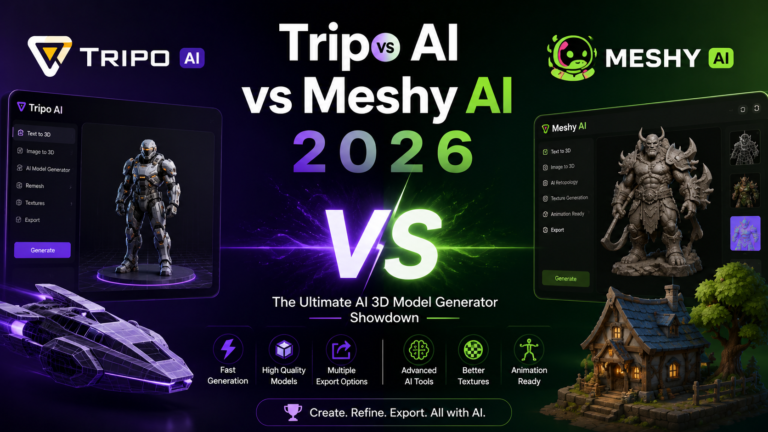
See our full Tripo AI Review 2026 and Meshy AI Review 2026 for complete breakdowns of self-serve AI 3D generation.
The comparison between Kaedim and Tripo AI or Meshy AI is primarily a comparison between a managed studio service and a self-serve AI tool. These are different products for different operational contexts.
Speed and cost: Tripo AI and Meshy AI win decisively. Tripo’s Smart Mesh P1.0 generates a quad-topology 3D model in approximately 10 seconds with 300 free monthly credits and approximately $10 per month for paid access. Meshy Pro at $20 per month generates textured, rigged, animated models with 1,000 monthly credits. Both deliver immediate self-serve results at a fraction of Kaedim’s price point and without a sales engagement for evaluation.
Human QA and pipeline fit: Kaedim offers a different value. The human quality assurance layer is what Kaedim offers that Tripo and Meshy do not: reviewed, quality-assured output delivered to production format rather than AI-generated output that requires developer-side quality checking. For game studios with defined quality standards where a percentage of AI-generated assets failing the standard creates operational problems, Kaedim’s quality assurance layer shifts that responsibility to the vendor.
What actually drives the choice: The decision framework from independent analysis is clear. Choose Kaedim when quality matters more than speed and you need assets that work in Unity/Unreal without cleanup.For teams where the cost of cleanup hours on raw AI output exceeds Kaedim’s premium, the premium is justified. For indie developers and teams that can accept AI output variability and perform their own cleanup, Tripo AI and Meshy AI provide 80-plus percent of the capability at 5 to 10 percent of the cost.
Frequently Asked Questions
How long does Kaedim actually take to deliver a model, and what determines the turnaround time?
Turnaround time depends on asset complexity and current pipeline volume. The “minutes” claim in Kaedim’s marketing applies to the AI processing step in isolation, not the complete delivery timeline including quality assurance review. Actual delivery times documented in user reviews range from under an hour for simple hard-surface props with clean input to multiple hours for complex character assets during high-demand periods. Input quality significantly affects processing time: clean, high-resolution concept art with clear silhouettes processes faster than rough sketches or low-resolution images that require more interpretation. For studios integrating Kaedim into production schedules, the practical planning assumption from reviewer experience is same-day delivery for simple assets and next-day for complex ones, rather than the minutes framing in the marketing. Negotiate a specific turnaround commitment in the pilot engagement before pipeline commitment.
Is Kaedim actually using AI, or are humans doing the modeling work?
This is the most publicly disputed question about Kaedim and the company has not provided transparent technical disclosure to resolve it. Multiple reviewers on Product Hunt question the AI claims and some argue that humans are doing or finishing the modeling work. One detailed negative review described what appeared to be human artist intervention based on the specific nature of the quality inconsistencies observed. Kaedim’s own description of the pipeline combines AI generation with human quality assurance, which is consistent with both interpretations: the AI may generate a base mesh that humans review and refine, or humans may be doing more primary modeling work than the AI framing suggests. The honest assessment is that without technical disclosure from Kaedim about the human-to-AI contribution ratio, the question cannot be definitively resolved from public information. The output quality that satisfied reviewers describe is the practical evaluation criterion regardless of the attribution question.
For which types of game assets does Kaedim perform best, and where should studios manage their expectations?
Kaedim excels with hard-surface objects like vehicles, accessories, and furniture at 85 to 90 percent accuracy, while organic shapes like characters or creatures see 70 to 80 percent accuracy. The practical implication: for studios primarily producing environmental props, vehicles, weapons, and architectural elements, Kaedim’s accuracy on the relevant asset types is higher and the output more consistently production-ready. For character-focused games where humanoid and creature characters are the primary asset type, the 70 to 80 percent accuracy rate means a meaningful portion of delivered assets will require significant cleanup before they meet production standards. While not able to completely replace manual modeling, Kaedim produces excellent base meshes for refinement. Studios should plan for cleanup time even on satisfied-reviewer assets; the question is whether Kaedim-generated base meshes with cleanup are faster than starting from scratch, and the answer from positive reviewers is yes when input art quality is high.
Final Verdict
Kaedim is a legitimate service for game studios and enterprise teams with the budget to justify the premium and the concept art quality to drive accurate output. The human QA layer, LoD generation, automatic UV unwrapping, and production pipeline integration collectively make it a viable option for studios that would otherwise outsource 3D modeling at rates that exceed Kaedim’s pricing for equivalent volume.
The caveats that belong in the same paragraph as that recommendation: the “minutes” marketing claim does not reflect actual delivery timelines for complex assets. The “AI generation” framing is disputed by enough independent reviewers that studios should ask Kaedim directly about the human contribution to their pipeline before making assumptions about scalability. Organic character accuracy at 70 to 80 percent means cleanup is expected, not exceptional, for character-heavy studios. And the absence of a self-serve trial requires a sales-mediated evaluation that indie teams and budget-constrained studios cannot practically complete.
For indie developers, solo creators, and teams without studio-level budgets, the accessible alternatives are the right starting point. Tripo AI provides 300 free monthly credits and 10-second quad-mesh generation. Meshy AI provides the complete pipeline with auto-rigging and 500-plus animation presets at $20 per month. Both deliver immediate self-serve results without sales engagement, at a fraction of Kaedim’s cost, with AI-generated output that is clearly attributable to AI generation.
For professional game studios with high-volume concept art pipelines and budget for managed services: request a Kaedim pilot with documented quality and turnaround commitments on your actual asset types before any volume commitment. The output quality described by satisfied reviewers is achievable. The conditions that produce it, clean high-resolution input, appropriate asset category selection, and calibrated turnaround expectations, require specific documentation before pipeline integration.
See our Tripo AI Review 2026 and Meshy AI Review 2026 for the self-serve alternatives we recommend for most individual creators and indie developers.
Rating: 4.0 / 5 — Legitimate studio-grade concept-to-3D service when budget and input quality support it. Turnaround and AI transparency claims require careful verification before pipeline commitment.
Disclosure: This article contains affiliate links.