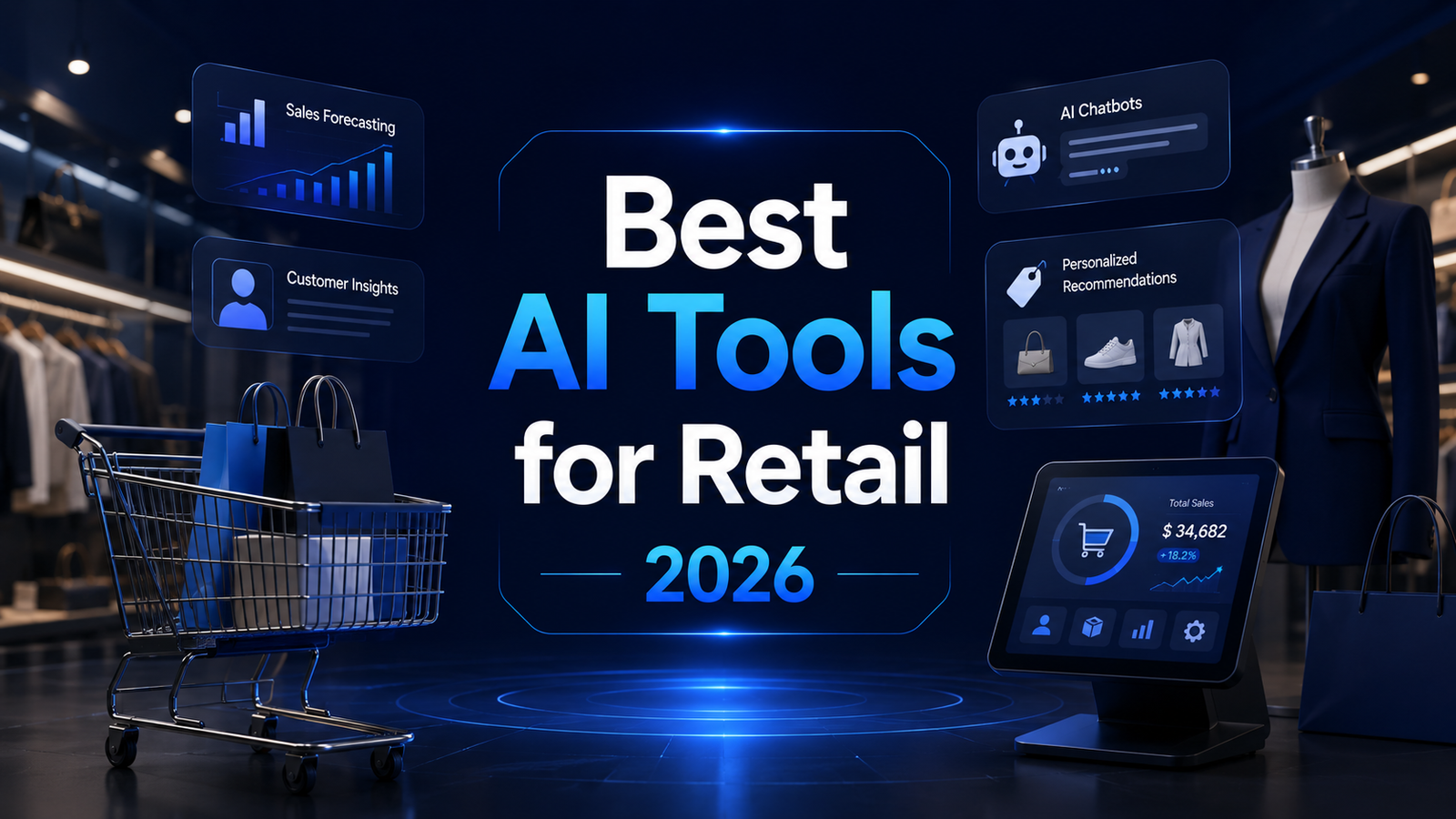
Best AI Tools for Retail 2026: Ranked, Reviewed and Compared
Retail has always been a data-intensive business. Customer purchase history, browsing behavior, inventory levels, pricing signals, and competitor positioning generate enormous volumes of information that determine whether a shopper buys, bounces, or returns. In 2026, the retailers winning market share are the ones using AI to act on that data in real time across every customer touchpoint.
The adoption numbers reflect a structural shift. As of 2025, 89 percent of retailers are using or testing AI, and the global AI-in-e-commerce market is approaching $9 billion. Shoppers who see personalized AI recommendations are 4 to 6 times more likely to convert than those who see generic product pages. Search accounts for roughly 40 percent of e-commerce sessions, and retailers using AI-powered search consistently report 15 to 35 percent revenue lifts versus keyword-only search. Meanwhile, email marketing platforms with AI send-time optimization and predictive segmentation consistently outperform manually scheduled campaigns by double-digit percentage points on open rates and revenue per subscriber.
The retail AI landscape in 2026 is stratified across distinct functions. Personalization and recommendation engines like Nosto and Dynamic Yield serve the on-site and omnichannel experience. Search and discovery platforms like Algolia address the product discovery bottleneck that causes significant abandonment on large catalogs. AI-powered CRM and email platforms like Klaviyo connect behavioral data to revenue-generating campaigns. Full-stack enterprise platforms like Salesforce AI and Vue.ai address the organizational challenge of connecting all these functions at scale.
Comparison Table: Best AI Tools for Retail 2026
| Tool | Best For | Starting Price | Free Plan |
|---|---|---|---|
| Salesforce AI (Commerce Cloud) | Enterprise retailers needing unified commerce, CRM, and AI across all channels | Custom enterprise pricing | No (demo) |
| Shopify AI (Magic) | Shopify merchants wanting free built-in AI for product content, search, and customer service | Free (included with Shopify) | Yes |
| Klaviyo AI | E-commerce email and SMS marketing with predictive analytics and revenue attribution | Free (250 contacts) / $20/month+ | Yes |
| Dynamic Yield | Enterprise retailers with technical teams wanting the most advanced A/B testing and personalization | Custom enterprise pricing | No |
| Nosto | Mid-market DTC and Shopify retailers wanting fast, effective on-site personalization | Custom (performance-based) | No (demo) |
| Vue.ai | Mid-to-large enterprises needing end-to-end AI across personalization, catalog, and operations | Custom enterprise pricing | No |
| ChatGPT | Retailers who need AI for product descriptions, customer communications, and content at scale | Free / $20/month (Plus) | Yes |
| Algolia | Retailers with large catalogs where search and discovery directly drive conversion | Free tier / Grow plan usage-based | Yes |
“Pricing is subject to change. Always verify current pricing on the tool’s official website before purchasing.”
Detailed Reviews
1. Salesforce AI (Commerce Cloud with Einstein)
Best for enterprise retailers who need unified AI across their entire commerce, service, and marketing stack on a single data platform.
Salesforce Einstein, embedded throughout Commerce Cloud, Service Cloud, and Marketing Cloud, provides AI that operates on a unified customer data model rather than isolated point solutions. Einstein Product Recommendations surface personalized product suggestions based on individual shopper behavior and purchase history across every channel. Einstein Search surfaces the most relevant products and sorting logic based on real-time shopper intent. Predictive sort in search and category pages adapts the ranking of results based on which products are most likely to convert for each individual visitor.
The Agentforce integration introduced in 2025 enables autonomous AI commerce agents that handle customer inquiries, process returns, check order status, and provide product guidance without human intervention. For enterprise retailers running customer service, merchandising, and marketing across the same Salesforce platform, the unified data model enables AI outputs that are more precise than those from disconnected best-of-breed tools.
Key Features: Einstein Product Recommendations across product pages, cart, and post-purchase, Einstein Search with AI-powered ranking and relevance, predictive sort for category pages based on individual conversion likelihood, Agentforce autonomous customer service agents, unified Customer 360 data model connecting commerce, service, and marketing AI, and AI-generated product descriptions in Commerce Cloud.
Pros:
- Unified data model produces more precise AI outputs than disconnected best-of-breed tool stacks
- Agentforce autonomous agents handle customer service at scale without dedicated headcount
- Commerce, service, and marketing AI all drawing from the same customer profile
- Deep enterprise integration with existing Salesforce CRM deployments
Cons:
- Custom enterprise pricing with significant annual contract commitments; not accessible for SMB or mid-market retailers without budget
- Implementation complexity requires Salesforce partner involvement and typically 3 to 6 month timelines
- Salesforce dependency: organizations not already on Salesforce face significant migration before accessing the full AI value
- Module-based pricing across Commerce Cloud, Service Cloud, and Marketing Cloud makes total cost unpredictable
Pricing:
- Custom enterprise pricing; contact Salesforce for current Commerce Cloud rates
- Agentforce adds consumption-based pricing on top of platform licensing
- No published pricing or self-serve access
2. Shopify AI (Magic)
Best for Shopify merchants who want AI product content, search, and customer service built directly into their existing platform at no additional cost.
Shopify Magic is the AI layer built into every Shopify plan, and for merchants who have not yet adopted AI tools, it is the logical starting point because it costs nothing and requires no new integrations or learning curves. The product description generator creates complete, tone-adjustable descriptions from product attributes in seconds. Shopify Inbox AI suggests response drafts for incoming customer messages based on product and policy content. Shopify’s AI-powered semantic search improves product discovery for shoppers on merchant storefronts.
The Sidekick AI assistant, available in Shopify admin, answers merchant questions about their store data, suggests optimizations based on performance metrics, and helps merchants make merchandising decisions informed by their actual sales patterns. For small and growing Shopify merchants, the combination of Magic and Sidekick provides genuine AI capability without any incremental budget.
Key Features: Magic product description generation from product attributes, Shopify Inbox AI for smart reply drafting, semantic search for shopper product discovery, Sidekick AI merchant assistant for store analytics and decision support, AI-powered email campaign generation, and automatic FAQ generation from store content.
Pros:
- Completely free with every Shopify plan; no additional budget required
- Zero implementation overhead; activates within the existing admin immediately
- Sidekick provides AI business intelligence specific to each merchant’s store data
- Covers three distinct workflows (content, search, customer service) at no additional cost
Cons:
- Less capable than specialized tools in each category: Nosto for recommendations, Algolia for search, Klaviyo for email
- Limited to Shopify platform merchants; WooCommerce, BigCommerce, and custom builds cannot access
- Product description output requires editing for accuracy and brand voice differentiation
Pricing:
- Included with all Shopify plans; no additional subscription required
- Shopify Basic: $39/month, Shopify: $105/month, Advanced: $399/month
3. Klaviyo AI
Best for e-commerce brands that want to generate measurable revenue from email and SMS through AI-powered personalization and predictive analytics.
Klaviyo’s AI layer transforms email marketing from a batch-and-blast channel into an individually timed, behaviorally targeted revenue engine. Predictive analytics identify when each individual subscriber is most likely to purchase, enabling precision delivery that generic scheduled campaigns cannot match. Product recommendations based on catalog purchase history and browsing behavior surface in follow-up emails automatically. Segments AI creates complex audience segments from plain-language descriptions, eliminating the manual audience builder complexity for sophisticated targeting.
Klaviyo’s platform consistently delivers the revenue attribution clarity that justifies its subscription: Shopify stores using Klaviyo report $85 in revenue for every dollar spent on the platform. Post-purchase flows, abandoned cart recovery, welcome series, and win-back sequences all run on AI-optimized timing specific to each customer’s behavioral patterns.
Key Features: Predictive analytics for individual purchase timing, AI product recommendations in email from catalog purchase history, Segments AI for natural language audience creation, automated flows for the full e-commerce customer lifecycle, SMS and email in one platform, and native Shopify, WooCommerce, BigCommerce, and Magento integrations.
Pros:
- $85 return per dollar spent reported by Shopify merchants; strongest email ROI documentation in the category
- Predictive send time per individual subscriber produces open rates that scheduled campaigns cannot match
- Segments AI removes the manual audience building that slows marketing teams
- Free plan for 250 contacts allows validating flows before the subscription investment
Cons:
- Pricing scales aggressively with list size; significant monthly cost increases as the database grows
- Platform depth can feel overwhelming for retailers new to behavioral email marketing
- Full AI features require moving beyond the free tier
Pricing:
- Free: 250 contacts, 500 emails/month, 150 SMS credits
- Email: Starting at $20/month (251 to 500 contacts), scaling with list size
- Email and SMS: Starting at $45/month, scaling with contacts and volume
4. Dynamic Yield
Best for enterprise retailers with technical teams who need the most advanced omnichannel personalization and A/B testing platform available.
Dynamic Yield, now part of Mastercard following its acquisition from McDonald’s, is built for data-driven retailers that want to experiment with personalization at the most granular level. Omnichannel personalization tools run across web, mobile app, and email from one system. The A/B testing visual editor is more mature than competing offerings. Predictive audience segmentation identifies high-value customers before they purchase, prioritizing experiences for visitors most likely to convert.
Dynamic Yield requires technical expertise to manage effectively. HTML coding is needed for advanced features like custom targeting rules. The pricing is enterprise-grade, making it unsuitable for smaller retailers without significant development resources and testing budgets. For large enterprise retailers with those resources, Dynamic Yield delivers the most sophisticated merchandising and personalization experimentation capability available.
Key Features: Omnichannel personalization across web, app, and email from a single platform, mature A/B testing with visual editor and statistical significance tracking, advanced predictive audience segmentation, real-time behavioral targeting, personalized product recommendations, dynamic messaging for cart abandonment and re-engagement, and enterprise data security.
Pros:
- Most sophisticated A/B testing and merchandising experimentation available for enterprise retail
- Omnichannel consistency ensures personalization logic is applied across every customer touchpoint
- Mastercard ecosystem partnership strengthens the financial services and payment data integration for large retailers
- Audience segmentation predictive analytics prioritize experiences for highest-converting visitor segments
Cons:
- Enterprise pricing makes it inaccessible for mid-market retailers; minimum investment well above Nosto
- Technical expertise required; HTML coding for custom targeting rules creates a developer dependency
- Implementation timeline and complexity require dedicated resources before go-live
- Not suitable for smaller retailers where Nosto or Klaviyo’s simpler approach delivers faster ROI
Pricing:
- Custom enterprise pricing; contact Dynamic Yield directly
- No self-serve tier or free trial
5. Nosto
Best for mid-market DTC and Shopify retailers wanting fast, effective on-site personalization with strong average order value uplift.
Nosto increases revenue by making every page feel tailored, keeping shoppers browsing longer and consistently lifting average order value through smarter, real-time recommendations. The platform analyzes browsing behavior, purchase history, and real-time session intent to surface personalized product recommendations across the full on-site experience: homepage, collection pages, product pages, cart, and post-purchase pages.
Shoppers who see personalized recommendations are 4 to 6 times more likely to convert, and Nosto’s Shopify integration is consistently praised for its speed of deployment. Retailers report 25 percent AOV increases documented within weeks of activation. The recommendation engine adapts individually for each visitor based on what they are doing in the current session, rather than displaying static bestsellers.
Key Features: AI product recommendations adapting to browsing behavior and purchase history, personalization across homepage, product, cart, and post-purchase touchpoints, on-site pop-ups and targeting for behavioral engagement, A/B testing for recommendation placement and algorithm configuration, email integration for behavioral recommendations in campaigns, and a Shopify app for rapid deployment.
Pros:
- Dead-simple Shopify plugin with 25 percent AOV lifts documented in weeks by retailers
- Recommendations across the full customer journey rather than just the product page
- Performance-based pricing model aligns Nosto’s incentive with the retailer’s results
- Consistent with cross-channel email integration for a unified personalization approach
Cons:
- Custom pricing requires demo engagement; no self-serve access or published rates
- Less powerful than Dynamic Yield for complex multi-site enterprise experimentation
- Initial setup can be technically complex for retailers without development resources
- Best value for Shopify and mid-market DTC; less appropriate for B2B retail or complex custom platforms
Pricing:
- Custom performance-based pricing; requires a demo and sales conversation
- Best suited for retailers generating meaningful monthly revenue where conversion lift justifies the investment
6. Vue.ai
Best for mid-to-large enterprises seeking a single end-to-end AI platform covering personalization, catalog intelligence, and operational AI.
Vue.ai addresses a challenge that best-of-breed tool stacks create: fragmented AI that requires multiple vendor relationships, data integrations, and management overhead. By unifying personalization, recommendation engines, inventory optimization, and operational AI in one platform, Vue.ai increases conversions, boosts average order value, and streamlines workflows simultaneously. The platform transforms large catalogs and customer data into actionable insights, making every interaction smarter and more profitable.
Vue.ai’s catalog intelligence uses computer vision to automatically tag products with attributes, generate descriptions, and normalize catalog data at scale, which is the operational foundation that makes personalization accuracy possible. For fashion, apparel, and large SKU retailers where catalog quality directly affects recommendation relevance, this operational layer differentiates Vue.ai from personalization-only platforms.
Key Features: End-to-end AI covering personalization, recommendations, catalog intelligence, and inventory optimization, computer vision-based product tagging and automatic attribute extraction, AI-powered product descriptions at catalog scale, demand forecasting and inventory management AI, omnichannel personalization across web, app, and email, and integration with Shopify, Magento, Salesforce Commerce Cloud, and custom platforms.
Pros:
- Only platform in this comparison that addresses both customer-facing personalization and operational catalog intelligence
- Computer vision-based catalog enrichment is uniquely valuable for fashion and apparel retailers with large SKU counts
- Unified platform reduces vendor management complexity versus assembling separate best-of-breed tools
- Mid-to-large enterprise positioning at lower price points than Salesforce Commerce Cloud
Cons:
- Custom enterprise pricing requires direct engagement; no self-serve evaluation
- More implementation complexity than single-function tools like Nosto for retailers needing only recommendation AI
- Less established market presence than Salesforce or Shopify among enterprise buyers
- ROI most clearly realized for retailers with both large catalogs and meaningful monthly revenue
Pricing:
- Custom enterprise pricing; contact Vue.ai for current rates
- No self-serve pricing or free trial
7. ChatGPT
Best for retailers of any size who need AI for product descriptions, marketing copy, customer communication templates, and content production at scale.
ChatGPT is the most accessible AI investment available to any retailer because the use cases are so broad and the entry cost so low. Product descriptions, collection page copy, email campaign drafts, social media captions, FAQ content, customer service response templates, ad copy variants, and blog posts all emerge from the same tool with minimal configuration. At $20 per month for Plus or from the free tier for occasional use, ChatGPT provides immediate productivity gains for every team member who writes retail content.
For retailers managing large catalogs, ChatGPT’s Advanced Data Analysis feature processes uploaded product spreadsheets and generates descriptions in bulk. Custom GPTs pre-loaded with brand voice guidelines, category-specific language, and product positioning generate on-brand content for any format without re-entering context in every session.
Key Features: Product description and marketing copy generation across all formats, Custom GPTs for brand-specific retail content assistants, Advanced Data Analysis for bulk product data processing, web browsing for competitor research and trend monitoring, image generation for basic visual content, and memory for persistent brand context across sessions.
Pros:
- Free tier is functional for occasional retail content needs without any subscription
- Most versatile retail AI tool; covers every writing and research task from one interface
- Custom GPTs eliminate repeated brand context setup for recurring content types
- Advanced Data Analysis processes uploaded catalog data for bulk description generation
Cons:
- No native integration with e-commerce platforms, PIM systems, or CRM
- Cannot access real customer behavior, sales data, or inventory systems without manual input
- Factual accuracy on product specifications requires human review before publication
Pricing:
- Free: GPT-5.x with daily limits, no credit card required
- Plus: $20/month, full GPT-5.4, web browsing, file analysis, Custom GPTs, memory
8. Algolia
Best for retailers where search and product discovery directly drive conversion, especially those with large, complex catalogs or multi-language audiences.
Algolia feels like the most commercially mature search engine because it understands context, not just keywords. NeuralSearch combines keyword and vector-based search to return relevant results based on semantic relevance and shopper intent even when queries do not contain exact product terminology. AI Re-ranking automatically pushes products most likely to convert to the top of search results based on real-time user behavior, learning continuously from click and purchase patterns.
Visitor searching on an e-commerce site is 2 to 3 times more likely to convert than one who browses. Retailers using Algolia consistently report elimination of zero-results dead ends, faster product discovery, and measurable improvement in search-to-purchase rates. The API-first architecture integrates with virtually any e-commerce platform including Shopify, Magento, BigCommerce, and custom builds.
Key Features: NeuralSearch combining keyword and vector-based semantic search, AI Re-ranking for conversion-optimized result ordering, AI Synonyms for automatic query expansion, real-time behavioral learning from clicks and purchases, AI-powered recommendations as a companion to search, 200-plus integrations and InstantSearch UI libraries for rapid implementation, and sub-20ms search response time.
Pros:
- Best-in-class developer experience; Stripe uses Algolia to power their own documentation search
- NeuralSearch semantic understanding handles natural language, misspellings, and context
- API-first design integrates with any platform without platform lock-in
- Free tier available; Grow plan usage-based billing allows evaluation before commitment
Cons:
- AI features are locked behind Grow Plus and Premium tiers; the free Build tier only includes keyword-based search
- Usage-based pricing creates budget uncertainty for high-traffic periods; $0.50 to $0.75 per 1,000 extra requests on Grow tiers can spike unpredictably
- Enterprise Elevate tier requires annual commitments starting around $50,000 per year
- Pure search and discovery focus requires pairing with a separate personalization tool for full recommendation coverage
Pricing:
- Free Build tier: keyword search only, 10,000 records included
- Grow: Usage-based billing, $0.50/1K additional search requests
- Grow Plus: $0.75/1K additional requests, includes AI features
- Premium and Elevate: Annual contracts; Elevate starts approximately $50,000/year
Frequently Asked Questions
How much revenue lift can retailers realistically expect from AI personalization tools?
Independent benchmarks and vendor-reported data consistently show revenue lifts of 15 to 35 percent for retailers that properly implement AI personalization. The wide range reflects the degree to which results depend on implementation quality, catalog size, and baseline experience quality rather than the tool itself. Retailers that see 35 percent lifts typically have well-tagged product catalogs that provide meaningful attribute data for recommendation algorithms, high traffic volumes that give AI models enough behavioral data to learn from, and teams that actively test and optimize recommendation placement rather than setting them and leaving them static. Retailers that see minimal lift typically have thin behavioral data, a small catalog that limits recommendation diversity, or implement recommendations in poor placement positions with low visibility. The practical framework for estimating expected lift: if your current search handles less than 50 percent of queries with zero results, fixing search first produces the fastest measurable return. If search is functional and cart abandonment is above 70 percent, personalization in abandonment recovery flows typically produces the highest ROI. If email open rates are below 20 percent on behavioral triggers, Klaviyo’s predictive send time optimization typically produces the most immediate improvement.
Should a mid-market retailer build a best-of-breed AI stack or use an all-in-one platform?
The decision depends on team capacity and implementation readiness more than budget alone. Best-of-breed stacks combining Algolia for search, Nosto for on-site personalization, and Klaviyo for email typically produce the strongest results in each function at the cost of three vendor relationships, three integration projects, and ongoing data synchronization overhead. All-in-one platforms like Salesforce Commerce Cloud or Vue.ai reduce vendor complexity and provide more consistent data models across functions at the cost of less specialized depth in any individual function. For retailers without dedicated technology teams, an all-in-one platform or a Shopify-native stack (Shopify Magic plus Klaviyo) often delivers better practical results than a theoretically superior best-of-breed stack that never gets fully implemented. For retailers with strong engineering capacity, best-of-breed consistently outperforms all-in-one on each individual metric. Start with the tool that addresses your single highest-impact gap, implement it fully, and expand from demonstrated results rather than theoretical completeness.
What should retailers evaluate before selecting an AI personalization or search tool?
Four evaluation criteria consistently predict implementation success. First, data availability: AI tools are only as good as the behavioral data they learn from. A tool promising personalization for a catalog of 500 SKUs with 1,000 monthly visitors will produce generic output until behavioral volume increases. Second, platform integration depth: native Shopify integrations deploy in hours; custom platform integrations can take months and require developer investment that is often underestimated at evaluation time. Third, implementation resources: every enterprise tool on this list requires implementation support beyond initial setup. Dynamic Yield requires HTML coding for advanced features. Salesforce Commerce Cloud requires a partner implementation. Budget for this reality before committing. Fourth, total cost including data volume: Algolia’s usage-based pricing is cost-efficient at moderate volumes and expensive at high search volumes. Klaviyo’s list-based pricing grows significantly with database size. Request cost projections at 3x and 10x your current volume to understand the economics of scaling before signing an annual contract.
Final Recommendation
The right retail AI stack in 2026 reflects the retailer’s platform, size, and specific conversion bottleneck rather than any single universal recommendation.
For Shopify merchants at any stage, start with Shopify Magic (free) and Klaviyo (free for up to 250 contacts). Both are zero incremental cost and address product content and email marketing, the two highest-leverage channels for most DTC brands.
For mid-market DTC retailers generating meaningful monthly revenue where average order value improvement has a direct revenue impact, Nosto’s performance-based pricing and Shopify-native integration typically produce the fastest documented ROI in the recommendation category.
For retailers where search abandonment is the most visible conversion problem, Algolia’s Grow plan provides immediate improvement in product discovery quality with usage-based pricing that scales predictably.
For enterprise retailers running complex multi-site, multi-channel operations where unified data across commerce, service, and marketing AI is the strategic requirement, Salesforce Commerce Cloud with Einstein provides the most integrated AI layer, particularly for organizations already invested in the Salesforce ecosystem.
For retailers with large catalogs where catalog data quality is a documented bottleneck for recommendation accuracy, Vue.ai’s combined catalog intelligence and personalization addresses the operational foundation alongside the customer-facing AI layer.
In every case, implement one tool well before adding the next. The compounding value of retail AI comes from consistent operation and continuous optimization, not from subscription volume.