
Meshy AI Review 2026: The Best Tripo Alternative for AI 3D Generation?
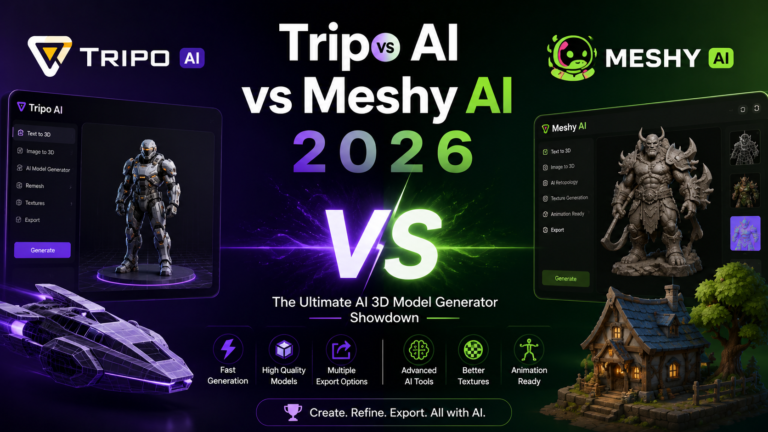
The question is worth asking seriously because in January 2026, Meshy AI crossed a threshold that changes the answer. Meshy-6, released January 18, 2026, produces watertight meshes with cleaner topology and sharper hard-surface edges that previous versions did not reliably deliver. In a 1,331-vote blind benchmark conducted by senior 3D artists from NetEase and Tencent, Meshy-6 was preferred over Tripo 3.1 by 63.8 percent. At GDC 2026, Meshy reported 10 million-plus users and over 100 million models generated.
That is a different competitive picture from 12 months ago when Tripo’s speed advantage and topology cleanliness made it the clearer choice for most game developers. In 2026, the comparison is more nuanced: Meshy wins on the depth of the end-to-end pipeline (generation, texturing, rigging, animation, and engine integrations in one place), Tripo wins on raw generation speed (10 seconds versus Meshy’s approximately 60 seconds) and on its larger free credit allocation. The choice depends on which of those trade-offs matters more for your specific workflow.
Plan Comparison Table
| Plan | Best For | Starting Price | Free Plan |
|---|---|---|---|
| Free | Testing quality before any payment commitment | $0 (100 credits/month) | Yes |
| Pro | Individual game devs, 3D artists, and XR creators who need regular production volume | $20/month (~50 fully-textured models at 20 credits each) | No |
| Max | Power users needing higher credit volume and priority queue | $80/month | No |
| Enterprise | Studios and teams requiring API access, custom limits, and commercial licensing | Custom pricing | No |
“Pricing is subject to change. Credits do not roll over at month end. Meshy-6 Preview costs 20 credits per generation; standard Meshy-6 costs 10 credits. AI texturing costs additional credits beyond generation. Always verify current credit costs and pricing at meshy.ai/pricing before purchasing.”
What Meshy AI Is
Meshy AI is a SaaS 3D model generation platform built around an in-house diffusion model that converts text prompts and 2D images into PBR-textured 3D meshes. The platform serves game developers generating prop and character assets, 3D printing enthusiasts producing figurines and prototypes, concept artists exploring forms quickly, XR developers building spatial content, and 3D artists who want to use AI-generated meshes as a starting point for manual refinement.
The Meshy-6 flagship model is the current generation. The Meshy-6 Preview tier provides higher-fidelity sculpting-level output at 20 credits per generation instead of 10 for standard Meshy-6. A Low Poly Mode on Meshy-6 generates game-ready low-polygon meshes optimized for real-time engine performance without the manual retopology step that high-poly AI output typically requires.
Key Features
Text-to-3D with style control. Describe what you want in plain language and Meshy generates a textured 3D model within approximately 60 seconds. Prompts like “low-poly fantasy sword” or “cyberpunk helmet” produce styled outputs aligned to the description. Text-to-3D in Meshy performs well for concept art, game props, and creative ideation where speed of exploration is the primary goal. Complex organic characters with specific proportions require more iteration and cleanup than structured hard-surface objects.
Image-to-3D with PBR texture transfer. Upload a single reference image or multiple views and Meshy reconstructs a 3D mesh with PBR textures applied. Multi-view input improves geometry accuracy for back-side detail. Unlike Tripo, Meshy also supports retexturing existing assets, applying Meshy’s texturing to models that were not generated within the platform. This retexturing capability extends Meshy’s texturing pipeline to imported meshes from other sources.
Full PBR texture maps. Meshy generates complete PBR material sets including Albedo, Normal, Roughness, Metallic, and Ambient Occlusion maps. These physically-based materials respond correctly to real-time lighting in Unity, Unreal Engine, and Godot, enabling game-ready assets without separate material creation. Tripo’s texturing is described by independent comparisons as limited to geometry output without support for retexturing existing assets.
Auto-rigging and 500-plus animation presets. Meshy includes automatic character skeleton generation and a library of over 500 preset animations covering walk cycles, attack animations, idle states, and more. Export rigged, animated characters directly to Unity, Unreal Engine, Godot, or Roblox in one click. This animation library is Meshy’s primary moat against Tripo in 2026: Tripo offers basic skeletal rigging but no built-in motion library comparable in scale.
3D printing pipeline with Bambu Studio integration. Meshy-6 generates optimized, watertight meshes with a 97 percent slicer pass rate on figurines in independent testing. Direct “Send to Bambu” integration skips the manual export-import step for Bambu Lab printer users. Export formats include STL, 3MF, and OBJ, with 3MF supporting multi-material color printing.
Seven native plugins across major DCC tools and engines. Blender, Unity, Unreal Engine, Godot, Roblox, Cinema 4D, and Maya are all supported with native plugins. The Blender plugin enables generating models in Meshy and importing directly into Blender in the same workspace without manual file management. Tripo supports Blender, Maya, Unity, Unreal Engine, Godot, and Cocos but not Cinema 4D.
Export formats covering every production pipeline. FBX, OBJ, GLB, USDZ, STL, BLEND, and 3MF export formats are supported. USDZ enables AR Quick Look on iOS without conversion. GLB is the standard for web-based 3D and WebXR. FBX and BLEND cover DCC workflows in Blender, Maya, and Cinema 4D.
Pros and Cons
Pros:
- Meshy-6 crossed a real quality threshold in January 2026: watertight meshes, sharper hard-surface edges, and Low Poly Mode for game-ready output that previous versions did not reliably produce
- 500-plus animation presets with auto-rigging are the most complete built-in animation pipeline of any AI 3D generator in 2026; Tripo offers basic rigging without an animation library
- Full PBR material sets including retexturing capability for imported meshes extends the texturing pipeline beyond models generated within Meshy
- 97 percent slicer pass rate on figurines and direct Bambu Studio integration make Meshy the strongest AI 3D tool for 3D printing workflows
- Seven native DCC and engine plugins cover the broadest pipeline integration in the category
- 10 million-plus users and 100 million-plus models generated represents the most validated production adoption of any AI 3D tool at this price point
- Free plan with 100 monthly credits allows quality evaluation without payment commitment
Cons:
- Complex organic shapes, particularly characters with specific facial proportions, still require cleanup in Blender or ZBrush before submission-quality output is achieved; multiple reviewers document distorted faces, extra fingers, and broken proportions on detailed character prompts
- Topology is not production-perfect in the technical sense; Meshy-6 produces cleaner geometry than previous versions but still generates denser triangle meshes rather than the structured quad topology that animators prefer for deformation-friendly rigging
- Credits deplete significantly faster than the monthly count suggests: each fully-textured generation costs 20 credits on Meshy-6 Preview, meaning the Pro plan’s 1,000 monthly credits covers approximately 50 textured models, and iteration cycles on complex subjects can consume this allocation quickly
- Credits do not roll over at month end
- Tripo generates models in approximately 10 seconds versus Meshy’s approximately 60 seconds; for workflows that require many rapid iterations across prompt variations, this speed gap matters
- The Meshy AI affiliate link to note for transparency: this review uses an affiliate link (https://www.meshy.ai?via=onyxranked) through which OnyxRanked may earn a commission
Pricing Breakdown
Meshy’s credit-based pricing requires understanding the credit cost per task before estimating real monthly volume.
Free: $0. 100 credits per month. Based on 20 credits per fully-textured Meshy-6 Preview generation, this covers approximately 5 high-quality textured models per month, enough for genuine quality evaluation. Standard Meshy-6 at 10 credits per generation doubles the free tier volume to approximately 10 models. Credits expire monthly without rollover.
Pro: $20/month. 1,000 credits per month. At 20 credits per Meshy-6 Preview textured generation, this covers approximately 50 fully-textured models. If iterations are needed, each retry consumes additional credits, reducing net usable models. Standard generation at 10 credits doubles this to approximately 100 models. For an indie game developer creating a level with 50 to 100 unique assets who expects 2 to 3 generation attempts per final asset, Pro’s credit allocation is tight but functional for consistent monthly output. Annual billing is available with a 20 percent discount.
Max: $80/month. Higher credit allocation for power users who hit Pro limits regularly. Includes priority queue access for faster processing during high-traffic periods.
Enterprise: Custom pricing. API access, custom credit limits, commercial licensing terms, and dedicated support. For studios integrating Meshy into production pipelines programmatically.
How It Compares to Tripo AI
For a full review of Tripo AI and its Smart Mesh P1.0 workflow, see our Tripo AI Review 2026.
The most practical comparison framework comes from independent testing rather than marketing claims from either vendor. Both platforms publish comparison pages that favor themselves, which is expected. The more reliable signal is the 1,331-vote blind benchmark from senior 3D artists at NetEase and Tencent, where Meshy-6 was preferred over Tripo 3.1 by 63.8 percent, suggesting Meshy’s quality lead is real for professional evaluators rather than a self-reported claim.
Where Meshy wins over Tripo:
Meshy’s animation library with 500-plus presets and auto-rigging is a genuine and significant advantage. Tripo offers basic skeletal rigging without a comparable animation library. For game developers and XR creators who need animated characters without a separate rigging and animation pipeline, Meshy covers an end-to-end workflow that Tripo does not replicate at the same completeness level. Meshy also leads on 3D printing integration with its Bambu Studio direct connection and watertight mesh output. And Meshy’s full PBR texturing with retexturing capability for imported assets extends the platform’s texturing value beyond internally-generated models.
Where Tripo wins over Meshy:
Tripo’s Smart Mesh P1.0, launched March 2026, generates clean structured quad topology in approximately 2 to 10 seconds, dramatically faster than Meshy’s approximately 60-second generation time. For workflows that require rapid iteration across many prompt variations, Tripo’s speed advantage compresses the exploration phase significantly. Tripo’s free plan also provides 300 credits per month versus Meshy’s 100, offering more experimentation volume at zero cost. Tripo’s annual billing provides a 40 percent discount versus Meshy’s 20 percent, making Tripo more economical for budget-conscious annual subscribers.
The practical recommendation:
Choose Meshy if you need the complete end-to-end pipeline with animation, the 3D printing workflow with Bambu integration, or the broadest DCC plugin coverage. Choose Tripo if generation speed is the primary constraint, if the larger free credit allocation is important for your evaluation, or if the cleaner quad topology is specifically required for manual rigging workflows.
Frequently Asked Questions
How many usable models can I actually produce on the Meshy Pro plan each month?
The answer depends on which generation mode and how many iterations each final asset requires. At 20 credits per Meshy-6 Preview fully-textured generation, the Pro plan’s 1,000 monthly credits covers 50 attempts. If the average final asset requires 2 generation attempts before reaching usable quality, the effective monthly output is 25 final models. At standard Meshy-6 (10 credits), 100 attempts produces 50 final models at the same 2-attempt average. For hard-surface game props where first-attempt success rates are higher, the Pro plan covers 40 to 50 usable models per month. For complex organic characters where iteration rates are higher, expect 15 to 25 usable outputs per month. The credit math is the most important thing to model before subscribing.
Is the Meshy-6 output actually production-ready, or does it always need Blender cleanup?
For most game prop use cases, Meshy-6 output is production-ready with minor UV and scale adjustments in the engine. Hard-surface assets including weapons, vehicles, tools, and architectural props show the cleanest results with the least cleanup required. For these asset types, the workflow that multiple independent reviewers describe consistently is: generate in Meshy, import to Unity or Unreal, adjust scale and material settings, done. Characters are the exception. Detailed organic character faces, hands, and feet frequently require cleanup for distorted features, extra geometry, or broken proportions. The recommendation for characters from independent analysis: use Meshy to establish the form and silhouette, then take the FBX into Blender for face cleanup, weight paint adjustment on hero characters, and UV refinement for the final 20 percent of quality that Meshy does not consistently deliver.
How does the Meshy affiliate link work, and does it affect this review?
The affiliate link used in this review (https://www.meshy.ai?via=onyxranked) earns OnyxRanked a 20 percent recurring commission for 24 months on subscriptions made through the link. This is disclosed in the pricing table and in the affiliate disclosure at the bottom of this article. The commission structure does not change the editorial assessment: the comparison with Tripo reflects independently benchmarked quality data and documented user feedback, not sponsored positioning. The Tripo preference for speed and free credit volume is stated accurately despite OnyxRanked not having an equivalent Tripo affiliate relationship.
Final Verdict
Meshy AI in 2026 is the most complete AI 3D generation pipeline for game developers, XR creators, and 3D printing enthusiasts who need more than just mesh generation. The 500-plus animation preset library with auto-rigging, the Bambu Studio direct integration for 3D printing, the full PBR texturing with retexturing capability, and the seven native DCC plugins collectively cover an end-to-end production workflow that Tripo AI does not replicate at the same completeness level.
Meshy-6 represents a genuine quality improvement over previous versions, and the 1,331-vote blind benchmark from senior NetEase and Tencent artists confirming a 63.8 percent preference for Meshy-6 over Tripo 3.1 is the most credible third-party quality signal available for this comparison.
The limitations are real and should inform the subscription decision. Credits deplete faster than the monthly count suggests for iterative workflows. Organic character detail requires Blender cleanup for hero asset quality. Topology is cleaner than before but not the structured quad mesh that animators prefer for deformation-friendly rigging. And Tripo’s 10-second generation speed and larger free credit pool make it the better fit for rapid iteration workflows and zero-cost evaluation.
The honest workflow recommendation from independent analysis: get 80 percent of the way there in Meshy in under a minute, take the FBX into Blender for the remaining 20 percent. For a solo indie developer, Meshy Pro at $20 per month replaces a freelance asset budget that previously ran $1,000-plus per month.
Rating: 4.2 / 5 — Best AI 3D pipeline for game development and 3D printing. Credit economics require planning; character output requires Blender finishing.
Disclosure: This article contains affiliate links. OnyxRanked may earn a commission on qualifying purchases or subscriptions made through links on this page.