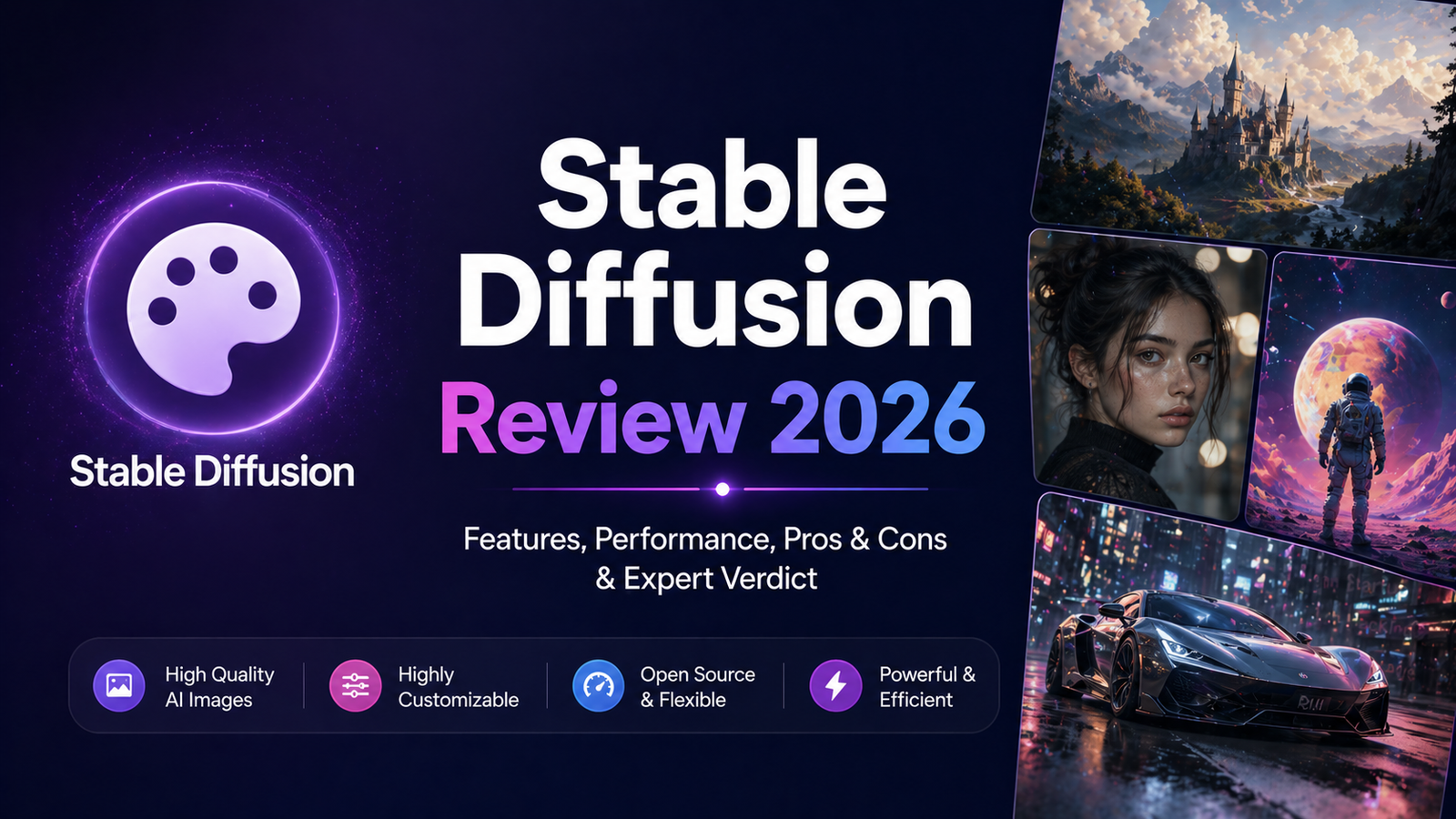
Stable Diffusion Review 2026: Still Worth It vs Midjourney?
Every other AI image generator in this category is a product you subscribe to. Stable Diffusion is something different: a collection of open-source model weights that you can download, run locally on your own hardware, modify, fine-tune on your own data, and use to generate unlimited images at zero cost per generation. There are no subscriptions, no credits, no usage limits, and no company server between your prompt and your output.
That fundamental difference explains why Stable Diffusion’s user profile looks nothing like Midjourney’s or DALL-E’s. Its users include researchers, developers, visual effects professionals, game studios, and technically capable creators who want maximum control, maximum privacy, and maximum creative flexibility rather than the most convenient path to a polished image.
The trade-off is equally clear: getting meaningful results from Stable Diffusion requires technical setup, hardware investment or cloud cost, and time learning a deeper toolchain than any subscription-based alternative. The question is not whether Stable Diffusion is capable; it objectively is, with the right models and configuration. The question is whether that capability is worth the overhead for your specific use case.
What Stable Diffusion Is and Who It Is For
Stable Diffusion is an open-source latent diffusion model developed by Stability AI in collaboration with researchers from Ludwig Maximilian University of Munich and Runway ML. The original SD 1.5 was released in 2022. Since then, the model family has expanded substantially: SDXL (2023) brought native 1024×1024 resolution and significantly improved anatomy and compositional quality. SD3 (2024) introduced a Multimodal Diffusion Transformer architecture with dramatically better text rendering and prompt adherence. SD 3.5 (late 2024) extended this with Large, Large Turbo, and Medium variants, the last of which is fully open source.
In 2026, the practical choice for most users entering the ecosystem is between SDXL (the community workhorse with the largest fine-tune and LoRA library) and SD 3.5 (architecturally superior but a younger community ecosystem). Flux, built by Black Forest Labs (founded by ex-Stability AI researchers), also runs in the same community toolchain and deserves mention as a competing open-weight model that has captured significant developer interest in 2025 and 2026.
Stable Diffusion is built for users who fall into one of these profiles:
Developers and technical users who want to build image generation into applications without paying per-image API costs at scale. Running Stable Diffusion locally or on self-hosted cloud infrastructure costs pennies per image at volume versus $0.04 to $0.12 per image through OpenAI’s API.
Artists and creatives who need maximum stylistic control. The SDXL community ecosystem includes thousands of fine-tuned checkpoints, LoRA style adapters, ControlNet conditioning tools, and inpainting extensions that allow levels of creative direction no closed-system tool provides. Anime artists, concept designers, and professional illustrators have built entire workflows around specific combinations of models and extensions that cannot be replicated elsewhere.
Privacy-sensitive professionals and researchers who need to generate images from sensitive or confidential material without that data transmitting to external servers. Local Stable Diffusion keeps all data on-device.
Organizations needing commercial control at scale. An enterprise generating 100,000 images per month pays nothing in per-image costs on self-hosted infrastructure. At DALL-E API rates, the same volume costs $4,000 to $12,000 per month.
Key Features
Open-weight model architecture. The core model weights are publicly available on Hugging Face under Stability AI’s licensing terms. Download them once and run locally with no ongoing cost per generation. The open architecture also means the community can fine-tune models on proprietary data, creating custom checkpoints that match specific brand aesthetics, character designs, or artistic styles.
LoRA fine-tuning for custom styles and subjects. Low-Rank Adaptation files are small (typically 50 to 150 MB) model modifications that teach the base model a specific style, character, or concept. Thousands of free LoRAs are available on Civitai, Hugging Face, and community repositories covering every conceivable aesthetic direction. Combining multiple LoRAs with weighted blending creates highly specific visual styles that no closed-system generator can replicate through prompting alone.
ControlNet for precise compositional control. ControlNet is a conditioning system that controls image generation using reference inputs: poses, depth maps, edge maps, segmentation maps, and more. Want to generate a new character in exactly the same pose as a reference photo? ControlNet handles this. Want to generate a landscape that follows the exact compositional structure of a sketch? ControlNet handles this. No major closed-system AI image generator offers equivalent compositional precision at any price.
Inpainting, outpainting, and img2img. Stable Diffusion supports editing any region of an existing image using text prompts (inpainting), extending images beyond their borders (outpainting), and using an existing image as the structural reference for a new generation (img2img). These editing capabilities are available through community frontends and work on any image, not just AI-generated ones.
SDXL at 1024×1024 native resolution. SDXL generates at native 1024×1024 resolution with dramatically improved handling of human anatomy, complex scenes, and text elements compared to SD 1.5. The community has produced hundreds of fine-tuned SDXL checkpoints optimized for specific use cases: photorealistic portraits, anime, concept art, product photography, and more.
SD 3.5 with MMDiT architecture. SD 3.5 uses a Multimodal Diffusion Transformer architecture with a T5 text encoder alongside two CLIP encoders, producing substantially better understanding of complex multi-object prompts and significantly improved text legibility within images. The Medium variant (2.5B parameters) is fully open source. The Large (8B) and Large Turbo variants have access restrictions for non-research use.
Pros and Cons
Pros:
- Zero cost per generation when running locally; the only costs are hardware (or cloud compute) and electricity
- Unlimited generation with no monthly credit caps or subscription rate limits
- ControlNet compositional control has no equivalent in any closed-system generator at any price
- Thousands of community fine-tuned checkpoints provide stylistic range that no single commercial model matches
- Complete data privacy: local generation means no images, prompts, or data transmit to external servers
- SD 3.5 Medium is fully open source with commercial use permitted under Stability AI’s license
- Vibrant ecosystem of community tools, tutorials, and active development that continuously expands capability
- AUTOMATIC1111, ComfyUI, and Forge frontends provide professional-grade interfaces with extensive extension libraries
Cons:
- Significant technical setup barrier: Python installation, virtual environments, package management, and hardware configuration are required before generating a single image
- Hardware requirements are meaningful: SD 1.5 requires at least 4 GB VRAM, SDXL requires 8 to 12 GB VRAM, and SD 3.5 Large needs 16 to 24 GB VRAM
- Output quality on base models without fine-tuning frequently requires extensive prompt engineering to match what closed systems produce with simple descriptions
- Anatomy, hands, and face generation on SD 1.5 and early SDXL models still shows quality gaps versus dedicated commercial tools without appropriate fine-tuned checkpoints
- No customer support: troubleshooting relies on community forums, Reddit, GitHub issues, and Discord servers
- Legal status of copyright for commercially used outputs generated on models trained on web-scraped data is actively litigated; Stability AI faces ongoing copyright cases that have not reached final judgment as of early 2026
Pricing Breakdown
Stable Diffusion has no subscription pricing because it is open-source. Cost depends entirely on how you access it.
Local installation: Free. Download the model weights from Hugging Face and run using AUTOMATIC1111, ComfyUI, or Forge. No ongoing cost beyond hardware and electricity. SDXL generates approximately 5 to 20 images per minute on an NVIDIA RTX 3090 depending on resolution and step count. Generation on Apple Silicon M2 Pro and above is functional using the MPS backend, running slower but without requiring dedicated NVIDIA hardware.
Cloud GPU rental (pay-as-you-go). For users without a suitable local GPU, cloud platforms including RunPod, Vast.ai, and Lambda Labs rent GPU compute. Typical costs for SDXL generation on a rented NVIDIA A100 run approximately $0.50 to $1.50 per hour, covering 500 to 2,000 image generations. For occasional high-quality generation sessions, this is significantly cheaper than subscription tools at equivalent volume.
Stability AI Platform API: Credit-based. For developers who want managed infrastructure rather than self-hosting, Stability AI’s platform at platform.stability.ai provides API access. New accounts receive 25 free credits. API pricing varies by model and generation parameters; verify current rates directly at the platform site.
Hosted services using Stable Diffusion. Numerous third-party services including NightCafe, Civitai, and various app platforms use Stable Diffusion models with their own subscription tiers starting at free plans with limited generations. These services trade the full control of self-hosting for convenience.
“Pricing is subject to change. Always verify current pricing on the tool’s official website before purchasing.”
How It Compares to Midjourney and DALL-E 3
Stable Diffusion vs Midjourney
Midjourney and Stable Diffusion are the most frequently compared AI image tools, but comparing them directly is somewhat misleading because they are genuinely different types of tools serving different priorities.
Midjourney is a subscription service producing aesthetically polished, artistically driven images through a conversational interface with no technical setup. Its V7 and V8 Alpha outputs are widely considered the benchmark for visual quality and artistic impact in AI image generation. For users who want the most stunning images with the least effort, Midjourney delivers this more reliably than default Stable Diffusion.
Stable Diffusion with the right fine-tuned checkpoint can match or exceed Midjourney’s output quality in specific domains. The photorealistic portrait quality of a well-configured SDXL RealVisXL setup, or the anime quality of a Pony XL checkpoint, produces results that compete with Midjourney V7 in those categories. The ControlNet compositional control available in Stable Diffusion has no Midjourney equivalent at any tier. And Stable Diffusion costs nothing per generation versus Midjourney’s $10 per month minimum.
The practical summary: Midjourney for users who want high-quality artistic outputs with minimal effort and no technical overhead. Stable Diffusion for users who want maximum control, customizability, privacy, or zero per-generation cost and are willing to invest in the technical learning curve.
Stable Diffusion vs DALL-E 3
DALL-E 3 (being replaced by GPT Image 1.5 from May 12, 2026) and Stable Diffusion differ most significantly on prompt interpretation and text rendering. DALL-E 3’s deep integration with GPT-4 produced better literal prompt adherence and more reliable text rendering than Stable Diffusion’s earlier models. SD 3.5 has significantly narrowed the text rendering gap, and prompt adherence on SD 3.5 Large is substantially improved over previous architectures.
DALL-E 3 offers easier access through ChatGPT and a clean API, with commercial use rights on paid plans and no technical setup. Stable Diffusion offers zero per-image cost at scale, complete data privacy, and levels of creative control that DALL-E’s black-box architecture cannot provide.
For developers building high-volume production applications, the economics favor Stable Diffusion decisively at scale. For casual users who already pay for ChatGPT Plus, DALL-E 3 is available at no additional cost with no setup. The tools are genuinely not competing for the same user.
Frequently Asked Questions
What hardware do I actually need to run Stable Diffusion locally in 2026?
The minimum viable setup depends on which model you want to run. SD 1.5 runs on any NVIDIA GPU with 4 GB VRAM, which includes entry-level cards like the RTX 3050. SDXL runs well on 8 to 12 GB VRAM; the RTX 3080 or RTX 4070 are practical choices. SD 3.5 Large requires 16 to 24 GB VRAM, which means an RTX 3090, 4090, or a professional-grade GPU. Apple Silicon Macs (M1/M2/M3) can run SDXL via the MPS backend using tools like AUTOMATIC1111 or Draw Things; an M2 Pro is functional for regular use, though slower than a dedicated NVIDIA setup. AMD GPUs work via ROCm on Linux with varying reliability; if purchasing hardware specifically for Stable Diffusion, NVIDIA remains the most compatible choice. For users who want to evaluate without purchasing hardware, RunPod and Vast.ai allow renting GPU compute by the hour, typically $0.50 to $1.50 per hour for SDXL-capable GPUs.
Are the images generated with Stable Diffusion safe to use commercially?
This requires careful attention to which specific model and license you are using. Stability AI’s SD 3.5 Medium is released under a license that permits commercial use for most scenarios; verify the exact license terms at stability.ai before any commercial application. SDXL 1.0 is available under the CreativeML Open RAIL++-M license, which also permits commercial use with certain restrictions. Community fine-tuned checkpoints on platforms like Civitai have their own individual licenses that vary significantly; some permit commercial use, some restrict it, and some are for personal use only. Always check the specific license for any checkpoint you intend to use commercially. Separately from licensing, the ongoing copyright litigation involving Stability AI regarding training data has not produced final judgments as of early 2026. Organizations with significant legal exposure on IP matters should obtain legal guidance on the current status of those cases before building commercial workflows on Stable Diffusion outputs.
Is Stable Diffusion still worth learning in 2026 given how capable closed-system tools have become?
Yes, for the users it is designed for. The honest framing from the development community is consistent: Stable Diffusion gives technically capable users the other 80 percent of creative capability that closed systems do not provide, at the cost of significantly more effort to reach the baseline quality that Midjourney delivers immediately. For users who want unlimited generation at zero variable cost, ControlNet compositional control, custom model training, complete data privacy, or the ability to build custom image generation applications, no closed-system tool provides an equivalent in 2026. For users who want polished images quickly without technical involvement, the effort investment is not worth the output difference. The question is not whether Stable Diffusion is better or worse in some abstract sense; it is whether your specific use case prioritizes what closed systems provide or what open-source provides.
Final Verdict
Stable Diffusion in 2026 remains the most powerful and most customizable AI image generation option available to anyone willing to work for it. The combination of zero per-generation cost, ControlNet compositional control, the SDXL community checkpoint ecosystem, SD 3.5’s architectural improvements in text handling and prompt understanding, and complete data privacy represents a capability ceiling that no subscription-based tool currently matches for users who access it fully.
The barriers are equally real and should not be understated. Technical setup, hardware requirements, troubleshooting overhead, and the time investment required to learn the toolchain are genuine costs that most users do not recover through improved output quality. For the majority of casual creators, Midjourney Standard at $30 per month produces better results with 5 percent of the effort.
Stable Diffusion earns its place for developers building production image pipelines, artists who need stylistic control that prompting alone cannot provide, researchers and professionals who require data privacy, and technically driven creators who find the depth of the toolchain itself part of the value.
For everyone else: start with Midjourney and return to Stable Diffusion when you find a specific creative or technical need that closed systems cannot address.
Rating: 4.4 / 5 (for technically capable users; 2.5 / 5 for non-technical users seeking quick results)