
Best AI 3D Generators 2026: We Tested Every Major Platform
Something material changed in January 2026. Meshy released Meshy-6. Tripo shipped Smart Mesh P1.0 in March. Rodin updated its Gen-2 architecture. And the collective output of the AI 3D category crossed a threshold that previous generations did not: watertight meshes that pass slicer checks for 3D printing without manual repair, PBR texture sets that respond correctly to real-time game engine lighting without additional material work, and auto-rigged characters ready for animation pipelines.
That does not mean AI-generated 3D output is production-ready without any human involvement in 2026. Hero character assets with specific facial proportions still require Blender cleanup. Production topology for high-deformation rigging still benefits from manual retopologizing. And engineering-grade CAD with parametric geometry is a completely different category that none of the mesh-generation tools on this list address.
What has changed is the ceiling for acceptable-quality generation and the proportion of output that reaches that ceiling without additional work. Game prop and weapon assets, product visualization models, XR environment content, and 3D printing projects now reliably reach usable quality from these platforms in under two minutes per model. That acceleration compresses what previously took 3D artists days of manual work into a workflow measured in minutes per asset.
This guide covers seven of the most significant AI 3D platforms in 2026, with specific use-case guidance on each.
Comparison Table: Best AI 3D Generators 2026
| Tool | Best For | Starting Price | Free Plan |
|---|---|---|---|
| Tripo AI | Fast, iterative game asset generation with clean topology and a full feature set | Free (300 credits/month) / paid from ~$10/month | Yes |
| Meshy AI | End-to-end production pipeline with animation, rigging, and 3D printing integration | Free (100 credits/month) / $20/month (Pro) | Yes |
| Luma AI | Photorealistic spatial environments and high-quality image-to-3D reconstruction | Free / $9.99/month (Lite) | Yes |
| Spline AI | Browser-based interactive 3D for web design, UI/UX, and real-time web experiences | Free / paid plans for teams | Yes |
| Rodin (Hyper3D) | Photorealistic character models with precise anatomical and organic detail | Free tier / from ~$99/month | Yes (limited) |
| Kaedim | Studio pipelines where AI generation is followed by human artist review for production topology | $120/month+ | Demo |
| Sloyd | Parametric game asset generation with real-time customization and unlimited credit-free generation | Free (Starter) / ~$11/month (Plus, annual) | Yes |
“Pricing is subject to change. Credit allocations, plan structures, and commercial license terms vary by platform and tier. Free plan exports on Meshy and Tripo carry non-commercial license restrictions. Always verify current pricing and license terms on each platform’s official pricing page before purchasing or deploying commercially.”
Detailed Reviews
1. Tripo AI
Best for game developers and 3D creators who need the fastest generation speed with clean topology and a large free credit allocation for iterative workflows.
Tripo AI has raised $50 million-plus from Alibaba and Baidu Ventures, serves 6.5 million-plus creators and 90,000-plus developers, and has generated nearly 100 million 3D models. The platform’s most significant 2026 update is Smart Mesh P1.0, released March 2026, which generates clean structured quad topology in approximately 2 to 10 seconds, the fastest generation with clean quad meshes of any platform on this list.
Key features: Text-to-3D and image-to-3D with multiview support, Smart Mesh P1.0 for structured quad topology in under 10 seconds, AI rigging and animation with automatic skeleton generation, 8K texture output on HD models, and direct export to Blender, Maya, Unity, Unreal Engine, Godot, and Cocos.
Pros: Fastest generation speed with structured topology; largest free plan at 300 credits per month; 40 percent annual discount is steeper than most competitors; broad DCC integration including Cocos which Meshy does not support.
Cons: No built-in animation preset library comparable to Meshy’s 500-plus presets; no retexturing capability for imported external meshes; no Bambu Studio direct integration for 3D printing workflows.
Pricing: Free (300 credits/month, non-commercial); paid plans from approximately $10/month. Contact Tripo for current paid tier details.
2. Meshy AI
Best for game developers and 3D content creators who need a complete end-to-end pipeline covering generation, PBR texturing, auto-rigging, animation, and 3D printing.
Meshy AI crossed a genuine quality threshold with Meshy-6 in January 2026. In a 1,331-vote blind benchmark by senior 3D artists from NetEase and Tencent, Meshy-6 was preferred over Tripo 3.1 by 63.8 percent. The platform serves 10 million-plus users with 100 million-plus models generated.
Key features: Text-to-3D and image-to-3D with Meshy-6 and Low Poly Mode, full PBR texture generation including retexturing of imported meshes, auto-rigging with 500-plus animation presets exportable to Unity/Unreal/Godot/Roblox, watertight mesh output with direct Bambu Studio integration, and seven native DCC and engine plugins.
Pros: Most complete end-to-end pipeline in the category; 500-plus animation presets with auto-rigging are a genuine moat over Tripo; 3D printing workflow with 97 percent slicer pass rate; retexturing capability for externally-generated assets extends the texturing pipeline beyond Meshy-generated models.
Cons: Generation takes approximately 60 seconds versus Tripo’s 10 seconds; smaller free plan at 100 credits versus Tripo’s 300; credits do not roll over; complex organic character faces require Blender cleanup.
Pricing: Free (100 credits/month, non-commercial); Pro $20/month (1,000 credits); Max $80/month.
3. Luma AI
Best for photorealistic spatial environments, NeRF-quality scene capture, and image-to-3D reconstruction of real-world objects.
Luma AI built its 3D capabilities from a computer vision and spatial understanding foundation rather than a generative AI foundation. The result is the strongest photorealistic environment generation and image-to-3D reconstruction of any platform on this list, with lighting-consistent spatial scenes that hold up under camera movement and a reconstruction quality for real-world objects that other platforms’ diffusion-based approaches do not match on photorealism.
Key features: Image and video-to-3D environment reconstruction, Genie 2 for text-to-3D object generation, photorealistic lighting-consistent scene generation, NeRF-based spatial capture for real-world environments, and video generation from 3D assets via Dream Machine.
Pros: Best photorealistic quality for environments and product visualization; NeRF-based reconstruction of real-world scenes is unique in this comparison; free tier available through web and Discord; Dream Machine video generation extends the platform beyond static 3D.
Cons: Less suitable for game asset workflows requiring multiple characters with consistent topology; Genie 2 object generation quality trails Meshy-6 and Tripo for non-environmental models; less focused on game engine integration than Meshy and Tripo.
Pricing: Free (limited monthly generations); Lite $9.99/month; higher tiers for production volume. See our full Luma AI Review 2026 for the complete breakdown.
4. Spline AI
Best for web designers and front-end developers who need interactive 3D objects, animations, and scenes that deploy directly in browser environments.
Spline occupies a distinct niche in this comparison: it is the only platform built specifically for browser-native interactive 3D rather than game engine or DCC tool output. The WebGL-based editor runs in-browser, generates 3D objects and scenes from text prompts, applies AI textures and materials, and exports directly for web deployment without requiring Blender or a game engine. For web teams building interactive product configurators, 3D landing pages, and UI elements with spatial depth, Spline covers the workflow without requiring any 3D background.
Key features: Browser-based 3D editor with text-to-3D and image-to-3D, AI text-to-texture and style transfer for materials, state-based animation system, real-time WebGL rendering, real-time collaboration, and direct web deployment without export.
Pros: Only platform in this comparison built specifically for browser-native interactive 3D; no local installation or GPU required; real-time collaboration for web teams; AI text-to-texture makes material adjustment immediate.
Cons: Not suitable for production game asset pipelines where FBX and optimized topology are required; less suited for high-polygon character generation; learning curve for users without any 3D background despite the browser-native approach.
Pricing: Free (core features); paid team plans for collaboration and advanced features. Verify current pricing at spline.design.
5. Rodin (Hyper3D)
Best for studios and professional creators who need the highest photorealistic fidelity for character models, organic shapes, and product visualization.
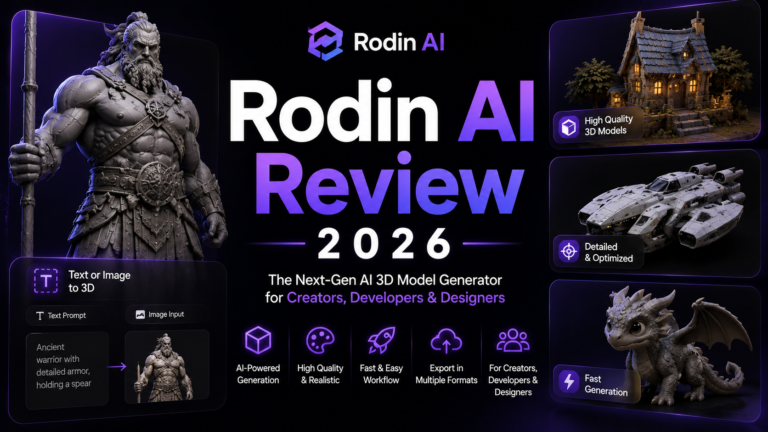
Rodin by Hyper3D uses a 10-billion-parameter Gen-2 architecture that produces the most photorealistic 3D output of any platform on this list, with anatomical precision for characters and surface detail fidelity for organic shapes that other platforms’ lighter models do not match. For cinematic pre-visualization, high-fidelity character development, and photorealistic product rendering, Rodin delivers a quality ceiling that justifies its premium pricing over Meshy and Tripo.
Key features: 10 billion-parameter Gen-2 architecture for photorealistic output, text-to-3D and image-to-3D with 4K PBR textures, high-fidelity character generation with anatomical accuracy, AI-assisted pose correction and expression mapping, and API for automated production pipelines.
Pros: Best raw photorealism and anatomical detail for characters and organic shapes; 4K PBR textures from generation; API for automated batch workflows; strong for cinematic pre-visualization and product visualization.
Cons: Highest price point on this list; mesh optimization targets visual rendering rather than printing or real-time game engine performance, requiring significant repair for 3D printing or animation workflows; no built-in animation or rigging.
Pricing: Free tier available; paid plans from approximately $99/month. Verify current pricing at hyper3d.ai.
6. Kaedim
Best for game studios and production pipelines where AI generation is reviewed and cleaned by human artists before delivery of production-ready topology.
Kaedim occupies the highest-service tier in this comparison: it is not a self-serve generation tool but a workflow that combines AI generation with human artist review to deliver production-ready topology for game pipelines. For studios where the gap between AI-generated mesh quality and production-ready asset quality must be guaranteed rather than managed by the developer, Kaedim’s human-in-the-loop model provides that guarantee at a price that reflects it.
Key features: Image-to-3D and text-to-3D generation, human artist topology review and cleanup, production-ready mesh delivery, export in GLB, GLTF, OBJ, FBX formats, and team collaboration features.
Pros: Human artist review provides production-quality guarantee that fully automated tools cannot offer; final topology is reviewable and production-ready; appropriate for studios where asset quality consistency is a hard requirement.
Cons: Starting price of approximately $120 per month is significantly higher than self-serve alternatives; not suitable for rapid iteration and ideation where generation speed and credit economy matter; demo access rather than immediate self-serve trial.
Pricing: Starting from approximately $120/month; contact Kaedim for current pricing.
7. Sloyd
Best for indie game developers who need unlimited parametric game-ready asset generation with real-time customization controls rather than diffusion-based open-ended generation.
Sloyd takes a fundamentally different approach from every other tool on this list: it combines generative AI with parametric templates, allowing users to generate assets and then refine them in real time using sliders, proportion controls, and structured parameters. Unlike fully automated diffusion-based generators that produce unpredictable outputs from open-ended prompts, Sloyd’s parametric approach produces structured, clean topology that can be refined predictably. The Sloyd.ai pricing comparison identifies it as the only 3D AI platform that grants unlimited generation without credit tokens on paid plans, making it the most cost-efficient choice for high-volume game asset production without per-generation budget management.
Key features: AI-assisted parametric 3D generation with real-time slider customization, text-to-3D and image-to-3D within parametric constraints, Sloyd 2.0 with render images and lighting controls, game-ready optimized topology with automatic UV unwrapping, and GLB, FBX, OBJ, and STL export.
Pros: Unlimited generation on paid plans without credit tokens; parametric approach produces predictable, structured topology; real-time customization controls allow iterative refinement; Starter plan is free with meaningful generation access.
Cons: Parametric approach limits outputs to within template library constraints, unlike diffusion models that generate from arbitrary descriptions; less suitable for highly detailed characters or complex scenes outside the template set; commercial 3D printing rights require license verification before selling prints.
Pricing: Free (Starter); Plus approximately $11/month (annual) or $15/month (monthly). Verify at sloyd.ai.
Frequently Asked Questions
Are AI-generated 3D models actually production-ready in 2026, or do they always need cleanup?
For most game prop and hard-surface asset use cases, AI-generated 3D models from Meshy-6 and Tripo Smart Mesh reached a production-ready threshold in early 2026 for a meaningful proportion of outputs without cleanup. Independent testing cites a 97 percent slicer pass rate for Meshy-6 on figurines, and game prop outputs from both platforms regularly import to Unity and Unreal without modification for textures and scale. The exceptions are consistent and documented: hero character faces and hands frequently require Blender cleanup for distorted features; the organic topology required for high-deformation character animation still benefits from manual retopologizing; and photorealistic rendering close-up on fine detail still trails manual artist work. The practical workflow that independent analysis consistently recommends: generate 80 percent of the way there in Meshy or Tripo in under two minutes, then invest the remaining 20 percent of manual time in the elements that matter most for the specific use case.
Which platform offers the best free plan, and what can I actually do with it?
Tripo’s free plan at 300 credits per month is the most generous in the comparison by credit volume, offering approximately 30 to 60 textured model generations per month depending on model complexity and generation settings. Meshy’s free plan at 100 credits per month covers approximately 5 to 10 high-quality Meshy-6 Preview textured models per month. Sloyd offers a free Starter tier with template-based generation without a credit ceiling. Luma AI and Spline both provide free access to their core generation features with limitations on volume and commercial use. Important commercial license note that multiple independent sources flag: Meshy and Tripo free tier exports carry non-commercial license restrictions, meaning models generated on those free plans cannot be used in commercial products without upgrading to a paid plan. Sloyd also excludes commercial 3D printing rights by default. For any commercial use case, verify the specific license terms for the exact tier before generating assets intended for deployment or sale.
What is the difference between AI 3D generators and parametric 3D tools, and when does each apply?
AI 3D generators in this comparison, including Tripo, Meshy, Luma, Rodin, and Kaedim, use diffusion models or neural reconstruction approaches to generate novel 3D geometry from text descriptions or reference images. They can in principle generate any shape described in a prompt, but output quality varies with prompt specificity and asset complexity. Parametric 3D tools like Sloyd combine AI assistance with structured templates and slider controls: the user customizes within a parametric system rather than describing anything from scratch. The practical choice between them is creative freedom versus predictability. For asset types where variety, originality, and arbitrary shape generation matter, diffusion-based generators produce outputs that parametric tools cannot. For asset types where consistent, structured topology and real-time refinement without quality variance matter, parametric tools like Sloyd provide more predictable results and unlimited volume without the credit management that diffusion tools require.
Final Recommendation
For most game developers, XR creators, and 3D content producers, the choice in 2026 is between Tripo AI and Meshy AI as the primary tools, with specific secondary tools for specialized use cases.
Choose Tripo AI if: Speed and iteration volume are the primary constraints. Tripo’s 10-second Smart Mesh generation with structured quad topology and 300 monthly free credits enables exploration of many prompt variations per session. Tripo’s 40 percent annual discount makes it the more economical choice for cost-sensitive developers who prioritize speed and credit volume over animation pipeline completeness.
Choose Meshy AI if: The complete pipeline matters more than generation speed. Meshy’s 500-plus animation presets with auto-rigging, Bambu Studio 3D printing integration, full PBR texturing with retexturing capability, and seven native DCC plugins create an end-to-end workflow that Tripo does not replicate at the same completeness level. For indie game developers producing animated characters, Meshy Pro at $20 per month replaces a freelance asset budget that previously ran $1,000-plus per month.
Choose Luma AI for photorealistic environment generation and product visualization where spatial quality is the primary criterion.
Choose Spline for browser-native interactive 3D in web products without a game engine.
Choose Rodin for the highest fidelity character and organic shape output where photorealism justifies the premium.
Choose Kaedim for production pipelines where human artist review is required for topology guarantee.
Choose Sloyd for unlimited high-volume parametric game asset generation without credit management overhead.
Start with the free tier of Tripo AI or Meshy AI and test both on the specific asset types your workflow requires. The choice between them is clearer after generating 10 to 20 real assets from each than after reading any comparison article.