Replit AI Review 2026: The Best AI Coding Environment for Beginners or Just Overhyped?
Replit raised $250 million in January 2026, reaching a $3 billion valuation. That is roughly triple its 2023 valuation of $1.16 billion, a trajectory driven entirely by one bet: that the largest market for AI coding tools is not senior engineers. It is the hundreds of millions of people who have an idea, some business problem, or a product vision, and no programming background to execute it.
Replit is not trying to be a better IDE for professional developers. It is trying to make the question “can I build this?” answerable by anyone with a browser and the ability to describe what they want in plain English. Agent 3, the autonomous coding agent that builds full-stack applications from natural language prompts, is the product expression of that bet. The February 2026 pricing overhaul, which retired the old Hacker and Teams tiers and introduced Core at $25 per month and Pro at $100 per month, signals that Replit is now monetizing that market seriously.
Whether it deserves the hype depends entirely on who you are. For beginners, non-technical founders, and anyone who wants to go from idea to deployed app without touching a local development environment, Replit in 2026 is genuinely impressive. For experienced developers who already have sophisticated local workflows with Cursor or GitHub Copilot, Replit’s value proposition is less obvious and the credit cost structure requires attention before committing.
Plan Comparison Table
| Plan | Best For | Starting Price | Free Trial |
|---|---|---|---|
| Free (Starter) | Students, hobbyists, and anyone evaluating the platform | $0 | Yes (permanent) |
| Core | Individual builders who want full Agent access and consistent cloud compute | $25/month ($20/month annual) | Free tier |
| Pro | Teams of up to 15 building with full collaboration and Turbo mode | $100/month flat ($95/month annual) | Free tier |
| Enterprise | Organizations requiring custom compute, SSO, and compliance controls | Custom pricing | Sales demo |
“Pricing is subject to change. Always verify current pricing on the tool’s official website before purchasing.”
What Replit AI Is
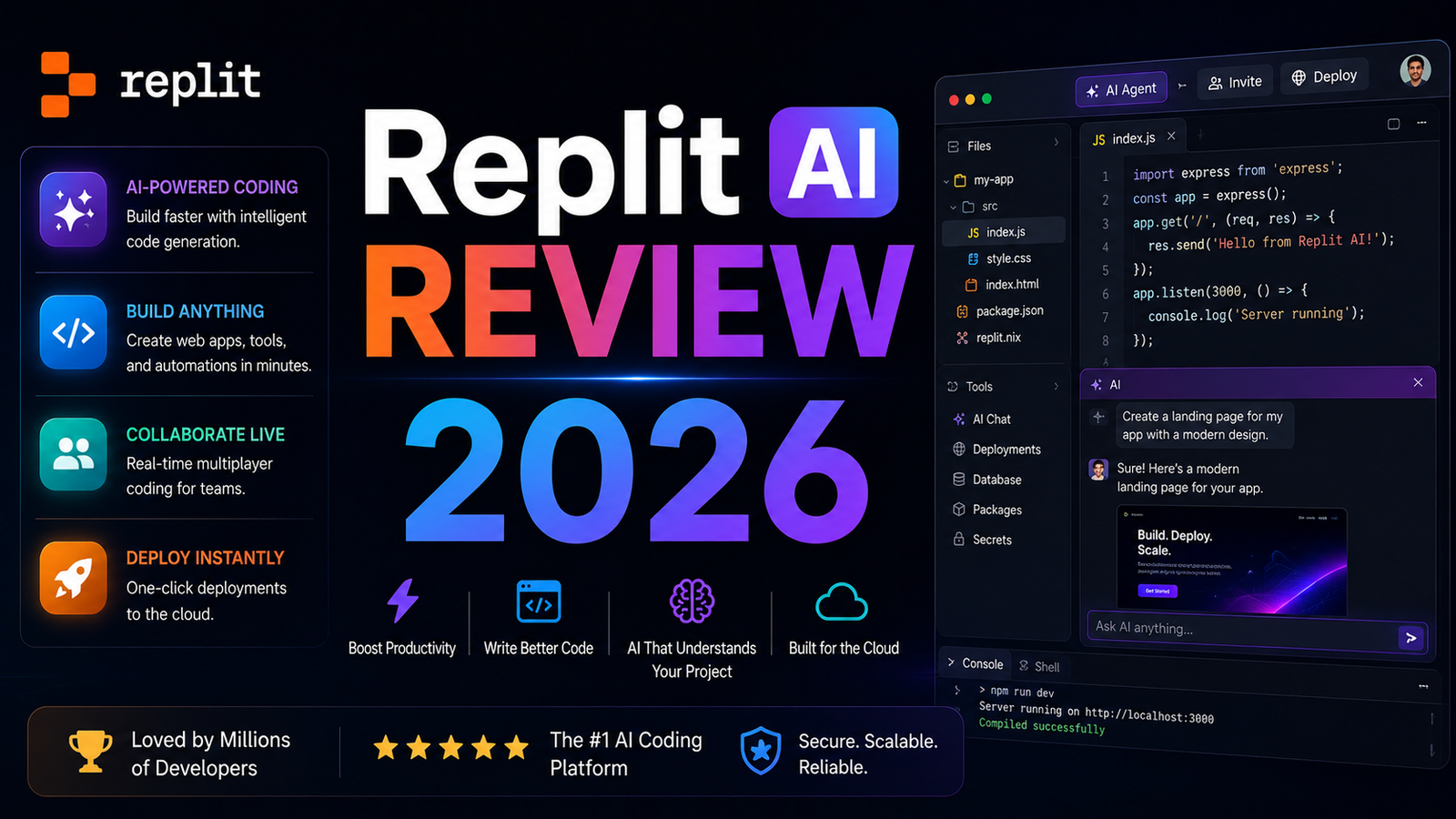
Replit is a cloud-based development platform that runs entirely in the browser. There is no local installation, no environment setup, no package manager configuration, and no deployment pipeline to configure manually. You open a browser, describe what you want, and Replit Agent builds it in the cloud.
The platform has existed since 2016 as an online IDE for learning and quick prototyping. The pivot to AI-first in 2024, following a round of layoffs, repositioned it entirely. In 2026, Replit’s primary identity is not a cloud IDE. It is an AI app builder where Agent 3 takes natural language input and produces working, deployed, full-stack applications covering frontend, backend, database, and hosting in a single workflow.
Replit is primarily aimed at three user profiles. Non-technical founders who want to prototype and deploy product ideas without hiring a developer. Students learning to code who want to skip environment setup complexity and focus on actually building. Experienced developers who want the fastest path from concept to deployed MVP, particularly for side projects and internal tools.
Key Features
Agent 3 with effort-based pricing. Replit’s autonomous Agent takes a natural language prompt and builds a complete application, handling framework selection, file structure, component creation, database provisioning, and deployment. Agent 3, the current version as of 2026, is measurably more capable than earlier versions on multi-step application scaffolding. It supports React, Next.js, Flask, Django, Express, and dozens of other frameworks. The Agent handles debugging iterations automatically, attempting to fix its own errors before flagging issues for user input.
Effort-based pricing replaced the flat per-checkpoint model in mid-2025. Simple tasks cost less than $0.25 in credits. Complex multi-component implementations cost proportionally more based on the actual work done. This is more fair than the flat model but requires monitoring during large projects, where a single ambitious prompt can consume a significant portion of the monthly credit allocation before producing usable output.
Mobile development support (early 2026). In early 2026, Replit expanded Agent’s capabilities to include React Native and Expo projects. Mobile apps can be scaffolded by the Agent and tested instantly on a phone using the Expo Go app without additional configuration. For non-technical founders who want a mobile app alongside their web application, this addition closes a gap that previously required a separate workflow.
Built-in database, deployment, and hosting. Every Replit project includes PostgreSQL and SQLite databases provisioned automatically, built-in deployment infrastructure, and hosting managed by the platform. The “build and deploy with one click” description is genuinely accurate for standard web applications. No external database configuration, no cloud provider account setup, no CI/CD pipeline construction. For users who do not know what any of those things are, this integrated infrastructure is the feature that makes Replit meaningfully different from tools that provide code generation without deployment.
Ghostwriter code completion. Alongside the Agent, Ghostwriter provides real-time inline code completion and chat assistance within the IDE. For users who prefer to write code themselves with AI assistance rather than delegating entire tasks to the Agent, Ghostwriter functions as the always-on coding companion. It is less powerful than Cursor‘s Supermaven completion engine for experienced developers, but competent for learning and light individual coding tasks.
MCP integrations for external services. Replit supports Model Context Protocol integrations, allowing direct connection to external services including OpenAI, Stripe, Google Workspace, and others within the development environment. For building applications that need third-party API integrations, MCP reduces the configuration work from the developer-facing boilerplate.
Real-time multiplayer collaboration. Multiple users can edit the same Replit project simultaneously. Core allows up to 5 collaborators; Pro supports 15 builders plus 50 viewers. For pairs and small teams building together, this real-time collaboration removes the Git workflow overhead that slows down non-technical collaborators.
Pros and Cons
Pros:
- Zero setup barrier: browser-based environment eliminates every environment configuration step that stops beginners from shipping
- Agent 3 builds complete full-stack applications including database and deployment from a single natural language prompt
- Mobile development support added early 2026 extends the platform beyond web apps
- Effort-based credit pricing is fairer for users who do most tasks in standard modes and only pay for complexity when they need it
- Real-time multiplayer collaboration makes pair programming accessible without Git workflow knowledge
- Integrated hosting, database, and deployment removes the infrastructure layer that is the second-largest barrier after code itself
- Strong beginner and student community with curriculum integrations and active support channels
Cons:
- Credit consumption on Agent-heavy projects can exceed monthly allocations before the project is complete; unused credits expire on Core, creating use-it-or-lose-it pressure
- Independent analysis shows typical 3 to 5x cost multipliers from usage overages when using AI Agent features intensively
- Performance limitations on free and Core plans for compute-intensive applications; sustained workloads that require dedicated server resources are not well served
- Agent can occasionally delete working code when implementing changes; always create checkpoints before major Agent-driven modifications
- Not the right tool for experienced developers building production applications where Cursor’s agentic depth, local environment control, and code ownership are priorities
- The Pro plan at $100 per month flat for up to 15 builders sounds economical but is best evaluated against actual projected credit consumption rather than user count alone
Pricing Breakdown
Replit’s February 2026 pricing overhaul retired the Hacker and Teams tiers and introduced the current structure. Understanding credits is essential before committing.
Free (Starter): $0. Basic IDE access, 50 languages and frameworks, 1 published app, limited daily Agent credits, and 1,200 minutes of development time per month. Sufficient for evaluating the platform and for light student use. Not sufficient for regular Agent-driven application building.
Core: $25/month ($20/month annual). Full Agent access, $25 in monthly usage credits, larger compute and memory allocations, private projects, 5 real-time collaborators, and access to the Pro tier discount on additional credit purchases. This is where most individual builders land for regular use. Credits do not roll over on Core; unused credits expire at the end of each billing cycle.
Pro: $100/month flat ($95/month annual). Full access for up to 15 builders and 50 viewers, $100 in monthly credit pool, Turbo mode for faster Agent execution, credit rollover for one month on unused credits, priority support, and tiered discounts on additional credit purchases. For small teams building together, the flat $100 rate compares favorably to per-seat tools if the team is actively building and consuming credits.
Enterprise: Custom pricing. Custom compute allocations, SSO, compliance controls, dedicated support, and organizational billing. Contact Replit for current enterprise rates.
Credit costs: Agent usage is effort-based. Simple tasks cost under $0.25 in credits. Complex multi-component implementations cost proportionally more. Independent analysis shows Core’s effective compute cost at approximately $0.125 per hour, which is 31 percent cheaper than GitHub Codespaces’ two-core tier, though this comparison understates the Agent credit layer that adds real cost beyond baseline compute.
The honest billing caveat: several user reviews describe significant billing surprises from Agent-intensive sessions that consumed monthly credits before projects were complete, with no warning during the session. Monitor the credit dashboard actively during large Agent projects and purchase additional credits before starting a multi-day build rather than running out mid-implementation.
How It Compares to Cursor and GitHub Copilot
The most important context for this comparison: Replit is not primarily competing with Cursor and GitHub Copilot for the same users. The tools serve genuinely different audiences and the comparison is most useful for developers who are deciding whether Replit replaces or complements their existing setup. For a direct head-to-head between those two tools, see our Cursor vs GitHub Copilot 2026 analysis.
Replit vs Cursor
Cursor is built for experienced developers who want the most capable agentic multi-file coding environment available within a local IDE. It requires VS Code familiarity, rewards a 1 to 2 week investment in learning Composer 2 and Background Agents, and produces the most capable autonomous multi-file implementation of any consumer coding tool. Replit is built for users who want to skip the IDE entirely and arrive at a deployed application faster.
For an experienced developer, Cursor’s agentic depth, local code ownership, .cursorrules customization, and multi-model flexibility produce better production-grade code with more control. For a non-technical founder, Replit’s zero-setup cloud environment with integrated deployment gets them to a working prototype without any of the prerequisite knowledge Cursor requires.
Replit vs GitHub Copilot
GitHub Copilot operates as an AI extension within your existing IDE. It does not deploy applications, provision databases, or manage hosting. It assists you with code while you remain in control of every infrastructure decision. Replit removes infrastructure decisions entirely in exchange for less control over how those decisions are made.
For a student learning to code, Replit’s integrated environment produces deployed applications faster and removes the environmental friction that stops many beginners before they write their first working function. Copilot’s strength, assistive code completion within an IDE, requires the student to have already navigated environment setup. For a professional developer, Copilot’s lower cost ($10 per month), broader IDE support, and SWE-bench accuracy advantage make it the more efficient daily coding assistant.
Frequently Asked Questions
Is Replit genuinely good for complete beginners with no coding background?
Yes, and this is where Replit’s 2026 improvements are most evident. The zero-installation browser-based environment removes the setup barrier that stops most beginners before they write a single line. Agent 3’s ability to produce working deployed applications from plain English descriptions means beginners can see results within the first session rather than spending weeks on environment setup, syntax learning, and deployment configuration. The platform’s integrated database and hosting means a beginner can build and share a functional web application without ever learning what a cloud provider, DNS record, or deployment pipeline is. The caveat is that applications built entirely by Agent without user understanding of the code produced are difficult to maintain, debug, or extend when Agent-generated code fails in unexpected ways. For beginners who want to build and ship, Replit is excellent. For beginners who want to actually learn programming, the Agent’s magic-box quality can substitute for understanding rather than building it.
How does the credit system work in practice, and how do I avoid billing surprises?
Monthly credits are the most misunderstood aspect of Replit’s pricing. The $25 monthly credit pool on Core covers a certain volume of Agent operations, compute time, and deployments. Effort-based Agent pricing means simple tasks consume under $0.25, while complex multi-component builds cost proportionally more. The billing surprise scenario documented in multiple user reviews involves starting a large Agent project, iterating extensively with the Agent through multiple cycles of generation and refinement, and consuming the monthly credit allocation before the project reaches a deployable state. Unused credits expire on Core at the end of each billing cycle. The practical mitigation is purchasing additional credits before starting a large project rather than after running out, monitoring the credit dashboard actively during Agent-intensive sessions, and using checkpoints before each major Agent operation so you can recover to a working state if credits run low mid-build.
Should experienced developers use Replit instead of their existing Cursor or Copilot setup?
Not as a replacement, but potentially as a complementary tool for specific use cases. The developers who describe Replit adding genuine value to their existing workflow are those who use it specifically for rapid prototyping of new ideas rather than for production development. The integrated deployment and hosting means a prototype built in Replit is shareable within an hour, whereas building the same prototype locally and deploying it takes significantly longer even for experienced developers. For production codebases, professional teams, and applications requiring precise control over infrastructure, security, and code quality, Cursor or Copilot with a local development environment remains the more appropriate choice. The hybrid approach that several developers describe is using Replit for initial concept validation and rapid stakeholder demos, then migrating the architecture to a local development setup for production development once the concept is confirmed.
Final Verdict
Replit AI in 2026 earns its $3 billion valuation from the market segment it actually serves. For non-technical founders, students, and anyone who needs to go from idea to deployed prototype without navigating the developer toolchain, Replit Agent 3 is the best available path. The zero-setup environment, integrated infrastructure, and natural language to deployed application workflow solve real problems for a real and large audience.
The hype is earned for that audience. For experienced developers comparing Replit to their existing tools, the picture is more nuanced. Cursor’s agentic depth, local environment control, and code precision exceed what Replit offers for production development. GitHub Copilot’s lower cost and IDE flexibility serve the daily coding assistance use case more efficiently. Replit is not overhyped for the users it was designed to serve. It is mismatched when positioned against professional developer tools as a direct substitute.
Start on the free Starter plan to evaluate Agent quality on the type of application you want to build. Upgrade to Core at $20 per month (annual) if the Agent consistently produces useful output on your use cases and you are hitting the free tier’s daily credit limits. Purchase additional credits before large Agent-intensive projects rather than waiting to run out mid-build. For experienced developers evaluating whether to replace your current setup, the more informative comparison is our Cursor AI Review 2026, which covers the deepest professional AI coding environment currently available.
Rating: 4.0 / 5 — Best AI coding environment for beginners and non-technical builders. Good supplementary prototyping tool for experienced developers. Not a replacement for Cursor or Copilot in production development workflows.