3D AI Studio Review 2026: A Cheaper All-Rounder for AI 3D Modeling?
The case for 3D AI Studio in 2026 is stated clearly on its own pricing page: access to Rodin/Deemos photorealistic models for client presentations at $29 per month versus Rodin’s $99 per month. Same 4K quality, better value. That framing is the platform’s clearest competitive angle, and it is not inaccurate. 3D AI Studio provides API access to multiple underlying generation models, including Rodin, under one subscription rather than requiring separate platform accounts for each model.
The honest review of that pitch is: it works, with caveats. The multi-model access is real. The generation quality on favorable inputs is competitive. The all-in-one workflow from text or image prompt through texturing, remeshing, LOD generation, and export to game engine formats covers more of the production pipeline than most tools at comparable pricing. What the platform does not deliver is the polished workflow tooling, animation capabilities, or the quality ceiling on challenging inputs that category leaders Meshy and Tripo provide.
For indie developers, freelancers, and 3D printing enthusiasts who want capable all-around AI 3D generation at the lowest sustainable subscription price, 3D AI Studio is a defensible choice. For game studios that need animated characters and production-polish beyond what the AI generates, the dedicated platforms remain the more complete solutions.
Plan Comparison Table
| Plan | Best For | Starting Price | Free Plan |
|---|---|---|---|
| Free / Trial | Testing generation quality before subscription commitment | $0 (sign-up credits) | Yes (limited credits) |
| Basic | Individual creators doing regular generation at accessible price | ~$19/month (~1,000 credits) | No |
| Studio | Active creators needing higher volume and broader model access | ~$29/month (~3,500 credits) | No |
| One-time purchase | Occasional users who want non-expiring credits for project work | $29 one-time (non-expiring credits) | No |
| Enterprise | Studios needing API access and higher volume | Custom pricing | No |
“Pricing is subject to change. Generation costs approximately 25 credits for standard text-to-3D and image-to-3D; remeshing, AI texturing, and premium model access may consume additional credits. The $29 one-time purchase provides non-expiring credits, unlike monthly plans where unused credits expire at period end. Always verify current pricing at 3daistudio.com before purchasing.”
What 3D AI Studio Is
3D AI Studio is a browser-based AI 3D generation platform that aggregates multiple AI generation models under one interface rather than building a single proprietary model. The platform provides access to different underlying AI engines, including the Rodin/Deemos photorealistic model, alongside its own generation pipelines. Users can choose which AI model to use for each generation task based on the asset type and quality requirements.
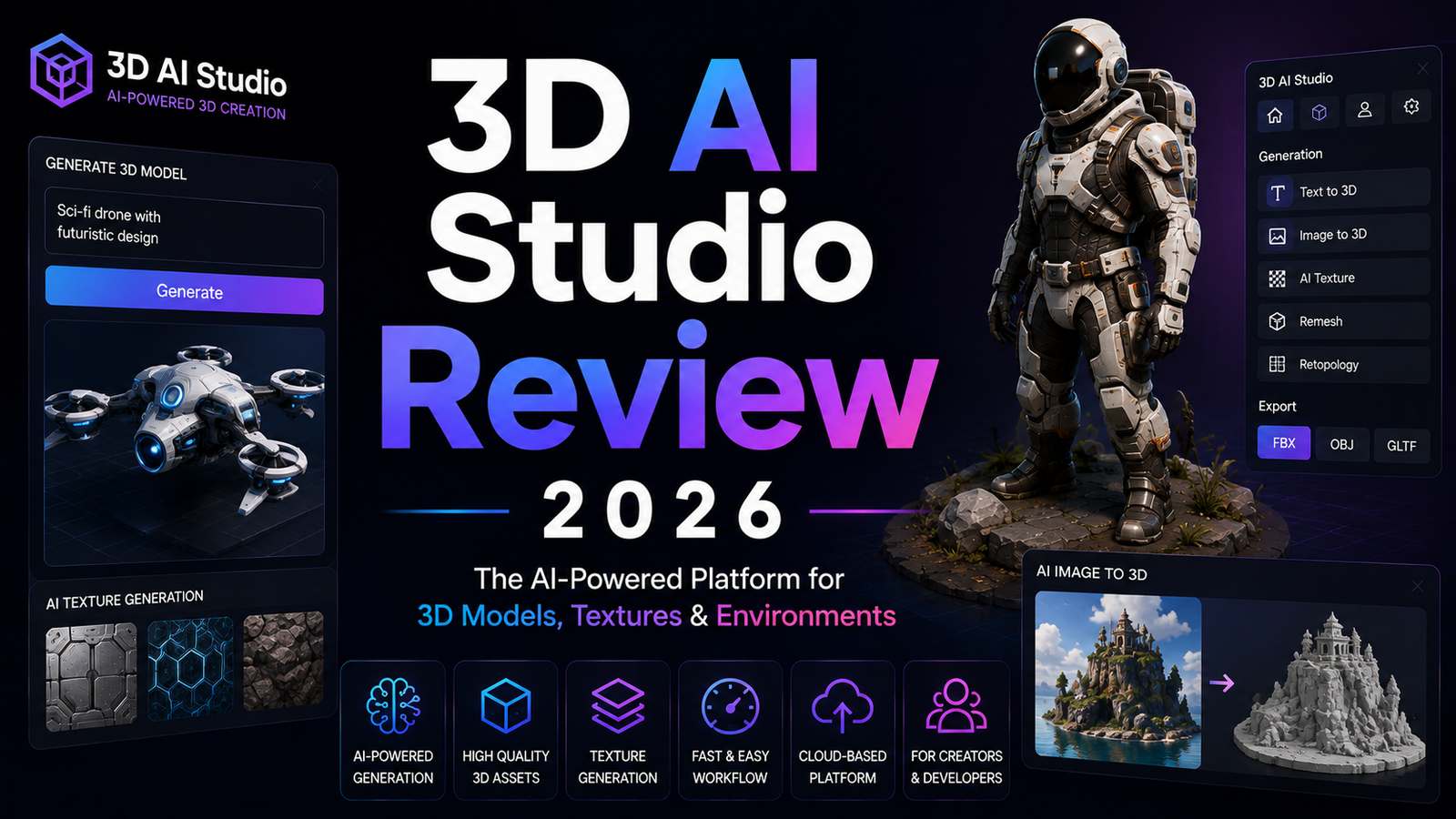
The platform positions itself as a complete 3D workspace covering the full pipeline from initial generation through texturing, remeshing, LOD generation, and export to game engine-compatible formats. Generation happens in the browser without local software installation, and outputs export in FBX, OBJ, STL, GLB, and USDZ formats compatible with Unity, Unreal Engine, Godot, Blender, and Three.js web applications.
The target user profile from independent reviews is game developers, indie creators, 3D hobbyists, product visualization teams, and 3D printing enthusiasts who want broad AI 3D generation capability at a subscription cost below dedicated platforms like Rodin, Meshy, or Tripo. The multi-model access approach differentiates it from single-model platforms by allowing different AI engines for different tasks within the same subscription.
Key Features
Multi-model AI generation including Rodin access. The platform’s most distinctive capability is providing access to multiple AI generation models within a single subscription, including the Rodin photorealistic model that costs $99 per month on Rodin’s own platform. For creators who need photorealistic quality on select hero assets without a dedicated Rodin subscription alongside other generation tools, this bundled access at $29 per month represents genuine cost savings on the photorealistic use case. Different models perform differently by asset type; the multi-model approach allows selecting the most appropriate AI engine per generation rather than being locked to one model’s strengths and weaknesses.
Text-to-3D from natural language descriptions. Describe an object in text and 3D AI Studio generates the corresponding mesh with textures. The platform performs well on common objects with strong training data: furniture, vehicles, tools, weapons, and standard architectural elements generate with recognizable proportions and believable textures from clear prompts. Generation takes under a minute on most asset types. Where the AI struggles is on highly specific objects outside the training distribution, complex mechanical assemblies with multiple moving parts, and outputs requiring precise aesthetic control beyond what prompt engineering achieves.
Image-to-3D from concept art and reference photos. Upload a concept art image, character sheet, product photo, or sketch and 3D AI Studio reconstructs a 3D mesh from the 2D input. Multiple independent reviews identify image-to-3D as the platform’s strongest generation mode, producing the most impressive results when fed clean, well-lit images with clear subject separation from background. The quality caveat documented consistently: poorly lit photos, cluttered backgrounds, and images with ambiguous depth information produce mangled or inaccurate geometry. Image quality dramatically affects output quality.
AI texturing and PBR material generation. Generated meshes can be textured with AI-generated PBR materials covering albedo, roughness, and metallic maps for physically-based rendering in game engines. The texturing step is available as a separate operation from generation, allowing retexturing of imported external meshes alongside the platform’s own generated models.
Quad remeshing and mesh optimization. The quad remeshing feature converts the triangle mesh output of AI generation into structured quad topology for animation, subdivision, and cleaner DCC tool import. For game animation workflows where deformation-friendly edge flow is required, the remesh step produces topology that raw AI generation does not automatically deliver. LOD generation creates multiple polygon-count variants for different rendering distances without requiring manual reduction in Blender.
Export compatibility across major game engines. FBX, OBJ, STL, GLB, and USDZ exports cover Unity, Unreal Engine, Godot, Blender, Three.js, and major 3D printing slicers. The USDZ export enables AR Quick Look on iOS devices without format conversion. Less common formats including FBX and COLLADA were noted in one review as requiring beta program access through settings, suggesting format availability varies by account configuration.
Built-in 2D image generation for concept art. The platform includes AI image generation for producing 2D concept art within the same workflow before moving to 3D, eliminating the context switch to a separate image generator for reference image creation.
Pros and Cons
Pros:
- Multi-model access including Rodin photorealistic generation at $29 per month provides quality options that would cost significantly more via dedicated platform subscriptions
- All-in-one workflow from generation through texturing, remeshing, LOD generation, and export within a single browser interface reduces tool-switching overhead
- One-time purchase option at $29 for non-expiring credits is the most accessible entry point for occasional users who do not want a recurring subscription
- Image-to-3D from concept art is the consistently strongest generation mode, producing usable base meshes from clean reference images
- Multiple export formats including FBX, GLB, OBJ, STL, and USDZ cover most game engine and 3D printing pipeline requirements
- Subscriptions start approximately 30% cheaper than main market competitors at comparable generation volume according to independent pricing analysis
- Free sign-up credits allow quality evaluation before any payment commitment
Cons:
- No built-in animation or auto-rigging at any plan tier; 3D characters require external Blender or Maya rigging for any animation workflow, which is the most significant gap versus Meshy AI’s 500-plus animation presets
- Generation is all-or-nothing with no mid-process steering; once a generation starts, output cannot be adjusted mid-computation, wasting credits on obviously wrong outputs that are only discoverable at completion
- Complex inputs, highly specific objects outside the training data, multi-part mechanical assemblies, and stylized art requiring precise aesthetic control produce inconsistent results across all generation modes
- FBX and COLLADA format access reportedly requires beta program enrollment through settings on some accounts, creating unexpected friction for users assuming universal format availability at subscription
- Output quality on challenging inputs trails the quality ceiling that Meshy-6 and Tripo Smart Mesh deliver in independent comparisons; the platform performs as an all-rounder rather than a category leader
- No native animation rigging means the platform serves concept validation, prop generation, and design visualization better than it serves character animation pipelines
- The multi-model approach means output quality varies depending on which AI model is selected, requiring some experimentation to identify the best model for each asset category
Pricing Breakdown
3D AI Studio’s credit-based pricing produces different effective costs per model depending on which plan tier and generation type is used.
At approximately 25 credits per standard text-to-3D or image-to-3D generation, the Basic plan at roughly $19 per month with approximately 1,000 credits covers roughly 40 generations per month before considering remeshing and texturing credit consumption. The Studio plan at approximately $29 per month with approximately 3,500 credits covers roughly 140 base generations. Per-model cost on the Studio plan works out to approximately $0.17 per model versus $0.38 per model on the Basic plan; the Studio tier is the better value for regular production use.
The $29 one-time purchase with non-expiring credits is the most relevant option for occasional users. Unlike subscription plans where unused credits expire at the billing period end, the one-time credits persist indefinitely. For teams with uneven monthly generation volume or for project-based use cases, this non-expiring structure is more efficient than a subscription that burns unused credits.
Remeshing, high-resolution texturing, and premium model access consume additional credits beyond the base generation cost. A fully remeshed and textured model with LOD generation consumes significantly more than a basic generation, and the effective models-per-month count should be calculated against the specific workflow steps used rather than the base generation credit cost alone.
How It Compares to Tripo AI and Meshy AI
See our full Tripo AI Review 2026 and Meshy AI Review 2026 for complete breakdowns of Tripo AI and Meshy AI.
3D AI Studio positions itself as a more affordable all-rounder. That positioning is accurate at the generation-only level, where multi-model access including Rodin at $29 per month is genuinely cheaper than the dedicated platforms’ equivalent quality output. The gap opens at the workflow depth level.
Tripo AI generates structured quad topology in approximately 10 seconds with 300 free monthly credits and direct engine plugin integration for Blender, Unity, Unreal, and Cocos. The generation speed advantage is significant for rapid iteration workflows. Meshy AI provides the complete pipeline including auto-rigging and 500-plus animation presets at $20 per month, covering the animated character production pipeline that 3D AI Studio does not address at any tier.
For game developers who need animated characters, Meshy AI is the more appropriate platform regardless of price comparison. For developers focused on props, environments, and design visualization where animation is not required, 3D AI Studio’s multi-model access and broader generation pipeline competes more directly.
The practical recommendation from independent analysis is that 3D AI Studio fits as an accessible all-rounder for teams that need generation quality range without animation requirements, while Tripo AI and Meshy AI remain the more specialized and capable choices for their respective strengths in speed and animated character pipelines.
Frequently Asked Questions
Does the multi-model access including Rodin actually save money compared to dedicated platform subscriptions?
For specific use cases, yes. The Rodin photorealistic model accessed through 3D AI Studio at the $29 Studio plan produces results comparable to what Rodin’s own Creator plan at $30 per month provides, while bundling additional generation models and workflow tools under the same subscription. For a creator who needs photorealistic quality on occasional hero assets but primarily uses standard generation for supporting content, 3D AI Studio’s multi-model approach at a comparable price covers both use cases. The saving is more significant if the alternative is maintaining separate subscriptions to Rodin for photorealistic work and another platform for standard generation. The caveat is that credit consumption rates for premium model access may reduce the effective generation volume per month compared to what the plan’s total credit count suggests.
How does the all-or-nothing generation approach affect workflow efficiency compared to platforms with mid-process controls?
The lack of mid-process steering is one of the most cited practical limitations in independent reviews. Once generation starts, there is no way to adjust the direction or cancel if the output is clearly heading in an unwanted direction. Credits are consumed regardless of whether the output is usable. For complex or highly specific generation tasks where the first attempt is statistically unlikely to produce exactly the right output, this all-or-nothing approach produces credit waste that platforms with iterative generation controls avoid. The practical mitigation is prompt testing with cheaper or lower-resolution generation options before committing full credits to a final quality generation, and maintaining realistic expectations for challenging inputs where multiple attempts are the norm rather than the exception.
What types of 3D projects does 3D AI Studio handle best, and what should teams use a different platform for?
Common objects with clear training data, furniture, vehicles, weapons, tools, architectural elements, and standard game props generate reliably from text prompts. Image-to-3D from clean reference photos is the consistently strongest generation mode across independent reviews, producing usable base meshes for concept art and product visualization workflows. Where the platform is less reliable: highly specific or stylized objects outside the training distribution, complex mechanical assemblies, and any workflow requiring precise aesthetic control. For character animation specifically, the absence of auto-rigging and animation presets makes 3D AI Studio a concept validation tool rather than a production character pipeline. For teams whose primary needs are prop generation, design visualization, e-commerce product modeling, and 3D printing preparation, the all-in-one workflow and multi-model access cover the requirement at accessible pricing. For teams building animated character pipelines, the animation gap is fundamental and Meshy AI’s auto-rigging at $20 per month is the more appropriate starting point.
Final Verdict
3D AI Studio is a capable, affordable all-rounder for teams that need multi-model AI 3D generation without the animation pipeline that dedicated platforms provide. The multi-model access including Rodin photorealistic generation at $29 per month is the platform’s clearest competitive advantage, offering quality options that cost significantly more on dedicated platform subscriptions. The quad remeshing, LOD generation, and all-in-one pipeline from generation through export cover more of the production workflow than most tools at comparable pricing.
The limitations are specific and should guide whether the platform is the right tool for each team’s primary use case. No animation or auto-rigging means character animation requires external tools. All-or-nothing generation without mid-process controls wastes credits on failed complex outputs. Quality on challenging inputs trails the category leaders in independent comparisons. And format availability inconsistency suggests the platform is still maturing toward the polish that more established alternatives provide.
For the indie developer, freelancer, and 3D printing enthusiast who needs reliable general-purpose AI 3D generation at accessible pricing without animation requirements: 3D AI Studio’s Studio plan at $29 per month, or the one-time $29 non-expiring credit purchase for occasional use, is a defensible value choice.
For game studios needing the fastest generation with clean topology, see our Tripo AI Review 2026. For the complete pipeline including animated characters, see our Meshy AI Review 2026.
Rating: 3.9 / 5 — Affordable multi-model all-rounder for prop generation and design visualization. Gaps in animation and mid-process control limit production pipeline suitability.
Disclosure: This article contains affiliate links.