HeyGen vs Tavus 2026: Which AI Video Tool Fits Your Team?
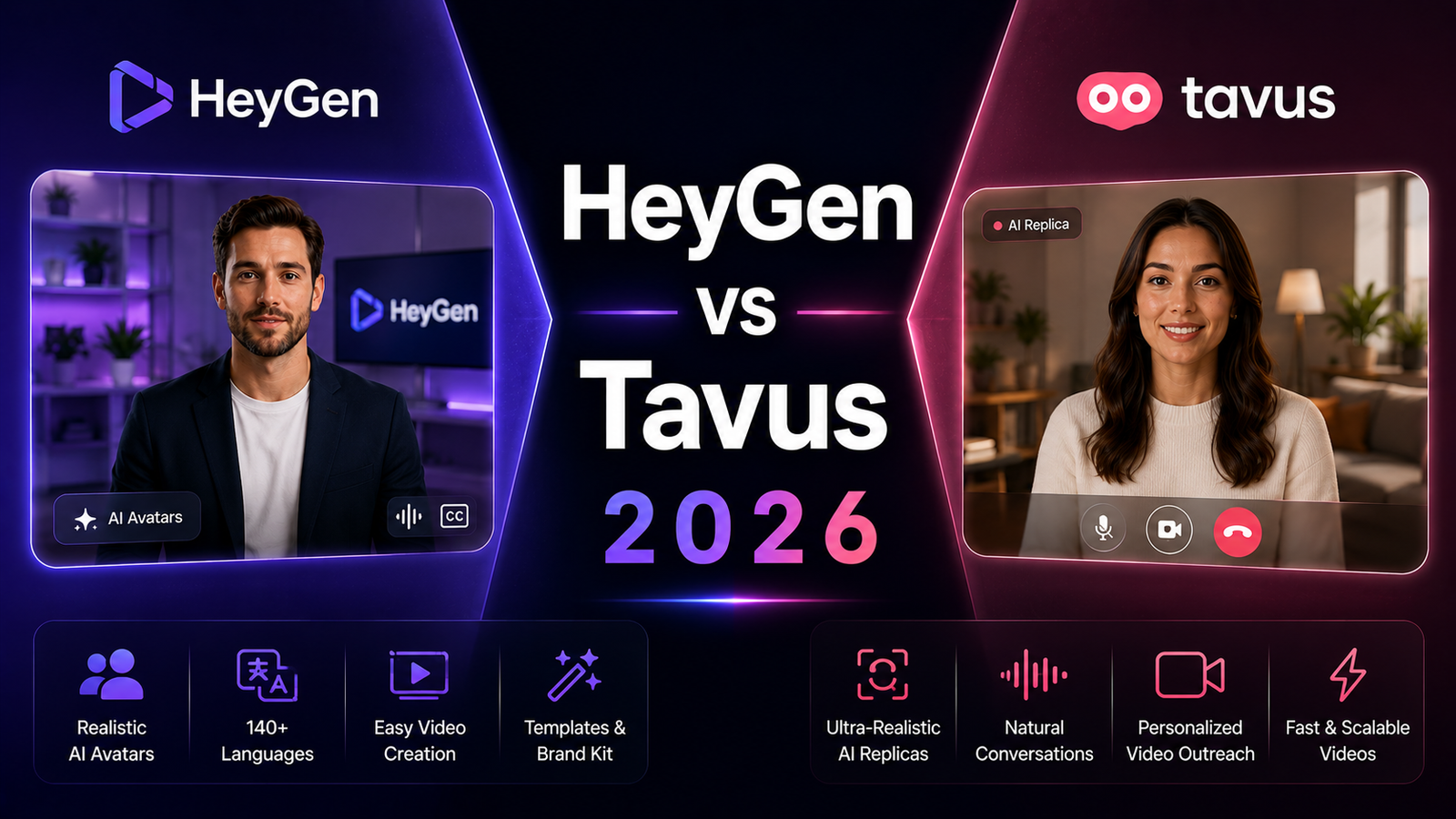
HeyGen and Tavus are the two names that come up most often when a team gets serious about personalized AI video and digital-twin creation. They overlap enough to feel like direct competitors, and they get compared constantly. But the moment you look past the shared category label, the real distinction is not about which one makes better avatars. It is about who is meant to use them.
Here is the split in one line. HeyGen is the no-code platform for non-developers who need to produce personalized and multilingual video quickly. Tavus is the developer-and-API platform for teams building real-time conversational avatars and programmatic personalization at scale into their own products. That difference, accessibility versus developer depth, decides almost every practical question that follows, and it is the reason most teams do not actually have a hard choice to make once they are honest about their resources.
This comparison walks through where each one wins, so you can match the tool to your team instead of the hype. The short version, which the rest of the piece will support: for the vast majority of teams, HeyGen is the right answer. For developers building conversational video as a product feature, Tavus is purpose-built and worth the added complexity.
Comparison Table
| Feature | HeyGen | Tavus |
|---|---|---|
| Core use case | No-code personalized and multilingual video | Real-time conversational avatars, personalization at scale |
| Ease of use | No-code Studio, web-based | Developer and API focused |
| Personalization at scale | Yes, plus no-code workflow | Yes, programmatic via API |
| Languages | 175+ (up to 300+ with lip-sync) | 30+ |
| Real-time conversational avatars | Yes, Streaming Avatar API | Yes, CVI with Phoenix, Raven, Sparrow models |
| Free tier | Yes, 3 free videos | Yes, developer tier |
| Starting price | ~$29/mo (Creator) | ~$59/mo (developer) |
Pricing is subject to change. Always verify current pricing on the tool’s official website before purchasing.
Who Each Tool Is For
HeyGen is built for people who need finished, professional video without touching code. That is a huge audience: marketers producing social and product video, sales teams sending personalized outreach, learning-and-development teams building training and onboarding content, and any team that needs the same message localized into many languages. The Studio interface is the whole point. A non-technical person can produce polished, personalized, multilingual video on their first day. HeyGen has become the default AI avatar tool for small and mid-sized businesses precisely because it removes the need for engineering help.
Tavus is built for developers and product teams. Its two core strengths, programmatic personalized video at scale and real-time conversational avatars, are both delivered through an API, and both are aimed at building video into an application rather than producing standalone clips. Tavus is the right call when the conversation itself is the product: a live digital human on a website, an interactive support agent, or a personalized video pipeline triggered automatically by your CRM. These are engineering projects, not content-team tasks.
So the audience question answers most of the decision. If your team makes videos and does not write code, HeyGen is the realistic choice. If your team builds software and needs conversational or programmatic video inside it, Tavus is designed for exactly that.
Ease of Use: No-Code Studio vs Developer API
This is the sharpest practical divide between the two.
HeyGen’s Studio is genuinely no-code. It works more like editing a presentation than programming. You choose an avatar, add your script, pick a language and voice, and preview as you build. Personalized and multilingual video that would normally require either on-camera talent or a developer is something a single marketer can produce in an afternoon. Even HeyGen’s real-time capability, the Streaming Avatar, is packaged to be far more approachable than a raw developer toolkit, and the guided avatar-creation flow captures appearance, voice, and consent in a single short recording.
Tavus is an API-first developer platform. Getting value from it means integrating its API, handling the technical setup, and building the video experience into your own systems. For a developer, this is the appeal, because the API is what unlocks real-time conversation and personalization at volume. For a non-technical team, it is a hard stop. Production deployments are engineering work measured in a sprint, not an afternoon, and the documentation, while capable, can leave developers working through under-documented edge cases on more novel builds.
The rule is simple: if no one on your team codes, HeyGen is the only one of these two you can realistically deploy. If you have developers and the video needs to live inside your product, Tavus gives them the depth they want.
Personalization and Real-Time Avatars
Both tools do personalized video and both offer real-time avatars, but they approach each differently.
On personalization at scale, HeyGen delivers it through a workflow non-developers can actually run, while also offering API access for teams that want to automate. Tavus delivers personalization purely programmatically: push a recording and a dataset to the API, and it generates a unique video for every record. If you want thousands of individualized videos triggered automatically by your CRM with no manual step, Tavus’s pipeline is built for that. If you want personalized video that a marketing or sales team can produce and control without engineering, HeyGen fits better.
On real-time conversational avatars, this is where Tavus’s technical sophistication shows most. Its Conversational Video Interface, powered by its Phoenix, Raven, and Sparrow models, leads on the things that make a live avatar feel real: emotional rendering, turn-taking precision, and multimodal perception. For applications where the quality of the conversation is the entire product, Tavus’s CVI is the more advanced option. HeyGen answers with its Streaming Avatar API, which is more accessible and practical for most teams that want an interactive avatar without building on a research-grade conversational stack, even if it is not as deep on pure conversational fidelity.
The honest read: Tavus wins on raw conversational-avatar sophistication for developers who need it, while HeyGen wins on making both personalization and real-time avatars usable by teams without a research budget.
Language Coverage
This one is not close, and it matters more than teams expect.
HeyGen supports a very large language range, reported at 175 or more languages, with lip-synced translation extending across an even wider set. For any team producing multilingual training, global marketing, or localized customer content, that breadth is a decisive advantage. You can take one video and ship it convincingly in dozens of languages with matched lip movement.
Tavus supports a more modest range, reported around 30-plus languages. For its core use cases, developer-built conversational agents and personalized outbound in a primary market, that is often enough. But if global localization is central to your strategy, HeyGen’s coverage is a real and hard-to-ignore edge.
For most teams weighing the two, if multilingual reach is a requirement, HeyGen wins this category outright.
Video Quality and Total Cost
Both produce strong output, and neither embarrasses itself, but the fit differs.
HeyGen’s avatars, driven by its latest Avatar technology, are widely regarded as among the most natural and expressive in the category, especially for business-headshot and presenter scenarios. For produced marketing, sales, and training video, HeyGen’s realism and consistency are easy to rely on. Tavus’s avatar quality is capable and its digital replicas can be convincing, though independent reviewers note the voice side is where the uncanny valley is most likely to surface. Because Tavus is often deployed programmatically or in live conversation, the bar it needs to clear is different from a hand-produced brand video.
On cost, HeyGen starts lower and more predictably, with a Creator plan around $29 per month and a Business plan stepping up with per-seat pricing for teams. Tavus starts around $59 per month at the developer tier and scales into Growth and Enterprise pricing that can reach into the hundreds per month, with usage-based components for conversational video. An unexpected traffic spike on a deployed conversational avatar can add meaningful overage charges. That variability is the tradeoff for a platform built to power applications rather than produce individual videos.
For most teams, HeyGen is both cheaper and more predictable. For developers whose product depends on real-time conversational video, Tavus’s higher and more variable cost buys a capability HeyGen does not fully match.
Frequently Asked Questions
Do I need to be a developer to use Tavus?
Effectively, yes. Tavus is API-first, and getting real value from it means integrating it into your own application, which requires engineering resources and typically a multi-week setup for production use. HeyGen, by contrast, is fully no-code through its Studio interface, so a non-technical team can produce personalized and multilingual video without writing any code. If your team has no developers, HeyGen is the realistic choice.
Which one is better for multilingual video?
HeyGen, clearly. It supports 175 or more languages with lip-synced translation extending even wider, which makes it the strong pick for global marketing, localized training, and multilingual customer content. Tavus supports around 30-plus languages, which is fine for its core developer and personalized-outbound use cases but well behind HeyGen if localization is central to your needs.
Is Tavus’s conversational avatar actually better than HeyGen’s?
For pure conversational fidelity, yes. Tavus’s CVI, built on its Phoenix, Raven, and Sparrow models, leads on emotional rendering, turn-taking, and multimodal perception, which matters when the live conversation is the product. HeyGen’s Streaming Avatar is more accessible and practical for most teams that want an interactive avatar without building on a research-grade stack. The better choice depends on whether conversation quality is your core requirement or a nice-to-have.
Final Verdict
HeyGen and Tavus look like rivals but are really built for two different kinds of teams, and getting the choice right comes down to one honest question: are you making videos, or building software?
For the vast majority of teams, the answer is making videos, and the winner is HeyGen. It is the no-code choice for marketers, sales teams, and L&D departments who need personalized, polished, multilingual video without engineering help. Its language coverage is far broader, its avatars are among the most natural in the category, its pricing is lower and more predictable, and a non-technical person can be productive on day one. For most businesses evaluating these two, HeyGen is simply the more practical and more capable tool for the work they actually do.
For developers and product teams building real-time conversational video or programmatic personalization into their own application, Tavus is purpose-built and genuinely more sophisticated where it counts. Its CVI is the most advanced conversational-avatar stack available, and for teams whose product depends on that, the added complexity and cost are the price of a capability HeyGen does not fully replicate.
Pick HeyGen if you want to make video. Pick Tavus if you want to build with video. Match the tool to your team’s resources and goals, and the decision makes itself.
Pricing is subject to change. Always verify current pricing on the tool’s official website before purchasing.
Disclosure: This article contains affiliate links.