Best AI Tools for E-commerce 2026: Ranked, Reviewed and Compared
The gap between e-commerce stores that use AI and those that do not is widening measurably in 2026. Klaviyo reports that Shopify stores using its AI-driven email flows earn $85 for every dollar spent on the platform. Stores installing AI product recommendation engines report up to 31 percent of total revenue attributable to those recommendations. E-commerce brands using AI chat report 24 to 42 percent reductions in human support tickets within the first 30 days. And AI-generated product descriptions, when edited and published consistently, show meaningful SEO lift within 60 to 90 days.
None of these outcomes are guaranteed, and none come automatically from signing up for an AI tool. They come from picking the right tool for the right bottleneck, implementing it properly, and measuring actual results. The stores winning with AI in 2026 are not the ones with the most subscriptions. They are the ones using three to five tools effectively, each one addressing a specific, measurable problem.
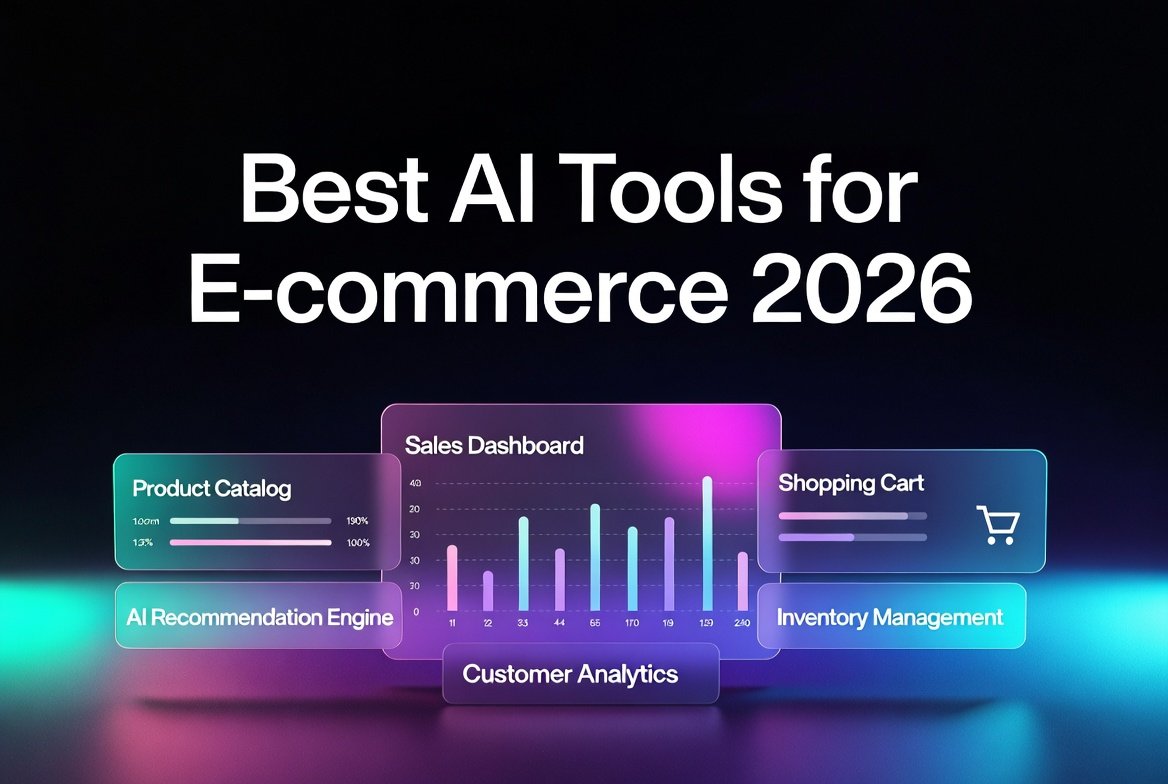
This guide covers eight tools that collectively address the e-commerce workflow from content and product pages through email marketing, customer support, and on-site personalization. Each section covers what the tool actually does, where it delivers, and where its limitations are real.
Comparison Table: Best AI Tools for E-commerce 2026
| Tool | Best For | Starting Price | Free Plan |
|---|---|---|---|
| Shopify AI (Magic) | Shopify merchants wanting free built-in AI for product content and customer chat | Free (included with Shopify) | Yes |
| ChatGPT | Flexible AI assistant for product descriptions, emails, and content at any budget | Free / $20/month (Plus) | Yes |
| Jasper | High-volume product content and brand-consistent marketing copy at scale | $59/month (Pro) | 7-day trial |
| Canva AI | Product visuals, social graphics, and ad creative without a design team | Free / $15/month (Pro) | Yes |
| Klaviyo AI | Email and SMS marketing automation with AI-powered segmentation and flows | Free (250 contacts) / $20/month+ | Yes |
| Tidio | 24/7 AI customer service chat with Shopify integration and live handoff | Free (100 conversations) / $29/month | Yes |
| Octane AI | Product recommendation quizzes and zero-party data collection | $50/month (Octane) | No (14-day trial) |
| Nosto | On-site personalization and AI product recommendations for mid-to-large catalogs | Custom (performance-based) | No (demo required) |
“Pricing is subject to change. Always verify current pricing on the tool’s official website before purchasing.”
Detailed Reviews
1. Shopify AI (Magic)
Best for Shopify merchants who want AI built directly into their store dashboard at no additional cost.
Shopify Magic is the AI layer built into every Shopify plan, covering product description generation, image editing, and Shopify Inbox AI for customer chat. For Shopify merchants who have not started with AI, Magic is the logical first step because it costs nothing and requires no new logins, integrations, or learning curves.
The product description feature generates complete descriptions from a list of product attributes in seconds. The writing is functional and brand-adaptable; applying a consistent tone setting across the catalog is straightforward and noticeably faster than manual writing for merchants with large product libraries. The AI image editing handles background removal, product photo enhancement, and basic scene generation without leaving the Shopify admin. Shopify Inbox’s AI suggests response drafts for incoming customer messages based on product and policy content, reducing response time for the most common inquiry types.
Key Features: Product description generation from product attributes, AI image editing and background removal for product photos, Shopify Inbox AI for smart reply suggestions in customer chat, automatic FAQ generation from store content, and integration with the Shopify admin with no additional configuration.
Pros:
- Completely free with every Shopify plan; no budget allocation required
- Zero implementation overhead; activates within the existing admin
- Covers three distinct workflows (content, image, chat) at no cost
- Consistent tone settings reduce editing time for large catalog updates
Cons:
- Product description output requires editing for accuracy and brand voice; AI drafts are starting points, not finished content
- Less capable than specialized tools in each category: Jasper for content depth, Tidio for chat, dedicated editors for image quality
- Limited to Shopify platform merchants; does not serve WooCommerce, BigCommerce, or other storefronts
Pricing:
- Included with all Shopify plans; no additional subscription required
2. ChatGPT
Best for stores at any budget level that need flexible AI assistance for writing, research, and content production.
ChatGPT is the highest-leverage AI starting point for most e-commerce operators because the use cases are so broad and the entry cost so low. Product descriptions, collection page copy, email campaign drafts, meta titles and descriptions, FAQ content, blog posts, ad copy variants, and customer response templates all emerge from the same tool with minimal prompt investment.
The Custom GPT feature is particularly valuable for e-commerce: build a brand-specific GPT pre-loaded with your tone guidelines, product category language, Fair Trade or sustainability certifications, and target customer persona, and it produces on-brand output without re-entering context in every session. The memory feature builds context about your store, products, and communication style over time.
Key Features: Product and marketing content generation across all formats, Custom GPTs for building brand-specific writing assistants, web browsing for competitor research and trend analysis, file upload for analyzing customer reviews or product data, memory for persistent brand context, and image generation for basic visual content needs.
Pros:
- Free tier is functional for stores with moderate content needs
- Custom GPTs eliminate repeated context-setting for recurring e-commerce writing tasks
- Web browsing enables live competitor pricing research and trend monitoring within the conversation
- No integration required; immediate productivity from day one
Cons:
- No native integration with Shopify, Klaviyo, or other e-commerce platforms; requires copy-pasting output into tools
- Factual accuracy on product specifications requires human review before publication
- Google rewards content demonstrating genuine expertise; AI-generated descriptions need editing for differentiation and accuracy
Pricing:
- Free: GPT-5.x with daily limits, no credit card required
- Plus: $20/month, full GPT-5.4 access, web browsing, file analysis, Custom GPTs, memory
3. Jasper
Best for established stores with large product catalogs that need brand-consistent content at high volume.
Jasper earns its place in e-commerce stacks when content volume makes manual writing or ChatGPT prompting too slow. Its Brand Voice feature analyzes existing product descriptions and marketing copy to extract a consistent tone, vocabulary, and style that applies automatically to all generated content. For a store with 500 SKUs needing optimized descriptions, Jasper scales the work without sacrificing brand consistency across the catalog.
The campaign workflow feature generates a full set of aligned marketing assets from a single product brief: the description, social captions, email subject lines, and ad copy all emerge from the same inputs maintaining consistent positioning. The Surfer SEO integration enables real-time content optimization scoring while writing, allowing description writers to confirm keyword relevance without switching tools.
Key Features: Brand Voice trained on existing content for consistent output across all writers, 50-plus e-commerce-relevant templates including product descriptions, email campaigns, and ad copy, Surfer SEO integration for real-time content optimization scoring, campaign workflow for multi-asset generation from a single brief, and API access on Business plans for custom content pipelines.
Pros:
- Best brand voice consistency for teams managing multiple contributors or high catalog volume
- 7-day free trial provides full access to evaluate quality before committing
- Surfer SEO integration eliminates a tool-switching step for SEO-conscious content teams
- Scales efficiently for catalogs that would take months to describe manually
Cons:
- $59/month starting price is the highest writing tool on this list; harder to justify for stores under $10,000/month in revenue
- Output requires editing for product accuracy; Jasper writes fluently but does not know your products as well as you do
- No native Shopify integration; content must be exported and imported to product pages
Pricing:
- Pro: $59/month (annual) / $69/month (monthly), 1 seat, 2 Brand Voices
- Business: Custom pricing, unlimited Brand Voices, API access
4. Canva AI
Best for e-commerce brands producing social media graphics, ad creative, and product marketing visuals without a design team.
Every product launch needs visual marketing: promotional graphics, social media announcements, email headers, and ad creative across multiple formats and platforms. Canva AI’s Magic Studio compresses this production cycle dramatically. Magic Resize adapts a single promotional graphic to every platform dimension in one click. Background Remover extracts product photos from any background for consistent catalog images. Magic Write generates caption copy directly in the design interface. The Brand Kit enforces consistent colors, fonts, and logos across every design produced by any team member.
For e-commerce operators running paid social campaigns, Canva’s ad template library covers Meta, TikTok, Pinterest, and Google Display formats with AI-adapted sizing. The image generation capability within Magic Media produces contextual lifestyle imagery for products without a photography shoot for social content where editorial quality matters less than volume.
Key Features: Magic Studio suite including background removal, image generation, Magic Eraser, and Magic Expand; Brand Kit for storing and applying brand identity across all designs; Magic Resize for single-click adaptation to every social and ad platform; Magic Write for caption and copy generation within the design interface; and 140 million-plus templates including e-commerce-specific layouts.
Pros:
- Most accessible visual production tool for non-designers producing at volume
- Brand Kit ensures consistent product photography and promotional graphics across teams
- Background Remover alone saves hours of Photoshop work per week for product catalog management
- Pro at $15/month delivers outsized value versus outsourced design costs
Cons:
- AI image generation quality trails dedicated generators for complex lifestyle photography
- 500 AI credits per month shared across all Magic Studio features can deplete for high-volume catalog operations
- Not suitable for high-end brand photography requiring studio quality output
Pricing:
- Free: Core templates and limited Magic Studio credits
- Pro: $15/month, full Magic Studio, Brand Kit, 1TB storage, commercial rights
- Teams: $10/user/month (3-user minimum)
5. Klaviyo AI
Best for e-commerce stores ready to move beyond manual email campaigns into automated, data-driven revenue flows.
Klaviyo is the email and SMS marketing platform most closely associated with Shopify, and its AI features make the case for why e-commerce email marketing is worth investing in properly. AI-powered flows generate automated sequences for abandoned carts, welcome series, post-purchase follow-up, and win-back campaigns using predictive models that identify the optimal send time per individual customer. The AI subject line generator consistently outperforms manually written subject lines in A/B tests. Predictive analytics identify when each individual subscriber is most likely to make their next purchase, enabling precision timing that batch campaigns cannot replicate.
The product recommendations feature is the compounding engine. When a customer purchases a standing desk, Klaviyo’s AI automatically identifies the most likely complementary products from catalog purchase history and surfaces them in follow-up emails, driving average order value without manual merchandising configuration. Every Man Jack, a men’s personal care brand, reported 12.4 percent of Klaviyo revenue attributable directly to predictive insights after implementation.
Key Features: AI-powered automated flows for abandoned cart, welcome, post-purchase, and win-back sequences; predictive send time optimization per individual subscriber; AI subject line generator with A/B testing; product recommendations based on catalog purchase history and browsing behavior; Segments AI for creating complex audience segments from natural language descriptions; and native integration with Shopify, WooCommerce, BigCommerce, and Magento.
Pros:
- Free plan covers 250 contacts and 500 monthly emails, functional for validating flows before upgrading
- Shopify merchants frequently cite $85 return for every dollar spent, driven primarily by automated flow revenue
- Segments AI eliminates the manual audience builder complexity for sophisticated targeting
- Single platform covers email, SMS, and push notifications without additional integrations
Cons:
- Pricing scales with contact list size; stores with large lists see significant monthly cost increases
- Full AI feature access requires moving beyond the free tier
- Platform depth can feel overwhelming for merchants new to email marketing automation
- Best results require meaningful setup investment in flow configuration and template design
Pricing:
- Free: 250 contacts, 500 emails/month, 150 SMS credits
- Email: Starting at $20/month (251 to 500 contacts), scaling with list size
- Email and SMS: Starting at $45/month, scaling with contacts and SMS volume
6. Tidio
Best for e-commerce stores that need 24/7 AI customer service without hiring additional support staff.
Tidio’s Lyro AI engine is trained specifically on e-commerce scenarios rather than being a general-purpose chatbot applied to retail. It understands the context of product browsing: it knows what is in the customer’s cart, what they have viewed, and what similar customers have purchased. When a customer asks “Will this fit a 2022 Honda Civic?”, Lyro can answer from the product knowledge base rather than redirecting the customer to contact support. When a customer asks “Where is my order?”, Lyro retrieves the actual tracking information from Shopify and presents it in the chat.
In a tested fashion store implementation, installing Lyro reduced human support tickets by 42 percent over 30 days. Most of that deflection came from order status and sizing questions, which the AI handled accurately by connecting to the Shopify knowledge base. Customer satisfaction on AI-handled conversations averaged 4.3 out of 5, slightly below but comparable to human-handled tickets. The live handoff feature is smooth enough that escalations to human agents happen without visible friction.
Key Features: Lyro AI chatbot with Shopify context awareness for product, cart, and order queries; 24/7 automated customer support with live agent handoff; proactive chat triggers based on browsing behavior; order status retrieval from Shopify order data in real time; knowledge base integration for FAQ, shipping, and returns responses; and integration with Shopify, WooCommerce, BigCommerce, and Magento.
Pros:
- Free plan covers 100 conversations per month, sufficient for stores in early growth stages
- Ecommerce-specific training produces more relevant responses than general-purpose chatbots
- Verified 42 percent ticket reduction in tested implementations within 30 days
- Setup takes approximately 15 minutes; no technical resources required
Cons:
- Effectiveness depends directly on quality of knowledge base content uploaded; generic setups produce generic responses
- Pricing at $59/month for 250 conversations limits volume for stores with heavy chat traffic
- Not suitable as a replacement for human support on complex pre-sale conversations requiring nuanced judgment
Pricing:
- Free: 100 conversations/month, basic chatbot
- Starter: $29/month, 100 Lyro AI conversations
- Growth: $59/month, 250 Lyro AI conversations
- Tidio+: $749/month, unlimited conversations, dedicated support
7. Octane AI
Best for stores where product fit is the primary conversion barrier and customers need guidance to find the right item.
Octane AI’s quiz engine converts the “I am not sure which product is right for me” hesitation into a guided path to purchase. The Smart Quiz Builder generates a complete product recommendation quiz, including questions, conditional logic, and results pages, from a single prompt. Quizzes built with Octane AI routinely outperform standard product pages for conversion because they meet the customer’s decision need rather than asking them to self-identify the right product from a catalog.
The zero-party data angle compounds the value. Every quiz response is a customer voluntarily revealing their preferences, use cases, and needs, data that syncs directly to Klaviyo, Attentive, and other marketing platforms for highly segmented follow-up. The Insights Analyst feature imports product reviews and identifies common customer complaints and purchase drivers, giving merchandising and content teams research that previously required manual synthesis.
Pricing scales with store revenue rather than features, making it accessible for smaller stores and scaling proportionally as the business grows.
Key Features: Smart Quiz Builder for generating complete product recommendation quizzes from a single prompt; zero-party data collection syncing customer responses to Klaviyo, Attentive, and Zapier; conditional logic for branching quiz paths based on customer responses; Insights Analyst for analyzing product reviews and identifying purchase drivers; and A/B testing for quiz optimization.
Pros:
- Quiz-driven product recommendations consistently outperform browse-and-add pathways for conversion
- Zero-party data from quizzes is more valuable for personalization than behavioral tracking alone
- Revenue-based pricing is accessible for stores under $1 million annually
- Smart Quiz Builder reduces quiz creation from hours to minutes
Cons:
- No free plan; 14-day trial required before the first billing cycle
- Value is highest in product categories with meaningful customer decision complexity (supplements, skincare, tech accessories); lower for commodity categories
- Requires Klaviyo or another ESP for the zero-party data benefit to compound into revenue
Pricing:
- Octane: $50/month (stores under $1 million in annual revenue)
- Octane Plus: $200/month (stores under $1 million)
- Higher tiers for larger revenue stores available via contact
8. Nosto
Best for mid-to-large e-commerce brands with extensive product catalogs that want on-site personalization at scale.
Nosto analyzes browsing behavior, purchase history, and real-time shopping intent to surface personalized product recommendations across the entire on-site experience: homepage, collection pages, product pages, search results, cart, and post-purchase pages. Unlike basic “customers also bought” widgets that display static bestsellers, Nosto’s AI adapts recommendations individually for each visitor based on what they are doing in the current session.
The performance impact is documented: product recommendations implemented through platforms like Nosto can drive up to 31 percent of total store revenue when implemented across all touchpoints. For stores with large catalogs where manual merchandising rules cannot realistically cover every possible customer segment, Nosto’s AI scales personalization to every visitor without additional merchandising work.
The platform extends personalization to email and on-site content as well as product recommendations, creating a consistent individualized experience across channels. Custom pricing and a performance-based component make Nosto most financially sensible for stores generating significant monthly revenue where even a one to two percent conversion lift is worth a meaningful monthly investment.
Key Features: AI product recommendations adapting in real time to browsing behavior, purchase history, and session intent; personalization across homepage, collection, product, cart, and post-purchase pages; on-site content personalization for banners, popups, and promotional messaging; email integration for behavioral product recommendations in campaigns; A/B testing for recommendation placement and algorithm tuning; and advanced merchandising controls for manual overrides when needed.
Pros:
- AI personalization at scale that manual merchandising rules cannot replicate for large catalogs
- Product recommendations can drive 31 percent of total revenue when implemented across all touchpoints
- Works across the full customer journey rather than just the product page
- Extends personalization to email for consistent cross-channel individual experience
Cons:
- Custom pricing and demo-required evaluation make cost unpredictable without direct vendor engagement
- Best value for stores with large catalogs and meaningful monthly revenue; may be oversized for stores under $50,000/month
- Implementation requires technical resources for full personalization setup across all page types
Pricing:
- Custom performance-based pricing; requires a demo and sales conversation
- Best suited for stores generating significant monthly revenue where conversion lift justifies the investment
Frequently Asked Questions
How many AI tools does an e-commerce store actually need?
Most e-commerce operators see the best outcomes from three to five tools rather than a comprehensive stack. The principle is one tool per function rather than multiple overlapping subscriptions. A practical stack for a store doing $10,000 to $50,000 per month looks like: Shopify Magic or ChatGPT Plus for product content, Klaviyo for email and SMS automation, and Tidio for customer service. That combination at roughly $60 to $70 per month covers content, marketing automation, and customer support without subscription overlap. Add Canva Pro at $15 per month if visual content production is a time sink. Add Octane AI at $50 per month if product fit is a conversion barrier. Add Nosto when revenue scale justifies investment in personalization at catalog depth. Implementing too many tools simultaneously is the most common AI adoption failure; most merchants who attempt five tools at once end up using two of them productively.
Is AI-generated product content safe for SEO in 2026?
Yes, with important conditions. Google’s Search Central guidance explicitly states that AI-generated content is acceptable when it is helpful, original, and provides genuine value. The conditions that matter practically: every AI-generated description should be edited for product accuracy and brand differentiation before publishing, descriptions should not be published identically across multiple products, and descriptions should reflect genuine expertise about the product rather than generic specifications anyone could write. The SEO risk is not using AI but publishing unedited AI output that lacks originality, contains factual errors, or duplicates content across SKUs. Stores that edit AI-generated descriptions before publication and differentiate them by product type and customer use case see SEO lift within 60 to 90 days of consistent publication. Stores that publish raw AI output at scale see the same thin-content penalties they would receive for any low-quality content.
Which AI tool delivers the fastest ROI for an e-commerce store?
Email marketing automation through Klaviyo consistently delivers the fastest and highest documented ROI in e-commerce AI. A properly configured abandoned cart sequence, welcome series, and post-purchase flow can generate 20 to 30 percent of total store revenue on autopilot within the first 30 to 60 days of implementation. Because Klaviyo’s free plan covers 250 contacts, stores can build and validate flows before spending anything. At $20 per month for the entry paid tier, the threshold for positive ROI is extremely low even for smaller stores. Shopify Magic is technically the fastest ROI because it costs nothing and produces immediate time savings on product content. But in terms of revenue impact, automated email flows running on Klaviyo AI represent the single highest-return AI investment available for an e-commerce store in 2026, particularly when the abandoned cart recovery flow is configured correctly.
Final Recommendation
The right AI stack for e-commerce in 2026 depends on your store’s current revenue stage and primary bottleneck.
For stores under $5,000 per month in revenue, the full stack at zero cost is viable. Shopify Magic covers product content for free if you are on Shopify. ChatGPT’s free tier handles everything Magic cannot. Klaviyo’s free plan covers 250 contacts for email flow validation. Tidio’s free plan covers 100 monthly conversations for basic chat. Start there, measure the outcomes, and upgrade individual tools only when the specific limitation becomes a documented constraint on revenue.
For stores between $10,000 and $50,000 per month, the highest-return paid stack is Klaviyo at $20 to $45 per month for email and SMS automation, Tidio at $29 to $59 per month for customer service deflection, and ChatGPT Plus at $20 per month for content production. Combined at $70 to $125 per month, this stack addresses marketing, support, and content with tools that have documented positive ROI at this revenue level.
For stores above $100,000 per month with large product catalogs, adding Jasper for content scale and Nosto for on-site personalization addresses the bottlenecks that become meaningful at higher volume. Octane AI belongs in this stack if product fit complexity is reducing conversion on any significant product category.
The consistent principle across every stage: start with the tool that addresses your highest-cost bottleneck today, implement it properly, measure the outcome over 30 to 45 days, and add the next tool only when the first one is working. E-commerce AI rewards sequential adoption and precise measurement over broad tool proliferation.