Hunyuan3D Review 2026: The Best Open-Source AI 3D Generator?
In January 2026, the AI 3D generation leaderboards shifted in a way that mattered for independent developers. Tencent published benchmarks claiming Hunyuan3D-2.0 outperforms leading industry models in text consistency, geometric accuracy, and visual quality. Then in March 2025, the Turbo version using Tencent’s self-developed FlashVDM architecture achieved second-level generation speed, 30 times faster than the previous generation. By September 2025, Hunyuan3D-3.0 introduced the 3D-DiT hierarchical sculpting model with geometric resolution at 1536 cubed voxels, tripling modeling accuracy over earlier versions.
All of this is open-source, downloadable from GitHub and Hugging Face, and free to run on your own hardware.
That combination of headline quality claims and zero-per-generation cost makes Hunyuan3D one of the most discussed AI 3D tools among developers in 2026. The caveat that tempers the excitement is consistent across every independent deployment report: running Hunyuan3D requires a capable NVIDIA GPU, meaningful Python and machine learning environment setup, and the ability to debug issues that community documentation does not always cover. For developers who have that infrastructure and those skills, Hunyuan3D is the most capable free AI 3D generator available. For everyone else, it is a research curiosity rather than a production tool.
Option Comparison Table
| Option | Best For | Starting Price | Free |
|---|---|---|---|
| Local self-hosted (GitHub/HF) | Developers and researchers with NVIDIA GPU who want unlimited local generation | Free (hardware cost only) | Yes |
| Hunyuan3D web interface (3d.hunyuanglobal.com) | Creators who want to try the model without setup, up to 20 free generations/day | Free (20 gen/day free) | Yes |
| Tencent Cloud API | Teams wanting cloud-hosted API access without managing local GPU infrastructure | Usage-based pricing via Tencent Cloud | Free tier (limited) |
| Via Scenario integration | Designers who want Hunyuan3D quality inside a polished commercial game art platform | Scenario plan pricing (from $10/month) | No |
“Pricing is subject to change. Hunyuan3D weights are free to download and use for non-commercial purposes under their license; commercial use terms should be verified on the GitHub repository before production deployment. Tencent Cloud API pricing is usage-based and changes independently of the open-source model. EU, UK, and South Korea users should verify current regional access restrictions before using the hosted web interface or API. Always verify current terms at github.com/Tencent-Hunyuan/Hunyuan3D-2 before any production commitment.”
What Hunyuan3D Is
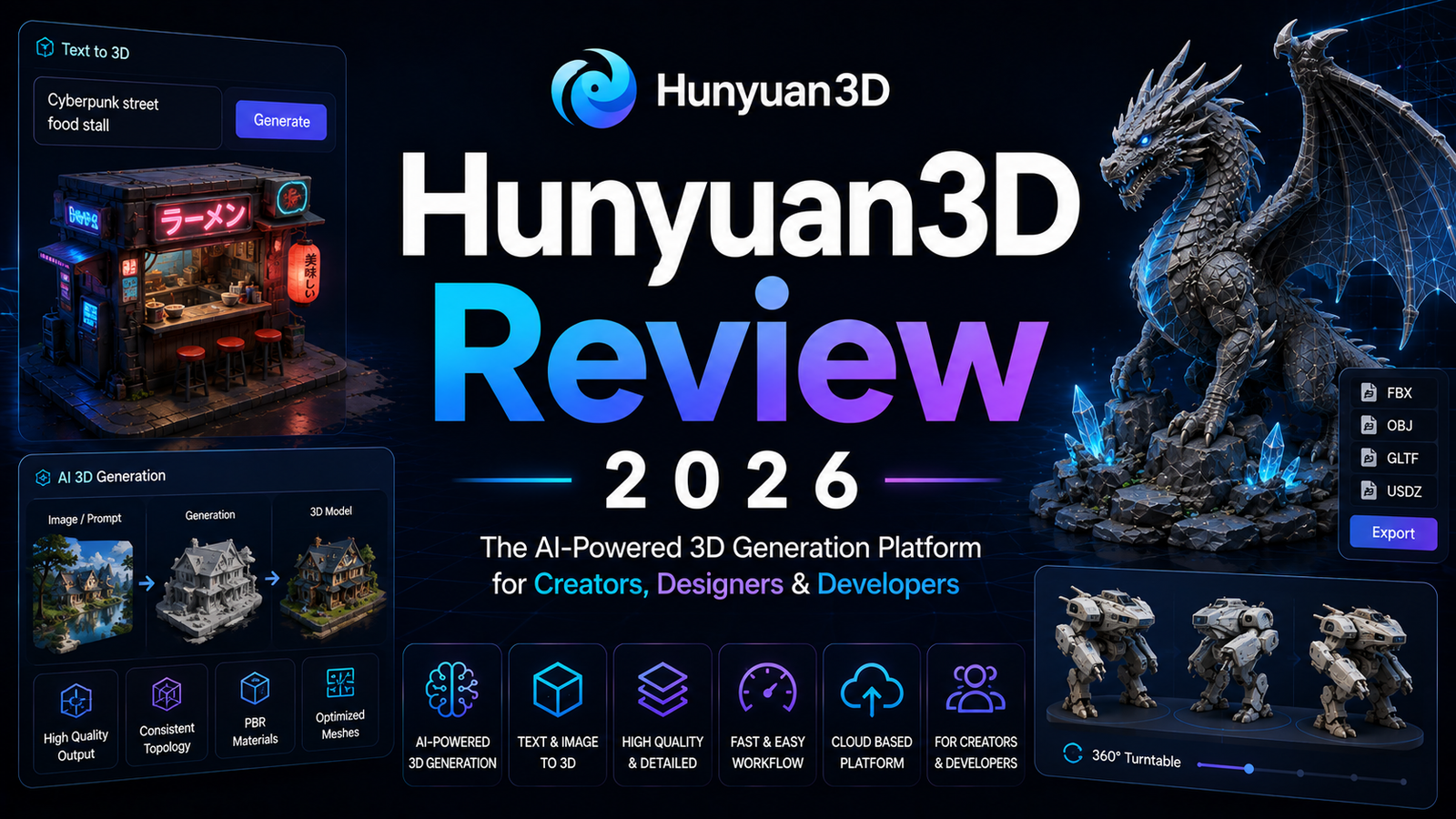
Hunyuan3D is Tencent’s open-source AI 3D generation model, developed by the company’s AI Lab in Shenzhen and publicly released beginning in November 2024. The model converts text prompts and 2D images into textured 3D meshes. It is available in multiple versions targeting different capability and hardware requirements, with the most recent generations delivering geometry at resolutions and accuracy levels that benchmark favorably against commercial alternatives.
The model family in 2026 includes several variants. Hunyuan3D-2.0 is the base release, available in full and turbo configurations. The Turbo version using FlashVDM architecture generates models in seconds rather than minutes on appropriate hardware. Hunyuan3D-2.5 increased geometric resolution to 1024 cubed voxels with PBR texture generation and normal map support. Hunyuan3D-3.0 released in September 2025 introduced the 3D-DiT hierarchical sculpting model at 1536 cubed voxels, tripling accuracy compared to 2.0. A mini variant targeting 5 to 6 GB VRAM configurations makes the model accessible on consumer hardware like an RTX 4080 laptop GPU.
Hunyuan3D-Part is a specialized model for automated mesh decomposition into clean sub-parts: screws, gears, housings, connectors, and other discrete components are separated automatically for workflow integration. The Tencent Cloud international site at 3d.hunyuanglobal.com launched in November 2025 provides a hosted web interface for international users without local setup, with 20 free generations per day.
Key Features
Open-source weights freely downloadable from GitHub and Hugging Face. The model weights are publicly available under Tencent’s open-source license. Any developer with a capable NVIDIA GPU can download, install, and run Hunyuan3D locally without per-generation cost. For organizations that generate thousands of 3D assets per month, eliminating the per-generation fee that commercial platforms charge changes the economics significantly. The license terms cover non-commercial use clearly; commercial use terms should be verified on the current GitHub repository before production deployment.
Text-to-3D and image-to-3D generation. Text prompts describe the desired object in natural language and Hunyuan3D generates the corresponding mesh with textures. Image inputs allow reconstructing 3D geometry from 2D references. Multi-view image inputs improve geometric accuracy by providing depth information from multiple angles that single-image inputs cannot supply. The 3.0 version supports mixed text and image inputs with adaptive classifier-free guidance for more controlled generation.
PBR texture generation with normal map support. Hunyuan3D-Paint is the texturing component, generating physically-based rendering material sets including albedo, roughness, metallic, and normal maps. For game-ready assets where real-time lighting response depends on PBR materials, the normal map integration improves surface detail beyond what albedo-only texturing achieves. The experimental normal map module introduced in 2.5 is described in independent analysis as a meaningful improvement for gaming and virtual reality surface detail.
FlashVDM architecture for second-level generation on appropriate hardware. The Turbo model using FlashVDM generates 3D models at 30 times the speed of the previous generation, producing shapes in seconds rather than minutes on high-end GPUs. On NVIDIA A100 or RTX 4090 hardware, generation runs in 8 to 20 seconds according to documented benchmarks. This speed is competitive with commercial platforms on equivalent hardware.
Blender integration via community plugin. The community-developed Blender 4.3 integration plugin allows importing Hunyuan3D generated models directly into Blender without manual export-import file management. Community support for ComfyUI workflows is also available, enabling Hunyuan3D integration into ComfyUI node-based pipelines alongside other generative AI models.
Hunyuan3D-Part for automated mesh decomposition. The specialized Part model analyzes a generated or imported mesh and separates it into discrete named components. For industrial design, product visualization, and game asset production where individual parts need separate materials or animation, this automated decomposition compresses a manual segmentation process into a single model call.
HY-World 2.0 for environment generation. Announced in April 2026, HY-World 2.0 extends the Hunyuan ecosystem from object generation to explorable 3D world creation from text or image input. For game environment prototyping and VR world creation, this represents the emerging frontier of the platform beyond individual asset generation.
Pros and Cons
Pros:
- Free to run locally with no per-generation cost; for teams generating hundreds or thousands of assets, this eliminates the credit cost that accumulates significantly on commercial platforms
- Quality benchmarks favorably against commercial alternatives at equivalent versions; the 3.0 model at 1536 cubed voxel resolution represents genuine quality advancement
- Open-source architecture enables fine-tuning on proprietary datasets for domain-specific generation quality improvements not possible with closed commercial APIs
- Integrates into existing AI pipelines through Tencent Cloud API or local inference, without coupling the project to a single commercial vendor’s platform decisions
- Active open-source community producing plugins, tutorials, and workflow integrations for Blender, ComfyUI, and other tools
- The hosted web interface at 3d.hunyuanglobal.com provides 20 free generations per day without any setup for testing output quality before infrastructure commitment
- No vendor lock-in; the weights are downloadable and the project continues regardless of Tencent’s commercial decisions
Cons:
- Requires a capable NVIDIA GPU: 6 GB VRAM minimum for geometry generation, 12 to 16 GB VRAM for shape plus texture generation using the full model. The mini variant lowers this to approximately 5 to 6 GB for compatible hardware, but texture generation quality is reduced. For teams without existing GPU infrastructure, the hardware cost significantly erodes the “free” advantage
- Technical setup requires Python environment configuration, CUDA installation, and dependency management that non-technical users cannot navigate without meaningful ML engineering support
- No polished hosted UI with the feature depth of commercial tools; the web interface at 3d.hunyuanglobal.com provides basic generation, but the workflow controls and asset management features of Meshy or Tripo are absent
- Support is community-based through GitHub issues, Reddit, and Discord rather than commercial support with response SLAs; production blockers require community resolution timelines
- Dense mesh output (up to 600,000 triangles per documentation) may require retopology for animation and AAA game production; this is specifically documented as a known limitation requiring post-processing tools
- Regional availability restrictions: EU, UK, and South Korea users face regulatory constraints that restrict access to the hosted service and may affect cloud API availability. Local self-hosting of the open-source weights is an alternative where the hosted service is unavailable
- Output quality trails the best commercial options on some asset categories; Rodin and Meshy-6 produce stronger results on hard-surface assets with clean topology in independent benchmarks, though the quality gap has narrowed with 3.0
The Real Cost Structure
Hunyuan3D is free software with non-free hardware requirements. Understanding the complete cost picture prevents the most common mistake: assuming “open-source” means “zero cost” without accounting for infrastructure.
Local self-hosting cost: The dominant cost is GPU hardware. For geometry-only generation, a minimum of 6 GB VRAM is required, achievable with consumer GPUs like the RTX 3060 and above. For the full generation pipeline including textures, 12 to 16 GB VRAM is required, targeting RTX 4080 and above or professional-grade GPUs. Cloud GPU rental is an alternative to hardware ownership: a spot A100 GPU on cloud providers runs approximately $1 to $2 per hour, producing dozens of models in a single hour of compute time for structured batch generation workflows. Monthly GPU cloud cost for regular production use typically runs $50 to $200 per month depending on generation volume and GPU tier.
Setup time cost: Initial environment configuration covering Python, CUDA drivers, PyTorch, and Hunyuan3D dependencies is documented as a multi-hour process for experienced ML practitioners and significantly longer for developers without prior ML infrastructure experience. Budget for setup time as a real cost before assuming local deployment is practical.
Ongoing maintenance cost: Open-source model updates require manual installation. New model versions do not automatically replace existing deployments. Dependencies occasionally conflict with operating system or CUDA version updates. Maintenance is a recurring time cost that commercial platforms absorb on behalf of their users.
Tencent Cloud API pricing: For teams that want the model quality without local infrastructure, the Tencent Cloud API provides hosted inference at usage-based pricing. Current API pricing should be verified on the Tencent Cloud international documentation, as it changes independently of the open-source model release cycle.
How It Compares to Tripo AI and Meshy AI
See our full Tripo AI Review 2026 and Meshy AI Review 2026 for complete breakdowns of hosted commercial alternatives.
The comparison between Hunyuan3D and Tripo AI or Meshy AI is primarily a comparison between two different architectures for accessing AI 3D generation rather than a direct quality contest.
Tripo AI provides 300 free monthly credits with 10-second quad-topology generation in a browser interface that requires no setup. Meshy AI provides the complete pipeline including auto-rigging, 500-plus animation presets, and PBR texturing at $20 per month with no infrastructure requirement. Both platforms absorb the GPU infrastructure, model maintenance, and technical setup cost as part of their subscription pricing.
Hunyuan3D’s practical advantage is elimination of per-generation cost at production volume. A team generating 500 assets per month pays roughly $20 per month for Meshy Pro’s credit allocation at credit costs, or potentially more if they exceed the plan’s credit ceiling. The same generation volume on self-hosted Hunyuan3D costs GPU compute time only, typically $50 to $100 per month in cloud GPU rental or less with owned hardware.
The quality comparison in 2026 is more nuanced than it was a year ago. Hunyuan3D-3.0’s 1536 cubed voxel resolution competes meaningfully with commercial tools on geometric detail. For specific asset categories where independent benchmarks have tested comparable outputs, results vary by asset type and the commercial tool version tested against. The honest characterization is that Hunyuan3D is competitive with mid-tier commercial tools and trails the best commercial options on some categories, particularly on clean game-ready topology where Tripo’s Smart Mesh P1.0 and Rodin’s native quad output lead.
The decision framework: choose Hunyuan3D when technical capacity for self-hosting is available and generation volume justifies the infrastructure investment over per-credit commercial pricing. Choose Tripo AI or Meshy AI when immediate results without infrastructure work, polished workflow tooling, and production support are more important than per-generation cost elimination.
Frequently Asked Questions
What GPU do I actually need to run Hunyuan3D, and can I run it on a laptop?
For geometry-only generation without textures, 6 GB VRAM is the documented minimum, achievable with consumer GPUs including the RTX 3060, RTX 3070, and RTX 4060. For full generation including texture output, 12 to 16 GB VRAM is required, targeting GPUs like the RTX 4080, RTX 4090, and professional-grade A100 or H100 cards. The mini variant of Hunyuan3D-2.0 reduces requirements to approximately 5 to 6 GB VRAM and is documented as compatible with Apple M1 Pro or NVIDIA RTX 4080 laptop configurations, making laptop deployment feasible for the mini model. Full model texture generation on laptop hardware requires a high-end discrete GPU with 16 GB VRAM, which limits compatibility to high-specification gaming laptops. CPU-only inference is technically possible but impractically slow for production use.
Is Hunyuan3D available in Europe, the UK, and South Korea?
Regional availability is a documented limitation. Regulatory constraints related to GDPR and AI regulation in the EU, UK, and South Korea affect access to the hosted web interface at 3d.hunyuanglobal.com and may affect Tencent Cloud API availability in those regions. The open-source model weights on GitHub and Hugging Face are accessible globally regardless of regional service restrictions, meaning local self-hosting is an available path for teams in restricted regions. Tencent has stated they are working on regulatory compliance for European deployment, but the timeline for full European access to hosted services has not been publicly confirmed. Teams in affected regions should verify the current regional access status at the official documentation before planning any commercial deployment that depends on the hosted interface or cloud API.
Can I use Hunyuan3D for commercial game development and product visualization without licensing concerns?
The license terms on the Hunyuan3D GitHub repository distinguish between non-commercial and commercial use, and the terms have evolved across model versions. The model weights are available for download and non-commercial research use clearly. Commercial use, which includes deployment in commercial games, product visualization for sale, and API services built on the model, requires verification of the current license terms on the specific model version being used. License terms on open-source AI models change between releases, so verifying the current terms on the GitHub repository before production deployment is the necessary step rather than relying on terms documented in any third-party review. For commercial production use, many teams use Hunyuan3D through the Tencent Cloud API under Tencent’s commercial service terms rather than directly deploying the open-source weights, as the API access comes with clearer commercial licensing documentation.
Final Verdict
Hunyuan3D in 2026 is the most capable open-source AI 3D generator available, and for the specific user profile it serves, that distinction is significant. Developers and researchers with NVIDIA GPU infrastructure who want to generate 3D assets at production volume without per-generation cost have a genuinely powerful option in Hunyuan3D-3.0’s 1536 cubed voxel resolution, FlashVDM-powered turbo generation, and PBR texturing pipeline. The open-source architecture enables fine-tuning and workflow integration that no commercial platform permits, and the absence of vendor lock-in is a practical advantage for teams building long-term production pipelines.
The limitations define who benefits equally clearly. Technical barrier to entry is real and high. GPU hardware cost is non-trivial. Community support is the only available support model. The dense mesh output requires retopology work for animation production. And the regional availability restrictions mean the hosted service is not universally accessible.
For teams without ML engineering capacity or GPU infrastructure, the real cost of Hunyuan3D after accounting for setup time and hardware is not obviously lower than a $20 per month commercial subscription. Tripo AI with its 300 free monthly credits and 10-second browser-based generation, and Meshy AI with its complete animation pipeline at $20 per month, deliver production results today without infrastructure investment. See our Tripo AI Review 2026 and Meshy AI Review 2026 for those alternatives.
For the developer who knows what CUDA is, has a capable GPU, and generates enough assets monthly to make per-generation cost significant: Hunyuan3D is the correct answer to the question this review’s headline asks.
Rating: 4.1 / 5 — Best open-source AI 3D generator for technical users. Not practical for non-technical teams or those without GPU infrastructure.
Disclosure: This article contains affiliate links.