Gong Review 2026: The AI Sales Intelligence Tool Worth the Price Tag?
Sales leaders have always made decisions on incomplete information. A rep says a deal is “looking good,” the forecast gets updated, and then the deal slips to next quarter with no warning. Gong was built to close that gap between what reps report and what customers actually say.
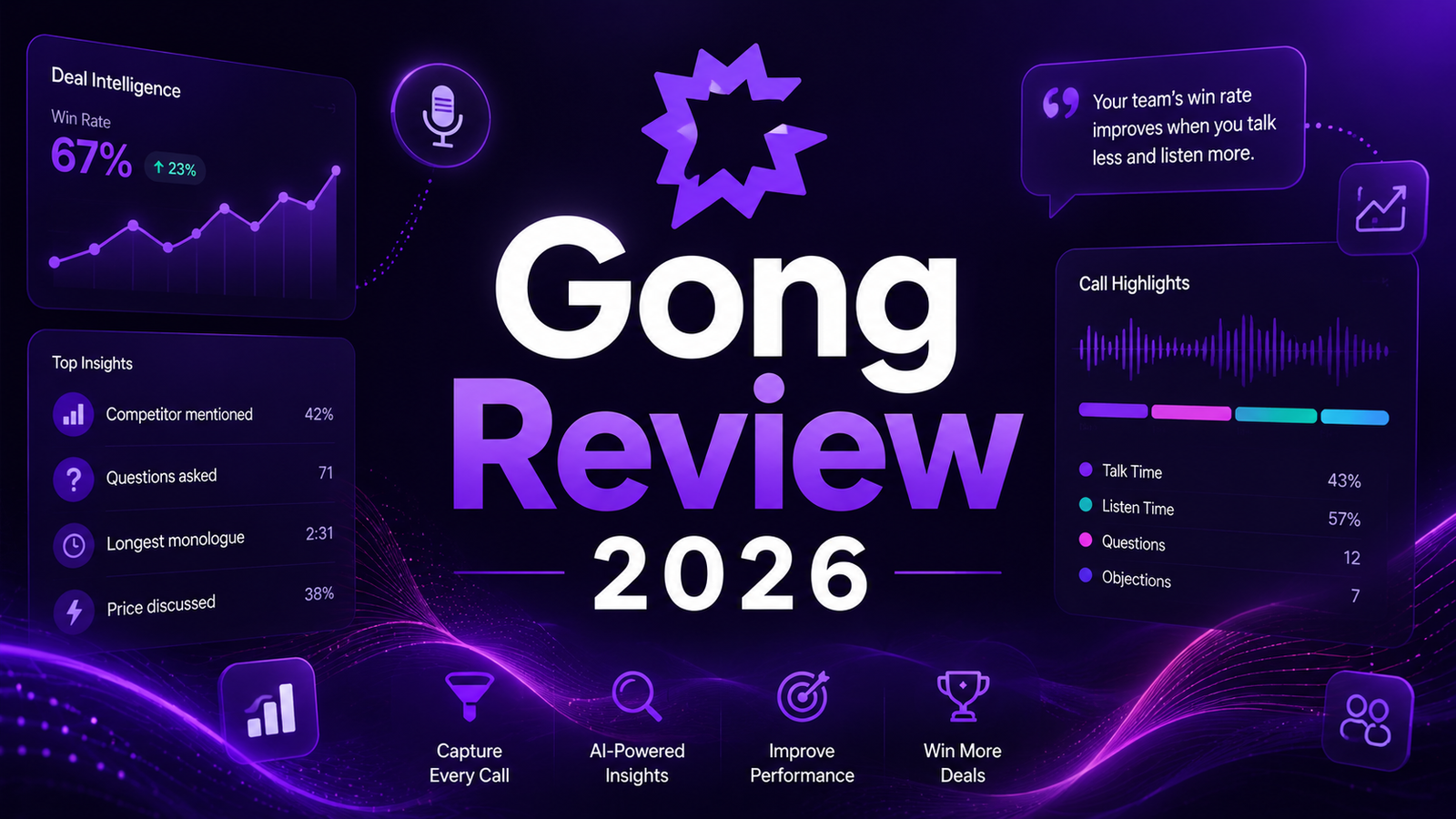
Founded in 2015, Gong is a revenue intelligence platform that records, transcribes, and analyzes every sales conversation across calls, video meetings, and email. It joins your Zoom, Google Meet, and Microsoft Teams calls as a bot, captures the conversation, and runs it through speech recognition and natural language models trained on billions of real sales interactions. The result is a layer of visibility most sales organizations have never had: which objections come up most often, which competitors get mentioned, which deals are actually at risk, and what the top performers do differently from everyone else.
Gong is not a CRM and does not try to be one. It works alongside Salesforce, HubSpot, or Microsoft Dynamics rather than replacing them. Your CRM holds the structure of your pipeline. Gong provides the reality check on what is actually happening inside it. This review covers what Gong’s AI genuinely does well, where it falls short, how the pricing actually works, and whether it fits your team in 2026.
Our Take: Gong is the most mature revenue intelligence platform available and its conversation analytics are genuinely best in class. The problem is the price floor. Between the mandatory platform fee and per-user costs, Gong only makes financial sense for teams of roughly 50 or more reps closing complex, high-value deals. Smaller teams get most of the value from far cheaper alternatives.
Comparison Table: Gong Plans 2026
| Plan | Best For | Starting Price | Free Trial |
|---|---|---|---|
| Platform Fee (mandatory) | All Gong deployments, billed annually | $5,000+ per year | No (demo only) |
| Up to 49 users | Mid-market sales teams | $5,000 base + $1,600/user/year | No (demo only) |
| 50 to 99 users | Larger sales organizations | $5,000 base + $1,520/user/year | No (demo only) |
| 100 to 249 users | Enterprise sales orgs | $5,000 base + $1,440/user/year | No (demo only) |
| Data Cloud (add-on) | RevOps and data teams exporting to BI tools | Custom pricing | No |
Pricing is subject to change. Always verify current pricing on the tool’s official website before purchasing.
What Gong Does and Who It Is For
Gong is built for B2B sales organizations with complex, multi-stakeholder deals where the cost of a lost opportunity is high enough to justify serious investment in understanding why deals are won and lost. It is most commonly deployed in mid-market and enterprise companies, and the economics strongly favor larger teams.
The platform breaks down into three core capabilities. Conversation intelligence captures and analyzes every customer interaction. Deal intelligence scores pipeline health and flags at-risk opportunities. People intelligence tracks rep performance over time and surfaces coaching opportunities. Together these turn a sales organization’s raw conversation data into something managers can actually act on.
The teams that get the most from Gong are the ones with enough deal volume and enough reps that patterns become statistically meaningful. A 10-person team generates some useful data. A 100-person team generates the kind of pattern recognition that genuinely changes how the organization sells.
Key Features
Gong’s conversation intelligence is the feature most people associate with the platform, and it is where the AI is strongest. Every call is processed automatically, producing transcripts with speaker separation at roughly 85 to 90 percent accuracy across accents, talk-time ratios, monologue length, interruption patterns, sentiment analysis across the conversation, and automatic detection of objections, competitor mentions, and buying signals. In 2026 Gong rolled out significantly faster processing, with call insights now available up to 70 percent quicker than before, addressing a long-standing complaint about the delay between a call ending and insights being ready.
Deal intelligence gives managers a single unfiltered view of every interaction tied to an individual deal. Instead of relying on a rep’s optimistic CRM notes, managers see the actual email threads, call recordings, and engagement signals, with AI flagging deals that show warning signs like going quiet, single-threading to one contact, or stalled momentum.
People intelligence tracks how individual reps perform over time, identifying coaching opportunities by comparing rep behavior against the patterns of top performers. Topic tracking lets managers see which themes come up across an entire team’s calls, which is valuable for spotting emerging objections or competitive threats early.
Gong also expanded its AI agent capabilities in 2026, moving beyond passive analysis toward more proactive surfacing of recommended next steps, though the platform remains fundamentally built around post-meeting analysis rather than real-time execution.
Pros
Conversation intelligence is the deepest and most accurate in the category, backed by models trained on billions of real sales interactions, which is a genuine moat over general-purpose transcription tools.
Deal intelligence provides a level of pipeline visibility that most sales leaders have never had, replacing gut-feel forecasting with data on what is actually happening in deals.
The 2026 processing speed improvement removes one of the biggest historical frustrations, with insights now available shortly after a call ends.
Integrations with major CRMs and conferencing tools are mature and reliable, reflecting a decade of platform development.
Coaching capabilities are excellent for larger teams, letting managers scale best practices across an entire sales force rather than coaching one rep at a time.
Cons
The mandatory platform fee, reported between $5,000 and $50,000 per year depending on deployment size, is a fixed cost that does not scale down, making the effective per-user cost painfully high for small teams.
Total cost for a small team gets expensive fast. A 10-user team can easily face $20,000 to $25,000 in year one before onboarding costs, which is difficult to justify below a certain deal volume.
Gong does not publish pricing, so every deal requires going through a sales process and negotiation, which adds friction to evaluation.
The platform is focused on post-meeting analysis rather than real-time execution, so it tells you what happened rather than helping during the conversation itself.
Implementation can be time-consuming, and the accuracy of insights depends heavily on good CRM hygiene, meaning teams with messy data get less value.
Pricing Breakdown
Gong does not list prices publicly, but based on consistent 2026 industry data the structure is a mandatory annual platform fee starting at $5,000 plus a per-user annual cost. For up to 49 users that per-user cost is approximately $1,600 per year. For 50 to 99 users it drops to roughly $1,520 per user. For 100 to 249 users it falls further to around $1,440 per user. Gong strongly incentivizes multi-year commitments, with 2-year and 3-year contracts commonly unlocking 15 to 30 percent lower annual pricing than single-year agreements.
The mandatory platform fee is the single most important factor in evaluating Gong. Because it is fixed regardless of team size, it spreads efficiently across a 100-person team but punishes a 10-person team. The practical sweet spot is generally 50 or more users.
Buyers should know that Gong negotiates aggressively. Bringing a competitive quote from Chorus.ai or Salesloft into the sales cycle commonly unlocks an additional 15 to 25 percent in discounts.
How Gong Compares to HubSpot AI and Salesforce Einstein
Gong is frequently evaluated alongside the AI features built into major CRMs. The most important distinction is that Gong is a dedicated conversation and revenue intelligence platform, while HubSpot AI and Salesforce Einstein AI are AI layers added on top of full CRM platforms.
HubSpot AI is the more natural fit for small and mid-market teams that want solid conversation intelligence and AI-assisted selling without a separate expensive platform. Its call analysis and forecasting are good rather than best in class, but they are included within a CRM most teams are already paying for, which changes the cost equation entirely.
Salesforce Einstein offers powerful predictive analytics and deep integration for organizations already committed to the Salesforce ecosystem. Its conversation intelligence through Einstein Conversation Insights is capable but generally considered less specialized than Gong’s purpose-built analysis.
The honest summary is that Gong wins on pure conversation intelligence depth and accuracy, while the CRM-native options win on cost efficiency and integration simplicity for teams that do not need Gong’s analytical ceiling.
Frequently Asked Questions
Is Gong worth it for a small sales team?
For most teams under roughly 50 reps, no. The mandatory platform fee does not scale down, so smaller teams pay a disproportionately high effective cost. Teams that want the core features of call recording, transcription, and AI summaries at a lower price point are usually better served by alternatives like Chorus, Fireflies.ai, tl;dv, or Avoma. Gong becomes financially sensible when deal value and team size are high enough that the conversation intelligence pays for itself.
Is Gong a CRM replacement?
No. Gong works alongside your CRM rather than replacing it. Your CRM such as Salesforce, HubSpot, or Microsoft Dynamics remains your system of record for pipeline, contacts, and opportunities. Gong captures and analyzes what actually happens in customer conversations and feeds those insights back into the CRM. The two are complementary, not interchangeable.
How accurate is Gong’s transcription and analysis?
Gong’s transcription accuracy is typically 85 to 90 percent across various accents, which is strong for sales conversations though not perfect. Technical terminology, industry jargon, and heavy accents reduce accuracy and may require review. The analytical insights are only as good as the underlying CRM data, so teams with poor CRM hygiene get less reliable output.
Final Verdict
Gong is the most capable revenue intelligence platform on the market in 2026, and for the right organization it delivers genuine measurable value. The conversation intelligence is best in class, the deal and people intelligence give sales leaders visibility they have never had, and the 2026 speed improvements removed the biggest historical complaint about the platform.
The deciding factor is almost entirely about team size and deal economics. The mandatory platform fee combined with per-user pricing means Gong only makes financial sense for sales organizations of roughly 50 reps or more closing complex, high-value deals. For those teams, Gong is frequently worth the price tag and pays for itself through improved win rates and forecasting accuracy.
For smaller teams, the math rarely works. If you are under 50 reps or running a simpler sales motion, the CRM-native options are the smarter starting point. HubSpot AI delivers strong conversation intelligence inside a CRM you may already use, and Salesforce Einstein AI is the natural choice for teams already committed to Salesforce. Both give you most of the practical value at a fraction of Gong’s total cost.
Gong is a premium tool for premium use cases. If your team fits the profile, it is one of the best investments a revenue organization can make. If it does not, the price tag is impossible to justify.
Pricing is subject to change. Always verify current pricing on the tool’s official website before purchasing.